Why Flash Sales Break Logistics Operations
A D2C brand runs its first Diwali sale. Orders triple on day one. The packing team processes at their usual pace. By day two, 800 orders are pending dispatch. The courier agent arrives and can take 200. The remaining 600 sit. Marketplace SLA breaches trigger. Customers start messaging. Reviews start dropping.
The sale was a commercial success. The logistics were not prepared for it. The post-sale recovery takes three weeks.
Flash sales and mega sale events - Big Billion Days, End of Season Sales, brand flash sales, Diwali campaigns - create volume spikes that expose every weakness in a seller's logistics operation simultaneously. The brands that execute peak sales well are not those with the most resources. They are those that plan logistics before the sale opens, not after.
What Is Flash Sale Shipping Management?
Flash sale shipping management is the planning of wallet balance, packaging stock, packing capacity, courier pickups and COD rules before a sale opens, so that a volume spike does not turn into a dispatch backlog. It matters because marketplace dispatch SLAs and courier pickup capacity do not flex automatically - an unannounced 3x spike can leave hundreds of orders unpicked overnight. The brands that handle it well plan before the sale opens and treat the 3 to 5 days afterwards as part of the sale.
How to Prepare Logistics Before the Sale Goes Live
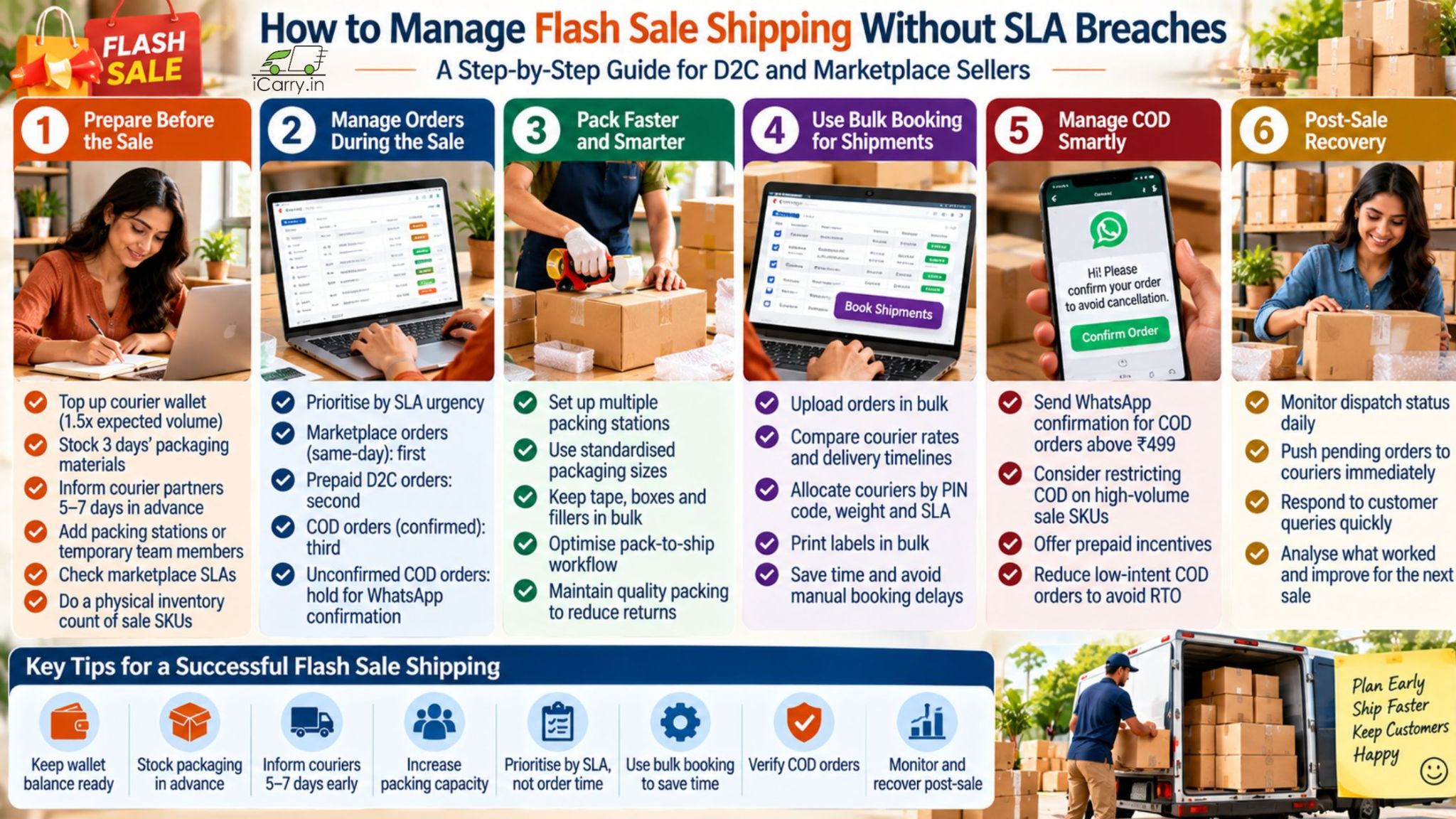
- Wallet and payment: Top up your courier aggregator wallet to handle the expected volume. A wallet that runs dry mid-sale stops all bookings instantly. Calculate expected dispatch value and load 1.5x that amount
- Packaging stock: Order a minimum of 3 days' peak-volume packaging supply before the sale. Tape, boxes, bubble wrap, poly mailers. A sale that runs out of tape on day two loses hours of packing capacity
- Courier volume notification: Inform your courier pickup agent and courier aggregator support of your expected volume 5 to 7 days before the sale. Courier hubs pre-arrange additional vehicle capacity for confirmed volume surges. Peak weeks stretch courier networks hard, with delivery agents routinely handling up to 200 packages a day at Diwali. An unannounced 3x volume spike creates a pickup failure
- Packing station capacity: Calculate how many orders your current stations can pack per hour. Divide expected day-one orders by packing hours available. If the number exceeds capacity, add stations or temporary team members before the sale opens
- SLA audit: For marketplace sellers, identify the dispatch SLA for each channel. Flag which orders breach first and prioritise accordingly. A marketplace SLA breach on day one of a sale costs more than the sale revenue it generates
- Inventory count: Physical count of all sale SKUs before the sale opens. Overselling stock that does not exist creates cancellations that damage account health more than any refund
During the Sale - Dispatch Operations
Prioritise by SLA, Not by Order Time
When orders are flooding in faster than they can be dispatched, the instinct is to process in order of receipt. The correct approach is to process in order of SLA urgency:
- Marketplace orders with same-day dispatch SLA: first priority
- Prepaid D2C orders (oldest first): second priority
- COD orders (confirmed only): third priority
- Unconfirmed COD orders: hold until WhatsApp confirmation received
COD During Sale Events
Sale periods generate high volumes of impulse COD orders. Many of these are low-intent - customers who ordered in excitement and will refuse at the door. Two rules for sale COD:
- Send WhatsApp confirmation before dispatching any COD order above ₹499 during a sale period
- Consider restricting COD on high-volume sale SKUs and offering a prepaid incentive. The RTO cost on impulse COD orders purchased at sale prices is disproportionate to the order value
Batch Booking, Not Individual Booking
During sale periods, individual order-by-order booking kills throughput. Bulk booking in iCarry® allows processing 100+ orders in one action. Pack the orders, weigh and label in batches, then bulk-book all confirmed orders in one session. This is the difference between processing 200 orders a day and processing 500.
Communicate Proactively on Delays
When order volume exceeds same-day dispatch capacity, proactively communicate:
- Send an order confirmation that sets realistic dispatch expectations: 'Due to high sale volume, your order will dispatch within 2 business days'
- A customer who was informed about a 2-day delay tolerates it. One who expected same-day dispatch and did not get it leaves a 1-star review
- Update marketplace estimated dispatch dates if your platform allows it
After the Sale - The Recovery Period
The 3 to 5 days after a major sale are as logistics-intensive as the sale itself:
- NDR surge: Sale orders generate higher-than-normal NDR rates. Impulse buyers miss their delivery slot, change their mind, or provide wrong addresses. Monitor NDRs in My Shipments daily and act within 24 hours - not 48
- Returns: Sale returns volume spikes 7 to 14 days post-event as customers receive and evaluate their purchases. Prepare your reverse pickup flow before the returns arrive
- COD remittance: A sale that generated 500 COD deliveries creates a large remittance cycle. Track COD collections and expected remittance dates against your cash flow needs. Enable faster COD remittance via iCarry® if the standard T+7 cycle creates cash flow pressure
- Performance review: Within 7 days of the sale, calculate actual dispatch SLA adherence, RTO rate, damage rate, and customer complaint rate from logistics. The post-sale review is the input for your next sale's pre-event planning
How iCarry® Supports Flash Sale Operations
iCarry® is a courier aggregator that helps businesses manage flash sale order volumes through multiple courier partners, bulk booking, and shipment management features.
- Bulk booking: Create multiple shipments using Excel or CSV uploads to streamline order processing during high-volume sale periods.
- Multiple courier partners: Compare available courier options and choose suitable services based on pickup availability, destination, shipment weight, serviceability, and cost. Compare courier rates before booking.
- Address Quality Scoring: Identify incomplete or potentially problematic delivery addresses before dispatch, helping reduce avoidable delivery failures and NDRs.
- Delivery Boost: For time-sensitive sale orders, Delivery Boost supports additional pre-delivery coordination to help reduce failed delivery attempts.
- Two-way WhatsApp Engagement: Customers can confirm availability, update address details, or coordinate delivery through WhatsApp engagement, helping businesses manage delivery coordination during busy sale periods.
- COD remittance: Manage COD collections and settlements across courier partners through one account, with automatic T+7 settlement and Early COD options from T+0 for faster access to funds.
- Free Bronze plan with no minimum shipment volume.
Frequently Asked Questions (FAQs)
How far in advance should I notify my courier about a flash sale?
Notify your courier pickup agent and courier aggregator support 5 to 7 days before the sale date with your estimated daily volume. Courier hubs use this information to pre-arrange additional pickup vehicle capacity. An unannounced volume spike of 3x or more on sale day almost always results in a partial pickup - leaving hundreds of orders in your warehouse overnight and triggering SLA breaches.
Should I restrict COD during flash sales?
Consider it seriously. Flash sale impulse purchases on COD have significantly higher RTO rates than regular COD orders - particularly on deep discounted items. Options: require WhatsApp confirmation before dispatching any COD above ₹499, offer a prepaid incentive ('Extra 5% off on prepaid'), or restrict COD entirely on your highest-volume sale SKUs. The saved RTO freight on even 5% of sale orders justifies the conversion friction.
How do I handle marketplace SLA during high-volume sale days?
Prioritise marketplace orders by SLA breach time, not by order receipt time. Process the orders closest to their SLA deadline first, regardless of when they were placed. For marketplace sellers with multiple channels, consider reducing flash sale activity on channels where SLA management is most complex during peak periods. One SLA breach on a low-margin sale SKU can offset the sale's entire profit contribution.
What should I do when post-sale NDRs spike?
Act within 24 hours on every NDR - not 48 hours. During post-sale periods, the reattempt window is the same but the consequence of missing it is higher: a customer who made an impulse purchase at a sale price is more likely to refuse reattempt than a regular buyer. Prioritise NDR resolution for high-value orders and COD orders where the RTO freight cost is highest relative to order margin.
Flash sale logistics is won before the sale opens: top up your wallet, stock packaging, notify your courier 5 to 7 days ahead, and add packing capacity. During the sale, prioritise by SLA, confirm COD before dispatch and bulk-book in batches - then treat the 3 to 5 days afterwards as part of the sale, acting on every NDR within 24 hours.