Introduction
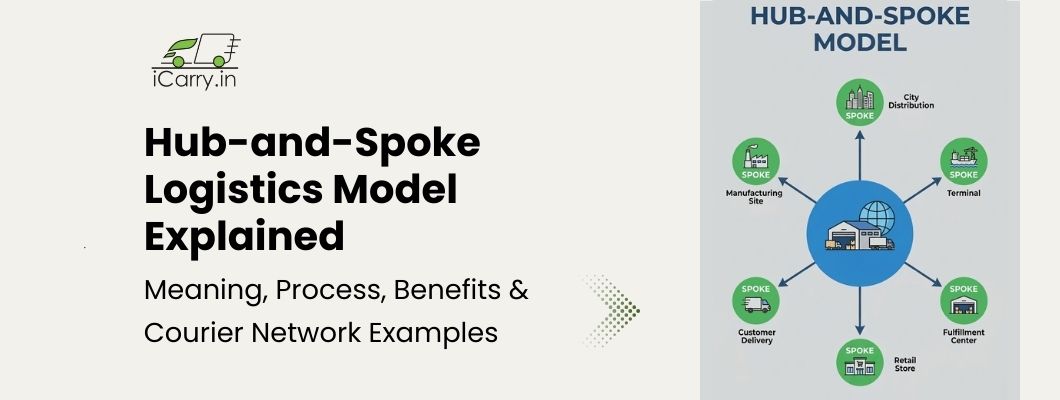
The hub-and-spoke model in logistics is one of the most widely used network structures for transporting goods efficiently across large geographic regions. In this model, shipments from multiple origin locations (spokes) are consolidated at a central hub for sorting and redistribution to destination delivery centers.
This system is widely used by courier companies, airlines, and supply chain operators to optimize transportation routes, reduce logistics costs, and improve delivery efficiency.
India's eCommerce market has grown rapidly over the past decade, with millions of parcels moving daily between cities, warehouses, and customers. According to IBEF's eCommerce industry analysis, India is among the fastest-growing digital commerce markets globally, driving rapid expansion in logistics infrastructure and courier networks. For courier and logistics companies, managing this massive shipment volume efficiently requires a well-structured transportation network.
Major Indian courier companies rely heavily on this model to move shipments across the country. It allows logistics networks to consolidate shipments from multiple locations, route them through central hubs, and distribute them efficiently to final destinations.
Without an organized network structure, courier companies would struggle with high transportation costs, inefficient routes, and delivery delays. The hub-and-spoke system solves this problem by centralizing operations and optimizing shipment movement.
For eCommerce brands, understanding how this model works can help them make better logistics decisions, reduce shipping costs, and improve delivery performance by optimizing shipping operations for online stores.
This guide explains the hub-and-spoke model in Indian courier networks, including its structure, working process, benefits, challenges, and optimization strategies.
What is the Hub-and-Spoke Model in Logistics?
Hub-and-Spoke Model Definition
The hub-and-spoke model is a logistics network structure in which shipments from multiple origin locations (spokes) are consolidated at a central hub, sorted, and then redistributed to destination delivery centers for final delivery.
In this system, transportation flows through centralized hubs instead of direct routes between every origin and destination. This structure simplifies logistics operations, improves route efficiency, and enables courier networks to handle large shipment volumes.
In a hub-and-spoke logistics network:
- Spokes represent smaller collection or delivery centers where shipments are picked up or delivered.
- Hubs are centralized sorting and distribution facilities where parcels are consolidated, sorted, and redirected to their destination routes.
Instead of shipping parcels directly between every city pair, shipments first move to a hub, where they are sorted and routed to the appropriate delivery centers.
In simple terms:
Spokes collect shipments → Hub sorts shipments → Spokes deliver shipments to customers.
This logistics network design reduces transportation complexity, improves operational efficiency, and allows courier companies to scale their delivery networks across large geographic regions.
Why the Hub-and-Spoke Model Matters in Logistics
The hub-and-spoke network plays a critical role in modern logistics operations. Research from McKinsey on supply chain management shows that network design plays a major role in improving logistics efficiency and reducing transportation costs.
1. Route Optimization
Instead of creating multiple direct routes between cities, shipments move through hubs, significantly reducing route complexity and helping improve last-mile delivery efficiency across courier networks.
2. Cost Efficiency
Consolidating shipments at hubs allows courier companies to use larger transport vehicles, reducing per-shipment transportation costs.
3. Faster Sorting Operations
Centralized sorting facilities use automated sorting systems to process thousands of parcels per hour.
4. Scalability
The model allows courier companies to expand networks by simply adding new spokes without redesigning the entire system.
5. Improved Delivery Coverage
Courier companies can reach tier-2, tier-3, and rural locations through local spoke centers connected to larger hubs.
Core Components of a Hub-and-Spoke Logistics Network
A hub-and-spoke logistics network consists of several key components.
Hub-and-Spoke Logistics Network Structure
The hub-and-spoke logistics model operates through a structured network of collection centers, regional hubs, national hubs, and delivery centers that work together to ensure efficient shipment movement across the courier network.
Origin Collection Centers (Spokes) are the first touchpoints in the logistics chain. These are local courier branches where shipments are collected directly from sellers, warehouses, or pickup locations. At this stage, parcels are received, scanned into the system, and consolidated with other shipments heading toward similar destinations. This process helps courier companies organize parcels before moving them into the broader transportation network.
After collection, shipments are transported to Regional Hubs, which function as intermediate sorting centers for parcels moving within a particular geographic region. Regional hubs help streamline logistics operations by grouping shipments based on their destination zones. For example, courier companies often operate separate hubs for North India, South India, and West India, allowing them to efficiently manage regional shipment flows. By consolidating shipments at these hubs, companies reduce unnecessary long-distance transportation and optimize routing efficiency.
For shipments traveling across larger distances, parcels are then routed through National Mega Hubs. These are large centralized logistics facilities designed to process high volumes of shipments moving between major regions of the country. National hubs typically feature advanced infrastructure such as high-speed automated sorting machines, large container handling capacities, and dedicated connectivity to long-haul transport networks. These facilities play a critical role in enabling courier companies to handle millions of parcels daily while maintaining delivery speed and accuracy.
Once shipments reach the destination region, they are sent to Destination Delivery Centers (Spokes). These local distribution facilities are responsible for managing the final stage of the logistics process—last-mile delivery. At these centers, shipments are scanned upon arrival, sorted according to delivery routes, and assigned to delivery personnel or vehicles. Efficient route planning at this stage helps courier companies ensure faster and more reliable deliveries to customers.
Connecting all these facilities is the Transportation Network, which enables the physical movement of shipments between hubs and spokes. Courier companies rely on a combination of line-haul trucks for road transport, air cargo routes for time-sensitive shipments, and rail logistics in certain corridors to move parcels across the network. A well-coordinated transportation infrastructure ensures that shipments move smoothly through the hub-and-spoke system while minimizing delays and operational costs.
Step-by-Step Process of the Hub-and-Spoke Logistics Model
The hub-and-spoke logistics model follows a structured shipment movement process designed to streamline parcel transportation across courier networks. In this system, shipments move from origin collection centers (spokes) to central sorting hubs and finally to destination delivery centers for last-mile distribution. This organized logistics workflow helps courier companies optimize transportation routes, reduce operational costs, improve sorting efficiency, and enable faster delivery timelines across regions.
Step 1: Order Pickup
The process begins with order pickup, where the courier partner collects the parcel from the shipment origin. This may include locations such as a seller warehouse, eCommerce fulfillment center, marketplace distribution hub, or local pickup point. Once collected, the parcel is transported to the origin spoke facility, where it officially enters the courier company's logistics network and is recorded in the shipment tracking system.
Step 2: Shipment Consolidation at the Origin Spoke
At the origin collection center (spoke), parcels undergo the first stage of logistics processing. Each shipment is scanned and registered in the courier management system, ensuring traceability throughout the delivery journey. Shipments are then grouped based on their destination regions or hub routes, allowing courier companies to consolidate multiple parcels moving toward the same geographic zone. This consolidation step improves transport efficiency and prepares shipments for movement to regional or national hubs.
Step 3: Transportation to the Sorting Hub
After consolidation, shipments are transported from the origin spoke to the nearest regional or national hub. Courier companies typically use line-haul trucks for road transport or air cargo networks for time-sensitive shipments. This stage forms the backbone of long-distance parcel movement in the hub-and-spoke logistics network.
Step 4: Hub Sorting and Processing
Once shipments arrive at the hub, large-scale sorting operations take place. Parcels are unloaded and passed through automated sorting machines or conveyor-based systems that scan shipment labels and determine their next routing destination. Based on destination codes, parcels are automatically redirected to the appropriate outbound routes heading toward their destination regions. Modern logistics hubs are designed to handle extremely high volumes, with large facilities capable of processing 50,000 to 300,000 parcels per day, enabling courier networks to scale efficiently during peak demand periods.
Step 5: Transfer to Destination Spoke
After sorting is completed at the hub, shipments are grouped according to their destination cities or delivery zones and transported to the corresponding destination spoke facilities. This movement typically occurs via long-distance trucks, cargo flights, or integrated multimodal transport networks, depending on distance and delivery timelines.
Step 6: Last-Mile Delivery
The final stage of the hub-and-spoke logistics process is last-mile delivery, which occurs at the destination delivery center (spoke). Here, shipments are scanned upon arrival and sorted based on delivery routes. Courier companies then assign parcels to delivery agents, optimize delivery routes using logistics software, and dispatch shipments for final delivery to customers. This operational stage is crucial for customer satisfaction, as businesses must carefully manage delivery success rates, address accuracy, and return-to-origin (RTO) risks to ensure efficient last-mile performance.
Real-World Business Examples
Example 1: Nationwide Courier Network
A parcel shipped from Jaipur to Kochi typically follows this path:
Jaipur pickup center → Delhi hub → Bangalore regional hub → Kochi delivery center → Customer delivery.
This structure avoids the need for direct city-to-city routes.
Example 2: eCommerce Fulfillment Operations
A D2C brand shipping nationwide may dispatch orders to a courier partner's local facility. From there, the courier network routes shipments through its hub network for nationwide distribution.
This allows businesses to reach customers across India without maintaining their own logistics infrastructure.
Example 3: Air Cargo Hub Networks
Some courier companies operate air cargo hubs in cities like Delhi, Mumbai, and Hyderabad to enable overnight deliveries between major cities.
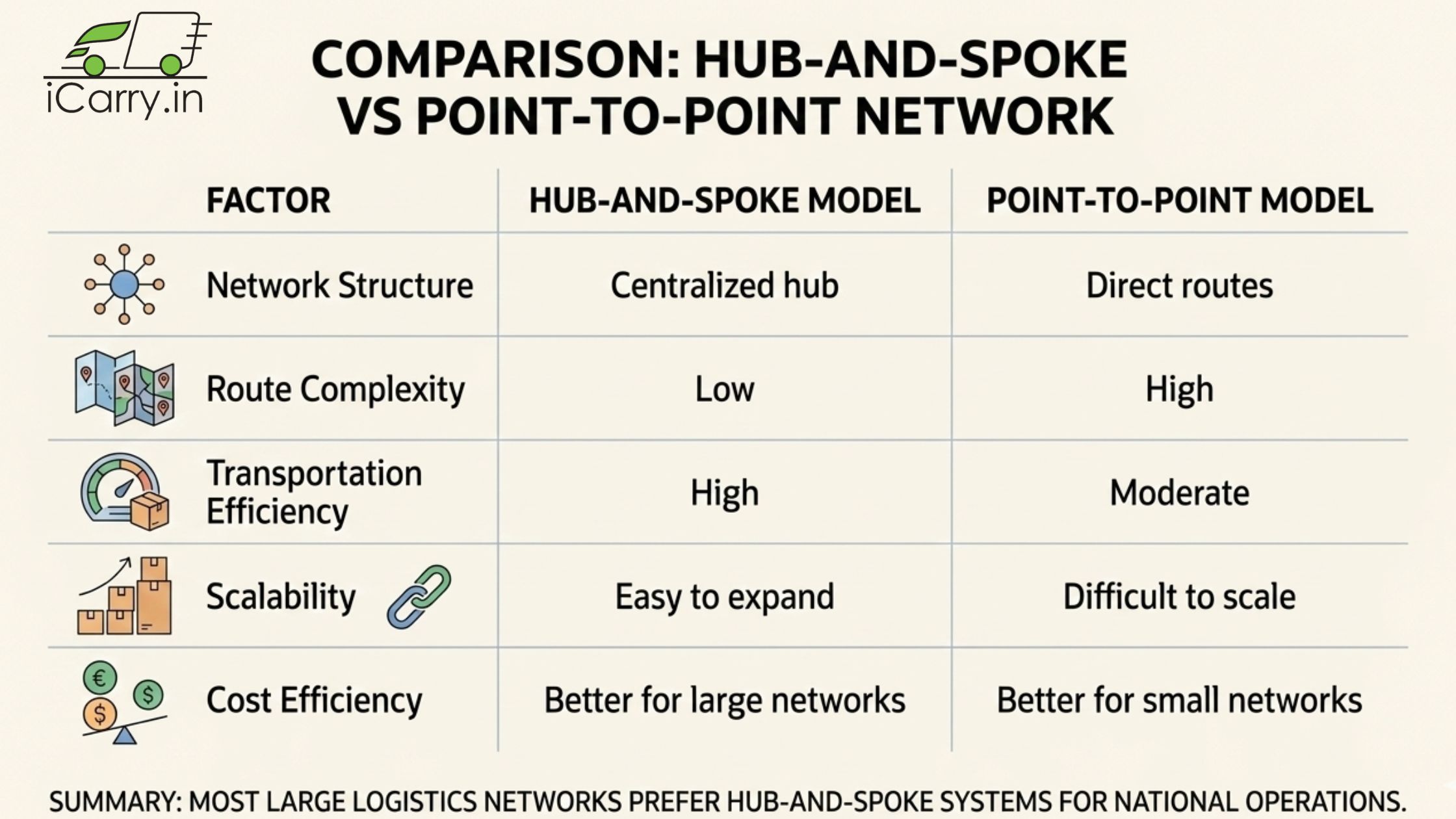
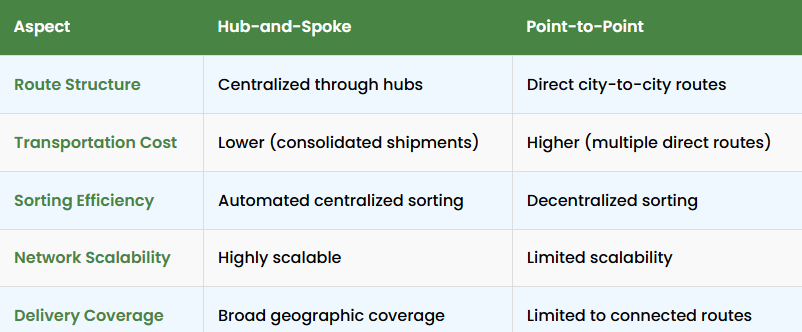
Hub-and-Spoke vs Point-to-Point Network
Most large logistics networks prefer hub-and-spoke systems for national operations.
Benefits of the Hub-and-Spoke Logistics Model
The hub-and-spoke logistics model offers several operational and cost advantages for courier companies and eCommerce logistics networks. By centralizing sorting operations and optimizing transportation routes, this system improves delivery efficiency, reduces costs, and enables logistics providers to scale their networks more effectively.
Lower Transportation Costs
One of the biggest advantages of the hub-and-spoke model is the reduction in transportation expenses. By consolidating multiple shipments at origin spokes and transporting them together to central hubs, courier companies can significantly reduce fuel consumption, vehicle usage, and empty return trips. Shipment consolidation also improves truck load efficiency, allowing logistics providers to move large volumes of parcels in fewer trips.
Faster Shipment Sorting and Processing
Centralized hubs are equipped with automated sorting systems, conveyor belts, and barcode scanning technology, which allow logistics companies to process thousands of parcels per hour. This automation speeds up parcel identification, route allocation, and shipment redirection, resulting in faster processing times compared to decentralized sorting operations.
Better Network Scalability
The hub-and-spoke structure makes logistics networks highly scalable. When courier companies expand into new cities or service areas, they only need to connect the new location to an existing hub rather than building a completely new logistics network. This makes it easier for companies to expand delivery coverage while maintaining operational efficiency.
Improved Delivery Coverage
By connecting smaller spoke centers to central hubs, courier companies can efficiently serve remote towns, semi-urban regions, and rural delivery locations. The hub-and-spoke network allows parcels to move through central logistics points before being dispatched to local delivery centers, enabling broader geographic coverage without significantly increasing operational complexity.
Higher Operational Efficiency
The structured shipment flow of the hub-and-spoke model improves overall logistics efficiency. Shipments move through clearly defined routes and sorting stages, which reduces handling errors, transit delays, and routing confusion. As a result, courier companies can achieve better delivery timelines, improved parcel tracking accuracy, and more reliable logistics operations across the entire network.
Challenges in the Hub-and-Spoke Logistics Network
While the hub-and-spoke logistics model offers major efficiency and scalability advantages, it also comes with certain operational challenges that courier companies must manage carefully. As shipment volumes increase and logistics networks expand, maintaining smooth operations across hubs and spokes becomes critical for ensuring consistent delivery performance.
Hub Congestion and Bottlenecks
One of the most common challenges in a hub-and-spoke network is hub congestion. Since central hubs handle large volumes of shipments coming from multiple regions, high parcel inflow during peak periods—such as festive sales or eCommerce promotions—can create operational bottlenecks. When hubs become overloaded, sorting delays may occur, which can impact overall delivery timelines across the network.
High Infrastructure Investment
Establishing and operating large logistics hubs requires significant capital investment. Courier companies must invest heavily in infrastructure such as automated sorting systems, large warehouse facilities, advanced parcel scanning technology, and extensive transportation fleets. Building and maintaining these high-capacity logistics facilities can be costly, especially for companies expanding into new regions.
Network Dependency Risks
In the hub-and-spoke model, the entire logistics network often depends heavily on a few major hubs. If a central hub experiences disruptions due to technical failures, weather conditions, labor shortages, or operational issues, it can affect shipment movement across multiple regions. This dependency makes hub reliability and contingency planning extremely important for logistics providers.
Last-Mile Delivery Complexity
Despite the efficiency of hub-based sorting and transportation, the last-mile delivery stage remains the most complex and resource-intensive part of the logistics chain. Factors such as traffic congestion, address accuracy, delivery density, customer availability, and return-to-origin (RTO) cases can create operational challenges. As a result, courier companies must continuously optimize last-mile logistics strategies to maintain high delivery success rates and customer satisfaction.
Common Mistakes Businesses Make in Hub-and-Spoke Logistics Networks
Many eCommerce businesses rely on courier networks that operate using the hub-and-spoke logistics model, but operational mistakes in shipping strategy can lead to longer delivery times, higher costs, and lower delivery success rates. Understanding these common mistakes helps businesses optimize their logistics operations and improve overall shipping performance.
Ignoring Courier Network Structures
One of the most common mistakes businesses make is selecting courier partners without understanding the structure and strength of their logistics networks. Different courier companies have varying hub locations, regional strengths, and delivery coverage capabilities. Businesses that overlook these factors may experience slower deliveries in certain regions. Leveraging courier aggregator platforms that connect businesses with multiple shipping partners can help businesses choose the most efficient courier partner based on destination and service quality.
Poor Shipment Planning
Improper shipment planning can disrupt the entire logistics flow within a hub-and-spoke system. If dispatch schedules are not aligned with courier pickup times or hub departure schedules, shipments may miss outbound transportation windows. This can cause parcels to remain idle at origin spokes for additional processing cycles, ultimately delaying delivery timelines.
Lack of Inventory Distribution
Many businesses ship all orders from a single centralized warehouse. While this may simplify inventory management, it often leads to longer transit times and higher shipping costs, especially when delivering to distant regions. Without distributed inventory placement, shipments must travel longer distances through multiple hubs before reaching the destination.
Not Using Regional Warehousing
Failing to adopt regional or distributed warehousing strategies increases dependency on long-distance shipments and central hubs. Businesses that store inventory across multiple fulfillment centers closer to customer locations can significantly reduce transit times, improve delivery speed, and lower transportation costs within hub-and-spoke courier networks.
Practical Best Practices for Businesses Using Hub-and-Spoke Logistics
To fully benefit from the hub-and-spoke logistics model, businesses should adopt strategic logistics practices that improve shipping efficiency, delivery reliability, and cost optimization.
Use Multi-Courier Strategies
Different courier networks often perform better in specific regions due to their hub locations, transportation routes, and delivery infrastructure. Many successful eCommerce brands therefore adopt multi-courier allocation strategies that distribute shipments across different logistics partners, allocating shipments based on destination, service level, and delivery performance. This approach helps businesses improve delivery reliability and reduce shipping risks.
Adopt Distributed Warehousing
Placing inventory across multiple regional fulfillment centers allows businesses to ship orders from locations closer to customers. Distributed warehousing reduces reliance on long-distance transportation routes and minimizes the number of hubs a shipment must pass through, leading to faster deliveries and lower logistics costs.
Optimize Dispatch Timings
Aligning order processing and warehouse dispatch schedules with courier pickup windows and hub departure times is essential for maintaining efficient shipment flow. Businesses that optimize dispatch timing can prevent parcels from missing transportation cycles and ensure faster movement through the logistics network.
Monitor Transit Time Data
Regularly analyzing transit time performance across different regions and courier partners helps businesses identify delays, bottlenecks, and underperforming routes. By monitoring logistics data and delivery metrics, companies can make informed decisions about courier selection and shipping strategies.
Choose Courier Networks with Strong Hub Infrastructure
Selecting courier partners with well-developed hub-and-spoke logistics infrastructure significantly improves delivery reliability. Courier networks with advanced sorting hubs, strong regional connectivity, and efficient transportation routes can move shipments faster and more consistently. This also helps businesses reduce hidden shipping costs caused by inefficient routing or poorly connected logistics networks.
Data-Driven Logistics Insights
Some typical benchmarks in Indian courier networks include:
Large courier hubs may process hundreds of thousands of parcels daily, enabling efficient nationwide shipping.
Conclusion
The hub-and-spoke logistics model is the backbone of modern courier and supply chain networks. By centralizing sorting operations at logistics hubs and connecting multiple regional spokes, this system enables courier companies to move large volumes of shipments efficiently across vast geographic areas. It reduces transportation complexity, improves route optimization, and allows logistics providers to scale operations while maintaining cost efficiency.
For eCommerce businesses, understanding how hub-and-spoke courier networks function can significantly improve shipping strategies. Choosing courier partners with strong hub infrastructure, aligning dispatch schedules with network routes, and distributing inventory strategically can help reduce transit times and improve delivery performance.
As India's eCommerce ecosystem continues to grow rapidly, logistics networks built on the hub-and-spoke model will remain essential for enabling fast, reliable, and scalable nationwide deliveries. The World Bank's Logistics Performance Index highlights how strong infrastructure and efficient transport networks significantly improve delivery performance and trade competitiveness.
Businesses looking to optimize their shipping operations can benefit from tools that simplify courier management and provide better visibility into logistics performance. Platforms like iCarry help eCommerce brands manage courier networks more efficiently through multi-courier integration, automated shipping workflows, and data-driven insights-enabling businesses to improve delivery reliability while reducing operational complexity and shipping costs.
Frequently Asked Questions (FAQs)
What is the hub-and-spoke model in logistics?
The hub-and-spoke model is a logistics network structure where shipments from multiple locations are consolidated at a central hub for sorting and redistribution to destination delivery centers.
Why do courier companies use the hub-and-spoke model?
Courier companies use this model to reduce transportation costs, simplify routing, improve sorting efficiency, and scale logistics networks efficiently.
What is the difference between hub-and-spoke and point-to-point logistics?
In a hub-and-spoke system, shipments pass through centralized hubs before reaching destinations, while point-to-point logistics involves direct transportation between origin and destination locations.
How does the hub-and-spoke model improve delivery efficiency?
By consolidating shipments and optimizing routes through centralized hubs, courier companies can process large shipment volumes faster and reduce transportation complexity.
What are examples of hubs in Indian courier networks?
Major logistics hubs are located in cities such as Delhi, Mumbai, Bangalore, Hyderabad, and Kolkata, where large sorting facilities handle nationwide shipments.
Does the hub-and-spoke model affect delivery speed?
Yes. While it may add an intermediate step, efficient hubs with automated sorting often improve overall delivery speed and network efficiency.
What industries use the hub-and-spoke model?
The hub-and-spoke model is widely used in logistics, aviation, courier networks, supply chain distribution systems, and airline route planning, where centralized hubs improve transportation efficiency.
What companies use hub-and-spoke logistics?
Many logistics, courier, and transportation companies use the hub-and-spoke model to manage large shipment volumes efficiently. Major courier providers such as Blue Dart, Delhivery, Amazon Logistics, Ecom Express, DTDC etc. rely on centralized sorting hubs connected to regional delivery centers. Airlines and global logistics companies also use this network structure to optimize routes, reduce transportation costs, and improve delivery speed.
What is an example of hub-and-spoke transportation?
A common example of hub-and-spoke transportation is a parcel shipped from Jaipur to Kochi. Instead of traveling directly between the two cities, the shipment moves from a local pickup center in Jaipur to a central hub in Delhi, then to a regional hub in Bangalore, and finally to the Kochi delivery center for last-mile delivery. This structured routing system improves efficiency and reduces transportation complexity.
The hub-and-spoke logistics model consolidates shipments from multiple origin spokes at central hubs for automated sorting and redistribution to destination delivery centers—this network structure reduces transportation costs, improves route efficiency, enables faster parcel processing, and allows courier companies to scale nationwide operations while maintaining delivery reliability.