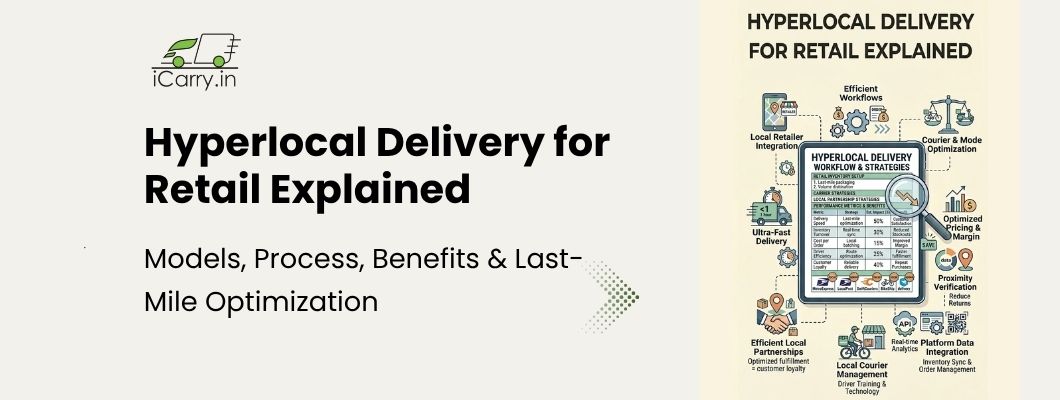
Hyperlocal delivery in retail is one of the fastest-growing shifts in Indian logistics. Customers in metros and Tier 1 cities now expect same-day or even 10-30 minute deliveries for groceries, medicines, and daily essentials. This expectation has pushed businesses across retail, quick commerce, and local D2C brands to rethink how they fulfill orders - moving from centralized warehouse models to localized, proximity-based delivery networks.
This guide explains how hyperlocal delivery works, the main fulfillment models businesses use, the real operational challenges involved, and the best practices for making shipping optimization work at a local scale.
What is Hyperlocal Delivery in Retail?
Hyperlocal delivery is a logistics model where goods are fulfilled from nearby stores or micro-warehouses and delivered to customers within a short geographic radius - typically 2 to 10 kilometres - within minutes to a few hours.
Unlike traditional eCommerce logistics that relies on regional hubs and multi-day shipping, hyperlocal delivery is built around speed, proximity, and real-time order execution. Logistics efficiency and last-mile optimization are now recognized globally as key drivers of customer satisfaction and operational performance.
In simple terms, the flow looks like this:
Customer places order → Nearest store or dark store fulfills it → Delivery partner dispatched → Order delivered in minutes to hours
Why Does Hyperlocal Delivery Matter for Retail Businesses?
Consumer behavior has shifted decisively. Faster delivery options now directly influence online purchasing decisions, and businesses that cannot match speed expectations lose orders to platforms that can. Hyperlocal delivery is no longer a premium service - it is becoming a baseline requirement in modern eCommerce operations for any retail business competing in urban markets.
The model creates specific advantages that traditional logistics cannot replicate:
- Faster fulfillment: Delivery within minutes rather than days, directly from nearby inventory
- Higher conversion rates: Speed at checkout increases the likelihood of purchase completion
- Competitive reach: Smaller retailers can compete with large marketplaces on delivery experience
- Better inventory efficiency: Existing retail locations double as fulfillment points without additional infrastructure
- Improved customer satisfaction: Speed and reliability build repeat purchase behaviour and create a seamless delivery experience for customers
Core Hyperlocal Delivery Models in Retail
Businesses adopt different fulfillment structures based on their scale, geography, and order volumes. The four main models are:
1. Store-Based Fulfillment Model
Orders are picked and packed from existing retail stores and dispatched through delivery partners. A local grocery or pharmacy, for example, fulfills orders within a 3-5 km radius using its current inventory. This is the most accessible entry point for small and mid-sized retailers because it requires no additional infrastructure beyond a delivery partner arrangement.
2. Dark Store Model
Dedicated micro-warehouses - known as dark stores - are set up exclusively for order fulfillment, with no walk-in retail function. They are designed for fast picking and high inventory availability, typically serving a 3-8 km radius. Quick commerce platforms like Swiggy Instamart and Blinkit operate dense networks of dark stores in major cities to achieve sub-30-minute delivery times.
3. Aggregator Platform Model
Third-party platforms connect customers with nearby stores and manage the delivery end to end, including order processing, rider assignment, and real-time tracking. Sellers list their inventory on the platform and focus on fulfillment while the platform manages logistics and customer interface.
4. Hybrid Model
A combination of owned dark stores, partner retailers, and third-party delivery fleets. This approach provides the most operational flexibility and scalability, allowing businesses to use the most efficient fulfillment source for each order based on location and inventory availability.
How Hyperlocal Delivery Works: Step-by-Step
Hyperlocal fulfillment depends on a fast, technology-driven workflow at every stage:
- Order placement: Customer places order via app, website, or platform
- Order allocation: System identifies the nearest store or dark store with inventory available
- Order picking: Staff pick and pack the order - often within minutes for small baskets
- Rider assignment: A delivery partner is assigned based on proximity and availability
- Dispatch and delivery: Order is dispatched and delivered within the promised time window
- Delivery confirmation: Customer receives real-time updates and delivery notification
The speed of each step depends directly on how close the fulfillment point is to the customer and how well the inventory and routing systems are configured.
Real-World Hyperlocal Delivery Use Cases in India
Hyperlocal delivery is already operating at scale across multiple categories in India:
- Quick commerce grocery: Platforms like Swiggy Instamart and Blinkit deliver groceries within 10-30 minutes from dark stores in major cities
- Pharmacy and medicine delivery: Local pharmacies partnered with delivery services for rapid prescription and OTC medicine dispatch
- Local retail digitization: Neighbourhood stores use hyperlocal delivery models to serve customers within walking distance, without building a full eCommerce operation
- Hyperlocal courier shipping: For sellers who need to move parcels within a city on the same day, hyperlocal courier services provide a faster alternative to standard surface shipping - useful for time-sensitive or perishable goods. iCarry.in offers hyperlocal courier service for same day delivery through our partners alongside standard B2C and B2B courier options, allowing businesses to choose the right delivery mode based on order urgency, location, and cost.
Hyperlocal Delivery vs Traditional eCommerce Logistics
The operational profile of hyperlocal delivery is fundamentally different from traditional logistics - not better or worse overall, but suited to a different set of use cases:
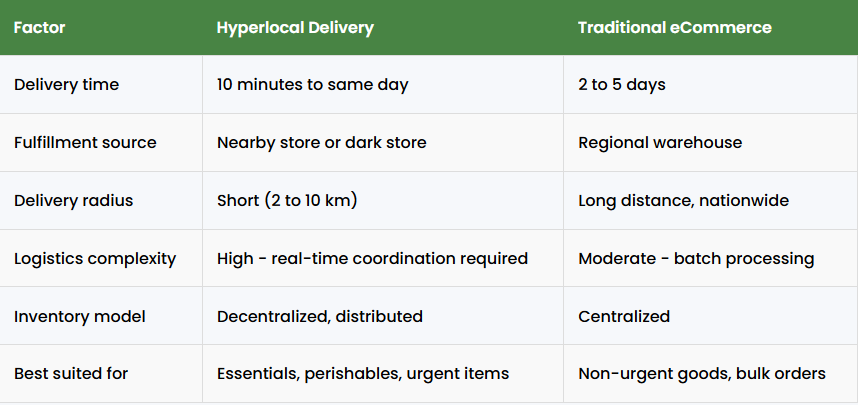
Most growing retail businesses need both models - hyperlocal for same-day demand and standard courier logistics for orders that can ship over 2-5 days. Using multiple fulfillment types in parallel is increasingly standard practice.
Benefits of Hyperlocal Delivery for Retail Businesses
When implemented with the right infrastructure and processes, hyperlocal delivery delivers measurable business outcomes:
- Delivery speeds measured in minutes to hours rather than days - a meaningful differentiator in competitive categories
- Higher customer satisfaction scores and repeat purchase rates driven by delivery reliability
- Improved inventory turnover as local stock moves faster through proximity-based fulfillment
- Competitive differentiation for independent retailers against large marketplace players
- Reduced delivery failure rates compared to long-distance shipping, since the delivery zone is tightly defined
Key Challenges in Hyperlocal Delivery Logistics
Hyperlocal delivery introduces operational complexity that businesses need to plan for before scaling:
High Unit Economics Pressure
Managing delivery fleets, dark store operations, and real-time logistics coordination costs significantly more per order than traditional warehouse-based shipping. Profitability depends on order density - enough orders per zone to justify the fixed costs.
Inventory Distribution Complexity
Stock must be tracked and managed across multiple physical locations simultaneously. An out-of-stock at one dark store cannot easily be fulfilled from another without delaying the order. Accurate inventory data is non-negotiable.
Demand Variability
Order volumes in hyperlocal delivery fluctuate significantly by time of day, weather, and local events. Demand forecasting and real-time data analysis are critical for managing supply chain variability in fast-moving retail environments.
Last-Mile Routing Efficiency
Efficient routing is essential for profitability. Without route optimization, delivery costs per order rise quickly - particularly as businesses tackle delivery inefficiencies and operational challenges at scale.
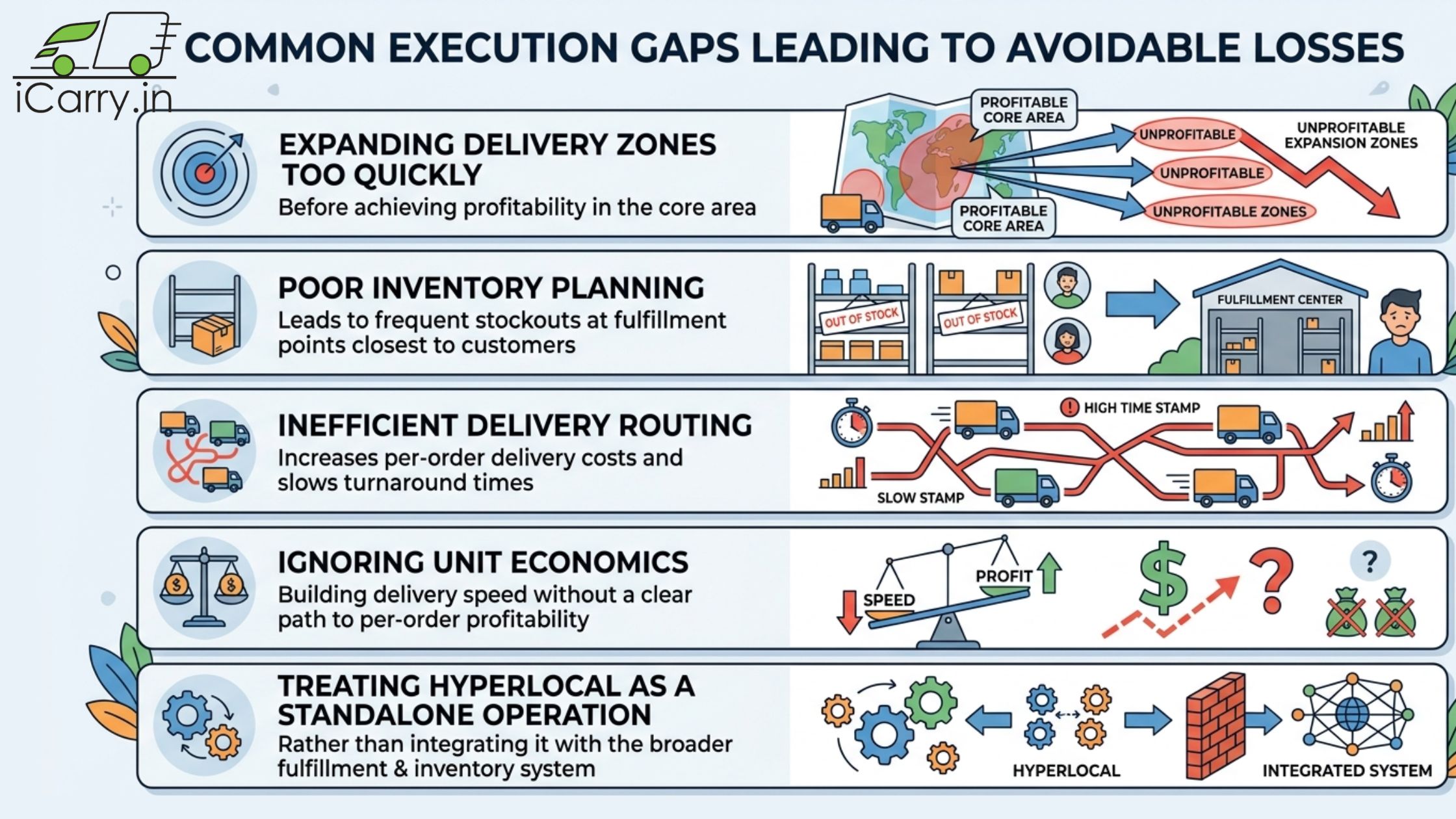
Common Mistakes Businesses Make in Hyperlocal Delivery
Many businesses face avoidable losses from execution gaps at the early stages:
- Expanding delivery zones too quickly before achieving profitability in the core area
- Poor inventory planning that leads to frequent stockouts at the fulfillment point closest to the customer
- Inefficient delivery routing that increases per-order delivery costs and slows turnaround times
- Ignoring unit economics - building delivery speed without a clear path to per-order profitability
- Treating hyperlocal as a standalone operation rather than integrating it with the broader fulfillment and inventory management system
Best Practices for Optimizing Hyperlocal Delivery Performance
Success in hyperlocal logistics requires a data-driven, localized approach. These are the strategies that consistently improve delivery performance and reduce cost per order:
Demand Forecasting by Zone and Time
Analyse order history by location, day of week, and hour to anticipate demand peaks. Position inventory at the right fulfillment point before the demand arrives - not in response to it.
Route Optimization
Use routing tools that minimize delivery distance and time for each dispatch cluster. Even small improvements in route efficiency compound significantly at volume.
Real-Time Inventory Accuracy
Inventory data at each fulfillment point must be current and accurate. A discrepancy between the system and the shelf directly causes delivery failures and customer cancellations.
Right-Sized Fulfillment Network
Start with a well-served core zone and expand coverage only when order density in the core is consistently profitable. Overextension of the delivery radius is one of the most common causes of hyperlocal unit economics failure.
KPI Monitoring
Track the metrics that matter: average delivery time, order fulfillment rate, delivery success rate, and cost per delivered order. Identifying underperforming routes or zones early prevents systemic losses.
Key Metrics and Industry Benchmarks
Hyperlocal delivery is expanding rapidly across India's retail and quick commerce sectors. Global eCommerce and digital economy reports consistently highlight last-mile delivery innovation as one of the fastest-evolving areas of retail logistics.
| Metric | Industry Benchmark |
|---|---|
| Average delivery time | 10 to 30 minutes (quick commerce) |
| Typical delivery radius | 2 to 10 kilometres |
| Growth trajectory | Rapid expansion, particularly Tier 1 and Tier 2 cities |
| Order behaviour | High repeat purchase frequency |
| Primary categories | Grocery, pharmacy, food, local retail |
How Hyperlocal Fits Into a Broader Shipping Strategy
For most retail and eCommerce businesses, hyperlocal delivery handles a specific segment of orders - primarily same-day, short-radius, time-sensitive shipments. The majority of orders still require standard domestic shipping across cities and states. Managing both efficiently from a single platform - with visibility across courier options, delivery timelines, and cost per shipment - is where courier aggregator platforms add the most value. Businesses that optimize intelligent logistics technologies across both hyperlocal and standard shipping see the strongest overall delivery performance and lowest blended cost per order.
iCarry supports hyperlocal shipping alongside standard B2C and B2B courier options, allowing businesses to choose the right delivery mode based on order urgency, location, and cost. This becomes especially useful for sellers managing both same-day local deliveries and longer-distance shipments, as it brings operational visibility and control into a single workflow without requiring multiple systems.
Final Thoughts
Hyperlocal delivery has moved from a niche logistics innovation to a mainstream expectation in Indian retail - particularly in urban grocery, pharmacy, and quick commerce categories. The businesses that succeed in hyperlocal are those that treat it as an operations problem first: the right inventory in the right location, accurate routing, and disciplined unit economics.
For retailers and eCommerce brands considering hyperlocal delivery, the practical starting point is identifying which order types and geographies genuinely benefit from sub-hour delivery, and building a fulfillment model around those specific cases - rather than applying a hyperlocal approach universally across all orders.
As India's quick commerce market continues to grow and customer expectations for speed rise further, hyperlocal logistics will increasingly shape what delivery looks like across retail segments. Businesses that invest now in the right fulfillment infrastructure, inventory discipline, and last-mile optimization will be better positioned to meet those expectations sustainably. For a broader view of where Indian eCommerce is heading, the guide on eCommerce trends for 2026 covers the delivery expectations and logistics shifts that retailers need to plan for.
Frequently Asked Questions
What is hyperlocal delivery in eCommerce and retail?
Hyperlocal delivery is a logistics model where products are fulfilled from nearby stores or micro-warehouses and delivered to customers within a limited geographic area - typically 2 to 10 kilometres - within minutes to a few hours.
It is used primarily for groceries, medicines, food, and local retail goods where delivery speed is a primary purchase driver.
How does hyperlocal delivery work?
A customer places an order via an app or website. The system identifies the nearest available fulfillment point - either a retail store or dark store - with the relevant inventory. Staff pick and pack the order, a delivery partner is assigned based on proximity, and the order is delivered within the promised time window. Real-time tracking keeps the customer informed throughout.
What is the difference between hyperlocal and traditional eCommerce delivery?
Hyperlocal delivery fulfills orders from nearby locations within hours. Traditional eCommerce fulfills orders from centralized regional warehouses and delivers within 2-5 business days. Hyperlocal requires decentralized inventory and real-time logistics coordination; traditional logistics operates on batch processing and longer shipping windows.
Which industries use hyperlocal delivery in India?
Grocery and quick commerce (Swiggy Instamart, Blinkit), food delivery, pharmacy and medicine, local retail, and same-day courier services for time-sensitive parcels are the primary use cases in India.
What are dark stores in hyperlocal logistics?
Dark stores are small, dedicated micro-warehouses that operate exclusively for order picking and fulfillment. They have no walk-in retail function and are designed for fast, high-volume order processing within a short delivery radius.
What are the biggest challenges in hyperlocal delivery?
The main challenges are high per-order operational costs requiring dense order volume to be profitable, real-time inventory accuracy across multiple locations, demand variability by time and geography, and last-mile routing efficiency. Each of these requires active monitoring and data-driven management rather than one-time setup.
Can small retailers offer hyperlocal delivery?
Yes. Small retailers can use the store-based fulfillment model - picking and dispatching orders from their existing location through a delivery partner arrangement - without building dedicated dark store infrastructure. The constraint is maintaining reliable delivery within a defined radius and managing demand during peak periods.
Hyperlocal delivery is a logistics model where goods are fulfilled from nearby stores or micro-warehouses and delivered within a 2-10 km radius in minutes to hours—enabling retail businesses to offer same-day fulfillment by combining store-based, dark store, or aggregator models with real-time inventory management, route optimization, and disciplined unit economics.