A manufacturer in Pune dispatches two orders on the same day. One goes to a retailer in Mumbai - same state, Maharashtra. The other goes to a retailer in Hyderabad - different state, Telangana. The products are identical. The tax treatment, the GST invoice structure, and the courier zone classification are all different.
Understanding the intrastate vs interstate distinction is not just an accounting requirement. It affects how GST is applied on your invoice, whether an e-way bill is mandatory, which courier zone the shipment falls in, and - for businesses claiming input tax credit - how the credit flows between the supplier and recipient.
India's GST framework, introduced in 2017, unified the country's fragmented state tax system. The distinction between intrastate and interstate supply is fundamental to how GST operates - and every Indian business that ships goods across or within state lines needs to understand it correctly.
What Is the Difference Between Intrastate and Interstate Shipments?
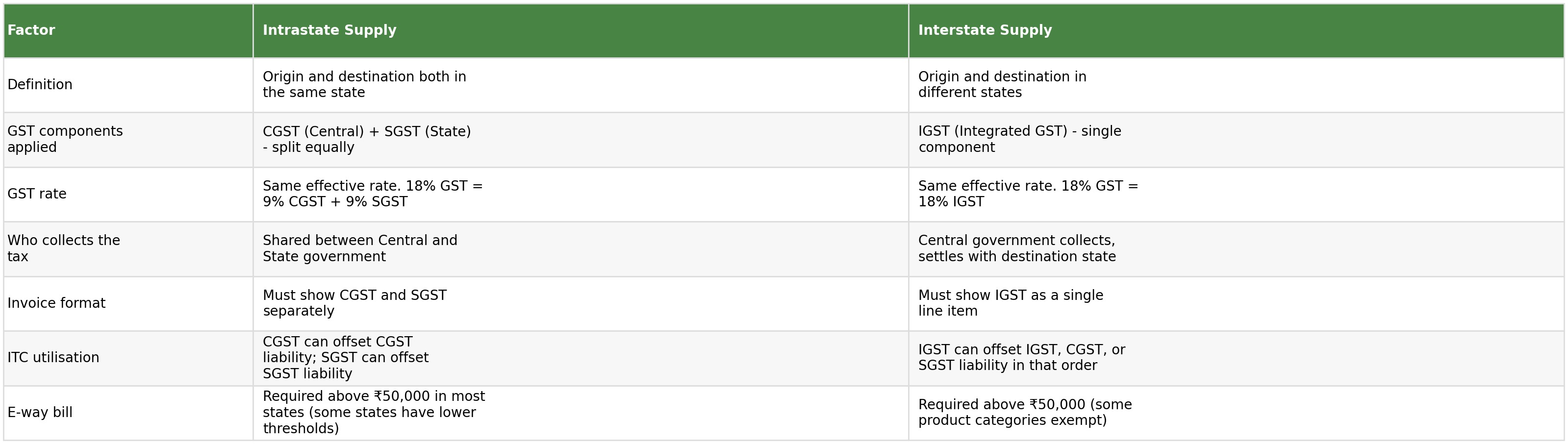
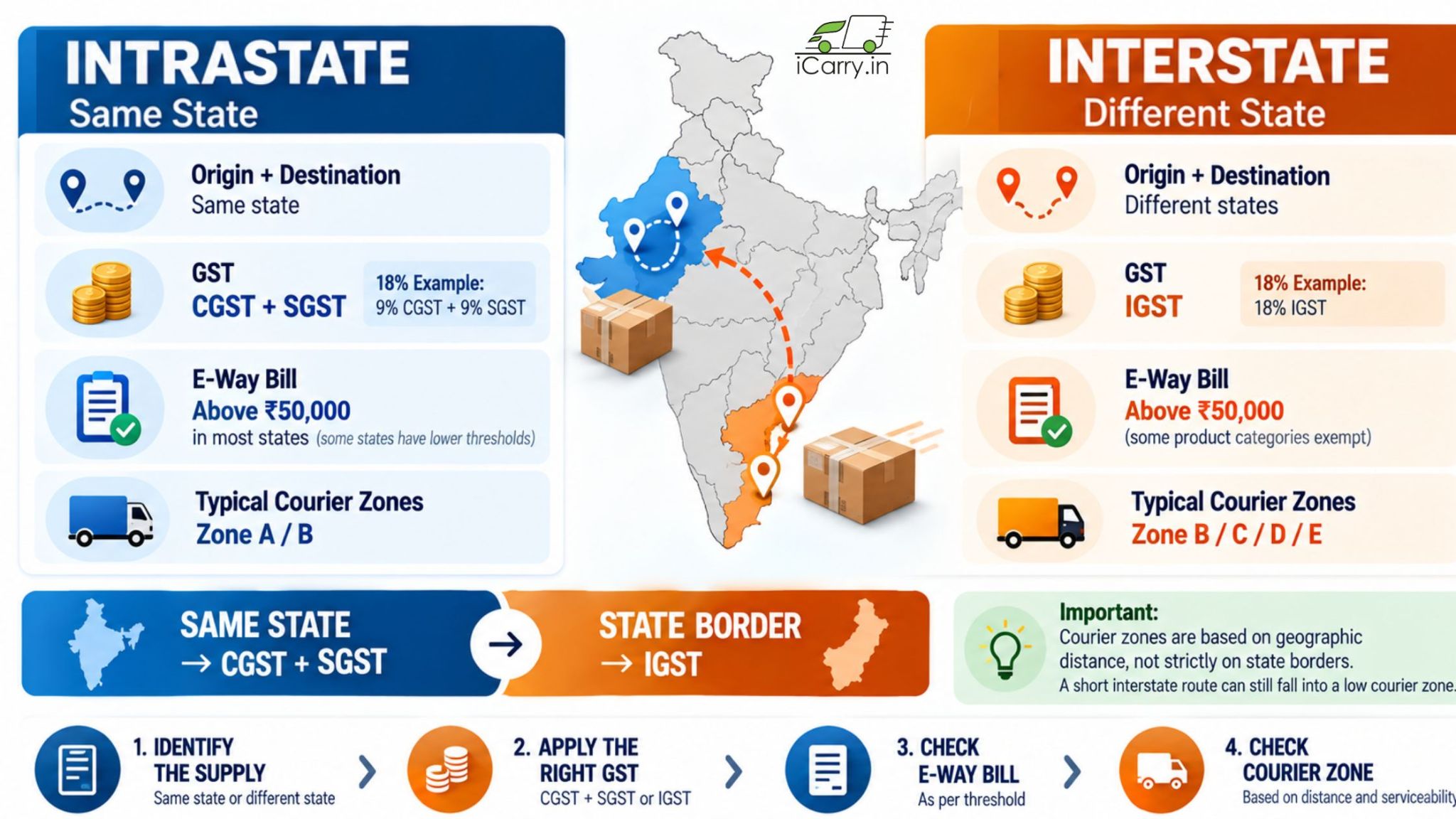
Intrastate shipments move within a single state, so the invoice splits GST equally into CGST and SGST. Interstate shipments cross a state border, so the invoice charges IGST as one combined tax instead. The GST rate stays the same either way - only how it is split, taxed, and later claimed as input tax credit changes, along with the courier zone and e-way bill rules that apply.
How to Check Your Intrastate vs Interstate Shipping Status
- Do you know whether each of your regular delivery destinations is in the same state as your dispatch location?
- Are you applying CGST+SGST for intrastate and IGST for interstate on your GST invoices?
- Do you know the e-way bill threshold for your product category?
- For businesses with multiple warehouses: do you know the GST implications of stock transfers between states?
- Are you claiming input tax credit correctly on IGST paid on interstate purchases?
The Core Distinction: Intrastate vs Interstate Supply
GST on Intrastate Shipments
When goods move within the same state - from your warehouse in Bengaluru to a customer in Mysuru, or from your Delhi warehouse to a retailer in Noida (both in the same state/UT for GST purposes) - the applicable taxes are CGST and SGST in equal proportions.
How it appears on the invoice: A product with an 18% GST rate billed intrastate shows ₹9 CGST and ₹9 SGST on the invoice for every ₹100 of taxable value. Never show IGST on an intrastate invoice - it is a compliance error.
For the recipient (B2B): The recipient can claim ITC on both CGST and SGST paid, using CGST credit to offset CGST liability and SGST credit to offset SGST liability.
Important: CGST credit cannot be used to offset SGST liability, and vice versa. This is a common ITC utilisation error.
GST on Interstate Shipments
When goods cross a state border - from Mumbai to Delhi, Bengaluru to Chennai, Kolkata to Ahmedabad - IGST applies as a single consolidated tax.
How it appears on the invoice: An 18% GST rate billed interstate shows ₹18 IGST for every ₹100 of taxable value. Never split IGST into CGST and SGST on an interstate invoice.
For the recipient (B2B): IGST credit is the most flexible - it can be used to offset IGST, CGST, or SGST liability (in that order of utilisation preference). Interstate purchases are often financially advantageous for the buyer's ITC position because of this flexibility.
Why this matters operationally: Businesses that apply the wrong GST type on an invoice - IGST on an intrastate transaction or CGST+SGST on an interstate one - create GST filing errors that require amendment, trigger mismatches in GSTR-2B reconciliation, and complicate the recipient's ITC claims.
E-Way Bill Requirements
The e-way bill is a document generated on the GST e-way bill portal that must accompany the movement of goods above specified value thresholds. It applies to both intrastate and interstate movement.
When an E-Way Bill Is Required
- Interstate movement: E-way bill required for all consignments above ₹50,000 in value. No exception for the mode of transport
- Intrastate movement: Required above ₹50,000 in most states. Some states have set lower thresholds. A few states have specific exemptions for certain product categories or movement types
- For courier and parcel shipments: The ₹50,000 threshold applies to the invoice value of goods being transported, not the shipment weight or courier charge
When an E-Way Bill Is NOT Required
- Movement of goods by non-motorised transport (handcart, human carry)
- Goods transported by a defence or government department under specific exemptions
- Specific exempted product categories (varies by state for intrastate movement)
- Movement of goods within a state below the applicable state threshold
- Certain agricultural and perishable goods in some states - verify state-specific notifications
Who Generates the E-Way Bill?
- The consignor (seller/sender): Typically generates the e-way bill before handing goods to the courier
- The courier/transporter: Can generate or update the e-way bill with vehicle information if the consignor has not
- The consignee: Can generate the e-way bill for an inward supply if the consignor has not done so
Practical implication for courier shipments: For B2B consignments above ₹50,000, the seller must generate the e-way bill before the courier agent picks up the goods. The e-way bill number should be provided to the courier for transit documentation. Failure to generate an e-way bill where required is a GST compliance violation with penalty implications.
Courier Differences: Zones and Rates
Beyond GST and e-way bill, the intrastate vs interstate distinction affects courier zone classification and freight rates:
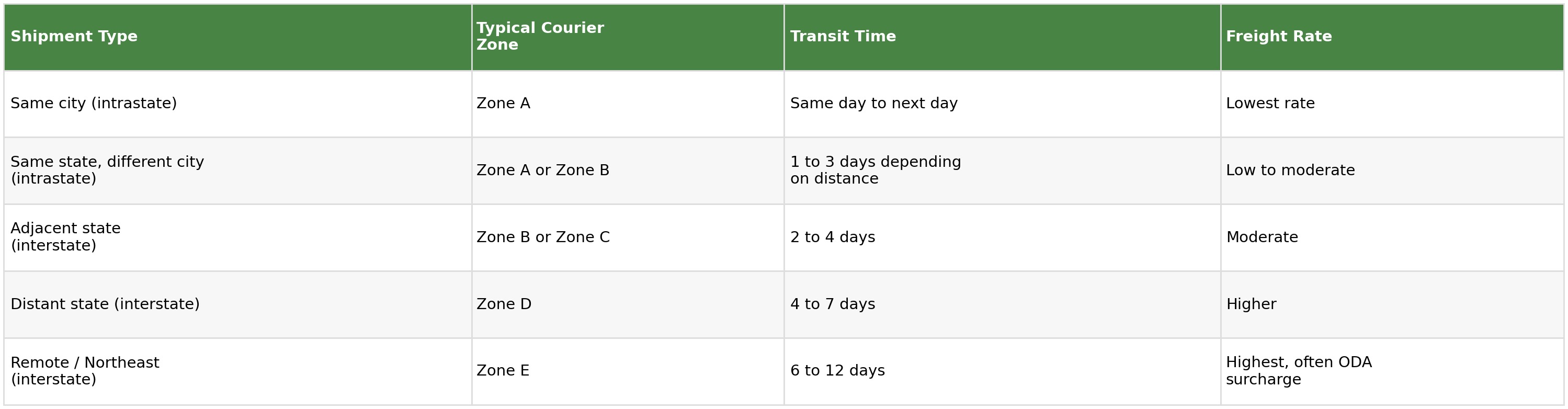
Zone classification by courier companies is based on geographic distance from the origin pincode, not strictly on state borders. A shipment from Delhi to Gurugram (Haryana) is interstate from a GST perspective but may be Zone A for courier billing. A shipment within a large state like Rajasthan from Jaipur to Barmer may be Zone B despite being intrastate.
Stock Transfers Between States - A Special Case
When a business moves its own inventory between two warehouses in different states - not a sale, but a branch transfer - this still constitutes an interstate supply under GST and requires:
- IGST self-invoice: The business must generate a self-invoice for the stock transfer at the taxable value of the goods, charging IGST. The receiving branch claims ITC on this IGST
- E-way bill: Required for stock transfers above ₹50,000 even though no actual sale occurs
- Documentary evidence: Delivery challan or stock transfer note accompanying the goods, separate from the self-invoice
This is one of the most commonly mismanaged compliance areas for businesses operating with multi-state warehouse networks. Many businesses move stock between branches without generating the required IGST self-invoice, creating GST audit exposure.
Practical Implications for Indian Businesses
For D2C Brands Shipping to Customers
- B2C sales do not require the customer to use ITC, so the CGST+SGST vs IGST distinction is primarily a filing and accounting matter
- The correct GST type must still appear on the GST invoice/bill of supply for proper return filing
- E-way bill is required for high-value B2C orders above ₹50,000 moving interstate
For B2B Sellers and Distributors
- Getting intrastate vs interstate wrong creates ITC mismatches for the buyer - they may not be able to claim credit correctly
- Interstate purchases give buyers maximum ITC flexibility - IGST credit offsets all GST liabilities
- Always confirm the delivery state matches the GSTIN state on the buyer's invoice before finalising the invoice
For Businesses With Multiple Warehouses
- Inventory held in multiple states may mean the 'supplying state' for GST purposes is not where your HQ is - it is where the goods are dispatched from
- Multi-state GST registration may be required if you have a fixed place of business (warehouse, office) in multiple states
- Stock transfers between states require IGST self-invoicing and e-way bills
How iCarry® Supports Intrastate and Interstate Shipping
iCarry® is a courier aggregator that handles the logistics side of both intrastate and interstate shipments across India - the GST and e-way bill compliance remains with the seller:
- Pan-India courier and LTL shipping: Ship intrastate and interstate orders through the same iCarry® account, whether you are sending individual parcels or larger, heavier consignments through LTL services. Compare applicable rates before booking.
- Multiple courier partners: Access multiple courier partners through one account and select suitable options based on the destination, shipment weight, dimensions, serviceability, and delivery requirements.
- B2B multi-box shipping: For larger B2B orders containing multiple cartons, businesses can book linked multi-box shipments to keep the consignment organised and track the cartons together.
- COD across states: COD is available for applicable intrastate and interstate shipments, with COD collection and remittance managed across courier partners through one account.
- Address Quality Scoring: Identify incomplete or potentially problematic addresses before dispatch, helping reduce failed deliveries and re-attempts across both intrastate and interstate shipments.
- OTP verification helps confirm that the shipment is received by the intended recipient and creates a verifiable, timestamped delivery confirmation, for high-value or sensitive shipments.
- Transit Loss Insurance: For eligible high-value shipments, businesses can enable Transit Loss Insurance while booking, with the available coverage and applicable fee shown before confirmation.
- Free Bronze plan with no minimum shipment volume.
Final Thoughts
The intrastate vs interstate distinction touches every B2B invoice, every e-way bill, and every ITC claim in Indian business. Getting it right is a compliance requirement - and getting it wrong creates reconciliation problems, ITC mismatches, and GST audit exposure.
The practical rules are straightforward: same state means CGST+SGST; different state means IGST. E-way bill above ₹50,000 for both intrastate and interstate. Stock transfers between your own warehouses in different states still need IGST self-invoicing and e-way bills.
For the logistics side - zone classification, transit time, and freight rate - intrastate shipments are generally Zone A or B with shorter transit and lower cost. Interstate shipments move through Zones B to E with proportionally higher transit time and cost. A courier aggregator that shows rates for both before every booking is the practical tool for managing the logistics cost of interstate and intrastate supply efficiently.
Frequently Asked Questions (FAQs)
What is the difference between intrastate and interstate supply under GST?
Intrastate supply is when both the origin and destination of goods are in the same state. CGST and SGST apply in equal halves. Interstate supply is when goods move from one state to another. IGST applies as a single consolidated tax. Both types carry the same effective GST rate - the difference is in how the tax is split and how ITC is claimed.
Is an e-way bill required for intrastate shipments?
Yes, for consignments above ₹50,000 in most states. Some states have set lower thresholds for intrastate e-way bills. A few product categories are exempt from e-way bill requirements under state-specific notifications. Check the current threshold for your specific state at ewaybillgst.gov.in.
Can CGST credit be used to pay SGST liability?
No. CGST credit can only offset CGST liability. SGST credit can only offset SGST liability. IGST credit is the most flexible - it can be used to offset IGST first, then CGST, then SGST liability in that order. This is why IGST credit from interstate purchases is often more useful for the buyer than intrastate CGST+SGST credit.
Do I need to generate an e-way bill for sending goods to my own warehouse in another state?
Yes. Stock transfers between your own business premises in different states are treated as interstate supply under GST. An IGST self-invoice must be generated and an e-way bill is required if the stock value exceeds ₹50,000. This is a commonly missed compliance requirement for businesses with multi-state warehouse networks.
How does courier zone classification relate to intrastate vs interstate?
Courier zones are based on geographic distance from the origin pincode, not strictly state borders. An intrastate shipment within a large state (Rajasthan, Madhya Pradesh) may be Zone B, while a short interstate shipment to a neighbouring city just across a state border may also be Zone A or B. Check the specific zone for each origin-destination pincode pair rather than assuming all intrastate shipments are Zone A.
Same state means CGST+SGST; different state means IGST. E-way bill above ₹50,000 for both intrastate and interstate. Stock transfers between your own warehouses in different states still need IGST self-invoicing and e-way bills - getting this right avoids the reconciliation problems, ITC mismatches, and GST audit exposure that follow from getting it wrong.