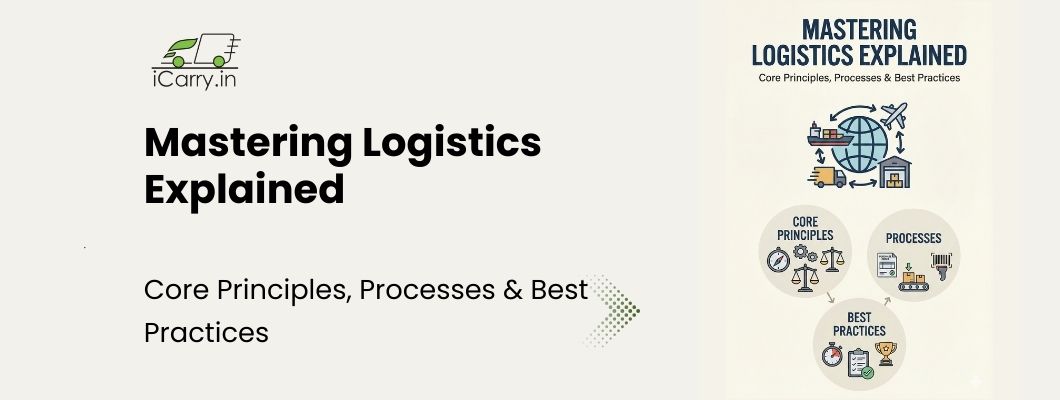
What is logistics management, and why is it critical for modern businesses?
Logistics management is the process of planning, implementing, and controlling the efficient flow and storage of goods, services, and related information from origin to final delivery. In simple terms, it ensures that the right product reaches the right customer, at the right time, and at the right cost.
In today's competitive environment, logistics is no longer a backend function - it directly impacts delivery experience, customer trust, and repeat purchases. Businesses that master logistics scale smoothly. Businesses that ignore it struggle with delays, high return rates, rising costs, and inconsistent customer experiences.
According to the Council of Supply Chain Management Professionals (CSCMP), logistics plays a central role in supply chain performance - and in competitive markets, performance is everything.
This guide explains logistics management in detail - including its core principles, key processes, types of logistics, best practices, common mistakes, and real-world examples.
What Does "Mastering Logistics" Mean?
Mastering logistics means achieving control, consistency, and visibility across the complete movement of goods - from sourcing and storage to final delivery and returns.
In practical terms, logistics mastery occurs when operations enable growth rather than restrict it. Instead of firefighting daily disruptions, businesses operate through structured systems that support predictable deliveries, optimized costs, smooth scaling, and faster issue resolution.
When logistics is mastered, it becomes a growth driver instead of a bottleneck.
Why Is Logistics Mastery or Logistics Management Critical Today
Modern businesses operate in an environment defined by shorter delivery expectations, thinner margins, high return volumes, and increasingly complex supply chains. Under these conditions, logistics cannot remain a backend execution function - it must evolve into a strategic capability.
The World Bank's Logistics Performance Index consistently demonstrates how logistics efficiency influences competitiveness and economic performance. At the company level, the same principle applies: operational precision determines whether growth remains profitable.
Logistics mastery is no longer optional. It is foundational.
The World Bank's Logistics Performance Index highlights how logistics efficiency directly impacts national competitiveness and business growth.
Core Principles of Logistics
1. Right Product, Right Place, Right Time
This is the foundation of logistics.
Failure in any one leads to:
- Stockouts
- Excess inventory
- Customer dissatisfaction
Accuracy matters more than speed.
2. Cost vs Service Balance
Faster delivery usually means higher cost.
Strong logistics teams:
- Identify where speed adds value
- Optimize where efficiency matters more
Not every order needs express delivery.
3. Visibility & Transparency
You cannot manage what you cannot see.
Effective logistics requires:
- Real-time inventory visibility
- Shipment tracking
- Clear exception alerts
Visibility reduces firefighting and improves proactive exception handling through structured non-delivery tracking and resolution systems.
Industry research from McKinsey emphasizes that end-to-end supply chain visibility significantly improves responsiveness and reduces disruptions.
4. Reliability Over Short-Term Fixes
Occasional last-minute solutions don't scale.
Well-designed systems:
- Deliver consistently
- Reduce dependency on individuals
- Build long-term trust
Predictability is more valuable than heroics.
5. Continuous Improvement
Logistics is never "complete".
High-performing teams:
- Measure performance
- Identify bottlenecks
- Improve processes incrementally
Small improvements compound over time.
Harvard Business Review has consistently highlighted continuous improvement and operational discipline as core drivers of scalable performance.
Key Logistics Management Processes
1. Demand & Supply Planning
Purpose: Align demand with supply availability.
Includes:
- Demand forecasting
- Inventory planning
- Capacity planning
Poor planning leads to overstock or lost sales.
2. Procurement & Inbound Logistics
Purpose: Ensure raw materials or inventory arrive on time.
Includes:
- Supplier coordination
- Inbound transportation
- Quality checks
Delays here affect the entire supply chain.
3. Inventory Management
Purpose: Balance availability with cost.
Includes:
- Safety stock planning
- SKU rationalization
- Inventory turnover optimization
Inventory equals locked capital.
4. Warehousing & Fulfillment
Purpose: Enable fast, accurate order processing.
Includes:
- Storage layout
- Picking and packing
- Dispatch operations
Warehouses are fulfillment centers, not storage rooms.
5. Transportation & Distribution
Purpose: Move goods cost-effectively and on time.
Includes:
- Route planning
- Carrier selection
- Cost optimization
Transportation often forms the largest logistics cost, especially when businesses rely on single-carrier setups instead of optimized multi-courier allocation.
Data from the Council of Supply Chain Management Professionals' State of Logistics reports consistently show transportation as one of the largest components of total logistics cost.
6. Last-Mile Delivery
Purpose: Deliver orders successfully to customers.
Includes:
- Address accuracy
- Delivery coordination
- Proof of delivery
This is where customers judge your brand - and poor last-mile visibility often results in failed delivery attempts and avoidable returns.
7. Returns & Reverse Logistics
Purpose: Handle returns efficiently.
Includes:
- Pickup and inspection
- Restocking or disposal
- Refund or replacement
Poor reverse logistics quietly erodes margins, particularly when high RTO rates are not proactively managed.
Studies published by Deloitte indicate that inefficient reverse logistics significantly impacts profitability, especially in eCommerce-heavy sectors.
Best Practices for Mastering Logistics
1. Standardize Before Automating
Automation amplifies existing processes.
Fix workflows first. Then apply technology.
2. Use Data, Not Assumptions
Gartner research notes that data-driven supply chains outperform peers in cost efficiency and service levels.
Track metrics like delivery success rate, cost per shipment, inventory turnover, and return-to-origin (RTO) rate - because hidden inefficiencies in shipping can silently drain margins.
Data reveals real problems.
3. Build Redundancy Into the System
Avoid dependency on one supplier, one warehouse, or one courier. Using diversified shipping networks reduce operational bottlenecks and improve delivery reliability.
Backup options reduce risk.
4. Align Logistics With Business Goals
Logistics should support:
- Growth plans
- Customer experience promises
- Margin targets
Disconnected logistics breaks strategy.
5. Invest in People, Not Just Tools
Systems don't solve problems - people do.
Train teams in:
- Decision-making
- Process discipline
- Ownership
Strong logistics runs on strong teams.
6. Communicate Proactively
Delays happen.
What matters:
- Early alerts
- Honest updates
- Clear timelines
Silence damages trust faster than delays.
Common Logistics Mistakes Businesses Make
Many businesses underestimate the strategic importance of logistics and treat it as a back-end operational function rather than a growth driver. This often leads to avoidable and compounding mistakes.
One of the most common errors is over-promising delivery timelines without aligning internal capabilities. While fast delivery can attract customers, unrealistic commitments damage trust when execution falls short.
Another frequent mistake is selecting logistics partners purely based on cost. Although competitive pricing matters, reliability, coverage, service quality, and return handling efficiency are equally critical. Choosing the cheapest option often leads to higher long-term costs through delays, failed deliveries, and customer dissatisfaction.
Businesses also tend to ignore return logistics until losses become significant. Poor reverse logistics management increases refund cycles, blocks working capital, and quietly erodes margins.
Finally, many companies treat logistics as "execution only" rather than as a strategic lever. In reality, logistics directly impacts customer experience, operational stability, and scalability.
Logistics failures rarely happen overnight. They build gradually - through small inefficiencies, overlooked metrics, and unmanaged risks - until they suddenly become visible in the form of rising costs, lost customers, or operational breakdowns.

How to Know If You're Mastering Logistics
Effective logistics management does not feel chaotic or reactive. It feels structured, predictable, and controlled.
You are likely on the right path if delivery timelines are consistent and reliable rather than dependent on constant firefighting. Inventory data should remain accurate and synchronized across systems, reducing stockouts and overstocking issues.
Operational costs should remain stable or improve even as order volumes increase. Scalability without cost volatility is a key indicator of maturity.
Most importantly, recurring problems are addressed through systems and process improvements - not temporary fixes. When issues are solved at the root level, operational stress decreases over time.
Mature logistics does not create noise. It creates stability.
Final Thoughts
Logistics management is not about achieving perfection in every shipment. It is about building systems that deliver control, consistency, and continuous improvement over time.
Businesses with well-structured logistics operations scale more confidently because their fulfillment processes can handle growth without breaking under pressure. They operate with less daily stress since processes are standardized and performance is measurable. Strong logistics also strengthens customer retention, as reliable delivery builds trust and repeat behavior. At the same time, efficient shipping management protects profit margins by reducing hidden costs such as failed deliveries, excess returns, and operational inefficiencies.
In the long run, product quality may attract customers initially, but it is fulfillment reliability that determines whether they return.
Logistics mastery is not defined by speed alone. It is built on visibility across shipments, control over operational variables, and consistent execution from dispatch to delivery. Businesses aiming to improve courier allocation, reduce return-to-origin (RTO) rates, and optimize shipping performance often adopt multi-carrier logistics platforms such as iCarry.in to centralize coordination and build scalable delivery systems.
Sustainable growth does not come from isolated improvements. It comes from logistics systems designed to perform reliably at every stage of expansion.
Frequently Asked Questions About Logistics Management
1. What is logistics management in simple terms?
Logistics management is the process of moving goods efficiently from suppliers to customers while controlling cost, speed, and reliability. It includes transportation, warehousing, inventory management, order fulfillment, and returns handling.
In simple terms, logistics management ensures products are delivered accurately and on time.
2. What are the 7 R's of logistics?
The 7 R's of logistics are:
- Right product
- Right quantity
- Right condition
- Right place
- Right time
- Right customer
- Right cost
These principles define effective logistics performance and customer satisfaction.
3. What are the main types of logistics?
The main types include:
- Inbound logistics – Receiving goods from suppliers
- Outbound logistics – Delivering goods to customers
- Reverse logistics – Handling returns and exchanges
- Third-party logistics (3PL) – Outsourcing logistics to specialized providers
Each type plays a critical role in operational efficiency.
4. What is the difference between logistics and supply chain management?
Logistics focuses on the movement and storage of goods.
Supply chain management (SCM) covers the broader system, including sourcing, procurement, production, logistics, and coordination between suppliers, manufacturers, and distributors.
Logistics is a component of supply chain management.
5. Why is logistics management important for businesses?
Logistics management is important because it:
- Reduces operational costs
- Improves delivery speed
- Enhances customer satisfaction
- Controls inventory levels
- Reduces return-to-origin (RTO) rates
- Supports business scalability
Poor logistics directly impacts profit margins and customer trust.
6. What are the key processes in logistics management?
Core logistics processes include:
- Demand forecasting
- Procurement and inbound transportation
- Inventory management
- Warehousing and fulfillment
- Transportation and distribution
- Last-mile delivery
- Reverse logistics
Together, these processes ensure smooth product flow from supplier to customer.
7. How can businesses improve logistics performance?
Businesses can improve logistics performance by:
- Increasing end-to-end visibility
- Using data-driven decision-making
- Diversifying courier and carrier options
- Optimizing inventory levels
- Standardizing workflows before automation
- Monitoring delivery success rates and RTO
Continuous improvement and performance tracking are key to long-term logistics mastery.
Logistics management ensures the right product reaches the right customer at the right time and cost through planning, implementing, and controlling efficient movement and storage—mastering logistics requires visibility, data-driven decisions, continuous improvement, and alignment with business goals to scale reliably while protecting margins.