You have set up your ONDC seller account. Your products are live. Orders start coming in across buyer apps. And then comes the logistics question that every ONDC seller faces sooner than expected: how does shipping actually work here?
ONDC is fundamentally different from Amazon or Flipkart. There is no single logistics arm handling delivery for you. There is no FBA equivalent that takes care of fulfillment at the cost of your packaging control and seller score independence. On ONDC, logistics is your decision - which model to use, which couriers to work with, how to manage COD, and how to handle delivery failures.
That independence is ONDC's strength. The Open Network for Digital Commerce is designed to give sellers genuine control over their business - including logistics. But control requires understanding. This guide is the shipping handbook for ONDC sellers who want to use that control to build a logistics operation that is faster, cheaper, and more reliable than what most closed-marketplace options provide.
What Is ONDC Seller Shipping? How Logistics Is Structured?
Unlike traditional marketplaces where a single logistics provider handles most deliveries, ONDC separates the buyer, seller, and logistics layers into independent participants. This means logistics on ONDC is not centrally managed - it is the seller's responsibility to choose and configure a logistics solution that works for their specific business.
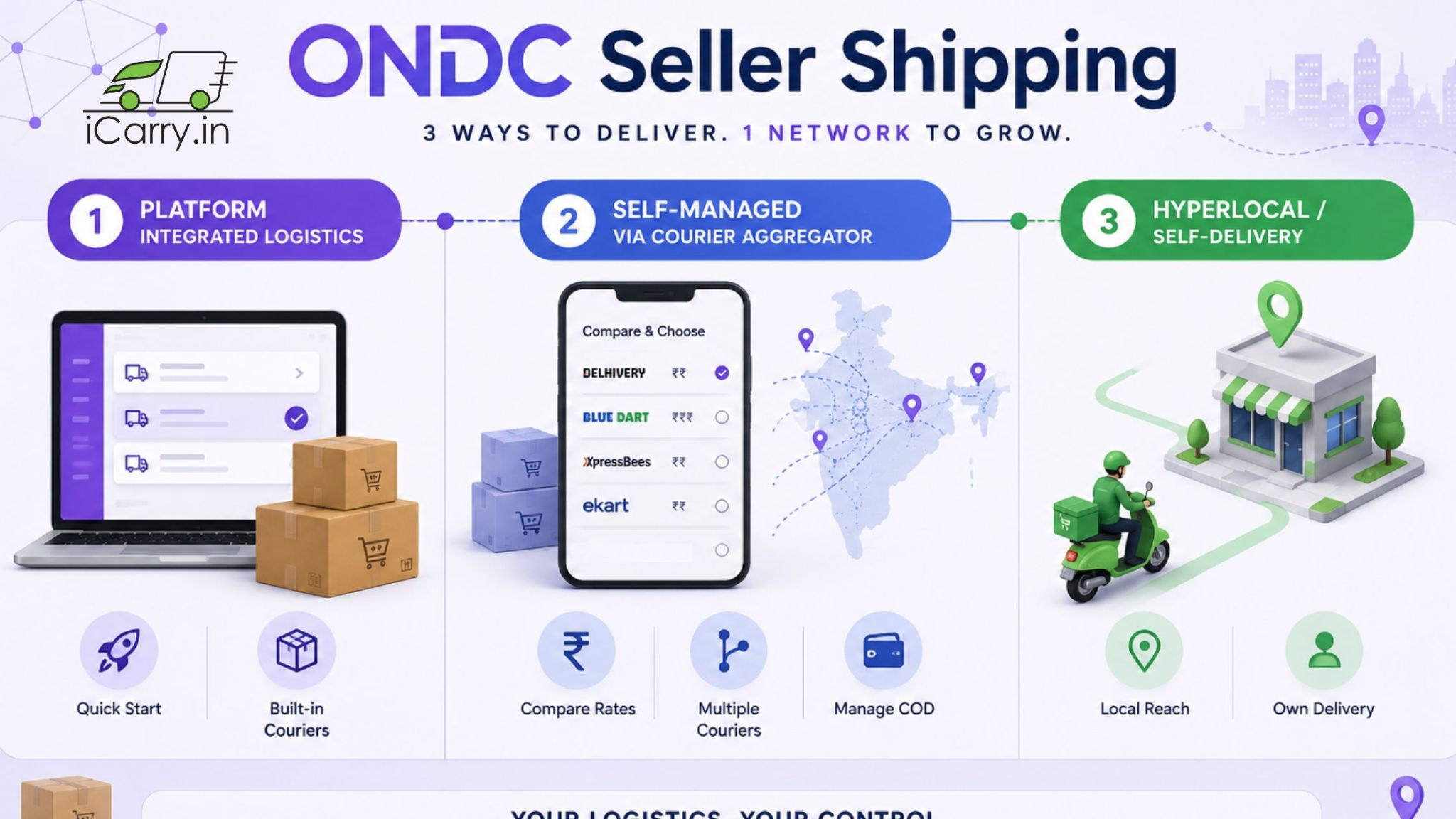
Three logistics approaches are available to ONDC sellers in 2026:

For most businesses - beyond new sellers testing ONDC - self-managed logistics via a courier aggregator delivers the best combination of cost, flexibility, and delivery management capability. Platform-integrated logistics is convenient but limits your courier choice and rate visibility.
How to Check Your ONDC Logistics Readiness
- Have you decided which of ONDC's three logistics models suits your business - platform-integrated, self-managed, or hyperlocal?
- If self-managing, do you have a courier aggregator account with access to multiple courier partners?
- Is your order management system integrated with your shipping platform so orders sync automatically?
- Do you have a COD remittance setup that handles daily automatic settlement?
- Have you configured your pickup address in your shipping platform to match your actual dispatch location?
- Do you know your current delivery success rate on ONDC orders - and which pincodes and couriers are generating the most failures?
Setting Up Self-Managed Shipping for ONDC
Step 1: Choose a Courier Aggregator
A courier aggregator connects your ONDC operation to multiple courier partners - Delhivery, Blue Dart, Xpressbees, Ekart, Amazon Shipping, Shree maruti, and others - from one account. You compare rates before every booking, book from one dashboard, track all shipments in one view, and manage COD remittance centrally. No separate contracts with each courier required.
Step 2: Configure Your Pickup Address
Register your dispatch location as a pickup address in your courier aggregator account. For ONDC sellers with multiple locations - a retail store and a warehouse, for example - register each as a separate pickup address. Each order can be routed to the nearest stocked location for dispatch.
Step 3: Integrate With Your ONDC Seller App
Most ONDC seller apps support API-based integration with third-party logistics providers. When an order arrives in your seller app, it should automatically pass to your courier aggregator account for booking. Confirm your seller app's integration method with your aggregator - some use direct API, some use file-based transfer.
Step 4: Configure COD Remittance
ONDC has significant COD order volume, particularly from Tier 2 and Tier 3 buyers. Set up your COD remittance destination account before your first COD order ships. Choose between bank-only remittance, auto-split bank and wallet, or wallet-only based on how you manage working capital. Confirm that daily automatic remittance is active.
Step 5: Test Before Going Live
Place a test order through an ONDC buyer app to your own address. Verify the full flow: order appears in your seller app, passes to your courier aggregator, booking confirms, label generates, pickup happens, tracking updates appear, and delivery completes. Fix any gap in this flow before real orders scale.
COD Management for ONDC Sellers
COD is the dominant payment method across ONDC's buyer base in 2026, particularly outside metros. Managing it well is the single biggest operational priority for most ONDC sellers.
COD Remittance on ONDC
Unlike marketplace platforms that aggregate and remit COD on their own schedule, ONDC sellers using self-managed logistics receive COD remittance directly from their courier aggregator. iCarry® processes COD remittance automatically every business day (Monday to Saturday) on the T+7 default cycle at zero cost for all plans. Early remittance from T+0 to T+4 is available at a nominal fee for sellers where working capital is tight.
T+0 means payment is processed the next business day after delivery. T+7 means seven business days after delivery. For an ONDC seller with 200 daily COD orders at ₹600 average order value, T+7 remittance means ₹8.4 lakh permanently in transit at any given time.
COD Confirmation Before Dispatch
ONDC COD orders - particularly those originating from buyer apps in smaller cities - have higher impulse purchase rates than marketplace COD orders. Implementing a WhatsApp confirmation step within 30 minutes of COD order placement significantly reduces doorstep refusals from buyers who change their mind before delivery.
COD Destination Accounts
iCarry® offers three COD remittance destination configurations: bank account only, auto-split between bank account and iCarry® wallet, and wallet only. For ONDC sellers who want to use COD collections to fund future shipment costs without manual transfers, wallet accumulation may be efficient. For those who need cash in their business bank account daily, bank-only remittance is the right configuration.
Delivery Management on ONDC - The Part Most Sellers Underestimate
On Amazon or Flipkart, the platform's logistics arm handles delivery failures, escalates to couriers, and manages the NDR process with its own operational team. On ONDC with self-managed logistics, that responsibility sits entirely with you.
This is not a disadvantage - it is an opportunity. Businesses that actively manage delivery failures reduce their RTO rate significantly below what platform-managed logistics typically achieves. But it requires the right tools.
NDR Management on ONDC
Every Non-Delivery Report on an ONDC order is a clock starting. Most couriers will make 2 to 3 attempts before triggering RTO. Acting on every NDR within 24 hours - updating delivery instructions and requesting reattempt - is what determines whether a failed first attempt becomes a successful reattempt or an avoidable RTO. The full RTO reduction framework for ONDC sellers applies directly.
Watch Overview of My Account > My Shipments to see how all ONDC shipment NDR statuses and tracking appear in iCarry®'s My Shipments dashboard across all couriers.
Delivery Boost for ONDC COD Orders
iCarry®'s Delivery Boost deploys trained agents who call your ONDC customers before delivery, audit courier NDR claims, and open tickets for fake non-delivery reports. Agents communicate in the customer's regional language - Hindi, Telugu, Tamil, Kannada, Malayalam, and others - making this effective across ONDC's diverse buyer geography. For ONDC sellers with high COD volumes in Tier 2 and Tier 3 markets, Delivery Boost directly reduces the RTO rate that determines whether the channel is profitable.
Two-Way WhatsApp Communication
iCarry®'s WhatsApp Engagement enables genuine two-way communication between the coordination team and the ONDC buyer - on the seller's behalf. When a buyer receives a delivery update and can reply to reschedule, update their address, or confirm delivery timing, first-attempt delivery success improves meaningfully.
For ONDC sellers specifically, this matters because ONDC buyer apps attract customers who may not be as digitally familiar with tracking and delivery coordination as marketplace buyers. A WhatsApp message they can actually reply to is significantly more effective than a tracking link they need to click through.
The seller has full visibility of every conversation - every message sent, every customer reply, every instruction given to the courier.
Address Quality Scoring
ONDC draws buyers from geographies that established marketplaces do not fully penetrate - smaller cities, district towns, emerging digital adopters. These buyers often enter delivery addresses in less standardised formats. iCarry®'s Address Quality Scoring evaluates every ONDC order address before dispatch and flags incomplete or high-risk entries, preventing first-attempt failures before they happen.
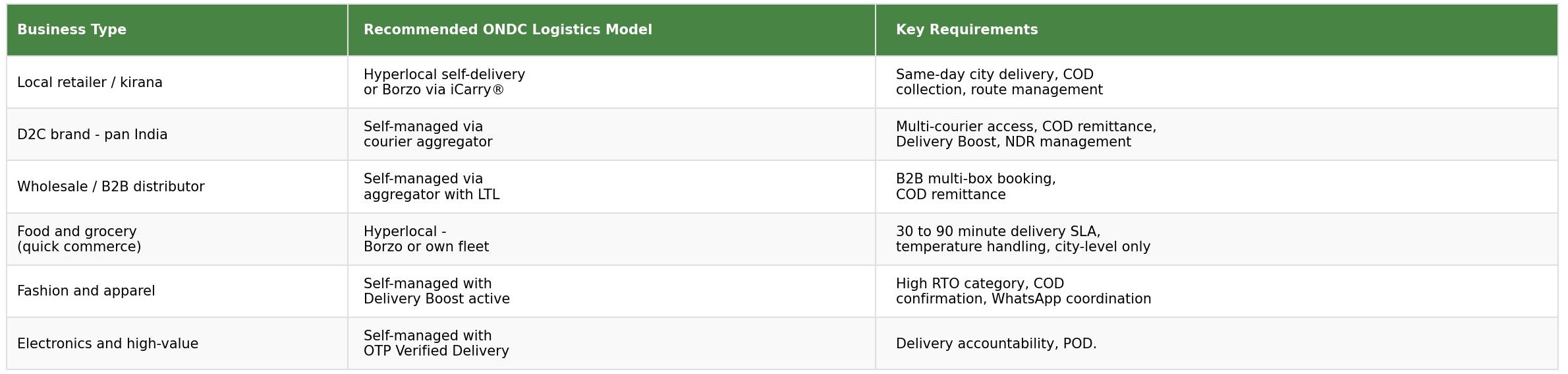
ONDC Logistics by Business Type
Shipping Cost Structure for ONDC Sellers
ONDC's lower commission structure versus traditional marketplaces creates room for better logistics spending - but only if shipping costs are managed actively. The components:
Base freight: Per-shipment courier charge by zone and chargeable weight. Compare across couriers before every booking. How to estimate and compare rates before confirming any ONDC order booking
RTO return freight: Equal to forward freight on failed deliveries. Every prevented RTO saves double freight. Active Delivery Boost and COD confirmation are the primary levers
Weight discrepancy charges: Preventable with accurate post-seal weight declaration and pre-uploaded product images for auto-dispute
Platform commission: ONDC seller app commission, typically 2 to 5%. Lower than traditional marketplace commission but still a shipping-adjacent cost in your order economics
The hidden cost components of shipping - ODA surcharges, fuel surcharge, COD fee structure - apply to ONDC orders exactly as they do to any other channel. Model your full per-order cost before setting ONDC product pricing.
Multi-Courier Routing for ONDC Pan-India Sellers
ONDC's reach extends across India - from metro buyers to Tier 3 town buyers in districts that established marketplace platforms have historically underserved. This geographic diversity means no single courier is optimal for every ONDC order. Multi-courier allocation by pincode and order type is the practice that reduces blended RTO and per-order cost for ONDC sellers with pan-India delivery scope.
Routing logic for ONDC orders:
COD orders to Tier 2 and Tier 3 cities - route to couriers with best RTO performance in those pincodes (typically Xpressbees or Ekart for South India)
High-value prepaid orders - route to Blue Dart or Delhivery express for delivery accountabilitys
Same-day city orders - route to Borzo via iCarry® for hyperlocal delivery
Budget surface orders to metros - route to Amazon Shipping or Shree Maruti for competitive rates
How iCarry® Supports ONDC Sellers Specifically
iCarry® serves ONDC sellers as a self-managed logistics partner - handling the shipping leg while the seller manages the ONDC order and customer experience:
Multiple courier partners from one account: Delhivery, Blue Dart, Xpressbees, Ekart, Amazon Shipping, Shree Maruti, DTDC, FedEx, Aramex and others from one account.
Multiple pickup addresses: Register retail location, warehouse, and any other dispatch point. Route each ONDC order to the correct pickup location
Delivery Boost: Agents call ONDC customers in their regional language, audit fake NDRs, and open tickets for fraudulent non-deliveries and try to make the delivery successful.
Two-way WhatsApp communication: Buyers can reply to update address, reschedule, or confirm availability. Full conversation visibility for the ONDC seller
Address Quality Scoring: Pre-dispatch validation of every ONDC order delivery address
OTP Verified Delivery: Helpful mainly for high-value prepaid ONDC orders
Free daily COD remittance: Automatic T+7 settlement every business day for all plans along with early cod options available.
Full REST API: For ONDC sellers with OMS or custom seller app systems that need programmatic shipment booking and status updates
Free Bronze plan: No monthly fee, no minimum volume. An ONDC seller shipping 15 orders a week uses the same platform as one shipping 15,000
Register and start your successful shipping journey at iCarry today.
Final Thoughts
ONDC gives Indian sellers something no traditional marketplace does - genuine logistics independence. You choose your courier. You control your COD remittance. You manage your delivery experience. The platform takes a lower commission and stays out of your supply chain.
That independence is powerful. But power without the right tools creates operational risk. ONDC sellers who manage logistics well - with multi-courier access, active NDR follow-up, Delivery Boost for COD orders, and daily COD remittance - build a delivery operation that outperforms what platform-managed logistics typically achieves.
ONDC has crossed 68 million transactions with over 5.35 lakh sellers onboarded, per the Economic Survey (reported by ONDC). The sellers who invest in logistics infrastructure now build an operational advantage that compounds as the network scales.
Frequently Asked Questions (FAQs)
How does shipping work on ONDC?
ONDC sellers choose their own logistics model - platform-integrated (via the seller app), self-managed via a courier aggregator, or hyperlocal self-delivery. Unlike traditional marketplaces, ONDC does not have a central logistics arm. Sellers are responsible for their own courier selection, shipping cost, COD management, and delivery performance.
Which courier is best for ONDC sellers?
No single courier is best for every ONDC order. Delhivery is strong for the pan-India surface. Blue Dart for high-value express. Xpressbees and Ekart for South India and Tier 2 COD. Borzo for hyperlocal. Using a courier aggregator gives access to all of them with rate comparison before every booking.
How is COD managed on ONDC?
ONDC sellers using self-managed logistics receive COD remittance directly from their courier aggregator. iCarry® processes automatic daily COD remittance on T+7 cycle at zero cost for all plans. Early remittance from T+0 to T+4 is available at a nominal fee. The seller configures whether collections go to a bank account, wallet, or split between both.
How do ONDC sellers reduce RTO?
Confirm COD orders before dispatch via WhatsApp. Enable Address Quality Scoring to catch bad addresses before shipment. Activate Delivery Boost for high-risk COD orders - agents call customers in their regional language. Act on every NDR within 24 hours. Route orders to the best-performing courier for each pincode.
Can I use iCarry® for ONDC seller shipping?
Yes. iCarry® supports ONDC sellers with self-managed logistics - multiple courier partners, Delivery Boost, two-way WhatsApp communication, Address Quality Scoring, daily COD remittance, and full REST API for OMS integration. Free Bronze plan with no minimum volume.
What is the difference between ONDC logistics and marketplace logistics?
On traditional marketplaces, the platform manages most logistics through its own fulfillment arm. On ONDC, logistics is the seller's responsibility. The seller chooses couriers, manages COD remittance, handles NDRs, and controls the delivery experience. This gives more control and lower commission cost but requires active logistics management.
ONDC gives Indian sellers genuine logistics independence - no central logistics arm means sellers choose between platform-integrated, self-managed via courier aggregator, or hyperlocal delivery models, with self-managed logistics via a courier aggregator delivering the best combination of cost, flexibility, and delivery control for most growing businesses. Success on ONDC requires active management: multi-courier routing by pincode, daily COD remittance, WhatsApp order confirmation, and Delivery Boost intervention on failed deliveries - the sellers who invest in this logistics infrastructure now build a compounding operational advantage as ONDC's 68 million transactions and 5.35 lakh sellers continue to scale.