It is 11 AM. You have 200 orders to dispatch before 2 PM for same-day pickup. Your packer is at the back of the storage area looking for a product that has been moved. Your label printer is out of paper. One order is missing an item because the pick list had the wrong SKU. Two orders have been packed in boxes that are too large.
By 2 PM, 140 orders are ready. 60 are not. The courier leaves with 140. The remaining 60 are dispatched the next day - a day late for every one of those customers.
Pick and pack is where logistics theory meets daily reality. India's e-commerce warehousing market is projected to grow from roughly $10 billion in 2025 to $39 billion by 2034 . For Indian businesses shipping at any meaningful scale the speed and accuracy of the pick and pack process determines whether orders ship on time, whether the right product reaches the right customer, and how much the packaging costs per order. Getting it right is not about expensive automation - it is about clear process, organised storage, and eliminating the small inefficiencies that compound across hundreds of daily orders.
This guide explains how pick and pack works, the methods available at different scales, the most common bottlenecks, and practical improvements any business can make today. A tight pick and pack process still needs a fast handover at the end - a platform like iCarry® is built for exactly that last step, from bulk booking to label printing.
What Is Pick and Pack?
Pick and pack is the warehouse fulfilment process of selecting (picking) the correct items for a customer order from storage and preparing them (packing) for shipment. It is the operational step between an order being placed and a shipment being handed to a courier.
It sounds simple. In practice, it involves storage organisation, pick list generation, item verification, packaging selection, label printing, and manifest preparation - all under time pressure with dispatch cutoff approaching.
In most Indian businesses, pick and pack happens in one of three environments: a dedicated warehouse with racking, a home-based operation with shelf storage, or a shared space that doubles as storage and dispatch. The principles that make it fast and accurate apply to all three.
How to Tell If Pick and Pack Is Holding You Back: Quick Checklist
- Do you consistently miss your courier pickup window because packing is not done in time?
- Are wrong-item errors (picking the wrong SKU or size) a regular occurrence?
- Does your packing team leave the station to find materials - tape, filler, labels - mid-pack?
- Are your boxes right-sized for your products, or are you using whatever box is available?
- Do you have a verification step before sealing - checking the item against the order?
- Is your storage organised so the fastest-moving SKUs are nearest the packing station?
The Pick and Pack Process - Step by Step
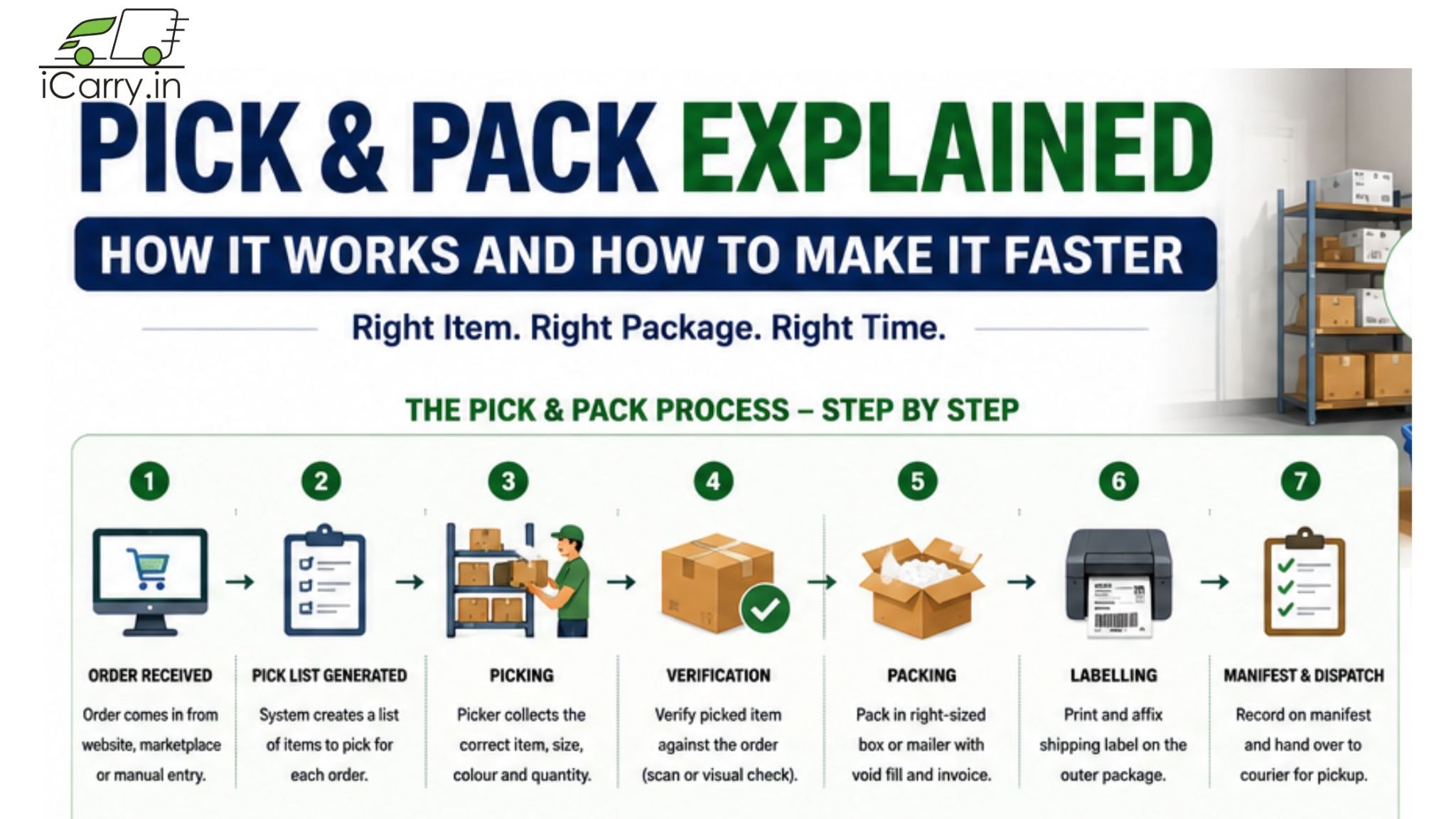
- Step 1 - Order received: Customer order comes in via Shopify, WooCommerce, marketplace, or manual entry. Synced to your shipping platform or entered manually
- Step 2 - Pick list generated: A list of items to collect for each order, or a consolidated list of all items needed across multiple orders. Either paper-based or digital
- Step 3 - Picking: The picker goes to the storage location and collects the correct item, size, colour, and quantity
- Step 4 - Verification: The picked item is verified against the order before packing - either by scanning a barcode, reading the label, or visual check
- Step 5 - Packing: Item placed in appropriate packaging - right-sized box or poly mailer, with void fill if needed. Invoice or packing slip inserted
- Step 6 - Labelling: Shipping label printed and affixed to the outer packaging. Label must be flat, fully visible, and not covering seams
- Step 7 - Manifest: All dispatched orders recorded on a manifest for the courier. Courier signs on collection
Picking Methods - Which One Fits Your Scale
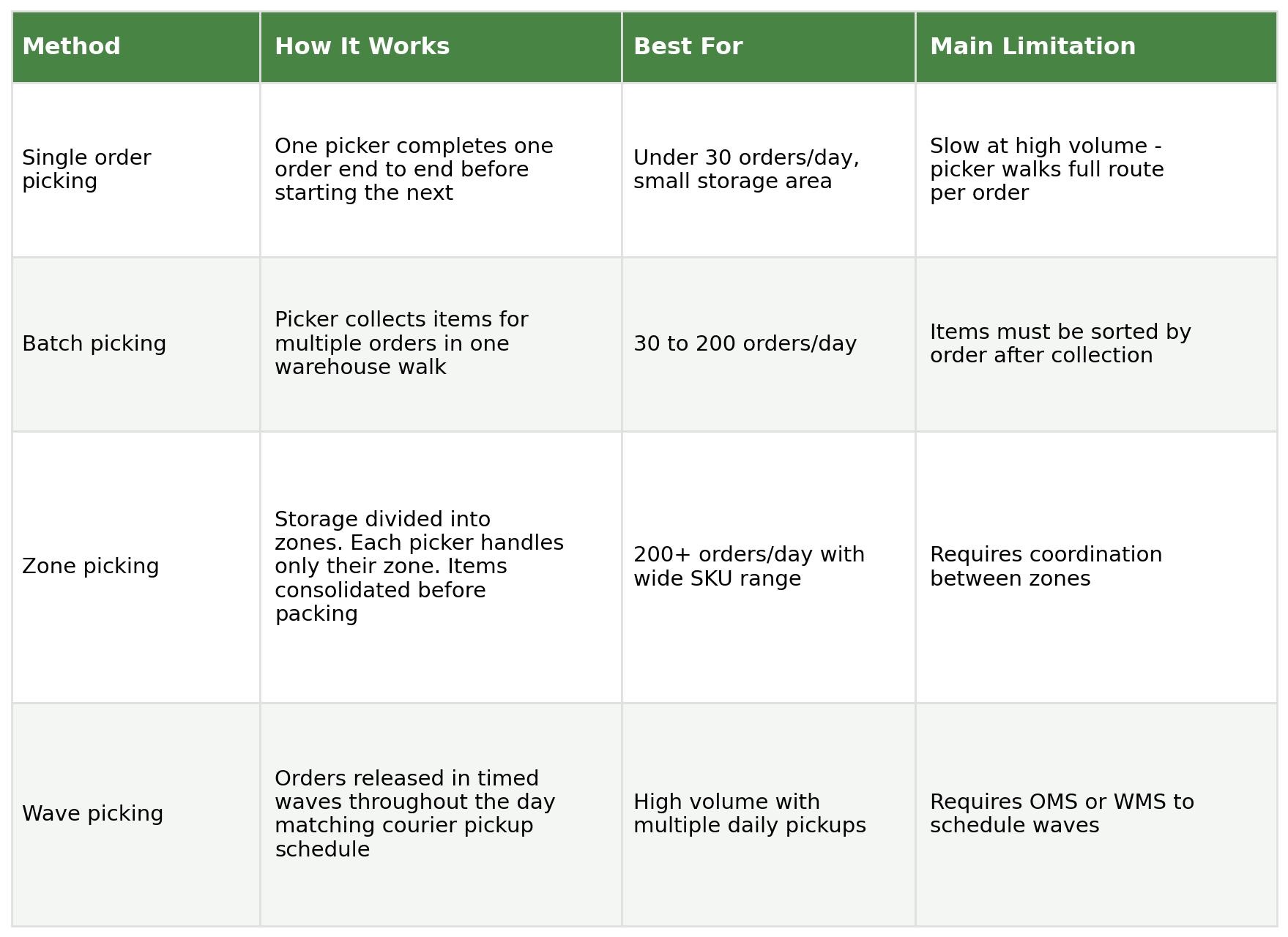
Most Indian businesses at 20 to 150 daily orders operate best with batch picking. One picker collects items for 10 to 15 orders per warehouse walk, then sorts at the packing table. This reduces the travel time that makes single order picking slow without the coordination complexity of zone picking.
The 6 Most Common Pick and Pack Bottlenecks
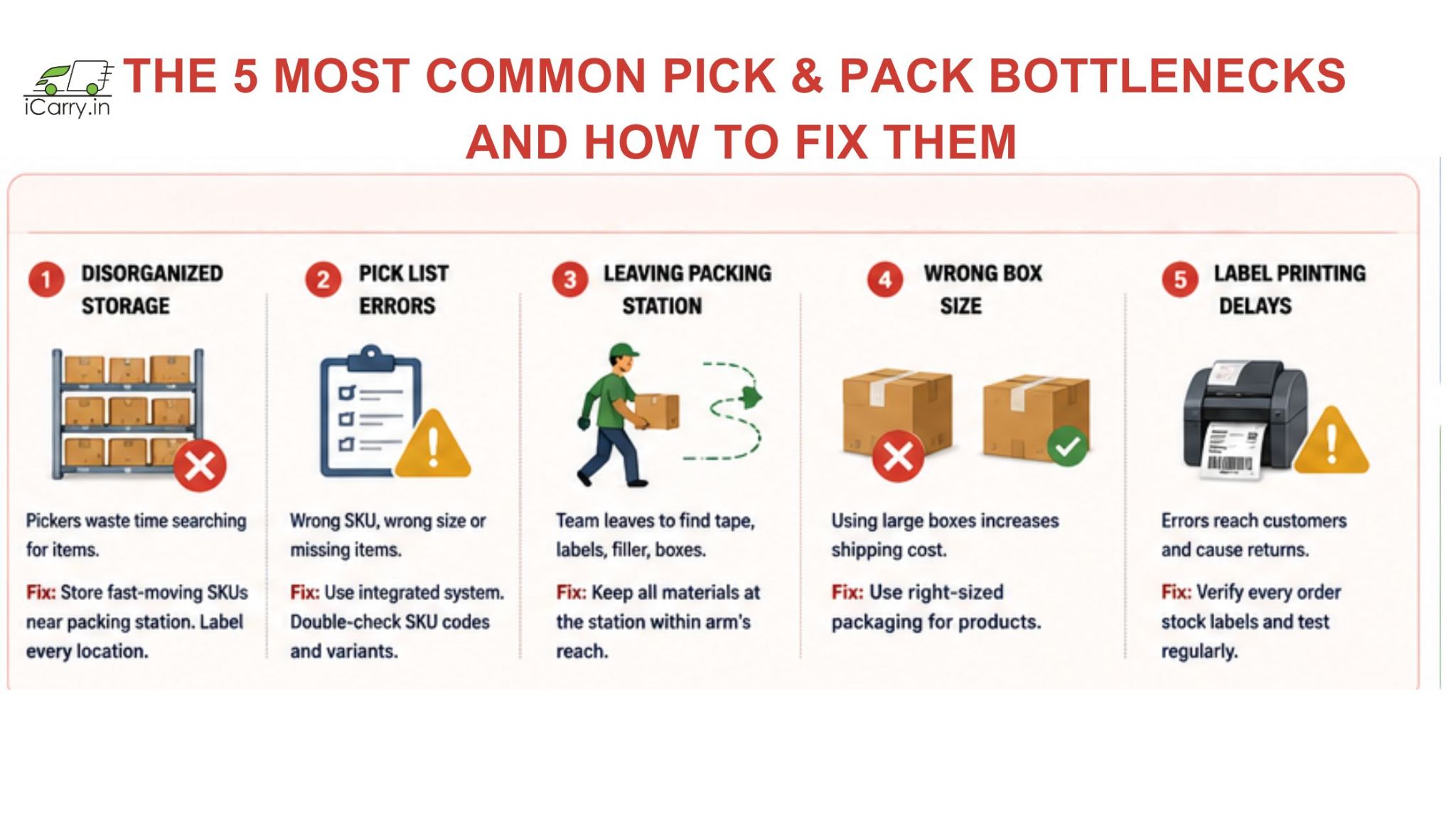
1. Disorganised Storage
The most consistent time waster. If fast-moving SKUs are stored at the back of the warehouse, pickers walk the full storage area for every order. If storage locations are not labelled, pickers search instead of retrieve.
Fix: Map your top 20 SKUs by monthly order volume. Store them nearest the packing station. Label every storage location with SKU code and product name. Review and reorganise quarterly as product velocity changes.
2. Pick List Errors
When pick lists are generated manually or from an unintegrated system, SKU codes get transposed, size variants get confused, and multi-item orders get incomplete picks. The error only surfaces when the customer reports the wrong item - by which point the order has shipped, been delivered, and a return has been initiated.
Fix: Connect your order management system directly to your shipping platform so pick lists are generated from the actual order data. Add a verification step - scan or read the product label - before every item goes into a box.
3. Packer Leaving the Station
A packer who has to leave the packing station to find tape, bubble wrap, the right box size, or a pen to write an address loses 2 to 5 minutes per interruption. At 150 orders per day, if this happens on 30% of orders, that is 90 to 225 minutes of dead time daily.
Fix: Set up the packing station once, properly. Everything within arm's reach: tape dispenser, 2 to 3 box sizes, poly mailers, bubble wrap, scissors, void fill, pens, and the label printer. Replenish at the start of each day before packing begins - not during.
4. Wrong Box Size
Packing a 200g product into a 30 x 25 x 20 cm box because the right size was not available inflates the volumetric weight and increases the courier charge by ₹30 to ₹60 per order. At scale, this is a significant monthly cost that appears nowhere as a named line item.
Fix: Stock 2 to 3 standard box sizes that fit your most common product categories. Order in sufficient quantity. Make right-sizing a non-negotiable step - packers must use the smallest box that adequately protects the product.
Right-sizing the box only pays off if you're also comparing rates - iCarry®'s rate comparison at booking checks the volumetric weight against every courier before you confirm.
5. Label Printing Delays
A label printer that is shared, slow, or running low on labels creates a queue at the end of the packing process that delays dispatch even when the packing itself is done.
Fix: Dedicate one label printer to the dispatch station. Print all labels for the day's orders in bulk at the start of the day if possible. Keep at least one full roll of label stock as backup. Watch how to print shipment labels and manifests in iCarry® for a walkthrough of bulk label printing.
6. No Pre-Dispatch Verification
Packing without verifying the item against the order is the primary cause of wrong-item dispatches. Wrong items generate returns, refund requests, and negative reviews - all costing far more than the 10 seconds a verification step takes per order.
Fix: Before sealing any parcel, the packer reads the order details and confirms the item, size, colour, and quantity match. For businesses using barcode scanning, scan the product barcode against the order at this step. A visual check on small operations is sufficient - the key is that it happens consistently, not that it uses technology.
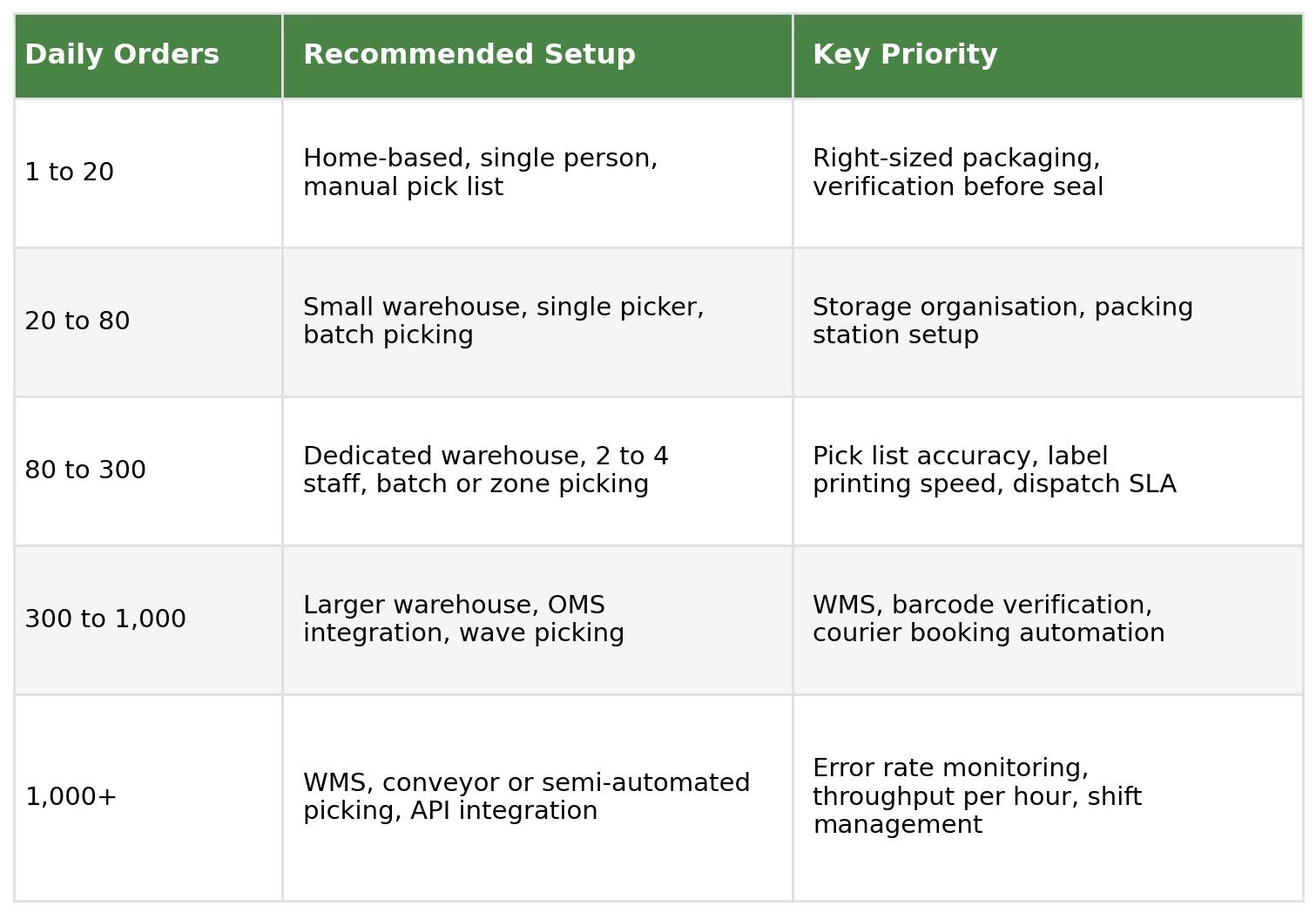
Pick and Pack at Different Business Scales
How iCarry® Connects to Your Pick and Pack Operation
iCarry® is a courier aggregator that connects directly to the dispatch end of your pick and pack process - the moment a sealed, labelled parcel is ready to ship.
- Store integration: Connect Shopify, WooCommerce, Flipkart, or other platforms so orders sync automatically. No manual entry - the order data flows from your store to iCarry® and generates the booking and label
- Bulk booking: Book all of the day's orders in one session - not one at a time. Dramatically reduces the time between pack-complete and courier handover
- Label and manifest printing: Print all shipping labels and the courier manifest in one step from the iCarry® dashboard. Labels go on boxes, manifest goes with the courier
- Rate comparison: Before bulk booking, compare rates across multiple couriers for each order's specific weight and destination. Ensures every packed parcel ships at the best available rate
- Address Quality Scoring: Pre-dispatch address validation flags risky addresses before labels are printed - preventing a sealed, labelled parcel being dispatched to an address that will fail delivery
The tighter your pick and pack process, the more value an integrated shipping platform adds at the dispatch end. Reducing shipping cost starts at the packing table with right-sized boxes, and continues through the courier booking with rate comparison before every shipment..
Final Thoughts
Pick and pack is not glamorous logistics. It is boxes, tape, labels, and people moving items from shelves to parcels. But it is where orders become deliveries - and every delay, error, or inefficiency at this step has a direct cost: a late shipment, a wrong-item return, a courier pickup missed, or a parcel that costs ₹40 more than it should because the box was the wrong size.
The businesses that run tight pick and pack operations do not necessarily use expensive technology. They use organised storage, a properly equipped packing station, batch picking, verification before sealing, and a label printer that works. These are not investments - they are disciplines.
Build the discipline before the volume forces you to. A pick and pack process that works at 50 orders per day, built correctly, scales to 500 with the addition of people and space - not a complete redesign.
Frequently Asked Questions (FAQs)
What is pick and pack in logistics?
Pick and pack is the warehouse process of selecting the correct items for a customer order from storage (picking) and preparing them for shipment (packing). It covers the complete sequence from receiving an order to handing a labelled, sealed parcel to the courier.
What is the difference between picking and packing?
Picking is the act of collecting the correct items from storage locations based on the order details. Packing is placing those items into appropriate packaging, adding void fill if needed, inserting an invoice or packing slip, sealing the parcel, and applying the shipping label. Both happen in sequence for every order.
What is batch picking and when should I use it?
Batch picking is collecting items for multiple orders in a single warehouse walk, then sorting them by order at the packing station. It is significantly more efficient than single-order picking for businesses processing 30 to 200 daily orders because it reduces the total travel distance in the warehouse. At higher volumes, zone picking or wave picking become more appropriate.
How do I reduce wrong-item errors in pick and pack?
Add a verification step before sealing every parcel - read or scan the product against the order details to confirm item, size, colour, and quantity match. Connect your order system to your shipping platform so pick lists are generated from actual order data rather than manually created. Verify before you seal, not after.
How does right-sized packaging reduce shipping cost?
Indian couriers bill based on whichever is higher - actual weight or volumetric weight (L x B x H in cm / 5,000). An oversized box inflates volumetric weight and increases the courier charge by ₹30 to ₹60 per order regardless of the product's actual weight. Using the smallest box that adequately protects the product eliminates this avoidable cost on every single order.
How does iCarry® integrate with pick and pack operations?
iCarry® connects to your store (Shopify, WooCommerce, Flipkart, and others) to sync orders automatically - eliminating manual booking entry. Bulk booking allows all of the day's packed orders to be booked in one action. Labels and manifests print from one screen. Address Quality Scoring flags risky addresses before labels are printed.
Pick and pack is not glamorous logistics - it is boxes, tape, labels, and people moving items from shelves to parcels, but every delay or error at this step has a direct cost. The businesses that run tight pick and pack operations do not necessarily use expensive technology - they use organised storage, a properly equipped packing station, batch picking, verification before sealing, and a label printer that works. Build the discipline before the volume forces you to.