A food brand dispatches 300 units of a health snack. Customs flags the consignment at a state border check: the FSSAI licence number is missing from the product label. The shipment is held. 300 units sit in a warehouse for four days. The business loses the sale window, pays storage charges, and still has to relabel every unit before the goods can move.
Product labelling compliance is one of the most consistently underestimated requirements in Indian commerce. For businesses shipping food, health, beauty, or regulated goods - getting the label right is not optional and not something that can be fixed after the consignment has left your warehouse.
India's labelling requirements span multiple regulators - the Food Safety and Standards Authority of India (FSSAI) for food products, the Central Drugs Standard Control Organisation (CDSCO) for drugs and cosmetics, the Legal Metrology Act for packaged commodities, and GST requirements for invoicing. Each regulator has its own mandatory fields, and non-compliance with any one of them can result in held shipments, product recalls, penalties, or rejection at the point of sale.
This guide covers what every Indian business shipping physical products needs to know about labelling compliance - by product category, by regulation, and by what to check before dispatch.
What Are India's Labelling Requirements for Shipped Products?
Labelling requirements for products shipped in India are the mandatory fields a regulator requires on a product's packaging or accompanying invoice before it can legally be sold or moved. Depending on what you sell, this means complying with FSSAI (food), CDSCO (drugs and cosmetics), the Legal Metrology Act (packaged commodities and MRP), and GST invoicing rules - often more than one at the same time. Missing a required field, such as an FSSAI licence number or a GST-inclusive MRP, is the most common reason a shipment gets held at a state check post or rejected by a marketplace.
How to Check Before You Ship Any Labelled Product
- Is your product label compliant with the relevant regulator (FSSAI, CDSCO, Legal Metrology)?
- Does the label include the mandatory MRP with GST-inclusive price where required?
- Is the manufacturer name and address on the label accurate and matching your registration?
- Is batch number, manufacturing date, and expiry date present for regulated products?
- Is the FSSAI licence number, CDSCO licence number, or other regulatory number present where required?
- Is the label language compliant - Hindi plus English, or local language requirements met?
- Does your shipping invoice include HSN code and correct GST rate for the product?
Why Labelling Compliance Matters for Shipments
Labels serve two distinct purposes in shipping: they help the product get to the customer correctly, and they demonstrate regulatory compliance at every point the product passes through.
For domestic shipments, a product with a non-compliant label can be seized at state check posts, rejected by organised retailers, or flagged by marketplace quality checks. For exports, incorrect labels can trigger customs holds at the destination country - with the seller liable for storage and demurrage charges.
The practical impact is always the same: delayed delivery, additional cost, and a customer who did not receive their order on time.
Category 1: GST and Invoice Labelling for All Shipments
Every commercial shipment within India requires a GST-compliant tax invoice if the seller is GST registered. While this is an invoice requirement rather than a product label requirement, it directly affects what appears on the shipping label and the documentation travelling with the goods.
Mandatory Fields on a GST Invoice for Shipments
Seller's legal name, address, and GSTIN
Buyer's legal name, address, and GSTIN (for B2B transactions)
Invoice number and date
HSN code for each product line item
Product description (specific, not generic)
Quantity and unit of measure
Taxable value, GST rate, and GST amount (split as CGST/SGST for intrastate or IGST for interstate)
Total invoice value inclusive of GST
The HSN code on your invoice must match the product's actual classification. Misclassified HSN codes create GST audit exposure and may result in demand notices. Understanding GST on shipping charges covers how shipping charges are treated separately from product GST on the same invoice.
E-Way Bill Requirements
An e-way bill is required for movement of goods valued above ₹50,000 within India. The e-way bill must be generated before the goods leave the premises and must travel with the consignment. The e-way bill number must match the invoice - discrepancies at check posts result in held shipments.
E-way bills are generated on the GST portal and are linked to the invoice, vehicle number, transporter ID, and delivery address. For courier shipments, most courier aggregators and direct couriers handle e-way bill generation as part of the booking process - but the responsibility for accuracy of the underlying details (declared value, HSN, delivery address) remains with the shipper.
Category 2: Legal Metrology - Packaged Commodities Labelling
The Legal Metrology (Packaged Commodities) Rules govern labelling for most pre-packaged consumer products sold in India. This covers a wide range of products - food, cosmetics, textiles, hardware, electronics, and more.
Mandatory Fields Under Legal Metrology
Manufacturer / packer name and address: Full legal name and complete address of the entity responsible for the product
Net quantity: Weight, volume, or count as applicable. Must use standard metric units
MRP (Maximum Retail Price): Must be printed as 'MRP ₹[amount] incl. of all taxes'. MRP must be GST-inclusive. No product can be sold above the printed MRP
Month and year of manufacture or packing: For food products, also includes best before / expiry date
Customer care contact: Phone number or address for consumer complaints
Country of origin: 'Made in India' or equivalent

Category 3: FSSAI Labelling for Food Products
The Food Safety and Standards Authority of India (FSSAI) regulates all food products sold in India - including health supplements, packaged snacks, beverages, spices, condiments, dairy, and any food sold commercially.
Mandatory FSSAI Label Fields
FSSAI licence or registration number: 14-digit number prominently displayed. This is the most commonly missing field and the most frequently flagged in compliance checks
Product name: Common and generic name of the food
Ingredients list: In descending order of weight. All additives must be declared with their International Numbering System (INS) code or name
Nutritional information per 100g / 100ml: Energy, protein, carbohydrates, fat, sugar, dietary fibre, sodium
Allergen declaration: Must declare if product contains or may contain any of the 8 major allergens: peanuts, tree nuts, milk, eggs, wheat, soya, fish, shellfish
Net quantity: Weight or volume in standard metric units
Manufacturing / packing date and best before date: In dd/mm/yyyy format or month and year format
Manufacturer / packer name and address: Full name and complete address
MRP inclusive of all taxes: For consumer retail packs
Batch or lot number: For traceability in case of recall
FSSAI Labelling for Health Supplements and Nutraceuticals
Products marketed as health supplements, nutraceuticals, or functional foods have additional requirements: the label must include a statement that the product is not intended to diagnose, treat, cure, or prevent any disease. Marketing claims must be approved and evidence-based. The word 'natural' or 'organic' requires specific certification.
Imported Food Products
Imported food products require a separate FSSAI licence for import and must be relabelled in India if the original label does not comply with FSSAI requirements. All mandatory fields must appear in English (and Hindi for products in certain categories).
Category 4: CDSCO Labelling for Cosmetics and Drugs
Cosmetics and drugs in India are regulated under the Drugs and Cosmetics Act, 1940, and the associated rules administered by CDSCO.
Cosmetics Labelling Requirements
Product name: Name of the cosmetic as registered or licensed
Ingredients list: In descending order of concentration. International Nomenclature of Cosmetic Ingredients (INCI) names preferred
Manufacturer name and address: Full legal details of the licensed manufacturer
Net content: Weight or volume
Batch number: For traceability
Manufacturing date and expiry date (or Period After Opening - PAO): PAO symbol (open jar icon with number of months) acceptable for products with shelf life above 30 months
CDSCO licence number: Where applicable for the product category
Warnings and usage instructions: Any safety warnings relevant to the product - for eye products, skin products with active ingredients, hair dye
OTC Drugs and Medicines
Over-the-counter drugs have stricter requirements including approved dosage information, active ingredient declaration by percentage, contraindications, side effects, drug interaction warnings, and a mandatory 'Not for medical advice' or equivalent statement. Prescription-only drugs require additional documentation and cannot be commercially shipped without proper authorisation.
Labelling for Marketplace and D2C Shipments
For businesses selling through marketplaces (Flipkart, Amazon, Myntra) or directly via their own store, product label compliance is the seller's responsibility - not the platform's. Marketplace quality teams conduct periodic compliance checks, and products found non-compliant are delisted without notice.
For D2C shipments, the product label must comply with all applicable regulations before the product leaves your warehouse. There is no relabelling opportunity at the marketplace's fulfilment centre or at the customer's doorstep.

Common Labelling Mistakes That Delay Shipments
Missing FSSAI licence number: The most common compliance gap for food brands. Always print the 14-digit number prominently on primary packaging
MRP without GST inclusion: MRP must be printed as inclusive of all taxes. 'MRP ₹299 excl. GST' is non-compliant
Vague product description: 'Herbal product' or 'wellness supplement' without specific ingredient and category classification creates compliance risk at multiple levels
Wrong or missing HSN code on invoice: The HSN code on the shipping invoice and the product classification must be consistent and correct
Label not in required language: Most regulated categories require English plus Hindi on labels for consumer products. Export labels must comply with destination country language requirements
Expiry date format incorrect: FSSAI requires dd/mm/yyyy or month-year format. 'Best by 06/26' is ambiguous and non-compliant
Allergen declaration missing: Even trace amounts of major allergens must be declared. 'May contain nuts' must appear if production shared equipment is used
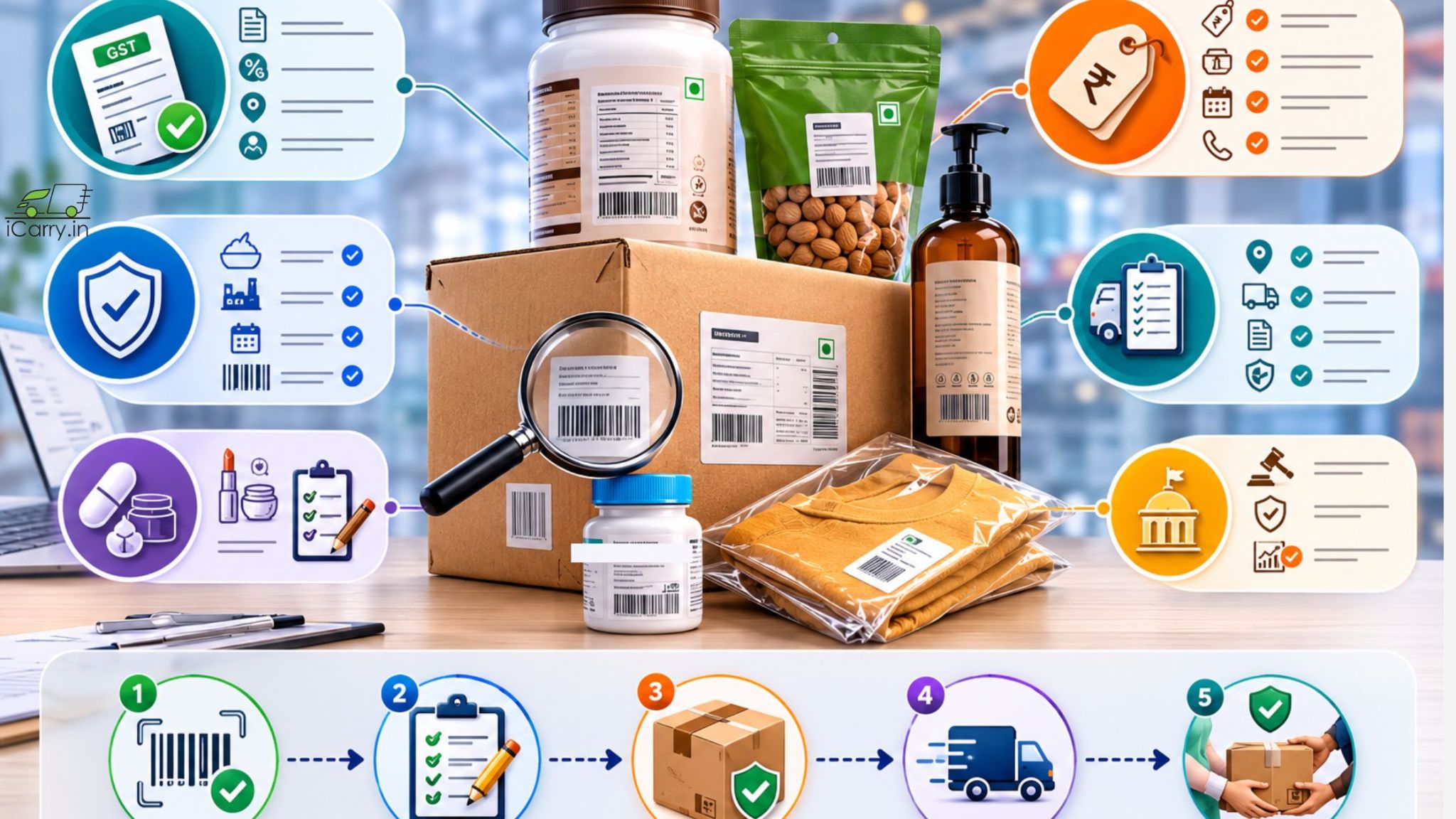
Shipping Label vs Product Label - Two Separate Things
The shipping label (the courier label on the outer parcel) and the product label (on the product itself) are two different compliance areas that are often confused.

All four must be present and correct for a compliant commercial shipment. Missing any one can result in delays or held consignments at different points in the delivery chain.
How iCarry® Supports Compliant Shipping
iCarry® is a courier aggregator that supports Indian businesses with the shipping leg of their logistics - but label compliance on the product itself always remains the seller's responsibility. What iCarry® provides that supports the overall compliance picture:
GST-compliant invoicing: Every iCarry® invoice shows freight charges with correct HSN code and 18% GST separately for ITC filing
Declared value at booking: Accurate declared value at booking ensures e-way bill triggers and insurance coverage are correctly activated
Address Quality Scoring: Pre-dispatch address validation prevents dispatch errors that lead to held or returned consignments on delivery
Multiple courier partners: Different couriers have different handling capabilities for regulated product categories. Matching your product type to the right courier reduces damage and handling compliance risk
Weight discrepancy management: Pre-upload product images per SKU to automatically dispute discrepancy charges within the 5-day window
Watch How to Estimate Shipment Cost to see how product category, declared value, and weight are entered at booking - each of which ties back to your labelling and invoicing compliance.
iCarry® serves all Indian businesses - from food brands navigating FSSAI compliance to pharmaceutical distributors managing CDSCO requirements. Free Bronze plan with no minimum volume.
Final Thoughts
Product labelling compliance in India is not one regulation - it is several, applied simultaneously depending on what you sell. A packaged food product must comply with FSSAI, Legal Metrology, and GST invoice requirements at the same time. A cosmetic must comply with CDSCO and Legal Metrology. Every regulated product must have a compliant invoice and e-way bill where applicable.
The cost of non-compliance is always higher than the cost of getting it right upfront. A relabelling exercise at a warehouse, a held consignment at a state check post, a marketplace delisting, or a regulatory penalty all cost more in time and money than the original investment in compliant labels.
Audit your product labels against the applicable regulator's requirements before your first shipment. Then build a pre-dispatch checklist that verifies label compliance on every batch before it leaves your warehouse. It takes five minutes. It prevents problems that can take five days to resolve.
Frequently Asked Questions (FAQs)
Is an FSSAI licence number mandatory on food product labels in India?
Yes. All food businesses selling packaged food products in India must display their 14-digit FSSAI licence or registration number prominently on the product label. This applies to all packaged food categories. Operating without a valid FSSAI number on the label is a compliance violation that can result in product seizure and penalties. Apply for registration or licence at FSSAI's portal.
What is MRP and must it be inclusive of GST?
MRP (Maximum Retail Price) is the maximum price at which a pre-packaged product can be sold to the end consumer in India. Under the Legal Metrology Act, MRP must be printed on the label as inclusive of all taxes. Printing MRP excluding GST is non-compliant. The format is: 'MRP ₹[amount] incl. of all taxes'.
What is the difference between FSSAI and CDSCO labelling requirements?
FSSAI regulates food products, beverages, health supplements, and food additives. CDSCO regulates drugs, cosmetics, and medical devices. Both have separate licence number requirements, ingredient declaration formats, and compliance standards. A product that is both a food and a cosmetic (such as an edible lip balm) may require compliance with both regulators. Verify at CDSCO's portal.
When is an e-way bill required for shipping in India?
An e-way bill is required for movement of goods valued above ₹50,000 within India. It must be generated before the goods leave the premises of dispatch and must travel with the consignment. The e-way bill is linked to the GST invoice and must match the declared value, HSN code, and consignee address exactly.
What happens if a product label is non-compliant during shipment?
At state check posts for domestic shipments, non-compliant products can be held pending documentation. Organised retailers and marketplace platforms reject non-compliant products at receiving. For exports, customs at the destination country may hold or return the shipment. Regulatory inspectors can seize non-compliant goods and impose penalties on the manufacturer or seller.
Do shipping labels and product labels have different requirements?
Yes. The shipping label (courier AWB on the outer parcel) is generated by the courier and contains delivery and tracking information. The product label is the manufacturer's label on the product itself and must comply with FSSAI, CDSCO, or Legal Metrology requirements as applicable. Both must be present and correct - one does not substitute for the other.
Product labelling compliance in India spans multiple regulators simultaneously depending on what you sell - FSSAI for food, CDSCO for drugs and cosmetics, the Legal Metrology Act for packaged commodities and MRP, and GST requirements for invoicing - with a missing FSSAI licence number or a non-GST-inclusive MRP being the most common reasons shipments get held at state check posts or rejected by marketplaces. The cost of non-compliance - relabelling, held consignments, delisting, or penalties - always exceeds the cost of getting it right upfront, making a five-minute pre-dispatch label audit one of the highest-value habits a shipping business can build.