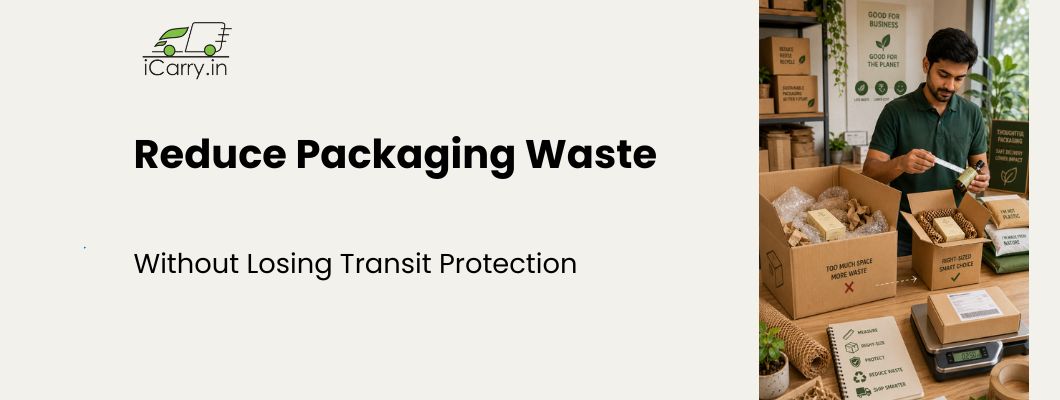
A D2C skincare brand ships 300 orders a day. Each order uses a 25 x 20 x 15 cm box regardless of the product size. The average product fits in a 15 x 12 x 8 cm box. The gap: ₹18 to ₹28 extra in volumetric weight billing per order. At 300 daily orders: ₹5,400 to ₹8,400 in avoidable courier cost per day.
The over-packaging is not just environmentally wasteful. It is financially wasteful. And these two problems - environmental impact and excess cost - have exactly the same solution: right-sized, efficient packaging.
India generates over 3.4 million tonnes of plastic waste annually, a significant portion from eCommerce packaging. As Indian regulatory and consumer pressure on sustainable packaging grows, reducing packaging waste is increasingly both a commercial imperative and a brand positioning decision. Businesses that figure out how to protect products with less material ship more profitably, generate less waste, and increasingly attract the segment of Indian consumers who factor sustainability into purchase decisions.
This guide shows exactly how to reduce packaging waste without compromising product protection.
What Counts as Over-Packaging?
Over-packaging is any box, void fill, or wrapping layer that is larger or thicker than what the product needs to survive transit intact. It shows up as a bigger box than the item requires, excess void fill compensating for that extra space, or protective layers stacked past the point of added benefit. The result is higher material cost, higher volumetric weight billing, and more waste for the customer to dispose of - without any corresponding gain in product protection.
The Business Case for Reducing Packaging Waste
Sustainable packaging is often framed as an ethical choice. For Indian businesses, the financial case is equally compelling - and more immediately persuasive:
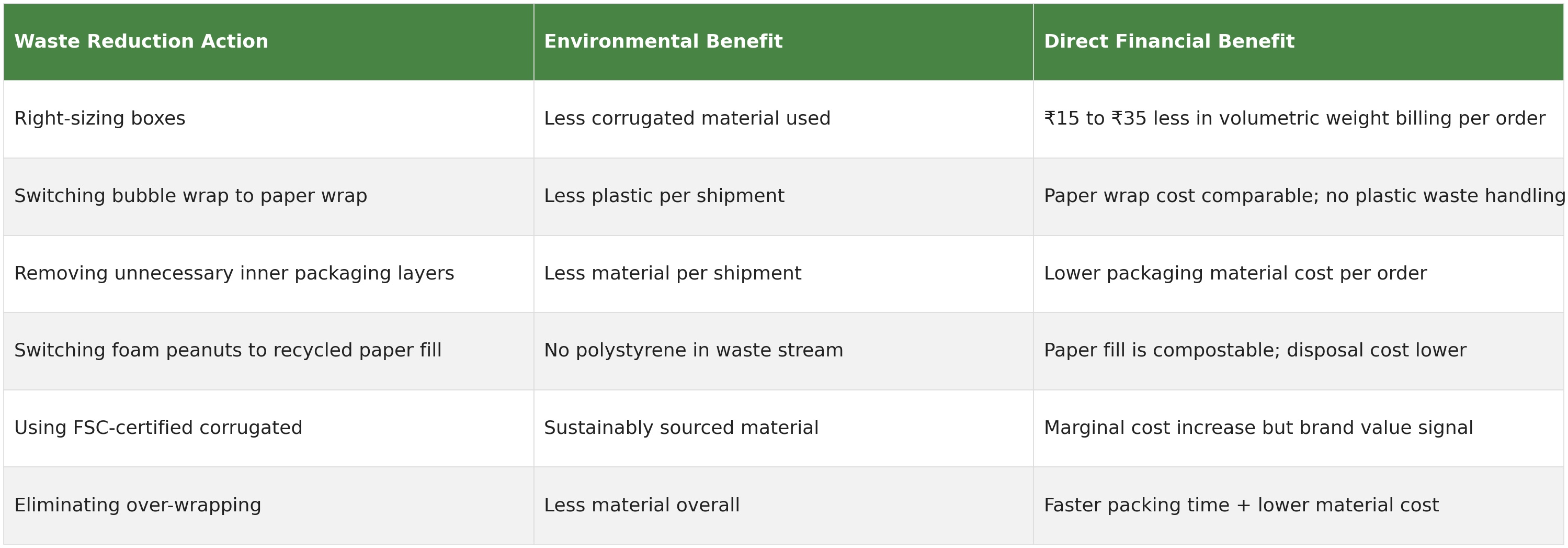
The financial and environmental benefits align almost perfectly. Waste reduction is margin improvement. Businesses that treat them as separate initiatives are making both harder.
The Over-Packaging Problem in Indian eCommerce
Over-packaging in Indian eCommerce happens in three consistent patterns:
Pattern 1: Wrong Box Size
The most common and most costly. A standard box is used for all SKUs regardless of product dimensions. A 50g lip balm in a 20 x 15 x 10 cm box has a 600g volumetric weight on a 50g product.
The fix: Create a box size reference for every SKU. Three to four standard box sizes covering your full product range is typically sufficient. Train packers to use the smallest box that allows 3 cm of cushioning on all sides. The financial saving pays for the investment in additional box sizes within days.
Pattern 2: Excessive Void Fill
Void fill is necessary to prevent product movement during transit. But crumpled newspaper, foam peanuts, and bubble wrap used beyond what is needed to immobilise the product is pure waste - material, cost, and disposal burden for the customer.
The fix: Right-size the box first (Pattern 1). A correctly sized box needs far less void fill because the gap between product and box wall is smaller. Void fill is compensating for an oversized box in most cases.
Pattern 3: Unnecessary Multiple Layers
Products that are individually wrapped in plastic, then placed in a branded inner box, then wrapped in tissue, then boxed in corrugated, then filled with bubble wrap. Each layer is applied without questioning whether the previous layer already provides sufficient protection.
The fix: Audit each product's packaging layers. Ask: what transit failure does this layer prevent? If the answer is 'the previous layer already prevents it', remove the redundant layer. The minimum packaging that delivers the product intact and maintains the unboxing experience is the right amount.
Sustainable Alternatives to Common Packaging Materials
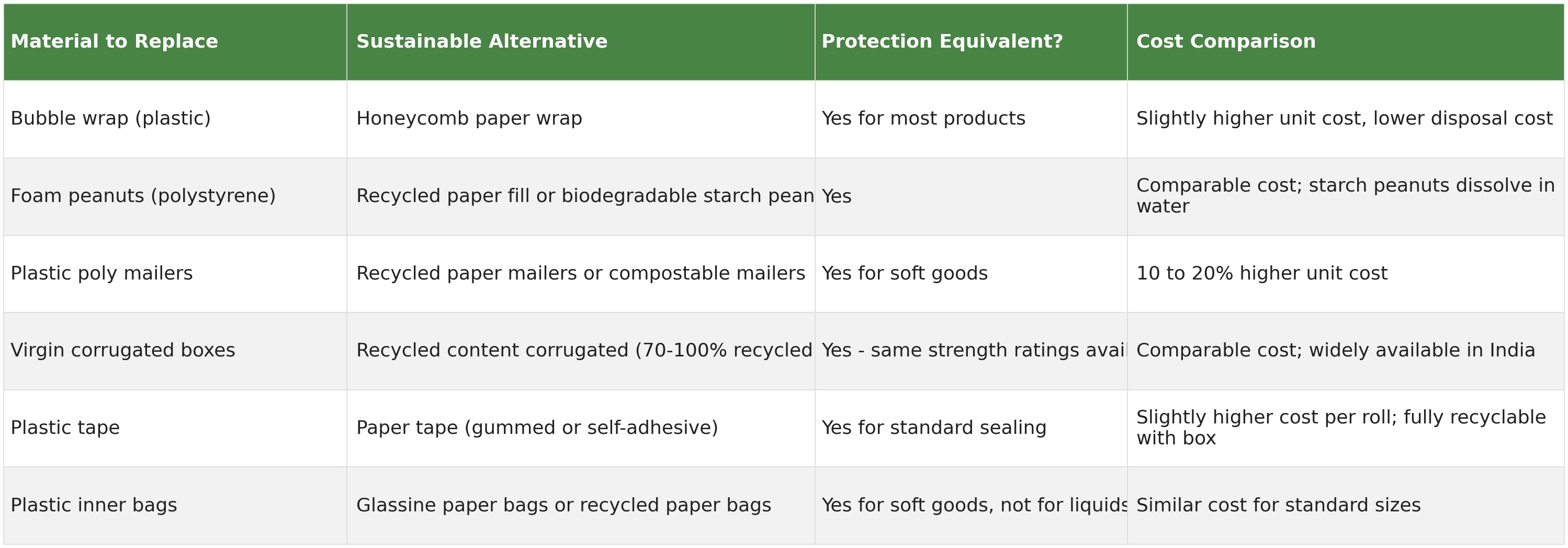
India sourcing note: Honeycomb paper wrap, compostable mailers, and recycled corrugated are increasingly available from Indian suppliers. Research local manufacturers in Delhi NCR, Mumbai, and Bengaluru for the best rates on sustainable alternatives - import sourcing adds cost and transit time that often outweigh the sustainability benefit.
Right-Sizing: The Highest Impact Single Change
Right-sizing packaging - using the smallest box or mailer that adequately protects the product - is the single highest-impact packaging waste reduction action available to Indian businesses. It simultaneously reduces material use, reduces volumetric weight billing, and often reduces packing time. Volumetric weight penalties from oversized boxes are a consistent margin leak that right-sizing eliminates completely.
How to Right-Size Your Packaging
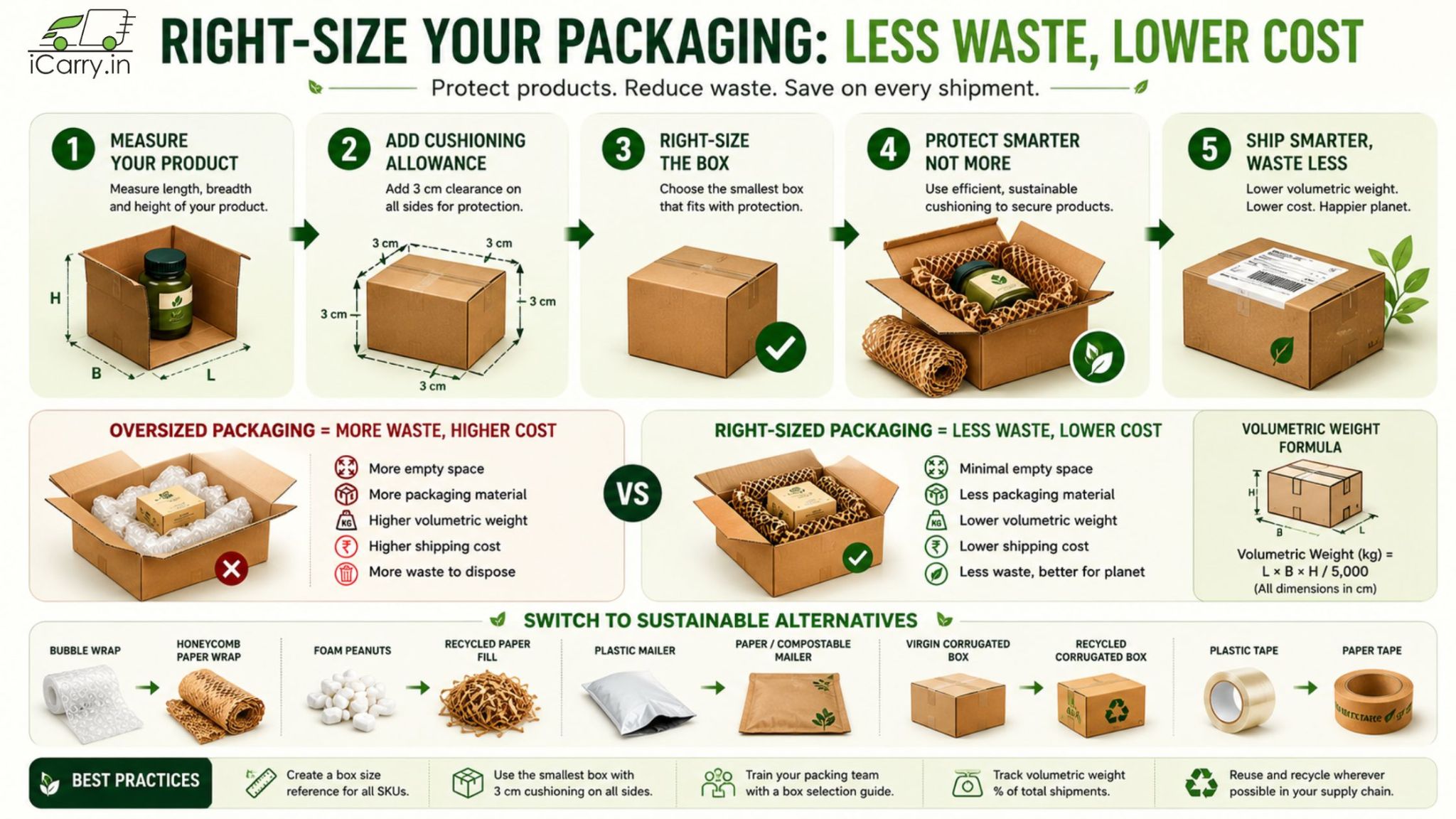
- Step 1 - Measure every SKU: Length, breadth, height of the product in its natural orientation. For products with irregular shapes, measure the bounding box dimensions
- Step 2 - Add cushioning allowance: Add 3 cm to each dimension for adequate cushioning. This is your target box inner dimension
- Step 3 - Match to your box range: Identify the smallest standard box in your range that meets the target inner dimension. If no box is close enough, add a new size to your range
- Step 4 - Calculate volumetric weight: L x B x H (cm) / 5,000 for the right-sized box vs the current box. The billing difference is your per-order saving - iCarry®'s rate comparison screen runs this calculation automatically for both box dimensions before you book, so you can see the saving without doing the math by hand
- Step 5 - Create a SKU-to-box reference card: Post at every packing station. Packers select box by reference, not intuition
For poly mailers: Many products shipped in corrugated can safely ship in poly mailers or paper mailers at a fraction of the packaging cost and volumetric weight. Soft goods, non-breakable apparel, flat accessories, and lightweight non-fragile items are candidates. Test one SKU for one month and measure the damage rate against the corrugated baseline.
The Customer Communication Angle
Many Indian D2C brands have found that communicating their sustainable packaging choice - on the box itself, in the order confirmation, or with a small insert - generates positive customer response.
- Simple box messaging: 'This box is made from 100% recycled content. Please reuse or recycle.' Zero cost to print. Positive brand signal to the 30 to 40% of Indian consumers who factor sustainability into brand preference
- Order confirmation messaging: 'We have right-sized your packaging to reduce waste. The smaller box also means less paper in landfill.'
- QR code to sustainability page: A QR code on the packaging that links to your brand's sustainability commitments - packaging materials, carbon offset, recycled content percentages - costs nothing but a sticker and builds brand perception
Sustainable packaging that is not communicated generates no brand benefit. Communicate it without overstating - 'we use recycled content corrugated' is specific and honest. 'We are committed to the planet' is vague and unconvincing.
What Over-Packaging Actually Costs Your Business
Model the true cost of your current packaging versus right-sized sustainable alternatives:
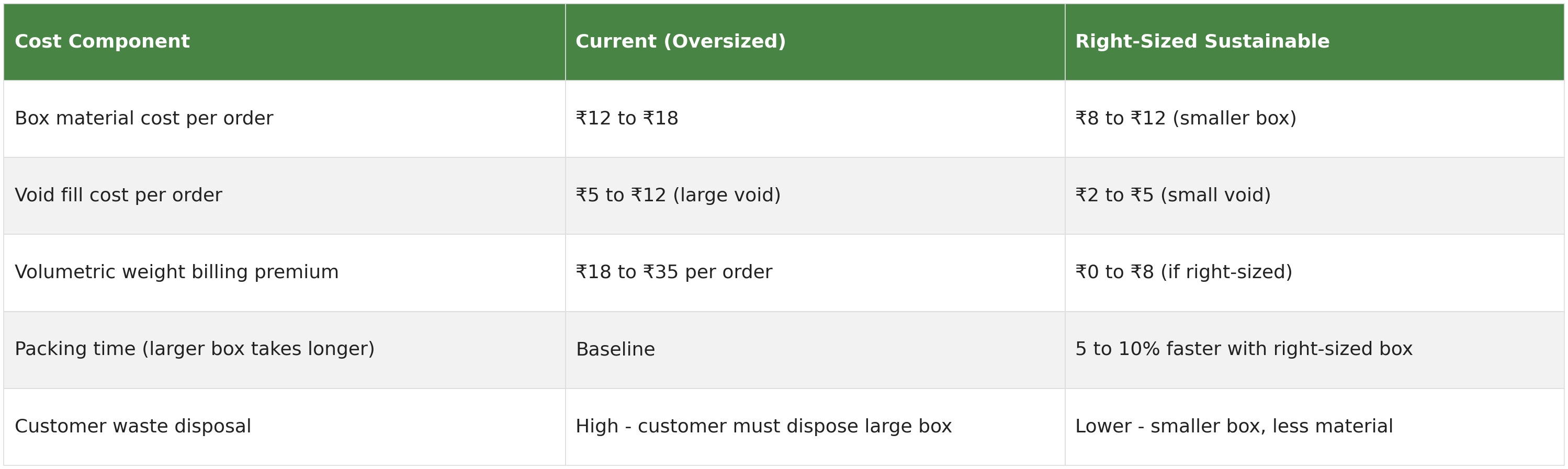
At 300 daily orders, the gap between the two columns is ₹25 to ₹50 per order in combined material cost and volumetric billing savings. That is ₹7,500 to ₹15,000 per day - ₹22.5 lakh to ₹45 lakh per year - from packaging right-sizing alone.
Indian Regulatory Context for Packaging
India's Plastic Waste Management Rules (amended 2022) have specific provisions relevant to eCommerce packaging:Under the Extended Producer Responsibility guidelines that anchor these rules, around 207 lakh tonnes of plastic packaging waste has been recycled nationally since the guidelines took effect in 2022 , per the Ministry of Environment, Forest and Climate Change - a scale that signals both the compliance direction and the recycling infrastructure now available to businesses that switch materials.
- Single-use plastics below specified thickness are prohibited for use as packaging
- Extended Producer Responsibility (EPR) obligations apply to businesses using plastic packaging above specified thresholds
- Plastic packaging must carry recycling symbols and material identification codes
- Compostable plastics must meet IS 17088 standards to be marketed as compostable
While compliance timelines and enforcement vary, the regulatory direction is clear: plastic packaging use in Indian commerce will face increasing restrictions. Businesses that transition proactively build the supply chain relationships and packing habits now that will be mandatory later.
How iCarry® Supports Sustainable Packaging Decisions
iCarry® is a courier aggregator that gives Indian businesses the rate visibility to make right-sizing financially obvious:
- Live rate comparison: Compare shipping rates across couriers at your right-sized box dimensions versus your current oversized dimensions before booking. The billing difference at your actual daily volume quantifies the right-sizing saving instantly. Estimate shipment cost for any box size before committing
- Weight and dimension declaration: Enter actual sealed parcel dimensions at booking. Accurate dimensions prevent both over-billing (from declared-too-large) and discrepancy charges (from declared-too-small)
- Discrepancy management: When couriers raise weight discrepancy charges - which happens when actual packaged dimensions differ from declared - the 5-day dispute window in iCarry®'s dashboard allows evidence-based disputes
- Multiple courier access: Some couriers have better dimensional weight policies than others. Rate comparison across couriers includes all surcharges and allows selection of the most efficient option for your specific packaging dimensions
- Free Bronze plan, no minimum volume.
Final Thoughts
Reducing packaging waste and reducing packaging cost are the same action. Right-sizing eliminates volumetric weight billing. Sustainable void fill costs no more than plastic foam. Recycled corrugated performs identically to virgin corrugated. The business case and the environmental case point in exactly the same direction.
Start with right-sizing - it delivers the largest financial return with the least operational disruption. Then audit void fill materials. Then evaluate sustainable alternatives for each packaging component category by category.
The businesses that do this work - measuring, trialling, replacing - end up with packaging operations that are cheaper to run, generate less waste, and increasingly resonate with the Indian consumer who is factoring sustainability into brand preference at a growing rate.
Frequently Asked Questions (FAQs)
What is the single most impactful packaging waste reduction action for Indian businesses?
Right-sizing - using the smallest box or mailer that adequately protects the product. Oversized boxes waste corrugated material and create volumetric weight billing penalties that increase courier cost by ₹15 to ₹35 per order. Right-sizing eliminates both problems simultaneously. At 300 daily orders, right-sizing alone typically saves ₹7,500 to ₹15,000 per day in combined material and freight costs.
Can sustainable packaging provide the same transit protection as conventional packaging?
Yes, in virtually all categories. Honeycomb paper wrap provides equivalent cushioning to bubble wrap for most products. Recycled content corrugated (70 to 100% recycled fibre) performs identically to virgin corrugated at the same thickness. Biodegradable starch peanuts perform equivalently to polystyrene foam peanuts. The protection is maintained; the material and waste impact is reduced.
What is volumetric weight and how does packaging size affect it?
Volumetric weight is calculated as L x B x H (in cm) / 5,000. Couriers charge based on whichever is higher - actual weight or volumetric weight. An oversized box inflates the volumetric weight far above the actual product weight and increases billing accordingly. Right-sizing the box reduces volumetric weight to close to actual weight, eliminating the volumetric billing premium.
Are sustainable packaging materials available in India at a reasonable cost?
Yes, increasingly. Recycled content corrugated boxes, honeycomb paper wrap, compostable mailers, recycled paper fill, and paper tape are all available from Indian manufacturers in Delhi NCR, Mumbai, Bengaluru, and other manufacturing clusters. Local sourcing is significantly cheaper than import sourcing and eliminates the irony of shipping sustainable packaging from overseas.
Do Indian customers respond positively to sustainable packaging?
Yes, particularly in urban metro and Tier 1 markets. Research consistently shows 30 to 40% of Indian consumers, particularly below age 35, factor brand sustainability practices into purchase preference. Sustainable packaging that is clearly communicated - on the box, in the order confirmation, or via a small insert - generates measurable positive brand sentiment without significant additional cost.
Reducing packaging waste and reducing packaging cost are the same action - right-sizing eliminates volumetric weight billing, sustainable void fill costs no more than plastic foam, and recycled corrugated performs identically to virgin corrugated. Start with right-sizing since it delivers the largest financial return with the least operational disruption, then audit void fill materials, then evaluate sustainable alternatives for each packaging component category by category.