
A business processing 400 orders a day brings on three new packing staff during a peak season. No formal training. The senior packer shows them the basics. Within a week the weight discrepancy charges from the courier have doubled. Two customers have received the wrong item. One fragile product arrived broken because the new packer used a poly mailer instead of a corrugated box.
The cost of that one week of untrained packing: ₹4,200 in weight discrepancy charges, ₹1,800 in replacement products and return freight, ₹900 in COD losses from a wrong-item delivery. Total: ₹6,900. The cost of a half-day packing induction: zero.
Packing team errors are one of the most controllable cost leaks in Indian logistics - and one of the least systematically addressed. As Indian businesses scale dispatch volumes - and skill gaps in operational roles are a well-recognised bottleneck, which is why the government's own National Logistics Workforce Strategy specifically targets training and certification across the sector (IBEF), the gap between what a trained packing team costs and what an untrained one costs compounds with every order. This guide builds the training framework that closes that gap.
What Is Packing Team Training?
Packing team training is a structured induction that teaches dispatch staff the specific, non-obvious skills that prevent the most expensive packing errors - calculating volumetric weight, weighing the sealed parcel rather than the product, taking pre-dispatch photographs as claim evidence, and verifying an order before sealing it. Without this training, a new packer typically learns only what a senior colleague happens to show them, which means the errors that actually cost money - wrong box sizing, under-declared weight, missing photo evidence - go uncorrected until they show up as discrepancy charges or failed claims.
How to Check If Your Packing Team Knows These
- How to measure a parcel correctly for volumetric weight declaration
- Which box size to use for each product category
- How to weigh the sealed parcel - not just the product - before declaring weight
- What photograph to take before sealing for damage and discrepancy claims
- How to identify and correctly handle fragile products
- What to check against the order before sealing - item, size, quantity, address
- How to mark high-value and fragile parcels on the outer box
Why Packing Team Training Directly Affects Your Bottom Line
Most business owners think of packing as a physical task - put item in box, seal, label. The financial reality is different. Every packing decision has a downstream cost implication:
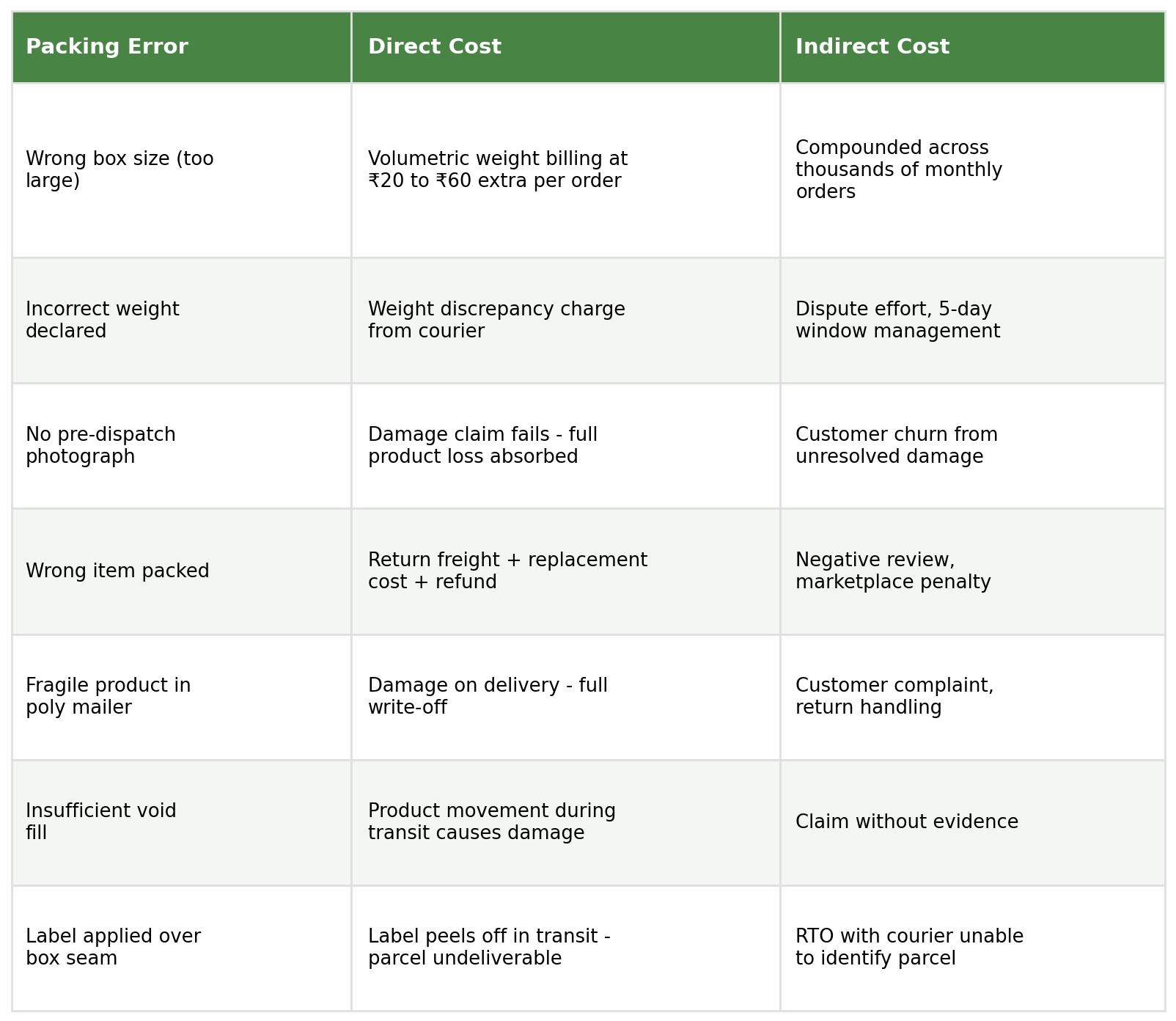
Module 1: Box Selection and Right-Sizing
The first and most financially impactful skill to train. Every packer must understand volumetric weight and how box size directly determines what the business pays per shipment.
What to Teach
Volumetric weight formula: L x B x H (in cm) / 5,000. Every packer must be able to calculate this manually for any box they use. Paste the formula on the wall above the packing station.
The right-sizing rule: Choose the smallest box that fits the product with 3 to 5 cm of void fill on all sides. Not the nearest available box. Not the one that is easiest to close. The smallest that fits correctly.
Box reference chart: Create a laminated chart at the packing station showing each SKU or product category next to the correct box size. Packers should not have to make a box selection decision from scratch for standard products.
Training Exercise
Give each new packer 5 products from your catalogue. Ask them to select the correct box for each, pack it, and calculate the volumetric weight. Compare against your standard. Correct any oversizing before they pack a single live order.
Module 2: Accurate Weight Declaration
Weight discrepancy charges from couriers are almost entirely caused by one error: declaring product weight instead of packed parcel weight. Training must make this distinction clear and non-negotiable.
What to Teach
- Always weigh after sealing: The packed, sealed, labelled parcel is what goes to the courier. That weight - not the product weight, not the product plus box - must be declared. Weigh with tape, label, void fill, and all inserts already inside.
- Scale placement: The weighing scale must be at the packing station, not across the room. If the packer has to carry the parcel to a scale, they will estimate. Estimation causes discrepancies.
- Record the weight: Write the weight directly on the box flap before transferring it to the booking system. This creates a physical record that can be cross-referenced if a discrepancy is raised.
- Round up by 50g: Courier scales may differ from your in-house scale by a small margin. Declaring 480g when your scale reads 470g prevents a discrepancy charge for a 10g difference.
Common Errors to Specifically Address in Training
- Declaring the product's stated weight from the product label - this does not include box, tape, or inserts
- Weighing before inserting the packing slip or promotional inserts - these add weight
- Using a household kitchen scale that is not calibrated for 0 to 5 kg commercial use
- Rounding down to the nearest weight slab to save money - this causes discrepancy charges that cost more than the saving
Module 3: Pre-Dispatch Photography
This is the most undervalued training topic and the one with the highest financial consequence when skipped. A pre-dispatch photograph is the evidence that converts a damage or discrepancy claim from unwinnable to winnable.
What to Teach - The 3-Photo Standard
- Photo 1 - Product before packaging: The item undamaged, clearly showing the product condition before any packaging is applied. For fragile items, photograph from multiple angles.
- Photo 2 - Sealed parcel on scale: The fully sealed outer box on the weighing scale with the weight reading visible. This proves the declared weight and the packaging integrity simultaneously.
- Photo 3 - Label visible: The sealed parcel with the shipping label fully visible and readable. This links the photograph to the specific AWB for claim purposes.
Train your team to take all three photos for every shipment above ₹2,000 in value. For businesses using iCarry®, pre-upload standard product images per SKU to enable automatic dispute triggering - How to Resolve Weight Discrepancies in iCarry® shows exactly how the dispute process works when evidence is pre-uploaded.
Making Photography Habitual
Photography feels like friction until it saves a ₹4,000 claim. The training message: 'The photo takes 10 seconds. The claim it supports recovers thousands.' Make it a non-negotiable step, not an optional one. Build it into the packing station flow - phone mount or tablet holder near the packing area so photography does not require the packer to move.
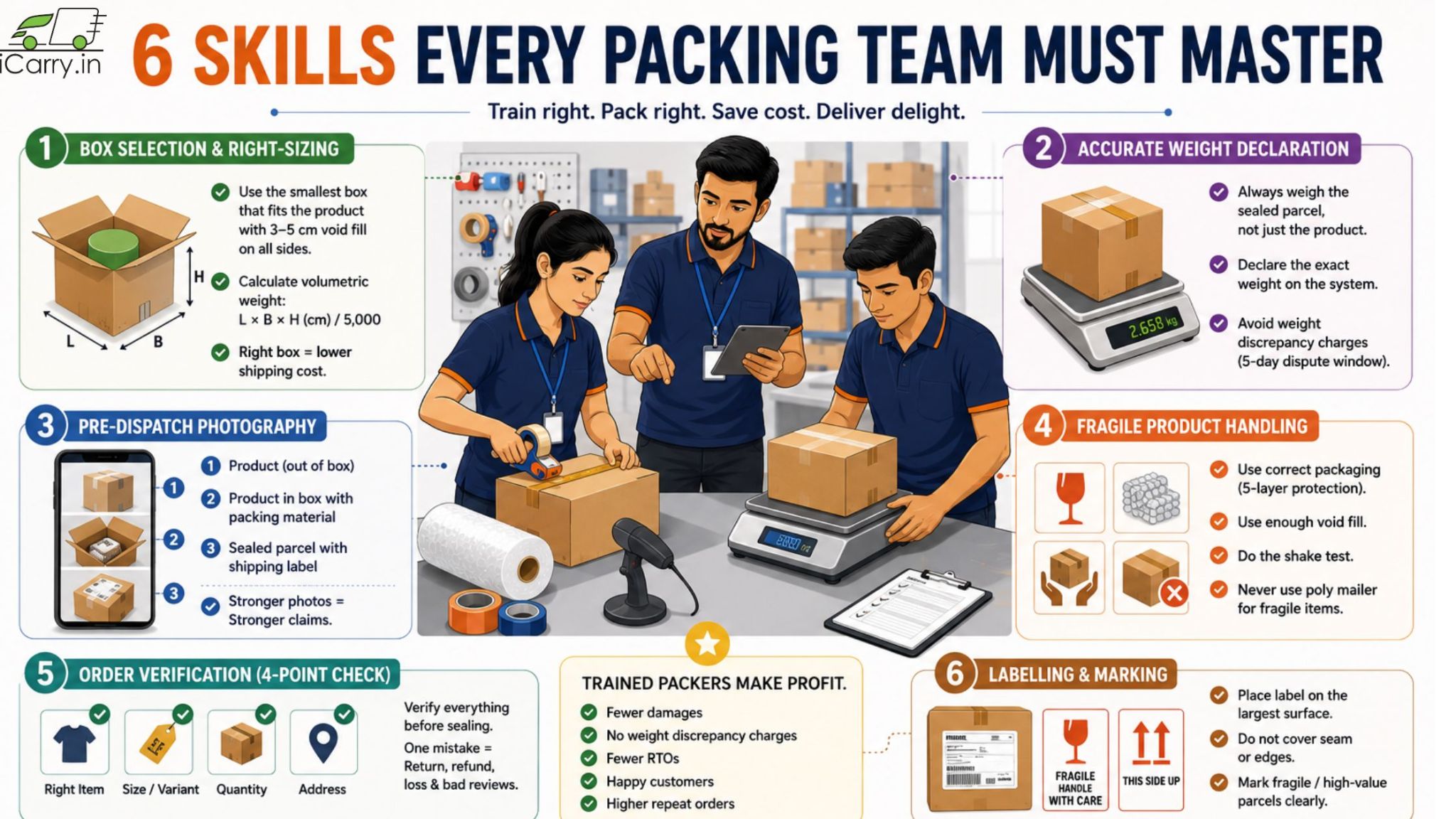
Module 4: Fragile Product Identification and Handling
Not all packers arrive knowing what fragile means in a courier context. Train explicitly on which products require special handling and exactly what that handling looks like.
What to Teach
- Fragile product list: Provide a specific list of every SKU that requires fragile handling. Do not leave packers to judge. A new packer who thinks a ceramic mug looks sturdy will use a poly mailer.
- Mandatory packaging for fragile SKUs: For each fragile SKU, specify the exact packaging: 'Item A - foam sheet wrap, 2 layers bubble wrap, foam dividers, 5-ply corrugated, no void space.' Specific. Not general.
- The no poly mailer rule for hard products: Drill this explicitly. Poly mailers are for soft, non-breakable items only. Any rigid, fragile, or liquid product must go in corrugated.
- The shake test: Before sealing any fragile parcel, shake it. If anything moves or makes a sound, add more void fill. Train until this is instinctive.
Module 5: Order Verification Before Sealing
The wrong item in the right box is a costly error - return freight, replacement, and a customer who may not come back. The verification step before sealing is the only point in the process where this error can be caught.
What to Teach - The 4-Point Check
- Item: Is this the correct product? Check product name or barcode against the order.
- Variant: Is this the correct size, colour, or flavour? The most common wrong-item error is correct product, wrong variant.
- Quantity: Does the quantity in the box match the order quantity?
- Address: Is the label on this box for this order? Cross-reference the order number on the label against the pick list before sealing.
Train packers to say the check out loud or mark a physical checklist before sealing. The physical action of checking prevents the cognitive shortcut of assuming. After training, audit 10% of packed orders randomly to verify the verification step is happening consistently.
Module 6: Labelling and Marking Standards
A shipment label that peels off in transit, is obscured by tape, or is applied to a seam becomes undeliverable. A fragile parcel that is not marked becomes a parcel handled like every other.
What to Teach
- Label placement: Flat surface only - top face of the box, never on a corner, edge, or seam. The label must lie completely flat with no bubbling or fold.
- Label protection: Apply a strip of clear tape over the entire label, not just the edges. Prevents peeling during transit through weather or moisture.
- Fragile marking: For all fragile SKUs: write or sticker FRAGILE and THIS SIDE UP on all four sides and the top in large, clearly visible text. Not just the top face.
- High-value marking: For orders above ₹5,000: add the declared value sticker inside the parcel (visible when opened) and ensure the outer label does not display the value visibly to reduce theft risk.
Building the Training Into Daily Operations
A one-time training session is not a training programme. Pack quality degrades as teams get busy and time pressure builds. Build ongoing quality management into daily operations:
- Daily 5-minute briefing: Before the dispatch window opens, the dispatch supervisor reviews any errors from the previous day. Specific, not general: 'Yesterday three orders had wrong box sizes. Today every packer measures before selecting.'
- Random audit: Supervisor checks 5 to 10% of sealed parcels before they leave. Weighs against declared weight. Checks photograph was taken. Checks label placement.
- Error tracking: Maintain a simple log of packing errors by type and by packer. Not for punishment - for identifying where the training needs reinforcement. If one packer generates 60% of weight discrepancy charges, they need specific coaching, not a general team briefing.
- Seasonal retraining: Before every peak period, run a refresher. New temp packers added for festive season must complete the induction before packing a single live order.
How iCarry® Supports Weight Discrepancy Management
iCarry® is a courier aggregator that provides tools that make your packing team's accuracy directly recoverable when couriers raise discrepancy charges:
- 5-day dispute window: All weight discrepancy charges raised by couriers appear in the iCarry® dashboard with a 5-day window to dispute. Your pre-dispatch photographs are the evidence.
- Pre-uploaded SKU images: Upload standard product images per SKU once. When a discrepancy is raised on that SKU, the dispute is triggered automatically with the pre-uploaded evidence - no manual action per dispute required.
- Dispute tracking: Track raised, disputed, and resolved discrepancies from one dashboard. Identify which couriers raise the most discrepancies on which routes - useful data for courier selection decisions.
- Delivery Boost: For high-value orders, proactive delivery coordination reduces the probability of a damage claim arriving back with no pre-dispatch evidence to support it
Final Thoughts
Packing team training is not a logistics nicety - it is a direct margin intervention. The cost of weight discrepancy charges, damage claims, wrong-item returns, and undeliverable parcels from undertrained packers consistently exceeds the cost of a structured induction programme by a factor of 10 or more.
Train before the first live order. Audit regularly. Track errors by type. Retrain before every peak period. The packing station is where your product quality meets your logistics cost - and where both can be protected or lost in seconds.
Frequently Asked Questions (FAQs)
What is the most common packing error that causes weight discrepancy charges?
Declaring the product weight rather than the sealed parcel weight. The courier charges based on the sealed parcel including box, void fill, tape, label, and all inserts. Packers trained to weigh only the product and use that as the declared weight will generate discrepancy charges on almost every shipment.
How do I create a packing SOP for my dispatch team?
Document the correct process for each product category: box selection by SKU, primary wrap requirements for fragile items, void fill type and amount, label placement, mandatory markings, weighing step, and photograph requirements. Laminate it and post it at every packing station. Review and update every quarter as your product range changes.
How many photos should my packing team take per shipment?
For shipments above ₹2,000 in value: three photos minimum. Product before packaging (undamaged condition), sealed parcel on scale (weight visible), and shipping label fully visible. For standard low-value shipments, one photo of the sealed labelled parcel with visible awb number is sufficient for basic claim support.
How do I reduce wrong-item packing errors?
Implement a mandatory 4-point verification before sealing every parcel: correct item, correct variant (size/colour), correct quantity, and label matches the order. Train packers to physically check each point rather than assuming. Audit 10% of packed orders randomly to verify the verification step is consistently followed.
How does iCarry® help with weight discrepancy disputes?
iCarry® shows all courier weight discrepancy charges in a single dashboard with a 5-day dispute window. Pre-uploaded product images per SKU enable automatic dispute triggering when a charge is raised - without manual action per dispute. Watch How to Resolve Weight Discrepancies in iCarry® for the complete process.
How do I maintain packing quality during peak season when volume spikes?
Treat every temporary packer as a new hire - they must complete the full packing induction before their first live order, not after. Increase audit frequency during peak periods to 20% of packed orders. Run a specific pre-peak refresher with the full team covering the highest-frequency errors from the previous year's peak season.
Packing team training is not about the physical act of putting an item in a box - it is about closing the gap between what a trained packer knows and what an untrained one guesses. Volumetric weight, sealed-parcel weighing, pre-dispatch photography, fragile handling, order verification, and correct labelling: six specific, teachable skills that consistently determine whether a shipment costs you money or protects your margin. Train before the first live order, audit regularly, and retrain before every peak - the packing station is the last checkpoint where cost and quality are still fully in your control.