A parcel fails first delivery because the customer was not home. The courier marks it NDR and waits for instructions. The seller does not act within 24 hours. The courier makes one more attempt, fails again, and initiates RTO. The parcel comes back.
Now the seller has a returned parcel, a customer who still wants the product, and a decision to make: reship the original parcel, book a fresh shipment, or issue a refund. Each option has a different cost, a different process, and a different implication for the customer relationship.
Redelivery and reshipping are two of the most operationally misunderstood situations in Indian logistics. As order volumes across Indian commerce grow - India's logistics market is projected to reach USD 159.54 billion by FY28 (IBEF) - the cost of handling these incorrectly - double freight, incorrect booking type, missed reattempt windows - compounds into a significant monthly loss for businesses that do not have a clear process.
This guide defines each scenario clearly and gives the exact steps to handle each one.
What Is Reshipping, Redelivery, and Reverse Shipment?
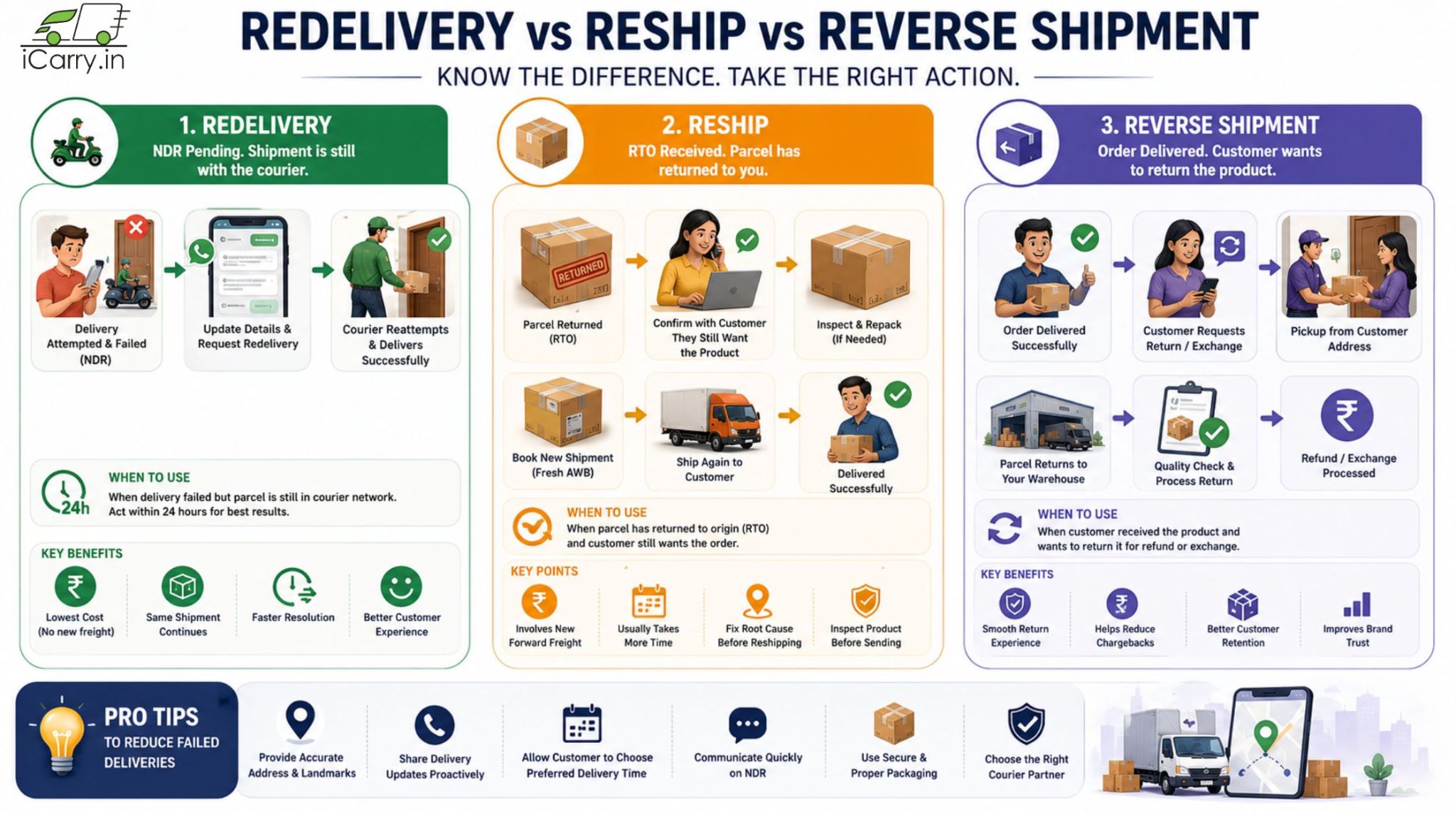
These are three distinct responses to three different points where a shipment can go wrong. Redelivery is requesting another attempt on a shipment that is still with the courier after a failed delivery (NDR). Reshipping is booking the product out again as a brand-new shipment after it has already returned to you (RTO). A reverse shipment is arranging pickup of a product the customer received but wants to send back. Confusing these - most commonly, defaulting straight to a reship instead of acting on the NDR first - is what turns a recoverable delivery into an expensive one.
How to Identify Which Situation You're In
- Has the shipment been delivered successfully and the customer wants to return it? - This is a reverse shipment.
- Has delivery been attempted but failed - NDR pending? - This is a redelivery reattempt.
- Has the parcel returned to origin (RTO) and the customer still wants it? - This is a reship.
- Has the customer confirmed they still want the product before you reship?
The Three Scenarios Defined
Scenario 1: Redelivery - NDR Pending, Shipment Still With Courier
The courier attempted delivery and failed. The shipment is at a local hub waiting for reattempt instructions. The parcel has not returned to you yet. This is the most recoverable situation - act within 24 hours.
Goal: Get the courier to make another delivery attempt with updated instructions before the reattempt window closes.
Scenario 2: Reship - RTO Received, Customer Still Wants the Order
The parcel came back. The customer still wants the product. You need to send it out again - either the same parcel or a fresh one if the returned item needs inspection first.
Goal: Dispatch the product to the customer again as quickly as possible with the underlying delivery issue resolved.
Scenario 3: Reverse Shipment - Customer Wants to Return a Delivered Order
The shipment was delivered successfully. The customer wants to return the product for a refund or exchange. You need to arrange pickup from the customer's address and bring the product back to your facility.
Goal: Book a reverse shipment from the customer's address back to your warehouse.
How to Handle Each Scenario
Scenario 1: Redelivery Reattempt - Step by Step
Time is critical here. Every hour of inaction after an NDR reduces the reattempt probability.
- Step 1 - Contact the customer immediately, but act based on the reason: WhatsApp or call within 2 hours of the NDR notification. The exact action depends on the reason the courier has logged against the delivery attempt - not home, address issue, access problem, preferred timing, or customer refused to accept.
Special case - "Customer refused to accept the order": This remark needs to be treated differently and faster than a routine NDR, since it is sometimes logged incorrectly by the courier field staff.
- Call the customer immediately and confirm, on a recorded call, whether they actually want the order.
- If the customer confirms they want the order: keep the call recording (VOC) as proof and share it with iCarry / attach it to the support ticket right away, so that corrective action can be taken against the courier's remark.
- Act the same day: this has to be done within the same day, or before the shipment leaves the final hub. If no action is taken in that window, the courier will initiate RTO on the shipment and it usually cannot be reversed after that.
- Step 2 - Get updated delivery details: New time slot preference, corrected address detail (floor, flat number, access code), or alternate contact number for the delivery executive to call.
- Step 3 - Update instructions in iCarry®: Log in to My Shipments, locate the NDR shipment, and submit updated delivery instructions against the AWB. Include the customer's preferred reattempt time and any address corrections.
- Step 4 - Request reattempt: Raise a support ticket or use the reattempt request function in the iCarry® dashboard for the specific AWB.
- Step 5 - Confirm with customer: Message the customer that a reattempt has been requested for the next business day and ask them to be available.
Track all NDR statuses and submit reattempt instructions directly from My Account > My Shipments in iCarry®.
Key rule: Most couriers allow 2 to 3 total delivery attempts. Each failed NDR that goes unactioned uses one of these attempts. Act before the window closes - not after RTO is initiated.
Scenario 2: Reship After RTO
The parcel has returned. Before reshipping, complete these steps:
- Step 1 - Inspect the returned parcel: Check the product condition. If the product is intact and resalable, the original parcel can be reshipped. If the packaging is damaged or the product needs inspection, repack before reshipping.
- Step 2 - Confirm with the customer: Before spending money on reshipping, confirm the customer still wants the order. A customer who refused delivery or who has been waiting too long may have already found an alternative. An unconfirmed reship is another potential RTO.
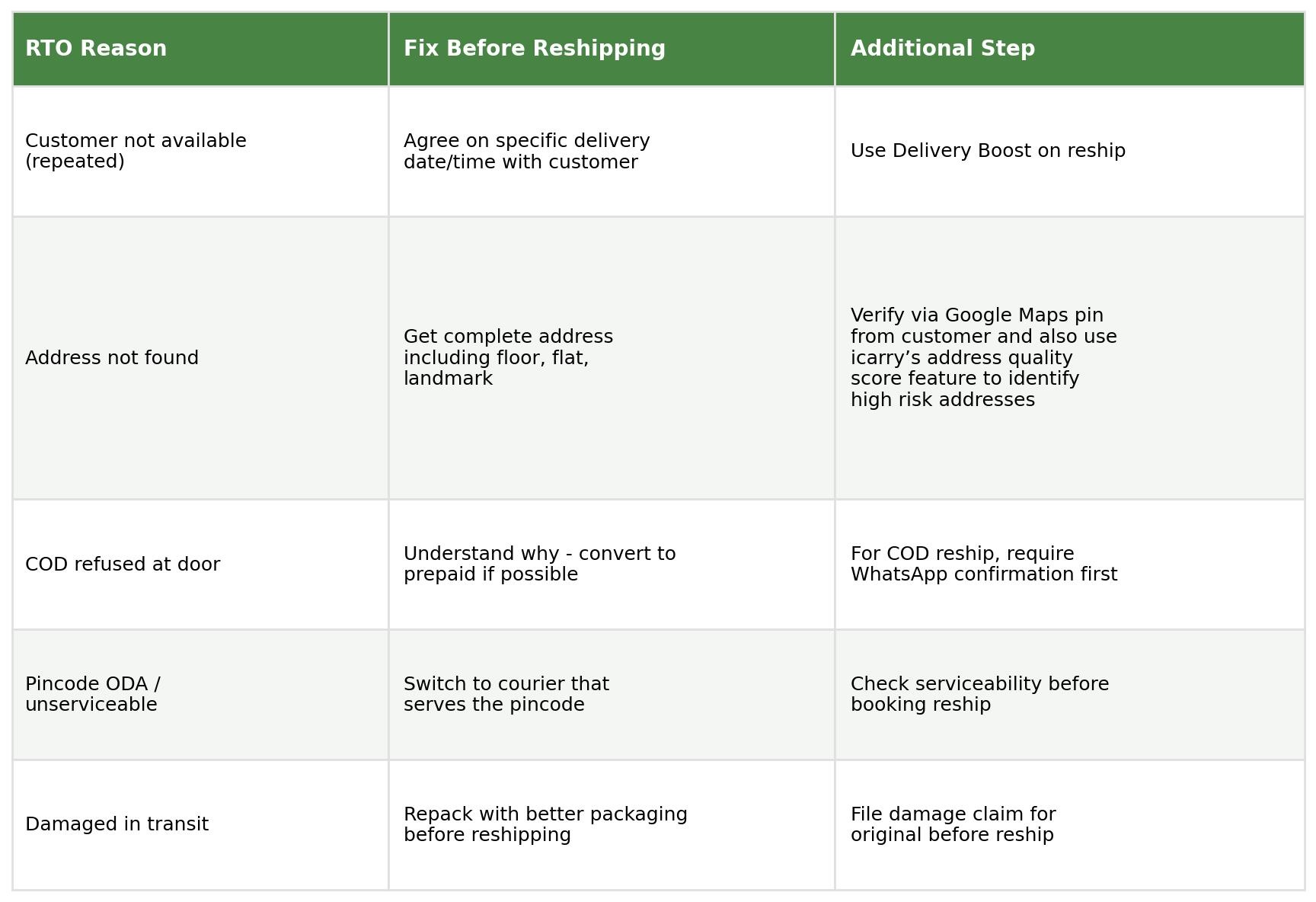
- Step 3 - Identify and fix the delivery failure reason: Why did the original shipment RTO? Address issue - correct it before reshipping. Customer unavailable repeatedly - agree on a confirmed delivery date before reshipping. COD refused - consider offering prepaid for the reship.
- Step 4 - Book the reship as a fresh shipment: Book a new shipment in iCarry® with the corrected delivery address and confirmed delivery details. Do not reuse the original AWB - it is closed.
- Step 5 - Dispatch with confirmation: For COD reshipping, send a WhatsApp confirmation before dispatch. For prepaid reshipping, send the new tracking number immediately on dispatch.
Scenario 3: Reverse Shipment - Booking a Customer Return
A reverse shipment moves goods from the customer's address back to yours. iCarry® supports two scenarios for reverse shipments:
If the original shipment was delivered via iCarry®:
- Go to My Account > My Shipments in your iCarry® dashboard
- Find the delivered shipment and click the Reverse Shipment button next to it
- The system pre-fills the customer address as the pickup point and your address as the destination
- Confirm the booking and share the pickup details with the customer
- Hand over the shipment to the pickup executive or the person assigned to collect the package. The pickup executive will pack the shipment and paste the shipping label
If the original shipment was not delivered via iCarry®:
- Add the customer's address as a new pickup address via Main Menu > My Addresses > Pickup Addresses
- Book a standard forward shipment using the customer's address as the pickup point and your warehouse address as the consignee
- Share the shipment label and manifest with the customer and ensure the parcel is packed, sealed, and handed over to the courier at their end
Important: For a reverse shipment to succeed, the customer must be briefed on what to expect - when the courier will arrive, what condition the product must be in, and how it needs to be packaged. A customer who is not ready when the pickup arrives creates a failed pickup, which is the reverse equivalent of an NDR.
Cost Comparison - Redelivery vs Reship vs Reverse
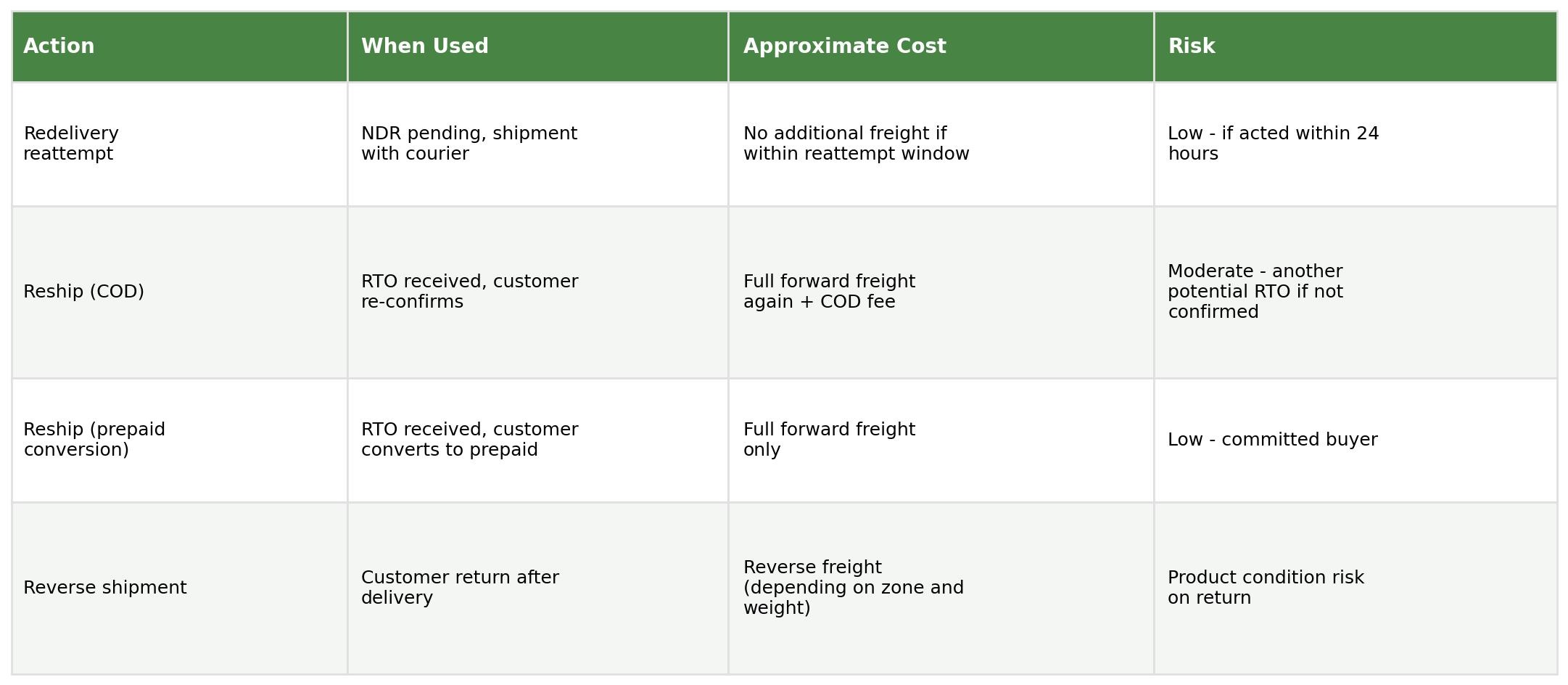
Cost principle: Redelivery is always cheapest - it uses the existing shipment. A reship costs you full freight again. A reverse shipment costs reverse freight plus the loss of the product margin if the return is accepted. Getting the redelivery reattempt right before the NDR becomes RTO saves the most money.
Preventing the Need to Reship - The Better Strategy
The best reship strategy is to not need one. Every RTO that results in a reship could have been prevented at the NDR stage. Reducing RTO at the NDR stage through proactive COD confirmation, Address Quality Scoring, and Delivery Boost is more cost-effective than managing reshipping after the fact.
- COD confirmation before dispatch: Eliminates the lowest-intent buyers before the first delivery attempt, reducing the probability of an NDR in the first place
- Address Quality Scoring: Catches incomplete addresses before dispatch - the leading cause of 'address not found' NDRs that eventually become RTOs
- Delivery Boost: Trained agents contact the customer before the first delivery attempt to confirm availability - converting potential NDRs into successful first-attempt deliveries
- Two-way WhatsApp engagement: When an NDR does occur, the coordination team contacts the customer to reschedule - without the seller needing to manually follow up on every NDR
How iCarry® Supports Redelivery and Reship Operations
iCarry® is a courier aggregator that gives Indian businesses the tools to manage redelivery, reshipping, and reverse shipments from one platform:
- NDR dashboard: All failed delivery notifications across all couriers visible in My Shipments. Update reattempt instructions directly from the dashboard against each AWB
- Reverse shipment booking: One-click reverse shipment from any delivered shipment booked via iCarry®. For non-iCarry® original shipments, book via pickup address configuration
- Reship booking: Book the reship as a fresh shipment with corrected address and confirmed delivery details. Rate comparison available before confirming
- Delivery Boost: For reshipped orders and high-risk redeliveries, Delivery Boost agents proactively coordinate with the customer before the next delivery attempt
- Multiple courier partners: If the original shipment RTOed due to courier serviceability, switch to a different courier for the reship from the same iCarry® account
Free Bronze plan, no minimum volume.
Final Thoughts
Redelivery, reshipping, and reverse shipments are distinct situations requiring distinct responses. Treating them the same - or not acting on NDRs fast enough and defaulting to reshipping - is one of the more expensive operational habits in Indian logistics.
The sequence is always: act on the NDR within 24 hours to secure redelivery, reship only after confirming the customer and fixing the underlying delivery issue, and book reverse shipments through the right process for the scenario.
The savings from preventing one RTO-to-reship cycle pay for the 10 minutes it takes to act on the NDR correctly the first time.
Frequently Asked Questions (FAQs)
What is the difference between redelivery and reshipping?
Redelivery is requesting the courier to make another delivery attempt on the same shipment - the parcel is still with the courier at a local hub following a failed attempt. Reshipping is dispatching the product again as a new shipment after the original has returned to the seller. Redelivery is always cheaper - it uses the existing courier movement. Reshipping costs full freight again.
How do I request a redelivery reattempt in India?
Contact the customer within 24 hours of the NDR notification to confirm availability and collect updated delivery details. Then update the delivery instructions against the specific AWB in your courier aggregator dashboard and request a reattempt. Most couriers allow 2 to 3 total delivery attempts before initiating RTO.
How do I book a reverse shipment on iCarry®?
If the original shipment was delivered via iCarry®, go to My Account > My Shipments, find the delivered shipment, and click Reverse Shipment. The system pre-fills the pickup and destination details. If the original was not via iCarry®, add the customer's address as a new pickup address via Main Menu > My Addresses > Pickup Addresses, then book a standard forward shipment with your warehouse as the consignee.
Should I reship a COD order that returned to origin?
Only after confirming with the customer that they still want the product. An unconfirmed COD reship has the same RTO risk as the original. Before reshipping, identify and fix the delivery failure reason - address issue, unavailability, or COD refusal. For COD reshipping, send a WhatsApp confirmation and get explicit customer confirmation before packing and dispatching again.
How long does a courier hold a failed delivery parcel before the RTO?
Typically 2 to 5 days from the first failed attempt, depending on the courier and their reattempt policy. After the final reattempt, RTO is initiated and the parcel begins its return journey. Act on every NDR within 24 hours - do not wait until day 3 to submit reattempt instructions.
What should I check before reshipping a returned parcel?
Inspect the product condition first - check for transit damage, verify the product is intact and resalable. If packaging is damaged, repack before reshipping. Confirm the customer still wants the order. Fix the delivery failure reason - corrected address, confirmed availability, COD converted to prepaid. Then book the reship as a fresh shipment with the corrected details.
Redelivery, reshipping, and reverse shipment each solve a different problem, and mixing them up is what turns a recoverable NDR into an avoidable RTO. Act on every NDR within 24 hours - that single habit is the cheapest fix in this entire guide. When a reship is genuinely needed, confirm the customer and fix the root cause first, so the second attempt does not fail the same way the first one did.