Why Your Returns Policy Affects Sales and Retention
Shoppers read your returns policy before they buy, especially on a brand they do not know. A confusing or hostile policy lowers conversion. A fair, clear one tells the customer: if this does not work out, you will not be stuck. After the sale, the way you handle a return often decides whether the customer comes back.
For D2C brands, returns are a cost to manage, not an enemy to eliminate. Indian shoppers are cautious about online purchases, so a visible policy supports trust. The aim is to make returns easy for honest customers and expensive for abuse, while keeping the logistics cost under control.
What Is a D2C Returns Policy?
A returns policy is the written set of rules that tells customers when they can return or exchange a product, who pays for reverse shipping and how refunds are made. It is shown before purchase, so it affects both conversion and repeat buying.
How to Write a Returns Policy: What It Must Cover
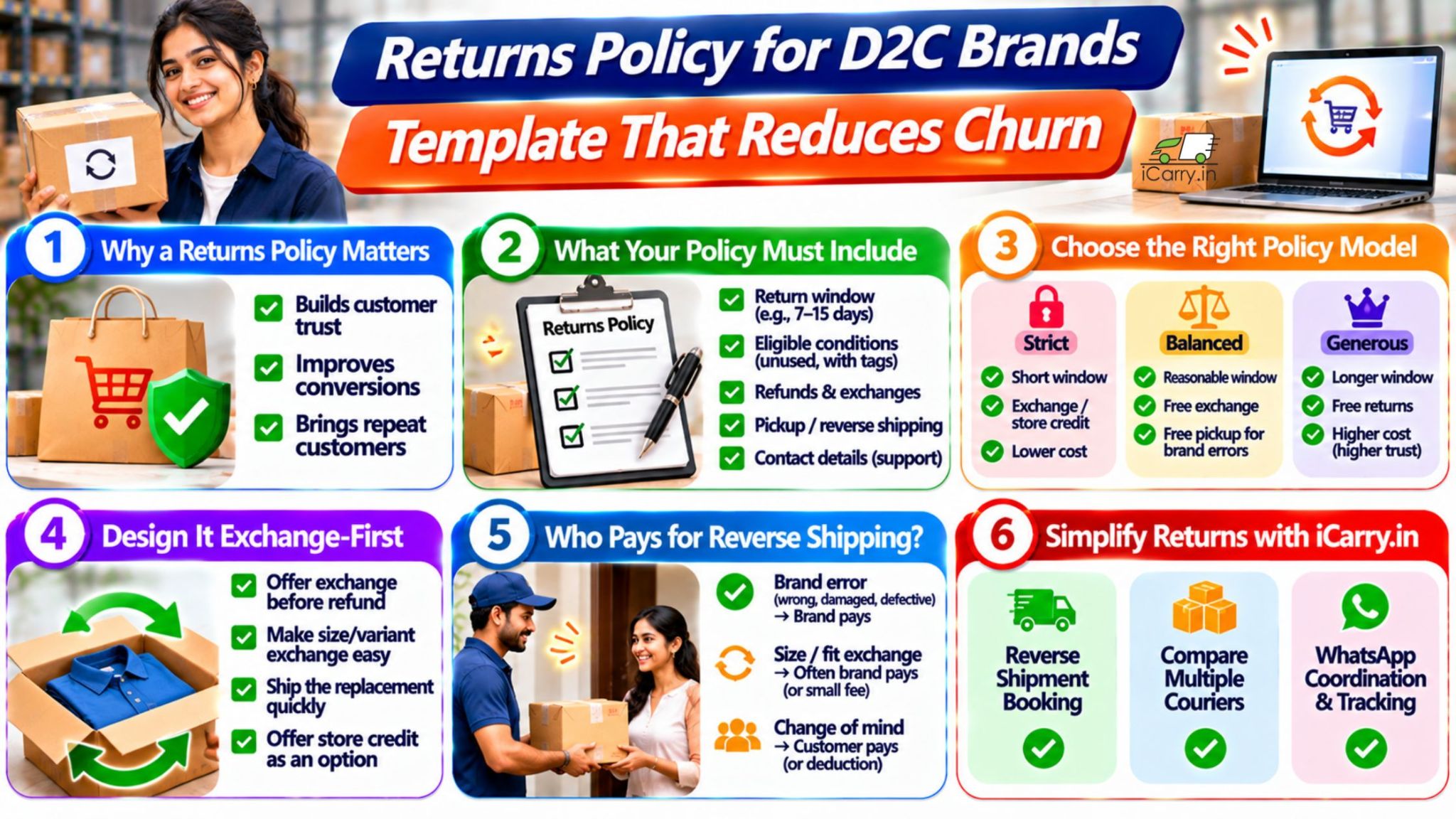
- Return window: Number of days after delivery within which a return or exchange can be requested
- Eligible conditions: What state the product must be in, such as unused, with tags and original packaging
- Non-returnable items: Products that cannot be returned for hygiene, safety or customisation reasons
- How to request a return: Channel, information required and any evidence needed
- Pickup or drop-off: Who arranges the reverse shipment and how
- Who pays reverse shipping: Clear rules for different return reasons
- Refund method and timeline: Original payment mode, store credit or bank transfer, and how many days it takes
- Exchange rules: Size, colour or variant exchange options
- Damaged, defective or wrong items: A faster and more generous process for brand errors
- Contact details: A phone number or WhatsApp number that customers can reach
Note: Indian e-commerce rules require sellers to disclose return, refund and exchange terms to customers. Check the current requirements that apply to your business and keep your policy visible on the site.
Choose a Policy Model
- Strict: Short window, exchange or store credit only, buyer pays reverse shipping. Lower cost, but can reduce conversion for new brands
- Balanced: A reasonable window, free exchange, free pickup for brand errors, buyer pays for preference returns. Works for many D2C brands
- Generous: Longer window and free returns for any reason. Higher cost, useful for premium or high-trust categories where lifetime value justifies it
Pick a model based on your margin, return rate, category and customer type, and review it every quarter using real return data.
Design the Policy Exchange-First
- Many returns are size or variant issues, and the customer still wants the product
- Offer exchange before refund, and make it easy, such as 'Reply with the size you need'
- Ship the replacement quickly. A fast exchange keeps the revenue and the customer
- Offer store credit as an option, sometimes with a small bonus, to retain the sale
- Keep refunds for genuine product issues or when an exchange is not possible
Who Pays for Reverse Shipping
- Brand error: Wrong item, defective or damaged in transit. Always the brand's cost
- Size or fit exchange: Many brands absorb the cost to retain the customer. Others charge a small fee
- Change of mind: The customer usually pays, or a flat reverse shipping fee is deducted from the refund
- Be transparent: State the charges before purchase, not after the customer starts a return
Return Conditions That Protect You
- Unused, unwashed and unworn, with tags and original packaging
- Return requested within the stated window with order details
- Photos or video for damage, defect or wrong item claims within a set period
- Serial numbers, IMEI or batch numbers must match the dispatch record where relevant
- Right to refuse a return that does not meet conditions, with a clear explanation
Typical Non-Returnable Categories
- Personalised and made-to-order items
- Innerwear, swimwear and hygiene products, once opened
- Opened cosmetics, food and consumables
- Digital products and gift cards
- Items clearly marked as final sale
Returns Policy Template (Edit to Fit Your Brand)
Use this as a starting point. Adjust the numbers, conditions and wording to your products, margins and local rules.
1. Return and Exchange Window
You can request a return or exchange within [7 / 10 / 15] days of delivery. The request must be made through [WhatsApp number / email / returns page].
2. Eligibility
Products must be unused, unwashed, in original condition with all tags, labels and packaging intact. Products showing signs of use, damage caused by the customer or missing parts may be rejected.
3. Items We Cannot Accept for Return
[List non-returnable categories, such as personalised items, opened hygiene products and final-sale items.]
4. Exchanges
If you need a different size, colour or variant, we will arrange an exchange subject to stock availability. [State whether the first exchange is free.]
5. Damaged, Defective or Wrong Items
If your order arrives damaged, defective or incorrect, please share clear photos or a short video within [48 hours / 3 days] of delivery. We will arrange a free replacement or a full refund.
6. Return Pickup
Once your request is approved, we will arrange a pickup from your address. Please pack the product securely in its original packaging. [Or: please send the product to the address below.]
7. Return Shipping Charges
Return shipping is free for damaged, defective or incorrect items. For returns due to change of mind or fit, [a reverse shipping fee of ₹[amount] will be deducted from your refund / the first exchange is free].
8. Refunds
After we receive and inspect the returned product, we will process your refund within [5 to 7] working days to your original payment method. For COD orders, we will refund to [bank account / UPI / store credit].
9. Contact Us
For any help, contact us at [phone / WhatsApp / email], [timings].
Make the Return Process Simple
- Let customers start a return on WhatsApp or a short online form, with the order number and reason
- Confirm the request and the pickup date within hours
- Send tracking updates for the reverse pickup, just like forward orders
- Inspect returns quickly and refund on time. Late refunds create the most angry reviews
- Tell customers what is happening at each step
Track reverse pickups just like forward orders in the iCarry® Shipment Dashboard.
Reduce Returns at the Source
- Add accurate size charts, measurements and detailed product information
- Use real photos and videos, and show fit on different body types or use cases
- Show customer reviews, including fit feedback
- Pack carefully to cut damage returns
- Confirm COD orders and addresses before dispatch to cut refusals
Catch incomplete addresses before dispatch with iCarry®'s Address Quality Scoring.
Measure Returns and Review the Policy
- Return rate: Returns as a percentage of delivered orders, by product and reason
- Exchange vs refund split: The share of returns saved through exchange
- Return cost per order: Reverse freight, handling and lost value
- Refund time: Average days between return received and refund
- Repeat purchase after return: Whether customers who returned still buy again
How iCarry® Supports Returns
iCarry® is a courier aggregator that supports the reverse logistics side of your returns policy.
- Reverse shipment booking: Book return pickups from the same dashboard as your forward shipments.
- Multiple courier partners: Choose the best courier for each reverse pickup location
- WhatsApp Engagement: Customers can coordinate pickup timing and update details, and you can see each conversation
- Tracking and support tickets: Monitor reverse shipments in the Shipment Dashboard and raise tickets for delays
Not sure which courier or service suits your returns? Contact iCarry® customer support and we will help.
Frequently Asked Questions (FAQs)
How long should a D2C return window be?
Many D2C brands use 7 to 15 days from delivery. Fashion and fit-sensitive categories often use longer windows, and low-margin or hygiene categories use shorter ones. Choose based on your margins and return data.
Should I charge customers for reverse shipping?
Never for brand errors such as wrong, defective or damaged items. For size exchanges, many brands absorb the cost to retain the sale. For change-of-mind returns, customers usually pay or a flat fee is deducted. State the rule clearly before purchase.
How can I reduce the cost of returns?
Offer exchange before refund, improve size charts and product information, pack well, confirm COD orders and addresses, inspect returns quickly, and track return reasons by product to fix the causes.
What should I do about return fraud?
Record serial numbers and dispatch photos, use tamper-evident packaging, inspect returns against your records, and set clear return conditions. Keep the process fair so honest customers are not penalised.
Cover the return window, conditions, non-returnable items, how to request a return, pickup, who pays reverse shipping, the refund method and timeline, exchanges and contact details. Choose a policy model that fits your margin, offer exchange before refund, keep the return process simple, and review return data every quarter.