India's Garment Export Opportunity
Picture this: you ship a silk saree to a buyer in London. It sits at customs for two weeks because the HS code is wrong, and the buyer asks for a refund. First-time garment exporters face this often, and the market is worth the effort: ready-made garments are India's largest textile export, at US$15.77 billion in FY26. Indian ethnic wear, handloom fabric, and fashion garments find buyers across the Indian diaspora and among mainstream consumers in the US, UK, EU, UAE, and Australia. For D2C brands and independent sellers, platforms like Etsy, Amazon Global Selling, and their own websites have made direct international garment exports viable at small volumes.
The logistics are more straightforward than most sellers assume. Clothing ships light, packs efficiently, and is durable enough to handle international transit without complex packaging. The documentation - correct HS codes, duty rates, GST treatment - is where most first-time clothing exporters make mistakes.
What Is International Clothing Shipping From India?
International clothing shipping from India means sending garments such as kurtas, sarees and dupattas to buyers abroad by courier, with the right HS code, export paperwork and duty details. The buyer or the seller pays import duty, depending on the destination country and how you sell. Get the HS code, duty and GST steps right, and your parcels clear customs without delays.
HS Codes for Garment Exports
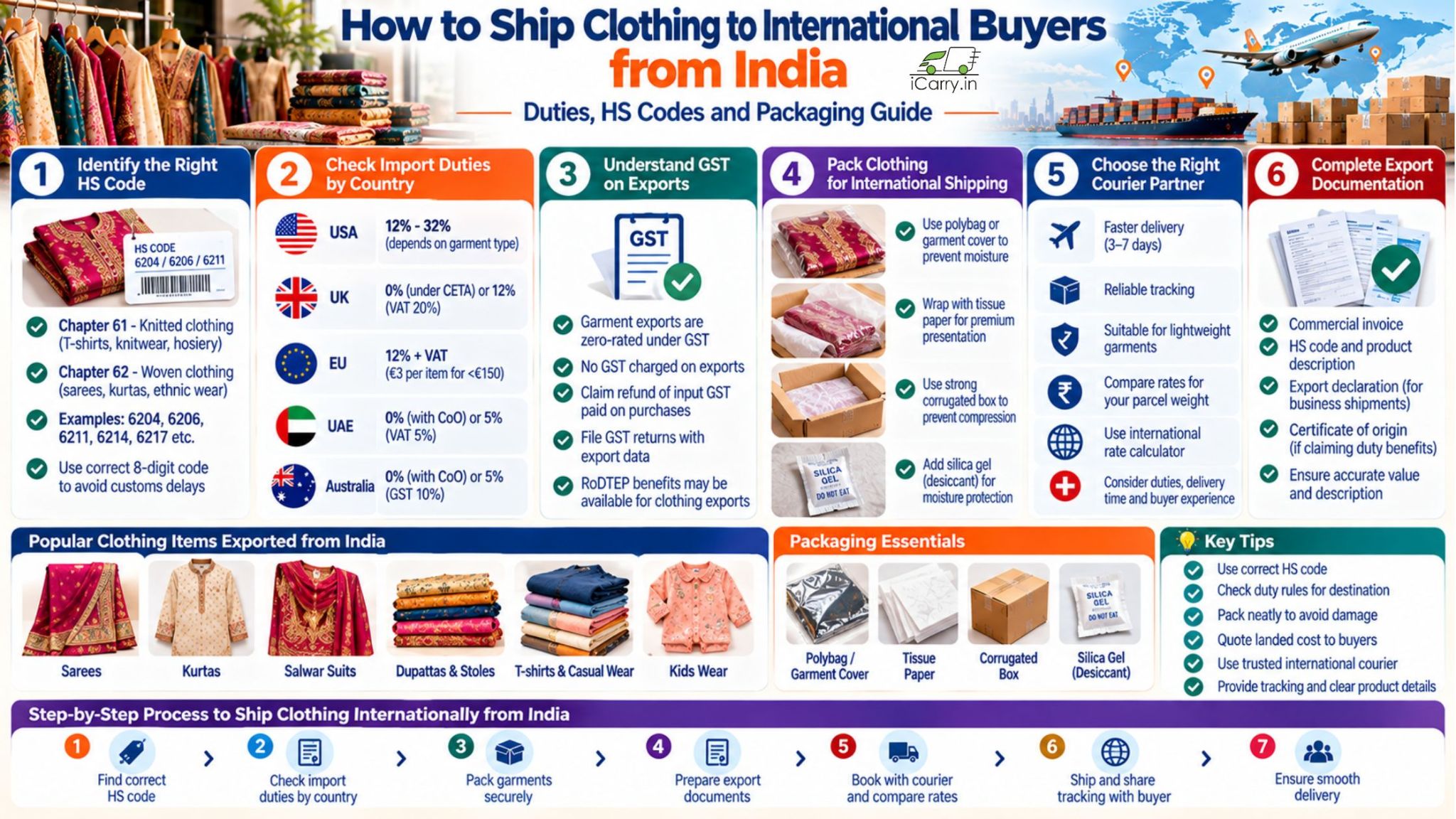
Apparel is classified in HS Chapters 61 and 62. The correct chapter depends on how the garment is made:
- Chapter 61: Knitted or crocheted clothing and accessories (t-shirts, knitwear, hosiery, knitted kurtas)
- Chapter 62: Woven clothing (sarees, salwar suits, woven kurtas, formal wear, denim, most ethnic wear)
Within these chapters, the 6-digit HS code narrows by garment type:
- 6211: Track suits, ski suits, swimwear and similar
- 6214: Shawls, scarves, mufflers, stoles, dupattas
- 6217: Other clothing accessories (textile belts, garment parts)
- 6209: Babies' garments and clothing accessories
For most Indian ethnic wear exports: 6211 is a catch-all heading and does not fit every garment. Kurtas, salwar suits, dresses and tops usually fall under 6204 or 6206, while ready-made sarees often fall under 6211. Always verify the full 8-digit code with a customs broker or the DGFT tariff schedule - incorrect classification causes customs delays and potential penalty at destination.
Import Duties on Indian Clothing by Market
- USA: Base garment duties range from 12% to 32% depending on fabric type and garment category. Clothing is one of the highest-tariff import categories in the US. The US has ended its US$800 duty-free de minimis exemption for all countries, so even small D2C parcels now pay duty. Extra US tariffs on Indian goods have also changed several times in 2025 and 2026, so check the current rate before you set prices. Pricing duty in upfront avoids refused parcels at the door
- UK: The India-UK trade agreement (CETA) came into force on 15 July 2026 and gives most Indian garments zero import duty, if you can show proof of Indian origin. Without that proof, the standard 12% duty applies. UK VAT of 20% still applies, and for orders under £135 it is collected at checkout
- EU: Import duty of 12% plus VAT (varies by country, typically 19 to 25%). Since 1 July 2026, parcels under €150 pay a flat €3 duty per item. Under the EU's IOSS system, VAT is collected at checkout for these orders. Above €150, the normal 12% duty and full import procedures apply
- UAE: 5% customs duty on garments, but Indian-origin garments can enter at zero duty under the India-UAE trade agreement (CEPA) with a certificate of origin. Without it, the buyer pays 5% on the declared value. UAE VAT of 5% also applies
- Australia: 5% import duty on most garments, but Indian-origin garments can enter at zero duty under the India-Australia trade agreement (ECTA) with a certificate of origin. GST of 10% still applies. The de minimis threshold is AUD$1,000, so most individual garment shipments clear without duty anyway
D2C vs B2B: Do not build your pricing on duty-free delivery. The US has ended its exemption and the EU now charges a flat €3 per item, so small D2C parcels are no longer clear free in most markets. B2B wholesale garment exports attract full import duty. Price accordingly and inform your buyers clearly.
Check your landed cost before you quote. Compare FedEx and Aramex rates for your garment weight with the iCarry® international rate calculator, so your price covers both shipping and duty.
GST on Garment Exports from India
- Exports are zero-rated under GST: Garment exports are zero-rated, meaning no GST is charged on exports and you can claim a refund of the GST paid on inputs used in production, if you export under a Letter of Undertaking (LUT) without paying IGST
- IGST refund: You can export under an LUT without paying IGST, or pay IGST and claim it back. If you pay IGST, file your GST returns correctly with export data. The IGST paid on the export is refunded through the GST system based on your shipping bill data filed with Indian customs (see the CBIC guide to GST for exporters)
- RoSCTL: Garments in Chapters 61 and 62 are covered by RoSCTL (rebate of embedded state and central taxes), not RoDTEP, and you cannot claim both. Ask your customs broker to include the RoSCTL claim on the shipping bill, and confirm it applies to courier-mode shipments. The scheme is extended in short periods (currently to 31 December 2026), so check it is still running
Packaging Clothing for International Courier Shipments
Clothing is one of the most courier-friendly product categories - durable, compressible, and lightweight. But presentation quality matters for fashion exports:
- Fold precisely and wrap in tissue: Tissue paper between folds prevents colour transfer and creasing. Presentation at delivery is part of the buyer experience in fashion exports
- Individual polythene bag per garment: Protects from moisture and keeps each piece separate
- Poly mailer for single soft garments under 1 kg: Adequate for t-shirts, light kurtas, scarves, dupattas
- Corrugated box for sets, premium garments, or anything above 1 kg: Better presentation and physical protection. Embroidered and embellished garments should never be compressed in a poly mailer
- Roll instead of fold for sarees and heavy dupatta: Rolling around acid-free tissue prevents fold creases in silk and heavily worked fabric
- Silica gel sachet: Essential for silk, zari, and embroidered garments shipping to humid climates. Moisture damages zari work irreversibly
Packed and ready? Book doorstep pickup and ship your garment parcel with iCarry®. There is no minimum volume, so even a single order is worth booking.
International Returns on Garment Exports
Size mismatches are common in garment exports because sizing standards differ across countries (UK 10 is not US 10 is not Indian M). Build your returns expectation into your export pricing:
- Include a detailed size chart in centimetres on every international product listing - not just S/M/L/XL
- State your returns policy clearly in the listing. Most international buyers will not return an item from India if the process is complex - they will simply leave a negative review
- For exchanges, factor in the cost of a second international shipment in your margin calculations
How to Check Your Garment Export Is Ready to Ship
- Confirm the HS code: Ask a customs broker to check it. A wrong code is the most common cause of customs delays and extra duty
- Get a certificate of origin: Needed to claim zero duty in the UK, UAE and Australia, so keep it ready before you ship
- Choose your GST route: Pick an LUT or pay IGST before you ship, because it decides how you get your tax money back
- Price in duty: Add duty to your price or tell the buyer clearly, as surprise charges at the door lead to refused parcels
- Pack for the journey: Wrap in tissue and add silica gel for silk and zari, since moisture damage cannot be undone
- Add a size chart in cm: It cuts size-related returns, which are costly on international orders
How iCarry® Supports Garment Exporters
iCarry® is a courier aggregator that provides access to available FedEx and Aramex services for international garment parcel shipments from India.
- International rate comparison: Compare courier rates before booking to evaluate available FedEx and Aramex options based on shipment weight, destination, and service requirements.
- Multiple courier partners: Compare available international shipping options and choose a suitable service based on delivery destination, transit requirements, and cost.
- No minimum shipment volume: Whether you ship a few garment orders each week or handle larger order volumes, iCarry®'s Bronze plan has no minimum shipment volume requirement.
- Bulk booking: Simplify domestic order processing with bulk shipment booking through Excel or CSV uploads.
Frequently Asked Questions (FAQs)
What HS code should I use for exporting sarees and ethnic wear from India?
Most sarees and woven ethnic wear fall under HS Chapter 62 (woven garments). The specific 8-digit code depends on the fabric type and garment construction. Common headings include 6211 for ready-made sarees and 6204 or 6206 for kurtas and tops. Always verify the full 8-digit classification with a customs broker before your first shipment - an incorrect HS code can result in higher duty being charged at the destination country's customs.
Do US buyers pay import duty on Indian garments?
Yes. The US ended its US$800 de minimis exemption for all countries, so even small consumer orders now pay duty. The duty is the base rate for your garment (12% to 32%) plus any extra US tariffs on Indian goods in force that day. Check the current rate before you quote a landed price, because these extra tariffs have changed several times in 2025 and 2026.
Is GST charged on garment exports from India?
No. Exports are zero-rated under India's GST framework - no GST is charged on exports. Additionally, you can export under a Letter of Undertaking (LUT) without paying IGST and claim back the GST paid on inputs (fabric, trims, processing), or pay IGST and claim it back through your shipping bill. File your GST returns correctly with export data so the refund is processed.
What packaging is best for exporting embroidered or embellished garments?
Never compress embroidered garments in a poly mailer - the embellishments flatten and can detach. Use a corrugated box with the garment individually wrapped in tissue and polythene. Roll heavily embroidered pieces around acid-free tissue rather than folding - fold lines under embellishment cause thread stress and can break embroidery at fold points. Include a silica gel sachet for silk and zari work to prevent moisture damage during international transit.
To ship clothing internationally from India, get the HS code right (Chapter 61 for knitted, Chapter 62 for woven), price import duty into your quote, choose your GST route (LUT or IGST) before you ship, and pack in tissue with silica gel for silk and zari. Compare FedEx and Aramex rates at your garment weight, and add a size chart in centimetres to cut returns.