
A skincare brand launches a new serum on Instagram. A popular creator shares it on Monday evening. By Tuesday morning there are 600 orders. By Wednesday there are 1,100. The brand's usual daily volume is 40 to 50 orders. Their packing table has two people. Their packaging supplier delivered 200 boxes last week. Their courier pickup window closes at 1 PM.
This is the best problem to have - and simultaneously one of the hardest to manage. A demand spike that exceeds your logistics capacity does not just mean delayed shipments. It means late dispatch, missed SLA penalties on marketplace orders, customers who ordered with excitement and wait two weeks, negative reviews that outlast the viral moment, and packaging shortcuts that damage the product experience you worked to build.
India's digital commerce ecosystem creates demand spikes faster than almost any other market in the world. A single viral moment - a celebrity mention, a creator review, a press feature - can multiply daily order volume by 10x or 20x overnight.Over two-thirds of Indian online shoppers now rely on influencers for product discovery and purchase decisions, according to influencer marketing report - which is exactly why a single mention can produce the kind of overnight spike this guide is about. The businesses that survive and convert these spikes into lasting growth are the ones with a logistics playbook ready before the spike arrives.
What Counts as a Demand Spike?
A demand spike is any surge in orders large enough that your normal packing, packaging, and courier pickup capacity cannot absorb it without delay - typically 5x to 20x your average daily volume, triggered by a viral moment, a marketplace sale, or a successful launch. It is different from steady growth because it arrives with no warning and no ramp-up time, which is what makes it a logistics problem and not just a demand problem.
Quick Checklist - Is Your Logistics Spike-Ready?
- Does your courier aggregator account support bulk booking for 10x your normal daily volume?
- Do you have packaging materials stocked or a supplier who can deliver in 24 hours?
- Do you have a temporary packing team you can call in - family, part-time help, or a temp agency contact?
- Have you communicated an updated dispatch timeline to customers on all channels?
- Have you checked that your courier's pickup capacity can handle a surge without missing your window?
- Have you paused new orders or set a cap if you genuinely cannot fulfil without quality compromise?
Why Demand Spikes Break Logistics
Most small and mid-sized Indian businesses build their logistics setup for average daily volume - the 50 to 100 orders per day that represents their normal. Every element of that setup is calibrated to that throughput: the packing station size, the packaging stock, the courier pickup volume, the label printer speed, the number of people on dispatch.
A 10x spike does not just need 10x the effort. It needs 10x the packaging materials, 10x the packing capacity, 10x the courier booking volume, and 10x the post-dispatch tracking attention - all at the same time, often with no advance warning.
The three failure modes that spike-driven logistics collapses create:
- Dispatch delay: Orders take 5 to 10 days to ship instead of 1 to 2. Customers who ordered in excitement turn disappointed. Reviews reflect the wait, not the product.
- Quality compromise: Rushed packing leads to wrong items, damaged packaging, and missing inserts. The brand experience that drove the viral moment gets delivered as a mediocre unboxing.
- Operational debt: The team burns out, errors accumulate, and the three weeks after the spike are spent clearing backlogs, handling complaints, and processing returns - not building on the momentum.
Before the Spike: Building Logistics Surge Capacity
The best time to prepare for a demand spike is before it happens. Even without knowing when or how big the spike will be, these preparations create meaningful surge capacity with minimal ongoing cost.
1. Maintain Packaging Stock Above Normal
Keep 2 to 3 weeks of packaging at your normal daily volume on hand at all times - not one week. When a spike hits, packaging is the first thing that runs out. Your supplier's lead time of 2 to 3 days is two to three days where you cannot ship. A standing inventory buffer eliminates this constraint on spike day one.
Identify a local packaging supplier who can deliver within 24 hours for emergency top-ups. Confirm this relationship before you need it.
2. Know Your Temporary Packing Capacity
If your normal packing operation is one person, identify three more people who can pack to your standard in an emergency - a family member who has done it before, a neighbour, a part-time worker, or a temp agency you have already contacted. Brief them on your packing standard before you need them. An untrained packer on spike day creates more problems than they solve.
3. Confirm Your Courier's Surge Pickup Capacity
Call your courier aggregator's support team and ask: if my daily volume increases from 80 to 800 parcels tomorrow, can your pickup agent handle that? What notice do I need to give? Most courier partners need 24 to 48 hours notice for significantly higher than normal pickup volumes. Knowing the answer before the spike means you can communicate when a large pickup is coming.
4. Keep Your Wallet Topped Up
A courier aggregator account with insufficient wallet balance stops bookings. During a spike, running out of wallet balance mid-booking session costs time and creates dispatch gaps. Keep a buffer above your normal weekly spend - refill before a planned launch or sale, not during.
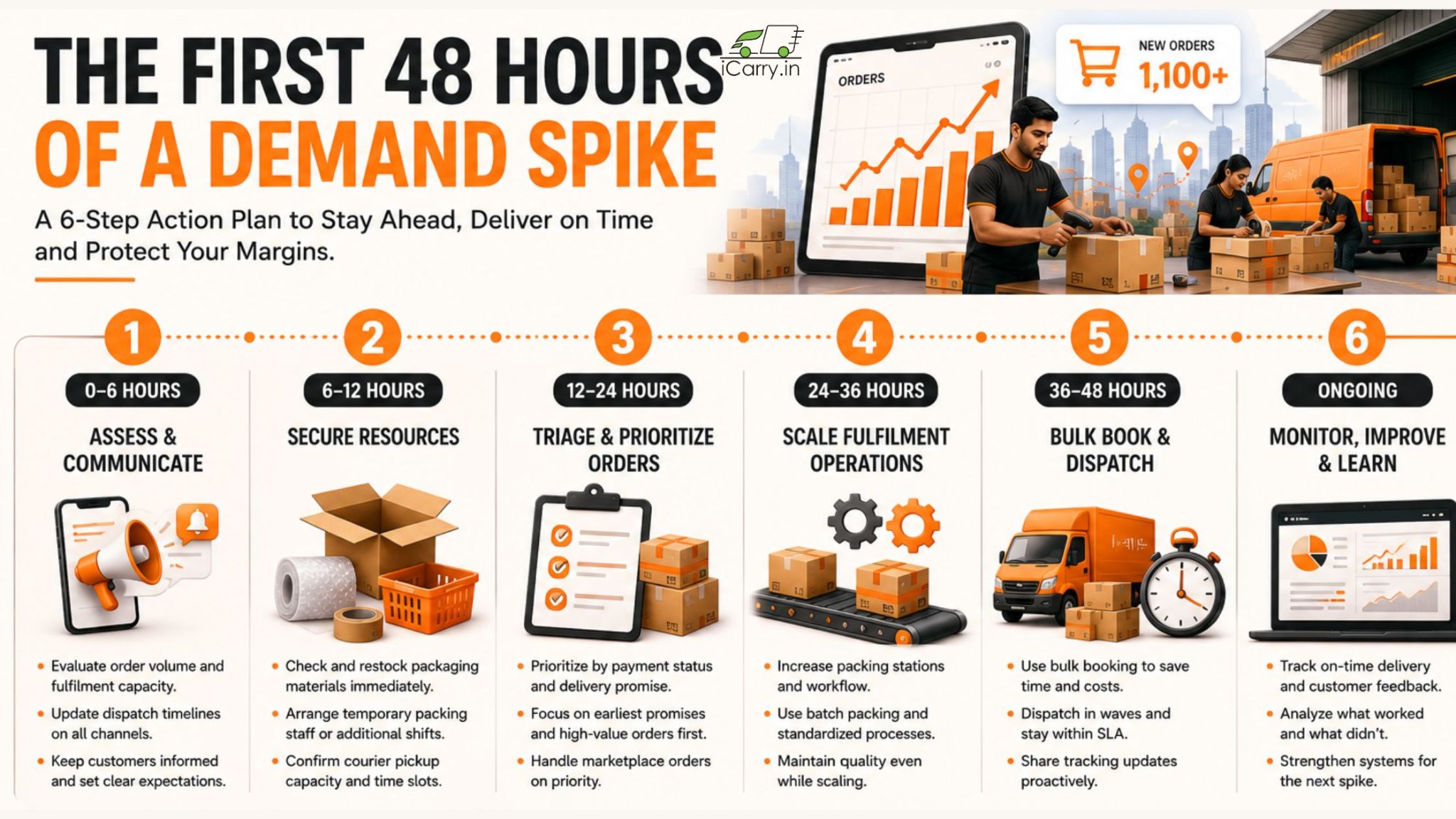
During the Spike: The First 48 Hours
The first 48 hours of a demand spike determine whether you convert the momentum or lose it to operational chaos. Priorities in order:
Step 1: Communicate Proactively to All Customers Immediately
Before you have shipped a single order, send a message to all customers who have placed orders in the last 24 hours. Acknowledge the surge, thank them for their purchase, and give them a revised honest dispatch estimate.
Example message: 'Hi [Name] - thank you so much for your order! We have received an incredible response and our team is working around the clock to dispatch every order. Your order will ship within [X] to [X] business days. We will send your tracking details as soon as it ships. We appreciate your patience and are committed to delivering the same quality that made you choose us.'
An honest, warm update sent immediately converts impatient customers into patient ones. Silence converts them into complainers.
Step 2: Triage Your Order Queue
Not all orders are equal priority. Process in this order:
- Prepaid orders before COD: Prepaid customers have already committed. Ship them first.
- Earlier orders before later ones: First in, first out. Customers who ordered on day one have waited the longest.
- Marketplace orders before direct channel orders: Marketplace SLA penalties for late dispatch are immediate and measurable. Direct channel customers who received your proactive message will wait more gracefully.
- Local zone orders before distant zone: If courier pickup capacity is limited, prioritise orders that can be fulfilled from the nearest stock and delivered fastest - giving you positive reviews coming in while you work through the backlog.
Step 3: Bulk Book Aggressively
Do not book one order at a time. Bulk booking through your courier aggregator processes the entire queue in one action. This is the single biggest operational time-saver during a spike. Compare rates across couriers before bulk booking - during a spike is when defaulting to one courier at rack rates is most expensive. Rate differences compound across hundreds of orders.
Step 4: Extend Dispatch SLA if Needed - Honestly
If the spike is genuinely too large to dispatch within your normal 1 to 2 day window, do not pretend otherwise. Update your website and order confirmation to reflect the honest timeline. Marketplace sellers should contact support to request an SLA extension if eligible.
A 5-day dispatch with honest communication generates fewer complaints than a 3-day dispatch that was promised in 1 day.
Step 5: Consider a Temporary Order Cap
If the spike volume exceeds what you can fulfil at your quality standard within any reasonable timeline, the right decision is to temporarily pause new orders or show a 'sold out' or 'pre-order' status. Accepting orders you cannot fulfil generates the worst outcome: a large cohort of customers waiting indefinitely who then cancel and leave negative reviews.
A sold-out notification creates scarcity. A 3-week wait with no communication creates churn.
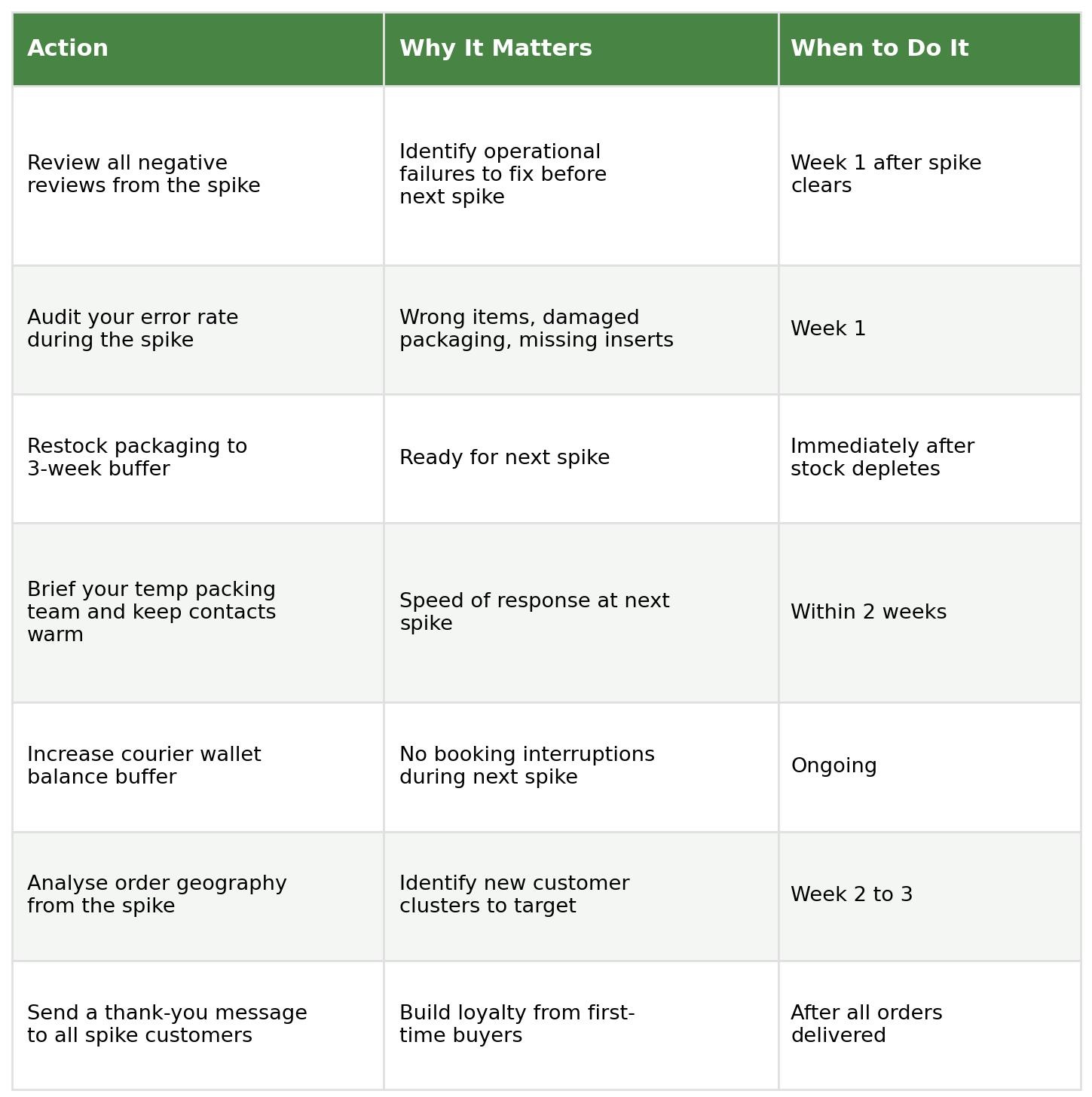
Post-Spike: Converting Momentum Into Sustained Growth
How iCarry® Handles Demand Spikes
iCarry® is a courier aggregator built for Indian businesses at every scale - including during the moments when scale changes overnight.
- No volume cap on bookings: iCarry® places no cap on daily booking volume. A business that normally ships 50 orders can ship 5,000 from the same account with the same tools
- Bulk booking: Book the entire spike order queue in one session. Labels and manifest generated in one action
- Multiple courier partners: If one courier's pickup capacity is limited on a given day, route orders to alternatives with availability. Spike-day flexibility requires multi-courier access
- Two-way WhatsApp engagement : During a spike, iCarry®'s delivery coordination handles consignee communication on your behalf - so your team stays focused on packing, not tracking queries
- Address Quality Scoring: With hundreds of orders to ship, pre-dispatch address validation prevents failed deliveries that create a second wave of customer service burden after the spike
- Real-time tracking: Monitor the entire spike batch across all couriers from one dashboard. See all active shipments in My Shipments without logging into multiple portals
Free Bronze plan, no minimum, no monthly fee. When the spike hits, your account is ready.
Final Thoughts
A demand spike is the moment every product launch works toward. It is also the moment most logistics setups are least prepared for. The gap between those two realities is what this guide exists to close.
Prepare the surge capacity before you need it - packaging buffer, temp packing contacts, courier surge notification process, wallet top-up. When the spike arrives, communicate honestly first, triage by priority second, bulk book third, and cap orders if you have to.
The brands that convert a viral moment into lasting customer loyalty are the ones that deliver on their promise even when volumes are 10x higher than expected. The logistics infrastructure to do that is not expensive. It is prepared.
Frequently Asked Questions (FAQs)
What should I do first when I receive 10x my normal order volume?
Communicate to all customers immediately with an honest revised dispatch timeline. Do this before packing a single order. An immediate, warm, transparent message converts impatient buyers into patient ones. Silence converts them into complainers. Then triage the order queue - prepaid before COD, earlier orders first, marketplace orders before direct channel.
How do I scale my packing operation for a demand spike?
Call in your temporary packing team (identified in advance). Brief them on your packing standard - right item, right size, sealed correctly, labelled clearly. Run an assembly line approach: one person picks, one packs, one labels. Double your throughput by eliminating the single-person end-to-end model. Replenish all station supplies before the session begins, not during.
Should I accept all orders during a demand spike?
Only if you can fulfil them within a timeline your customers will accept. If the spike volume genuinely exceeds your fulfilment capacity at any reasonable standard, it is better to pause orders, show sold-out status, or offer pre-order with a clear timeline. Accepting orders you cannot fulfil generates a larger cohort of frustrated customers than a sold-out notification creates.
How does a courier aggregator help during a demand spike?
A courier aggregator like iCarry with no booking caps lets you process your entire spike order queue in bulk - one session, one manifest, labels for all orders. Multi-courier access means you can split volume across multiple couriers if one courier's pickup capacity is strained. Rate comparison ensures you are not overpaying rack rates during the highest-volume period you will experience.
How do I prevent quality failures during a spike?
Maintain your standard packing checklist even when speed is the pressure. Right item, right size, sealed correctly, labelled clearly. A verification step before sealing - check the item against the order - takes 10 seconds and prevents the wrong-item returns that consume disproportionate post-spike customer service time. Do not shortcut the verification step when volume is highest.
A demand spike is the moment every product launch works toward, and also the moment most logistics setups are least prepared for. Prepare the surge capacity before you need it - packaging buffer, temp packing contacts, courier surge notification process, wallet top-up. When the spike arrives, communicate honestly first, triage by priority second, bulk book third, and cap orders if you have to. The brands that convert a viral moment into lasting customer loyalty are the ones that deliver on their promise even when volumes are 10x higher than expected.