An online automotive parts marketplace dispatches a headlight assembly to a garage in Coimbatore. The part is packed in its original manufacturer box and placed in a standard 3-ply corrugated outer. It arrives with the housing cracked. The garage returns it. The marketplace absorbs the forward freight, the return freight, the replacement part cost, and two business days of the garage's downtime waiting for a functional part.
The packaging failure cost more than the profit margin on the sale.
India's automotive aftermarket is one of the country's largest industrial commerce categories. With over 300 million registered vehicles on Indian roads, the demand for spare parts, accessories, and components spans everything from small consumables (filters, belts, bulbs) to heavy mechanical parts (engines, gearboxes, suspension components) and sensitive electronics (ECU units, sensors, cameras). Each product type presents distinct shipping challenges - weight, fragility, dimensions, and the B2B delivery requirements of workshops, dealers, and distributors.
This guide covers exactly how to ship automotive parts and accessories in India correctly.
What Is Automotive Parts Shipping in India?
Automotive parts shipping in India involves matching packaging, handling, and courier selection to products ranging from small components such as spark plugs and sensors to heavy parts such as engine components. Fragile parts, including lenses, sensors, and precision surfaces, require appropriate protection during transit, while heavier components need packaging that can withstand handling and movement. Deliveries to workshops, dealers, and service centres may also require coordination around receiving hours and delivery conditions. Choosing the right packaging and courier service helps reduce the risk of damage, failed deliveries, and returns.
How to Check If Your Automotive Part Is Ready to Ship
- Have you calculated chargeable weight (actual vs volumetric) for each part category?
- Are fragile components (lights, sensors, electronics) individually packed with no surface contact?
- Are heavy parts (engines, gearboxes, axles) in 5-ply corrugated with weight marked on the carton?
- For B2B dealer or garage delivery: is the business delivery address and receiving hours confirmed?
- For fluids (oils, coolants): is the primary seal intact with secondary containment and KEEP UPRIGHT marked?
- Have you enabled declared value coverage for high-value electronic components?
The Automotive Parts Shipping Challenge
Automotive parts create three distinct logistics challenges that rarely appear in other categories simultaneously:
- Weight extremes: The category spans 50g spark plugs and 120 kg engine blocks. The right courier, packaging, and billing calculation differs dramatically across this range. What works for a filter kit does not work for a differential assembly
- Fragility within heavy packaging: Many automotive parts combine heavy structural components with fragile sub-components. A headlight assembly is heavy but contains a fragile polycarbonate lens. A brake calliper is heavy but has precision-machined surfaces that must not be scratched. A sensor housing is lightweight but contains micro-electronics that fail if compressed
- B2B delivery complexity: Most automotive parts go to workshops, dealers, and distributors - business addresses with specific receiving requirements, professional standards for part condition, and operational urgency when a vehicle is off-road waiting for a part
Packaging by Automotive Part Category
Exterior Body Parts (Bumpers, Bonnets, Panels, Mirrors)
Large exterior parts are the most challenging to ship via courier. Many exceed standard courier dimension limits:
- Wrap all painted and finished surfaces in foam sheet before any other packaging - paint scratches are grounds for return
- Corner protection on all protruding edges - bumper corners and panel edges are the first casualty in transit
- For mirrors: remove glass if possible and pack separately. Mirror glass packed within the assembly housing is a breakage risk
- Check courier maximum dimensions before booking - many exterior body parts exceed the 120 to 150 cm limit for standard couriers and require freight or specialist over-dimension services
- 5-ply corrugated mandatory. Stretch wrap the outer carton for additional structural reinforcement
Lighting Components (Headlights, Tail Lights, LED Assemblies)
- Original manufacturer packaging (moulded foam inserts) is always the first choice if available
- Without original packaging: foam sheet wrap around the lens face first, then bubble wrap around the assembly
- Rigid corrugated with custom foam inserts that hold the assembly in a fixed position - no movement inside the box
- Tail light assemblies with integrated wiring harnesses: secure the harness to prevent it pulling or stressing connector points
- Mark FRAGILE and THIS SIDE UP on all faces
- 5-ply corrugated for assemblies above 1 kg
Engine and Transmission Components (Heavy Mechanical)
These are the heaviest parts in the automotive category and require freight-level packaging:
- Individual metal-to-metal contact must be prevented - use foam sheet between components in a multi-part consignment
- Oil ports must be sealed before packaging - even a small amount of residual oil creates contamination in the packaging and triggers courier rejection
- Weight must be marked on the outer carton: 'Gross weight: 28 kg'. Receiving personnel need advance warning before lifting
- For individual units above 30 kg: LTL freight or specialist heavy goods courier - standard courier weight limits will be exceeded
- Wooden crate or heavy-duty pallet with strapping for engine block shipments. Corrugated is inadequate for this weight class
Electronic and Sensor Components (ECU, ABS Modules, Cameras, Sensors)
Automotive electronics are the most value-dense and most failure-prone parts in transit:
- Anti-static bag around every electronic component before any other packaging
- Foam cutout or rigid foam insert that holds the component in a fixed position
- No compression on the component - pressure on an ECU housing can crack circuit boards without visible external damage
- Moisture protection: silica gel sachet inside the sealed box
- Declare value accurately and enable coverage - ECU and ABS module replacements can cost ₹15,000 to ₹75,000+
- Express couriers are preferred for high-value electronics - fewer handling points reduce failure risk
Filters, Belts, and Small Consumables
These are generally straightforward to ship using standard, right-sized corrugated packaging to help avoid unnecessary volumetric weight.
- Oil and air filters: The original filter box is usually suitable as the inner packaging. Place it inside a corrugated outer box for additional protection during transit.
- Belt kits: Secure all components within the kit packaging before placing them in the outer box. This helps prevent individual components from separating during transit and arriving as an incomplete kit.
- Small hardware: Pack nuts, bolts, clips, and similar parts in a sealed plastic bag inside a small corrugated box. Avoid poly mailers for small metal parts that could puncture the packaging
Automotive Fluids (Engine Oil, Coolant, Brake Fluid)
- Primary cap must be induction sealed or torqued to manufacturer specification - never rely on the cap alone for courier transit
- Each bottle in a ziplock bag as secondary containment
- Mark KEEP UPRIGHT on all faces of the outer carton. Mark FLAMMABLE where applicable (petrol additives, certain cleaners)
- Do not use poly mailers for any automotive fluid regardless of seal quality
- Check courier acceptance criteria for flammable liquids - certain products may require dangerous goods declaration
Weight and Volumetric Billing for Automotive Parts
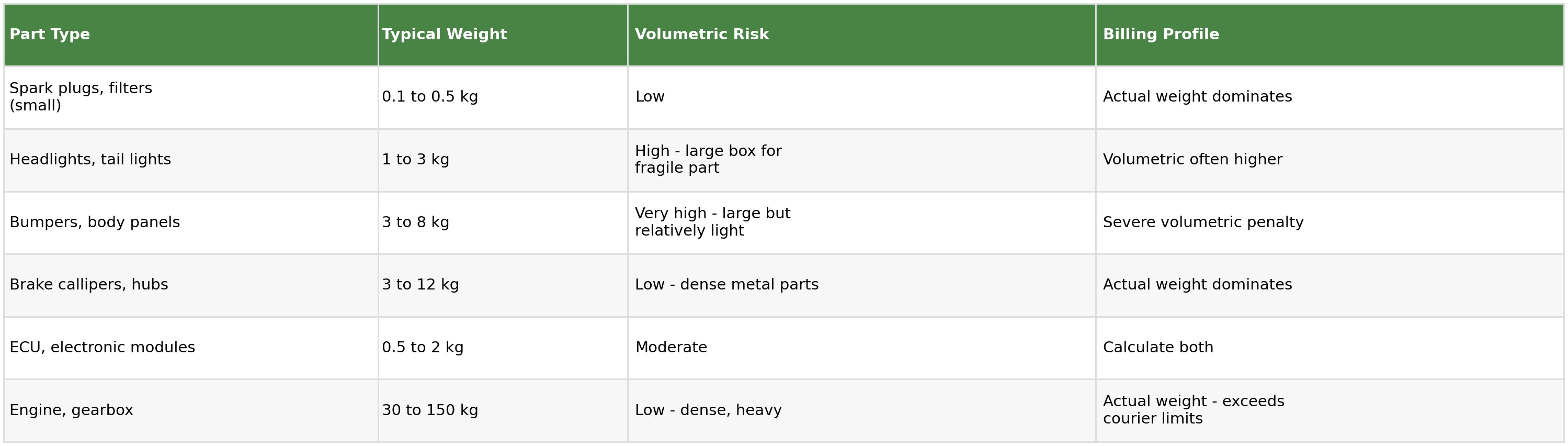
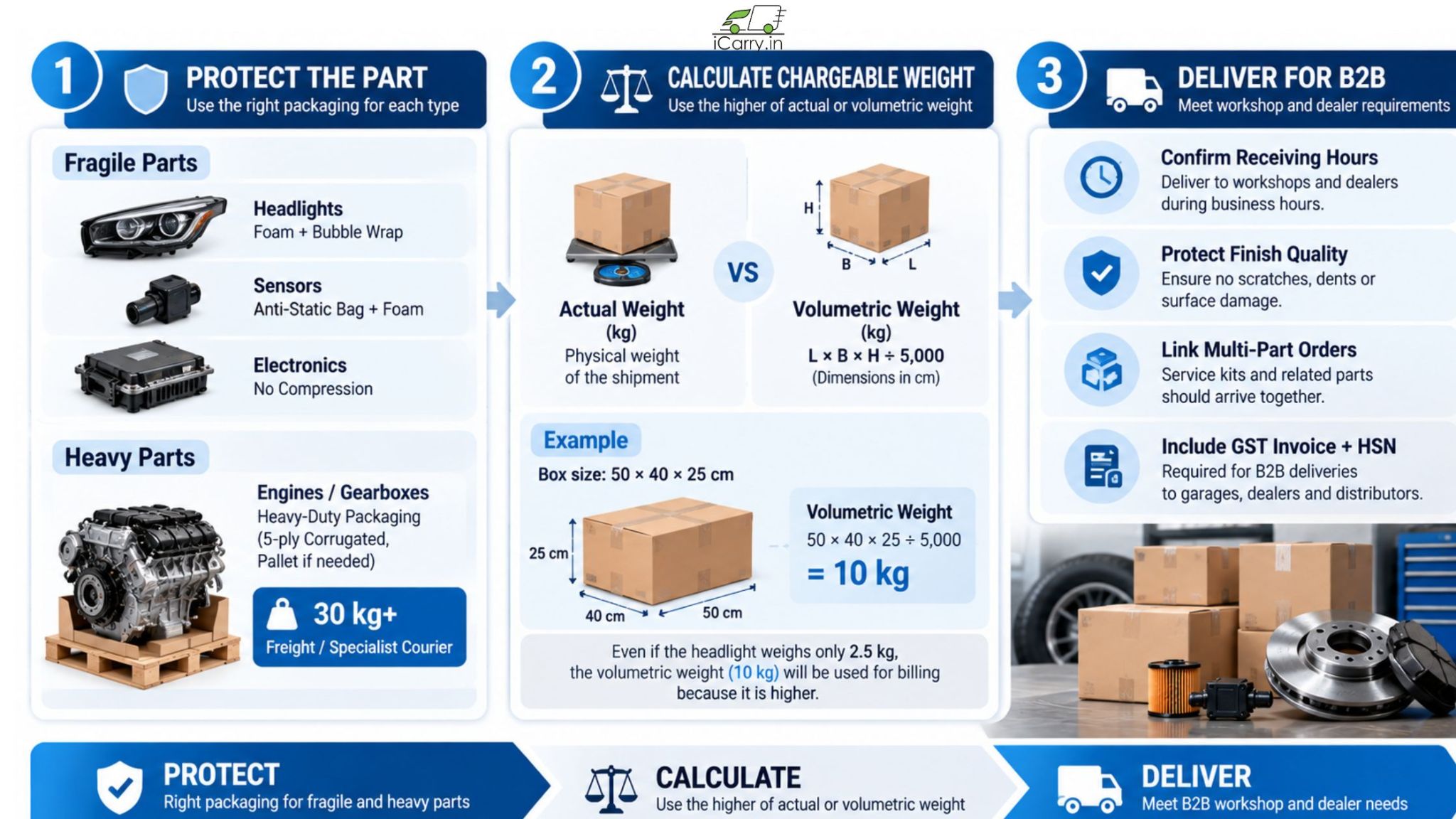
For all automotive parts, calculate chargeable weight before setting your shipping price. Headlights and exterior body panels are the most common sources of volumetric billing surprises - a headlight assembly in a 50 x 40 x 25 cm box has a 10,000g volumetric weight regardless of the 2.5 kg actual weight.
B2B Automotive Delivery - Workshops, Dealers, and Distributors
Automotive parts B2B delivery has specific requirements that differ from consumer deliveries:
- Operational urgency: A vehicle in a workshop bay waiting for a part means lost mechanic time and a delayed customer. B2B automotive buyers have low tolerance for late delivery or damaged parts on arrival. Same-day or next-day delivery for Zone A is often expected for routine parts
- Condition standards: Workshops inspect parts on arrival before installation. A part with cosmetic damage from transit may be refused as non-installable, even if functionally sound. Packaging must protect finish quality, not just structural integrity
- Receiving hours: Workshops typically operate 9 AM to 7 PM Monday to Saturday. Delivery must align with these hours - residential-style delivery windows do not work for workshop B2B
- Multi-part orders: A service kit (filter + oil + belt + gasket) that arrives as separate shipments on different days creates a problem for the workshop scheduling the service. Where possible, ensure all parts of a kit dispatch together and use multi-box linking
- Documentation: B2B automotive buyers require a proper tax invoice with HSN codes for GST compliance. Parts purchased for resale or use in a service business generate ITC claims
How iCarry® Supports Automotive Parts Businesses
iCarry® is a courier aggregator that serves Indian automotive parts businesses - from small accessories sellers to B2B parts distributors:
- Rate comparison at actual part weight: Enter the actual shipment weight and dimensions at booking and compare available courier rates before confirming. This helps businesses choose suitable options based on the part's weight, dimensions, destination, and delivery requirements.
- B2B multi-box booking: For multi-part service kits and larger orders, book linked B2B multi-box shipments, keeping multiple cartons associated with the same shipment for coordinated tracking and delivery.
- Transit Loss Insurance: For high-value components such as ECU units, ABS modules, sensors, and other electronic parts, businesses can enable Transit Loss Insurance while booking. The available coverage and applicable fee are shown before confirmation.
- OTP Verified Delivery: For high-value or sensitive automotive parts, OTP verification requires the recipient to enter a one-time password before delivery is completed, creating a verifiable, timestamped delivery confirmation.
- Multiple courier partners: Use multiple courier partners through the same iCarry® account and select suitable options based on weight, route, serviceability, and handling requirements.
- Address Quality Scoring: Workshop and dealer addresses can include unit numbers, industrial estate names, and other location details. Address Quality Scoring helps identify incomplete or potentially problematic addresses before dispatch.
- Two-way WhatsApp Engagement: Coordinate delivery with workshops, dealers, and other business customers through two-way WhatsApp communication, allowing recipients to confirm availability, update address details, or coordinate delivery when required.
- COD remittance: For businesses shipping automotive parts on COD terms, iCarry® provides automatic T+7 COD settlement, with Early COD options from T+0 for faster access to COD funds.
- Free Bronze plan, no minimum volume.
Final Thoughts
Automotive parts is a category where logistics quality is a direct commercial differentiator, particularly as margins come under pressure and new competitors enter the aftermarket. A workshop that receives the right part in perfect condition on the day promised builds a supplier relationship that drives repeat B2B orders. A workshop that receives a cracked headlight assembly switches suppliers.
The packaging investment for automotive parts is non-negotiable: original manufacturer packaging where available, foam-first for fragile electronics, anti-static for sensors, 5-ply corrugated for heavy assemblies, and secondary containment for fluids. These decisions cost marginally more per order and prevent the returns, replacements, and relationship damage that cost multiples more.
On the logistics side, the automotive category's weight range requires multi-courier access - because no single courier is the best choice across a 50g sensor and a 28 kg brake assembly. A courier aggregator that shows rates for both is the efficient way to manage the cost of a wide product range.
Frequently Asked Questions (FAQs)
What packaging is required for shipping headlight assemblies in India?
Foam sheet around the lens face first - no surface contact with bubble wrap or corrugated directly. Then bubble wrap around the full assembly. Moulded foam inserts or a rigid foam cutout that holds the assembly in a fixed position inside a 5-ply corrugated box. Mark FRAGILE and THIS SIDE UP on all faces. No movement inside the sealed box. Original manufacturer moulded packaging is best if available.
Can I ship engine blocks and gearboxes via standard courier?
No. Engine blocks and gearboxes typically weigh 30 to 150 kg, exceeding standard courier weight limits of 25 to 30 kg per parcel. These require LTL (Less than Truckload) freight, a specialist heavy goods courier, or a pallet delivery service. All oil and fluid ports must be sealed before dispatch. Weight must be clearly marked on the outer packaging for safe handling by receiving personnel.
How do I prevent automotive electronic components from being damaged in transit?
Anti-static bag around every electronic component before any other packaging. Rigid foam insert or cutout that holds the component in a fixed position - no compression from stacking. Moisture protection with silica gel sachet inside the sealed box. Express couriers for high-value ECU and ABS modules reduces handling points. Declare value accurately and enable declared value coverage - automotive electronics are high-value and non-repairable if transit-damaged.
What are the delivery requirements for automotive B2B customers (workshops, dealers)?
Workshops expect delivery within business hours (9 AM to 7 PM, Monday to Saturday). Parts must arrive in installable condition - cosmetic damage on visible surfaces is grounds for return even if functionally sound. Multi-part service kits should be dispatched together and arrive together, not as separate shipments on different days. Documentation must include a proper GST tax invoice with HSN codes for workshop ITC claims.
How does volumetric weight affect automotive parts shipping costs?
Dense metal parts (callipers, axles, hubs) bill on actual weight - volumetric weight is lower. Exterior body parts and lighting components bill primarily on volumetric weight because their packaging is large relative to their actual weight. A bumper in a 120 x 60 x 30 cm box has a 43,200g volumetric weight regardless of its 5 kg actual weight. Always calculate both before setting shipping charges on large exterior parts.
Automotive parts logistics quality is a direct commercial differentiator: original manufacturer packaging where available, foam-first for fragile electronics, anti-static for sensors, 5-ply corrugated for heavy assemblies, and secondary containment for fluids. These decisions cost marginally more per order and prevent the returns, replacements, and relationship damage that cost multiples more - and no single courier is the best choice across a 50g sensor and a 28 kg brake assembly, so multi-courier access matters.