An Ayurvedic brand lists a proprietary herbal formulation on a major marketplace. The product description includes the line: 'Clinically proven to lower blood sugar levels.' The listing goes live. Within 48 hours, the marketplace's compliance team flags it. The listing is suspended. The reason: specific disease treatment claims for an Ayurvedic product require CDSCO drug approval, not just an AYUSH manufacturing licence.
The product was genuine and well-formulated. The claim was the problem.
India's Ayurveda, Yoga, Naturopathy, Unani, Siddha, and Homoeopathy (AYUSH) sector is one of the country's most important wellness industries, valued at over $16 billion and growing rapidly. But Ayurvedic and herbal product brands face a uniquely complex compliance landscape - sitting at the intersection of AYUSH regulations, FSSAI requirements (for products marketed as food supplements), and CDSCO oversight (if disease claims are made). Add to this the packaging requirements for oils, powders, and liquid formulations, and the logistics for this category demands specific knowledge.
This guide covers what every Ayurvedic and herbal product brand shipping in India must know.
What Is AYUSH Compliance for Shipping Ayurvedic Products?
AYUSH compliance for shipping Ayurvedic products means meeting the manufacturing licence, labelling, and claims rules set by the Ministry of AYUSH before a product ever reaches a courier. Depending on the product, it can also mean FSSAI rules for food supplements or CDSCO approval where the label makes a disease-treatment claim. Getting the licence number, label format, or claims wrong is the single biggest reason Ayurvedic listings get suspended or shipments get rejected.
How to Check If Your Ayurvedic Product Is Ready to Ship
- Does your manufacturing unit hold a valid AYUSH manufacturing licence from the state licensing authority?
- Is your Drugs Licence number (for Ayurvedic drugs) or FSSAI number (for food supplements) on every label?
- Have all label claims been reviewed - do any claims imply disease treatment or cure?
- Is the correct classical or patent/proprietary formulation designation on the label?
- For liquid formulations: is the primary seal induction-sealed, not just capped?
- Is the product's shelf life sufficient for the delivery zone's transit time?
The Regulatory Framework - AYUSH vs FSSAI vs CDSCO
The first and most critical decision for any Ayurvedic or herbal brand is identifying which regulatory framework governs their product. This determines the licence required, the label format, and the claims permitted:
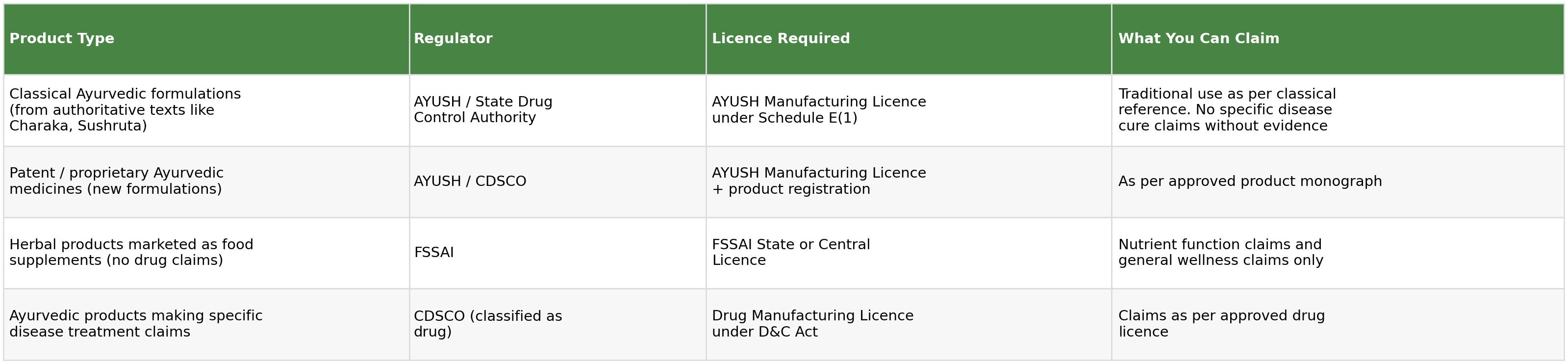
The claim determines the classification: An Ayurvedic oil marketed as 'traditional hair nourishment' falls under AYUSH. The same oil marketed as 'proven to treat alopecia' becomes a drug claim and falls under CDSCO. The product does not change - the claim does. Always have a qualified regulatory consultant review label and marketing claims before going to market.
AYUSH Mandatory Label Requirements
The Drugs and Cosmetics Act and AYUSH guidelines specify mandatory label elements for Ayurvedic drugs and formulations. The Ministry of AYUSH and state drug control authorities enforce these requirements:
- Drugs Licence number: The manufacturing licence number issued by the state drug control authority. Mandatory on all Ayurvedic drug labels
- Product name: Classical name (if applicable) and brand name
- Formulation type: Tablet, capsule, churna, kwath, taila , ghrita, asava, arishta, etc. The Ayurvedic dosage form must be correctly described
- Ingredients: All ingredients with Sanskrit/common names and quantities per unit dose
- Batch number and manufacturing date
- Best before / expiry date
- Dosage and administration instructions
- Contraindications and warnings where applicable: 'Not to be used during pregnancy', 'Keep out of reach of children' where relevant
- Net content (weight or volume)
- MRP inclusive of all taxes
- Manufacturer name and address with AYUSH licence number
- Classical text reference: For classical formulations, the reference text (e.g. 'Ref: Charaka Samhita, Chikitsa Sthana') provides traceability to the traditional basis
Prohibited on Ayurvedic labels: Claims that the product 'cures', 'treats', 'prevents', or 'reverses' specific modern medical disease names without regulatory approval. 'Supports joint health' may be acceptable; 'Treats osteoarthritis' is not without approved evidence.
Packaging Ayurvedic Products for Courier Transit
Oils (Tailas) - Bottles and Sachets
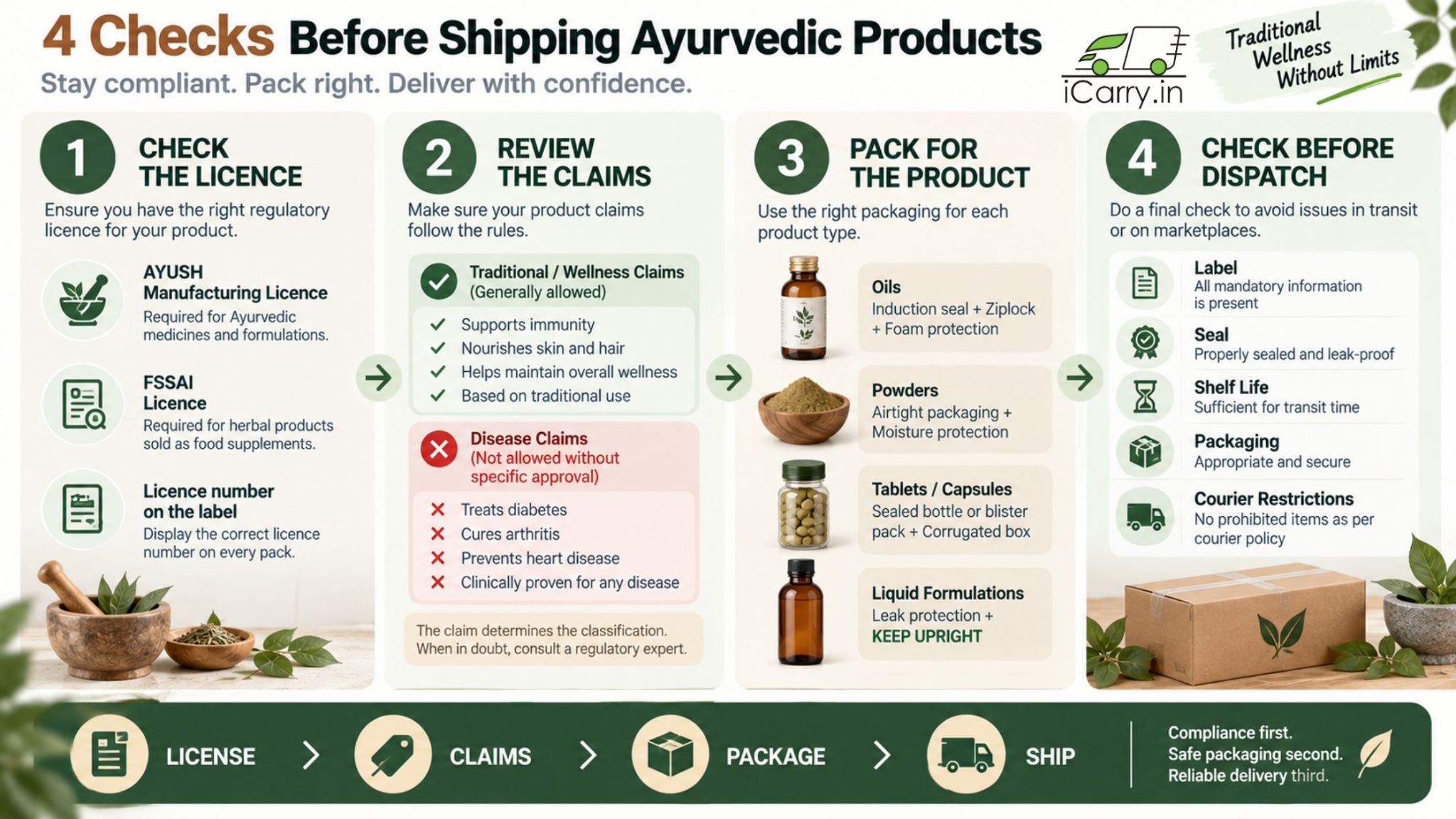
- Glass bottles: induction seal mandatory on the inner cap. Individual bubble wrap per bottle. Corrugated outer with foam dividers
- Plastic bottles: induction seal + childproof cap. No glass-to-plastic contact. Corrugated outer
- Sachets: heat-sealed, laminated foil material. Bundle sachets in a sealed polythene bag before boxing
- Mark KEEP UPRIGHT on all faces of the outer carton. Ayurvedic oils can stain fabric and packaging if they leak
- Ziplock secondary seal around each bottle as leak containment
Powders (Churnas, Bhasmas, Rasayanas)
- Primary packaging: airtight foil pouch or HDPE jar with induction seal. Moisture is the primary enemy of powder formulations
- Silica gel sachet inside the outer carton for additional moisture protection
- Bhasmas and fine powders: double-sealed packaging mandatory. Bhasmas are extremely fine and will disperse through any imperfect seal
- HDPE jars: verify the lid is fully threaded and sealed before boxing. A partially closed HDPE jar lid fails in transit
- For branded gift sets with multiple churna jars: foam tray insert to prevent jar-to-jar contact
Tablets and Capsules
- HDPE bottle or blister pack with sealed lid or intact blister
- Cotton wool inside HDPE bottles prevents rattling and absorbs any moisture
- Corrugated outer - never poly mailer for tablet formulations
- For glass vials or specialty packaging: bubble wrap individual vials, foam dividers in the outer carton
Liquid Formulations (Asavas, Aristas, Kwathas)
Fermented Ayurvedic preparations (asavas and aristas) and liquid decoctions present specific transit challenges - they contain alcohol from natural fermentation and can generate gas pressure in sealed containers:
- Use only glass bottles with induction-sealed metal caps for asava and arista. Plastic bottles are not appropriate for fermented preparations
- Do not fill bottles to the brim - leave 3 to 5% headspace for any gas expansion
- Transport at ambient temperature - avoid direct sun exposure during summer transit
- Declare alcohol content accurately if above 0.5% - certain courier partners and routes have restrictions on alcohol-containing products
Claim Restrictions - The Most Common Compliance Risk
Ayurvedic and herbal brands consistently face marketplace delisting and regulatory notices due to label and marketing claims. The framework:
- Permitted traditional use claims: 'Used in Ayurveda for digestive support', 'Traditional Ayurvedic formulation for respiratory wellness.' These reference traditional use without claiming disease treatment
- Permitted wellness claims: 'Supports immunity', 'Promotes overall wellbeing', 'Nourishes skin and hair.' General wellness without disease specificity
- Prohibited disease claims: 'Treats diabetes', 'Cures arthritis', 'Proven remedy for PCOD', 'Reverses hair loss due to alopecia.' Any claim that a product treats, cures, or prevents a named medical condition is prohibited without the appropriate drug approval
- Grey zone - use with caution: 'Balances blood sugar levels', 'Supports healthy joints'. These can be interpreted as disease claims by marketplace compliance teams. Have a regulatory consultant review before use
The safest approach: all claims should be rooted in traditional Ayurvedic classical text references where possible. 'As referenced in Charaka Samhita for respiratory support' is more defensible than 'proven to treat cough and cold.'
International Export of Ayurvedic Products
Ayurvedic products face specific challenges in international markets:
- Heavy metal limits: Classical bhasmas and some Ayurvedic formulations contain processed heavy metals (lead, mercury, arsenic) within Ayurvedic classical limits. These are illegal to import in most Western markets regardless of classical processing. Verify destination country regulations before exporting any formulation containing minerals or processed metals
- Herb-specific import restrictions: Certain Ayurvedic herbs face import restrictions in specific countries (e.g. kava, certain Aristolochia species). Verify the destination country's restricted herb list
- Classification at customs: Ayurvedic products may be classified as drugs, food supplements, or cosmetics by destination country customs. The classification affects import duty, documentation, and regulatory approval requirements
- CDSCO export NOC: For export of Ayurvedic drugs, an NOC (No Objection Certificate) from CDSCO may be required
How iCarry® Supports Ayurvedic and Herbal Product Brands
iCarry® is a courier aggregator that serves Ayurvedic brands and herbal wellness businesses across India:
iCarry® supports Ayurvedic and herbal businesses with shipping, delivery coordination, COD management, and other logistics features designed to simplify day-to-day order fulfilment across India:
- Multiple courier partners: Access multiple courier partners through one iCarry® account and select suitable options based on destination, shipment weight, serviceability, and delivery requirements.
- Weight and rate comparison: Enter shipment weight and dimensions and compare courier rates before booking, helping businesses choose a suitable option for each shipment.
- Transit Loss Insurance: For high-value Ayurvedic products, businesses can enable Transit Loss Insurance while booking. The available coverage and applicable fee are shown before the shipment is confirmed.
- Address Quality Scoring: Check customer addresses before dispatch to identify incomplete or potentially problematic addresses and reduce avoidable delivery issues.
- OTP Verified Delivery: For high-value or sensitive shipments, OTP verification requires the recipient to enter a one-time password before delivery is marked complete, creating a verifiable, timestamped delivery confirmation.
- Two-way WhatsApp Engagement: Coordinate with customers before delivery through two-way WhatsApp engagement. Customers can confirm availability, update their address, or coordinate delivery, while businesses can view the conversation history.
- Delivery Boost: Support pre-delivery coordination through additional delivery efforts, helping improve the chances of successful first-attempt delivery and reduce avoidable RTOs.
- COD management: Manage COD collections and settlements across courier partners through one account, with automatic T+7 remittance and Early COD options from T+0 for faster access to COD funds.
Final Thoughts
Ayurvedic and herbal product brands operate in one of India's most opportunity-rich wellness categories - but also one of its most regulation-specific. The compliance framework is not complex once understood: get the right AYUSH manufacturing licence, put the licence number on every label, restrict claims to traditional use and wellness statements, and never use disease treatment language without appropriate regulatory approval.
On the logistics side, the packaging decisions for oils, powders, and liquids are specific but learnable: induction seals on all liquid products, airtight packaging for powders, and corrugated outer boxes with secondary leak containment for everything that can flow.
Brands that combine regulatory compliance, professional packaging, and reliable logistics can build greater customer trust, create a smoother delivery experience, and encourage repeat purchases.
Frequently Asked Questions (FAQs)
Does selling Ayurvedic products online require a manufacturing licence?
Yes. Manufacturing Ayurvedic drugs for commercial sale requires a manufacturing licence from the state drug control authority under Schedule E(1) of the Drugs and Cosmetics Act. The licence number must appear on every product label. Selling Ayurvedic products without a valid manufacturing licence is a violation of the D&C Act. Contact your state drug control authority or visit ayush.gov.in for guidance on the licensing process.
Can I claim my Ayurvedic product treats a specific disease?
No, without specific regulatory approval. Disease treatment claims (treats, cures, prevents, reverses a named medical condition) on Ayurvedic products require CDSCO drug approval beyond the basic AYUSH manufacturing licence. Most Ayurvedic product claims should be framed as traditional use statements ('Used in Ayurveda for respiratory support') or general wellness claims ('Supports immunity'). Have a regulatory consultant review all claims before going to market.
How should I package Ayurvedic oils to prevent leakage in courier transit?
Use induction-sealed glass or plastic bottles. Place each bottle in a ziplock bag as secondary containment. Wrap glass bottles individually in bubble wrap. Use corrugated outer boxes with foam dividers between bottles. Mark KEEP UPRIGHT on all four sides and the top of the outer carton. Never use poly mailers for any oil formulation. Test packaging by inverting and shaking before committing to a format.
Can asavas and aristas (fermented Ayurvedic preparations) be shipped via courier?
Yes, with appropriate packaging. Use glass bottles with induction-sealed metal caps only. Leave 3 to 5% headspace for any gas expansion from natural fermentation. Do not fill to the brim. Declare alcohol content accurately at booking if the preparation contains above 0.5% alcohol. Some courier partners have restrictions on alcohol-containing products for specific routes.
How does iCarry® support Ayurvedic brands with high COD volumes?
iCarry® manages COD collection and remittance across multiple courier partners through one account. Businesses receive automatic T+7 COD settlement at no cost, with Early COD options from T+0 available for faster access to COD funds. Two-way WhatsApp engagement also helps coordinate with customers before delivery, allowing them to confirm availability, update their address, or coordinate delivery, which can help reduce failed delivery attempts and RTOs on COD orders.
Ayurvedic and herbal product brands operate in one of India's most opportunity-rich wellness categories, but also one of its most regulation-specific - get the right AYUSH manufacturing licence, put the licence number on every label, restrict claims to traditional use and wellness statements, and never use disease treatment language without regulatory approval. On packaging: induction seals on all liquid products, airtight packaging for powders, and corrugated outer boxes with secondary leak containment for everything that can flow.