
A diya seller in Jaipur ships 400 orders in the week before Diwali. She packs them in newspaper and places four diyas per box with loose fill. Three hundred arrive intact. Sixty arrive with chips or cracks. Forty are fully broken. She spends the week after Diwali processing refunds and managing angry reviews.
The next year she changed the packaging: foam sheet on every diya, individual compartments in the box, no diya touching another diya. She ships 600 orders. Eight arrive broken. The reviews say 'beautifully packed.'
Diwali is India's largest gifting and home decoration occasion. The festival drives a surge in online orders for decor, lighting, and gifting products in the 2 to 3 weeks leading up to the festival date. For sellers of diyas, candles, rangoli sets, decorative lights, idols, and gifting sets, Diwali represents the year's highest-revenue period - and its highest logistics risk.
Three things can go wrong: the product breaks in transit, the order arrives after Diwali, or the courier network is overwhelmed and both happen simultaneously. This guide covers how to prevent all three.
What Is Diwali Decor Shipping in India?
Diwali decor shipping in India means dispatching diyas, rangoli sets, lights, and idols early enough and packaged well enough to survive both a fragile product category and the year's highest-volume courier season. Courier networks run at 150 to 200% of normal volume in the weeks before Diwali, which extends transit times across every zone. Get the dispatch date or the packaging wrong and the result is either a broken product or a gift that arrives after the festival it was bought for.
How to Prepare for Diwali Dispatch
- Have you calculated the dispatch start date accounting for Zone D and E transit times plus buffer days?
- Are all fragile decor items individually wrapped with no product-to-product contact inside the box?
- Have you pre-informed your courier agent of expected volume at least 5 days before peak dispatch begins?
- Have you checked which of your destination pincodes are ODA or high-delay during festival season?
- Is declared value coverage enabled for all orders above ₹2,000?
- Have you set realistic delivery timelines in your product listings - not standard transit time, but festival-period transit time?
The Dispatch Timing Problem - Plan Earlier Than You Think
The most common Diwali logistics failure is not a packaging failure - it is a timing failure. Sellers dispatch in the 3 to 4 days before Diwali expecting standard transit times. But courier networks at Diwali are operating at 150 to 200% of their standard daily volume. Sorting centres slow. Vehicles are overloaded. Zone D orders that normally take 5 to 6 days take 8 to 10 days.
The dispatch timing framework for Diwali:
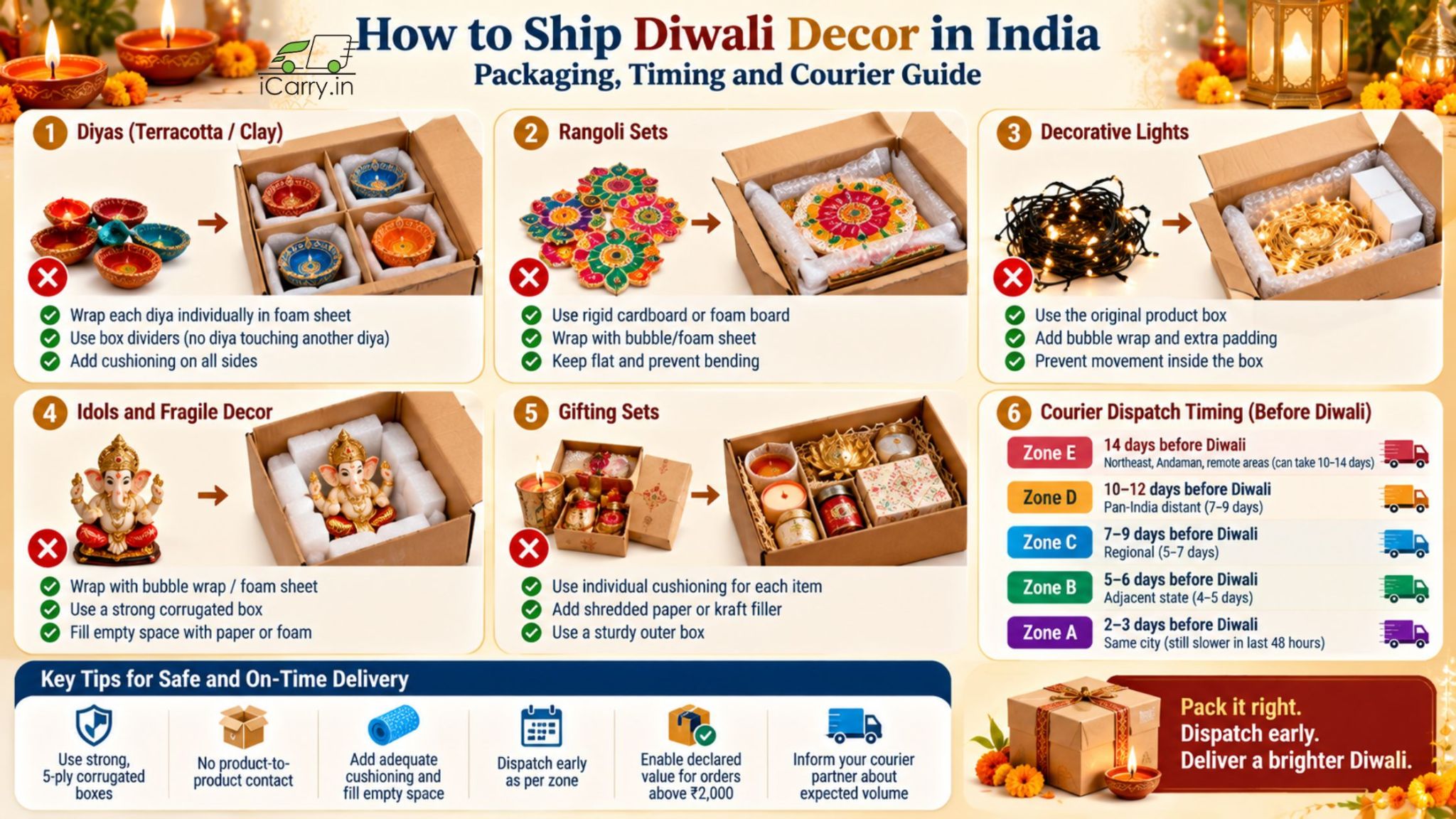
- Zone E recipients (Northeast, Andaman, remote): Dispatch 14 days before Diwali. No exceptions. Zone E in festival season can take 10 to 14 days
- Zone D recipients (pan-India distant): Dispatch 10 to 12 days before Diwali. Festival-season Zone D routinely takes 7 to 9 days
- Zone C recipients (regional): Dispatch 7 to 9 days before Diwali
- Zone B recipients (adjacent state): Dispatch 5 to 6 days before Diwali
- Zone A recipients (same city): Dispatch 2 to 3 days before Diwali. Same-city orders have the most flexibility but even Zone A slows during the final 48 hours before the festival
The rule: Add 2 to 3 days to every standard transit time for Diwali-season shipments. Then add another 1 to 2 days as a buffer. A Zone D order dispatched 10 days before Diwali has a reasonable chance of arriving 1 to 2 days before the festival. An order dispatched 5 days before has almost no chance.
Packaging Diwali Decor by Product Type
Terracotta and Clay Diyas
Diyas are the highest-damage-risk product in the Diwali decor category. Terracotta is brittle, chips easily on edge impact, and cracks under any compressive force. The packaging principle is absolute: no diya touches another diya, no diya touches the box wall.
- Wrap each diya individually in foam sheet - not newspaper, which provides almost no protection
- Create compartments within the box using corrugated dividers cut to fit between diyas. Each diya in its own cell
- Fill any remaining void space completely - a diya that can shift one centimetre can chip on impact
- For set packs (sets of 5, 10, 20): each diya individually wrapped and then the set placed in a tray with dividers before boxing
- 5-ply corrugated for all diya orders - standard 3-ply softens under moisture and handling pressure in transit
- Mark FRAGILE and DO NOT STACK on all four sides and top of the outer box
Glass and Crystal Decor (Vases, Tealight Holders, Glass Lanterns)
- Each piece in foam sheet first, then two layers of bubble wrap
- No glass-to-glass contact at any point inside the box
- Corrugated dividers between pieces for multi-piece sets
- Box right-sized to the product with 4 to 5 cm cushioning on all sides
- Mark FRAGILE and KEEP UPRIGHT where orientation matters (open-top vases, lanterns with glass panels)
- For lanterns with intricate metalwork: wrap metalwork separately in foam to prevent scratching of the finish
Decorative Lights (Diwali String Lights, LED Diyas, Electric Lanterns)
- Wind string lights loosely - tight winding stresses the wire at the bulb socket connections
- Secure the plug end so it does not bang against the lights during transit
- For LED diya products: protect the individual LED elements from impact
- Electronic components inside decorative lights: ensure the battery or transformer compartment is closed and secure
- Poly mailer is acceptable for string light sets below 500g with no rigid elements. Corrugated for anything heavier or with a rigid power unit
Rangoli Sets (Powder, Stencils, Accessories)
- Rangoli powder packets: seal each packet individually with tape or heat seal before boxing. Powder that escapes its packet inside the box ruins the whole order
- Stencils: protect flat surfaces from bending. Rigid cardboard backing behind stencil sheets before boxing
- Glass bottles of liquid rangoli: treat as fragile - induction seal, ziplock secondary containment, corrugated with dividers
- Complete rangoli kit boxes: shrink wrap or tape the kit box shut before placing in a corrugated outer
Idols and Decorative Figurines (Ganesh, Lakshmi, Brass Decor)
- Brass idols: individually wrapped in foam sheet to protect the finish from scratches. Brass is soft and scratches against other surfaces
- Resin and plaster idols: treat as highly fragile. Foam first, bubble wrap second, corrugated outer with internal bracing
- For idols with protruding elements (multiple arms, crowns, weapons): wrap each protrusion individually before wrapping the whole piece
- Never place idols loose in a box with other products - always in their own individual packaging
Managing Courier Network Congestion During Diwali
The courier network at Diwali is under maximum stress, with delivery agents routinely handling up to 200 packages a day during peak Diwali week. Understanding the congestion pattern helps plan around it:
- The congestion window: The 7 days before Diwali are the peak congestion period. Sorting centres in major hubs (Mumbai, Delhi, Bengaluru, Hyderabad) process 2 to 3x their standard daily volume. Transit times extend for all zones
- Courier hub capacity: Inform your pickup courier agent of your expected Diwali volume at least 5 to 7 days before your peak dispatch week begins. Hub managers can pre-arrange additional vehicle capacity for confirmed large volumes. An unannounced 500-order day creates a pickup failure
- ODA pincodes delay more: ODA pincodes that take 2 extra days in normal season can take 4 to 5 extra days in the Diwali season. Flag ODA destination orders for earlier dispatch
- COD risk in festival season: Impulse COD orders placed in the festival excitement have higher doorstep refusal rates when they arrive 2 to 3 days after Diwali. Send WhatsApp confirmation for all COD orders above ₹299 before dispatching
Bulk and Corporate Diwali Orders
Many Diwali decor sellers receive bulk orders from corporates buying decor sets for offices, gifting, or event decoration. Bulk orders during festival season create specific logistics requirements:
- Batch dispatch by zone: Dispatch Zone D and E recipients of the bulk order first, Zone A last. All arrive before Diwali despite different dispatch dates
- Multi-box B2B booking: For large corporate orders shipped to a single address (office, event venue), book as linked multi-box shipments. All cartons tracked together and delivered together
- Single recipient, large quantity: For 50+ units going to one address, negotiate a direct vehicle delivery with a transporter rather than routing through the courier network at its peak congestion period
- Individual recipient gifts (100+ addresses): Start address verification 10 days before dispatch. Corporate Diwali gift lists routinely have 15 to 20% incomplete or incorrect addresses
Setting Realistic Customer Expectations
One of the highest drivers of Diwali-related negative reviews is the gap between the customer's delivery expectation and the reality of festival-season transit times. Manage expectations proactively:
- Update product listing delivery estimates during Diwali season: 'Please note: Diwali season orders may take 2 to 3 additional days due to high courier network volume'
- Send a WhatsApp or email at dispatch noting the realistic delivery window: 'Your Diwali decor has been dispatched. With festival season courier volume, please expect delivery by [date]'
- For orders placed within 5 days of Diwali: add a note at checkout that delivery may not arrive before the festival date, and offer the option to receive after or to cancel
- Customers who were warned about potential delays and received them are far more understanding than customers who expected on-time delivery and did not get it
How iCarry® Supports Diwali Season Dispatch
iCarry® is a courier aggregator that gives Diwali decor sellers multi-courier access, rate comparison, and delivery management tools for the season's peak:
- Multiple courier partners: If your primary courier is saturated during peak Diwali week, route overflow volume to an alternate courier through the same iCarry® account. No new account setup required. Compare rates before every booking
- Bulk booking: Process all day's orders in one bulk booking session. Critical during peak Diwali dispatch when manual individual booking is not viable at volume
- Delivery Boost: For premium Diwali gift sets and high-value decor orders, Delivery Boost pre-delivery coordination reduces failed first attempts - particularly important in the 3 days before Diwali when reattempts may not happen before the festival
- Two-way WhatsApp engagement: Customers can reschedule, update their address, or confirm delivery timing - reducing the failed deliveries that mean a Diwali order arrives after the occasion
- Declared value coverage: Enable for all Diwali decor orders above ₹2,000. Festival-season transit involves more handling points and higher damage risk
- COD remittance: Diwali is a high-COD season across all decor categories. iCarry®'s automaticT+7 settlement and Early COD options from T+0 for faster access to COD funds.
Free Bronze plan, no minimum volume.
Final Thoughts
Diwali is the highest-revenue, highest-risk period for any seller of decor, gifting, or festival products. The two variables that determine whether the season is profitable or loss-making are packaging quality and dispatch timing. Get both right and Diwali generates reviews and repeat customers that carry the brand through the rest of the year. Get either wrong and the refunds, replacements, and negative reviews of a bad Diwali season take months to recover from.
Package every fragile decor item as if it is the most important thing you will ever ship - because for the customer who ordered it for their Diwali puja, it is. And dispatch Zone D orders 10 to 12 days before Diwali without exception. The festival does not wait for a late delivery.
Frequently Asked Questions (FAQs)
How early should I dispatch Diwali orders to ensure they arrive before the festival?
Dispatch Zone E orders (Northeast, remote pincodes) 14 days before Diwali. Zone D (pan-India distant) 10 to 12 days before. Zone C (regional) 7 to 9 days before. Zone B (adjacent state) 5 to 6 days before. Zone A (same city) 2 to 3 days before. Add 2 to 3 days to all standard transit times during Diwali season due to courier network congestion.
How should I package clay diyas for courier transit?
Wrap every diya individually in a foam sheet - not newspaper. Create corrugated cardboard dividers inside the box so each diya sits in its own compartment with no contact with adjacent diyas or the box wall. Fill all remaining void space completely. Use a 5-ply corrugated outer. Mark FRAGILE and DO NOT STACK on all four sides. A diya that cannot move inside the box will not break in normal courier transit.
Why do transit times increase during Diwali?
Courier networks process 150 to 200% of their standard daily volume in the 7 to 10 days before Diwali. Sorting centres are slow, vehicles are fully loaded, and delivery agents have more stops per route. All zones experience transit time extensions of 2 to 5 days versus standard SLA. Plan around this by dispatching earlier and communicating realistic delivery timelines to customers at the time of ordering.
Should I offer COD on Diwali decor orders?
With caution. Festival impulse purchases on COD have elevated doorstep refusal rates when the order arrives 1 to 2 days after Diwali. Send a WhatsApp confirmation before dispatching all COD orders above ₹299. Consider restricting COD to Zone A and B orders where delivery is more likely to happen before the festival. For Zone D COD orders placed within 5 days of Diwali, strongly consider declining COD and offering prepaid only.
How does iCarry® help with Diwali season dispatch volume?
iCarry® supports high Diwali dispatch volumes with bulk booking and access to multiple courier partners, allowing businesses to choose different courier options based on the delivery location, shipment weight, serviceability, rates, and the shipping data. Delivery Boost can help with pre-delivery coordination for time-sensitive festive orders, while Two-way WhatsApp Engagement allows businesses to coordinate delivery with customers and handle address updates or delivery availability. All shipments can be monitored through one dashboard across courier partners.
Diwali decor logistics comes down to two variables: packaging that stops product-to-product contact, and dispatch timed to the destination zone - 14 days out for Zone E, down to 2 to 3 days for Zone A, with 2 to 3 extra days built in everywhere for festival-season congestion. Get a diya, idol, or glass piece wrapped so it genuinely cannot move inside the box, dispatch early rather than on standard timelines, and warn customers about realistic delivery windows up front. That combination is what separates a profitable Diwali season from a season of refunds.