A hardware distributor in Pune ships an order to a contractor in Nagpur. The consignment: 12 angle grinders, 8 power drills, 4 sets of drill bits. Total weight: 38 kg. Total cartons: 4. One carton contains ceramic tile cutters - fragile if dropped. One carton contains abrasive grinding wheels - fragile if compressed.
The courier agent arrives with a standard delivery vehicle. Two cartons are stacked incorrectly at the sorting centre. The tile cutters arrive broken. The contractor refuses the damaged carton. The distributor absorbs the return freight and the replacement.
India's home improvement and hardware market - tools, electrical fittings, plumbing supplies, tiles, adhesives, fasteners, and building materials - is one of the country's most volume-intensive B2B logistics categories. Growing construction and real estate activity combined with the rise of online hardware procurement means Indian hardware businesses are shipping increasingly complex, heavy, and fragile products to contractors, retailers, and end customers across the country.Tiles are a good example of the scale involved - India's decorative construction materials market, including paints and ceramic tiles, was valued at roughly US$ 10.46 billion in 2025 and is projected to reach US$ 16.38 billion by 2030 , per IBEF - a lot of that volume moves through exactly the kind of courier and B2B logistics networks this guide covers.
This guide covers the specific logistics challenges of hardware and home improvement products - weight and billing, fragile product protection, B2B multi-box shipments, and courier selection for this demanding category.
What Makes Hardware Shipping Different?
Hardware and home improvement products - tools, tiles, pipes, fittings, and building materials - combine three challenges that most other product categories only face one at a time: heavy weight that drives up billing, fragile components packed inside heavy cartons, and frequent multi-box B2B orders that need to arrive together. Getting any one of those wrong is usually what turns a routine delivery into a damage claim or a billing dispute.
Quick Checklist - Hardware Shipping Essentials
- Have you calculated the chargeable weight (higher of actual vs volumetric) for each carton?
- Are fragile hardware items (ceramic, glass, blades) individually protected within the carton?
- For multi-carton B2B orders: have you booked a multi-box shipment with linked AWBs?
- Have you marked weight limits on the carton exterior to prevent over-stacking?
- Is the B2B delivery address a business address with daytime receiving capability?
Weight and Billing for Hardware Products
Hardware products are one of the most billing-intensive categories in Indian courier logistics - not because they are expensive to ship per kg, but because they frequently create billing surprises through weight and dimension mismatches.
Actual Weight vs Volumetric Weight
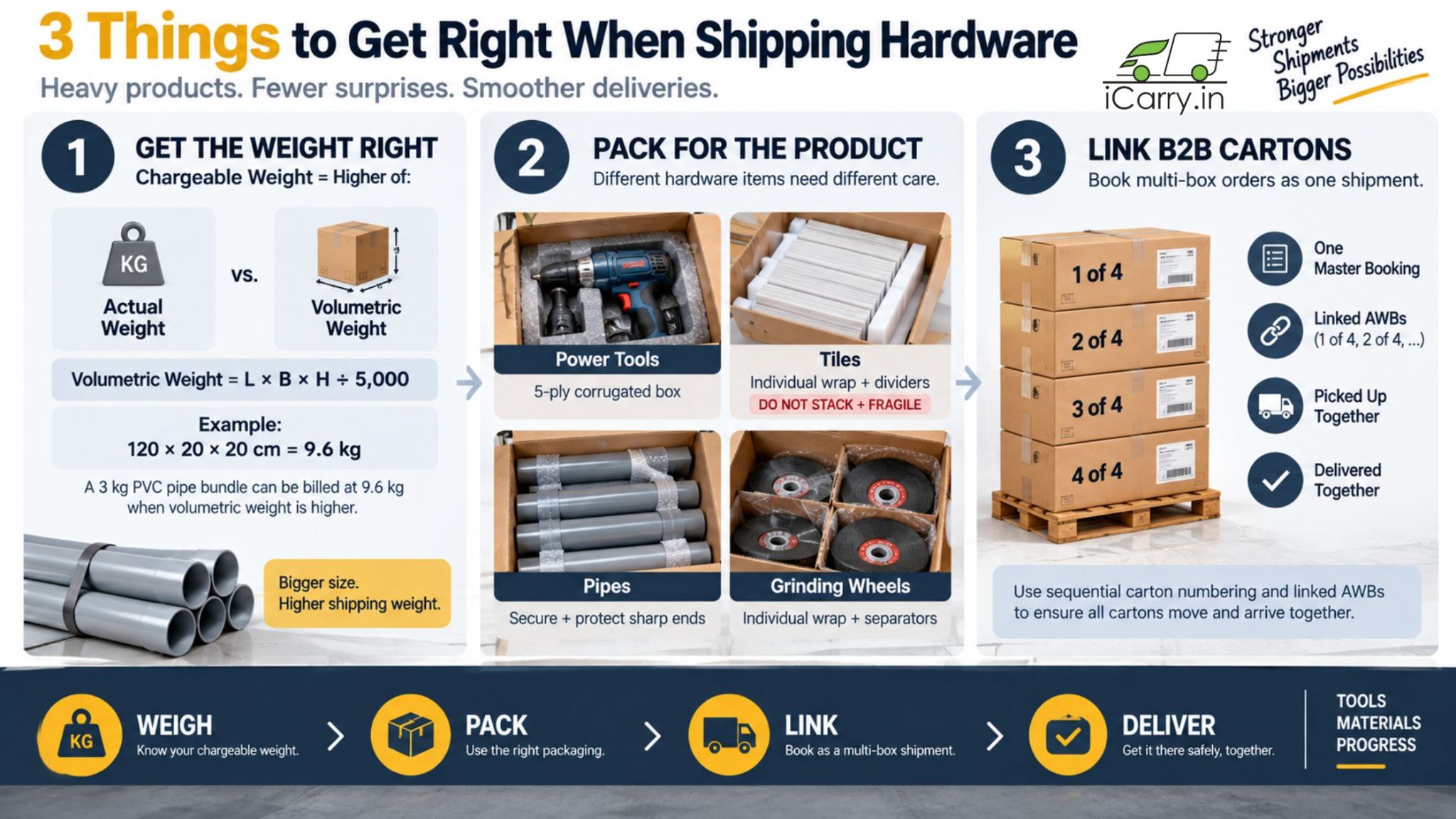
Indian couriers charge based on whichever is higher - actual weight or volumetric weight (L x B x H in cm / 5,000). Hardware products create both types of billing surprises :
- Heavy dense products (metal tools, fasteners, pipes): Actual weight is typically higher than volumetric weight. A 5 kg drill in a 30 x 20 x 15 cm box has a 1,800g volumetric weight. Billed at 5 kg actual. No volumetric penalty here - but weight itself creates cost
- Lightweight bulky products (plastic fittings, PVC pipes, foam insulation, packaging materials): Volumetric weight dominates. A bundle of PVC pipes in a 120 x 20 x 20 cm box has a 9,600g volumetric weight but may weigh only 3 kg actual. Billed at 9.6 kg. The volumetric penalty is severe
- Mixed consignments: A carton with both heavy metal tools and lightweight plastic accessories. Weigh sealed cartons after packing. Both components contribute to volumetric weight; only the metal contributes to actual weight proportionally
The hardware shipping rule: Always weigh after sealing. Hardware products are routinely 15 to 30% heavier packed than the product weight alone because of the wood, foam, and corrugated packaging required to protect them. Underdeclaring weight on heavy hardware leads to consistent discrepancy charges.
Weight Slab Billing for Heavy Hardware
Most couriers transition from per-slab to per-kg billing above a certain weight. For heavy hardware consignments, understanding the billing structure prevents unexpected invoice totals:
- Standard courier billing typically uses 500g slabs up to 10 kg
- Above 10 kg, billing is usually per-kg with a minimum additional per-kg rate
- For very heavy individual cartons (above 25 to 30 kg), some couriers apply an overweight surcharge
- B2B surface freight is often more cost-effective than courier for consignments above 30 kg - calculate both options before booking
Packaging Hardware Products for Courier Transit
Power Tools and Electric Tools
- Original manufacturer packaging (styrofoam inserts, branded box) is the best protection if available
- If original packaging is unavailable: foam-padded corrugated outer, tool oriented flat with no protrusions able to puncture the box
- Secure all accessories (bits, blades, batteries) separately inside the box - accessories that shift damage the tool during transit
- Remove batteries from battery-powered tools before shipping - lithium batteries in power tools require specific handling
- Wrap blade and cutting edge accessories in blade guard or foam. Never let exposed cutting edges contact the box walls
- 5-ply corrugated mandatory for any power tool above 3 kg
Ceramic and Porcelain Tiles, Sanitary Ware
- Individual tiles wrapped in foam sheet or bubble wrap - no tile-to-tile contact
- Tile stacks secured vertically in the carton (on edge) rather than flat - tiles are more resistant to breakage when stacked vertically
- Foam or cardboard dividers between wrapped tiles
- Mark DO NOT STACK and FRAGILE on all faces of the carton
- 5-ply corrugated minimum. Standard 3-ply corrugated will collapse under stacking weight in a sorting centre with heavy cartons above it
- For sanitary ware (wash basins, toilet fixtures): individual moulded foam inserts are the industry standard. Custom foam is expensive but the damage rate without it is not financially viable
Plumbing Fittings and Pipes
- Small fittings (valves, connectors, nuts, bolts): Seal in plastic bags to prevent movement and rust from moisture. Box in corrugated with void fill
- Longer pipes and rods: Standard courier often does not accept oversized length items. Check maximum dimension limits (typically 120 to 150 cm) before booking. For longer items, LTL freight or specialist over-dimension courier is required
- Metal pipes: Sharp cut ends must be capped or taped to prevent puncturing the outer carton and other parcels in transit
- PVC and plastic pipes: Bundle securely to prevent pipes separating in transit. Wrap bundle in corrugated and strap. Measure the bundle's volumetric weight - long PVC bundles have extreme volumetric billing
Electrical and Wiring Products
- Wire coils and cable rolls: secure to prevent unrolling in transit. Tape or band the roll
- Circuit breakers and MCBs: original packaging preferred. Protect terminals from contact
- Switchgear and distribution boards: rigid corrugated with internal bracing to prevent the unit from moving
- Fragile components (glass fuses, indicator lights, LCD displays): foam wrap individually before boxing with the larger product
Abrasive and Cutting Products (Grinding Wheels, Saw Blades)
Grinding wheels and diamond saw blades are fragile and sharp simultaneously - a combination that requires specific care:
- Never stack grinding wheels directly on top of each other - they chip at the contact edge
- Individual foam sheet wrap around each wheel
- Cardboard ring or tube separator between wheels in a column
- Corrugated outer box, standing upright to distribute weight evenly
- DO NOT STACK markings on all faces. Grinding wheels in a horizontal carton under stacking weight will crack at the outer edge
- Blades with teeth: wrap in cardboard or foam to protect the teeth and the other contents from the sharp edges
B2B Multi-Box Hardware Shipments
Hardware B2B orders frequently span multiple cartons - a retailer order of 50 plumbing kits, a contractor order of tools and accessories, a site delivery of electrical supplies across multiple carton types.
Multi-box B2B shipments must be booked as linked consignments with a single overarching booking that connects all carton AWBs.The iCarry® multi-box booking flow is built for exactly this scenario.
- Link all cartons to one booking: Each carton gets its own AWB but all are linked under one B2B multi-box booking. This ensures all cartons are picked up together, routed together, and delivered together
- Number cartons sequentially: '1 of 4', '2 of 4' on each carton outer. The receiving B2B customer knows the complete consignment and can report if any carton is missing at delivery
- Manifest per carton: For high-value B2B shipments, include a packing list inside each carton listing its specific contents. If one carton is separated in transit, the contents of each are documented
- Delivery address specifics for B2B: Hardware deliveries go to workshops, construction sites, retail stores, and warehouses. Confirm: is there a loading dock? Are there stairs? What are receiving hours? A 40 kg hardware consignment arriving at a first-floor workshop with no lift and no receiving staff creates a failed delivery
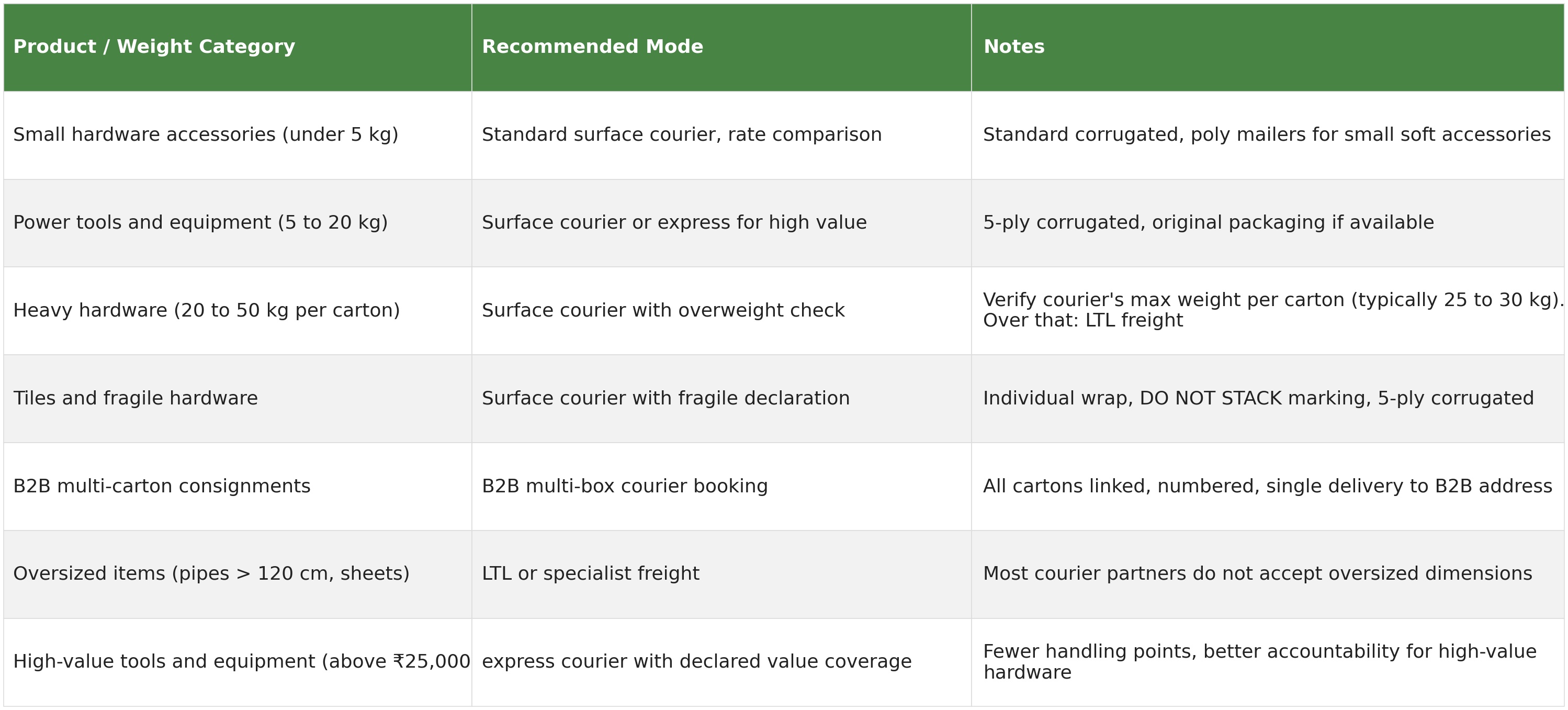
Courier Selection for Hardware Products
Managing Returns on Hardware Products
Hardware returns have specific challenges compared to consumer goods:
- Used tools: Most hardware B2B and B2C sales are final for used or installed products. Define clearly in your returns policy: tools that have been used, installed, or modified are non-returnable
- Damaged in transit: Hardware damage claims require photographic evidence (pre-dispatch and on-arrival), declared value coverage at booking, and filing within the courier's claim window. For fragile hardware (tiles, ceramics), take photos of every individually wrapped item before boxing
- Wrong product: Hardware specifications (thread size, voltage rating, capacity, dimensions) must be exactly correct. Wrong product returns require the full reverse logistics process. Verify B2B orders against the purchase order before dispatch
- B2B partial returns: A retailer who returns 10 of 50 units requires a reverse pickup of the return quantity. Keep the original multi-box booking reference to link the return to the original order
How iCarry® Supports Hardware and Home Improvement Businesses
iCarry® is a courier aggregator that serves Indian businesses across all product categories - including hardware distributors, home improvement brands, tool suppliers, and building materials B2B operators:
- B2B multi-box booking: Book multi-carton hardware consignments as linked B2B shipments, with all cartons tracked together for coordinated delivery.
- Weight and rate comparison: Enter the actual weight and dimensions at booking and compare rates across courier partners before confirming. This helps businesses select suitable courier options for heavier hardware consignments.
- Multiple courier partners: Use multiple courier partners through the same iCarry® account. If one courier has a weight or route limitation, you can choose another available courier without managing separate shipping relationships.
- Address Quality Scoring: Check address quality before dispatch to identify incomplete or potentially problematic addresses, which is particularly useful for construction sites, workshops, warehouses, and other locations with non-standard addresses.
- OTP Verified Delivery: Add an extra layer of delivery verification for high-value or sensitive hardware shipments. The recipient enters a one-time password before the delivery is marked complete, creating a verifiable, timestamped delivery confirmation.
- Transit Loss Insurance: For high-value consignments such as power tools, professional equipment, and premium fittings, businesses can enable Transit Loss Insurance while booking the shipment itself. The available coverage and applicable fee are shown during booking before confirmation.
- COD remittance: For hardware businesses serving retailers, contractors, or other B2B customers on COD terms, iCarry® provides automatic T+7 COD remittance, with Early COD options from T+0 for faster access to collected funds.
- Free Bronze plan, no minimum volume.
Final Thoughts
Hardware and home improvement products are among the most demanding categories in Indian courier logistics. Heavy cartons, fragile components within heavy packaging, multi-carton B2B consignments, non-standard delivery addresses, and the technical specification-sensitivity of the products all create logistical complexity that standard consumer goods workflows are not designed for.
The businesses that manage hardware logistics well are those that take specific decisions: right packaging for each product type rather than generic corrugated for everything, multi-box B2B booking for multi-carton orders, declared value coverage for high-value equipment, and courier selection based on weight limits and handling quality rather than just rate.
Hardware customers - contractors, retailers, site managers - are repeat buyers with predictable volume and specific product knowledge. The logistics experience they receive from your business is part of the commercial relationship. Get it right consistently and hardware distribution becomes a high-loyalty business.
Frequently Asked Questions (FAQs)
Which courier is best for heavy hardware products in India?
No single courier is best for all hardware product types. For heavy dense products (tools, metal fittings, fasteners), compare surface couriers on per-kg rates above 10 kg. For fragile hardware (tiles, ceramics), prioritise couriers with fewer handling points and better fragile-item handling. For high-value equipment, Blue Dart's express service with declared value coverage is worth the premium. Use a courier aggregator to compare options for each consignment.
How do I book a multi-carton B2B hardware order?
Use the B2B multi-box booking feature on your courier aggregator (iCarry®). Each carton gets its own AWB but all are linked under one master booking. This ensures all cartons are picked up together, routed together, and delivered as one consignment. Number cartons sequentially ('1 of 4', '2 of 4') on the outer carton. Include a packing list inside each carton listing its specific contents.
How do I prevent tiles and ceramics from breaking in transit?
Stack tiles on edge (vertically) rather than flat in the carton - tiles are significantly stronger in this orientation. Wrap each tile individually in foam sheet. Use cardboard dividers between wrapped tiles. Use 5-ply corrugated outer box. Mark DO NOT STACK and FRAGILE on all four sides and the top. Do not use 3-ply corrugated for tile shipments - it collapses under the stacking weight of other heavy cartons in a sorting centre.
What should I do when a heavy hardware shipment arrives damaged?
Photograph the damaged carton and contents immediately before moving anything. Note the AWB number and the last tracking scan location. Report to the courier within the claim window (typically 7 to 15 days from delivery for domestic damage claims). Submit pre-dispatch photographs, signed pickup manifest, and damage photographs. If declared value coverage was enabled, the claim amount is up to the declared value. Without coverage, the courier's liability is limited to their default per-kg rate.
Can all couriers handle cartons above 25 kg?
No. Most courier partners have a maximum weight per parcel of 25 to 30 kg. Cartons above this threshold require either LTL (Less than Truckload) freight or a specialist over-weight courier service. Always verify the weight limit for each courier at your destination pincode before booking. A 32 kg carton booked without checking the weight limit will be rejected at pickup or returned at the hub.
Hardware and home improvement products are among the most demanding categories in Indian courier logistics - heavy cartons, fragile components within heavy packaging, multi-carton B2B consignments, non-standard delivery addresses, and technical specification-sensitivity all create complexity that standard consumer goods workflows are not designed for. The businesses that manage hardware logistics well take specific decisions: right packaging for each product type, multi-box B2B booking for multi-carton orders, declared value coverage for high-value equipment, and courier selection based on weight limits and handling quality rather than just rate.