
Why Are Kitchen Products Tricky to Ship?
Kitchenware and small appliances combine weight, bulk and fragility. A cast iron kadai is heavy. A glass lid cracks. A mixer grinder has a motor, a jar and blades that must not move. An air fryer is large, light and expensive. Different products fail in different ways.
Kitchen and small appliance sales are a major home category in India, helped by India's expanding online retail market. Orders have higher value than most home goods, so damage and return costs are high. A correct packing approach per product type prevents most losses.
What Is Kitchenware and Appliance Shipping in India?
Kitchenware and appliance shipping is the courier delivery of cookware, glassware and small appliances such as mixers and air fryers, which combine weight, bulk and fragility. It depends on packing each product type correctly, controlling volumetric weight and declaring the true value.
Check Weight, Dimensions and Courier Limits
- Many standard couriers accept single cartons up to about 25 to 30 kg and have maximum dimension limits. Check each courier before booking
- Large items such as chimneys, microwaves, big air fryers and cookware sets may exceed limits or attract surcharges
- For items above the courier limit, use a heavy goods or freight option
- Compare actual weight with volumetric weight. Appliances in retail boxes are often bulky
Packaging by Product Type
Small Appliances (Mixers, Kettles, Toasters, Air Fryers, Induction Cooktops)
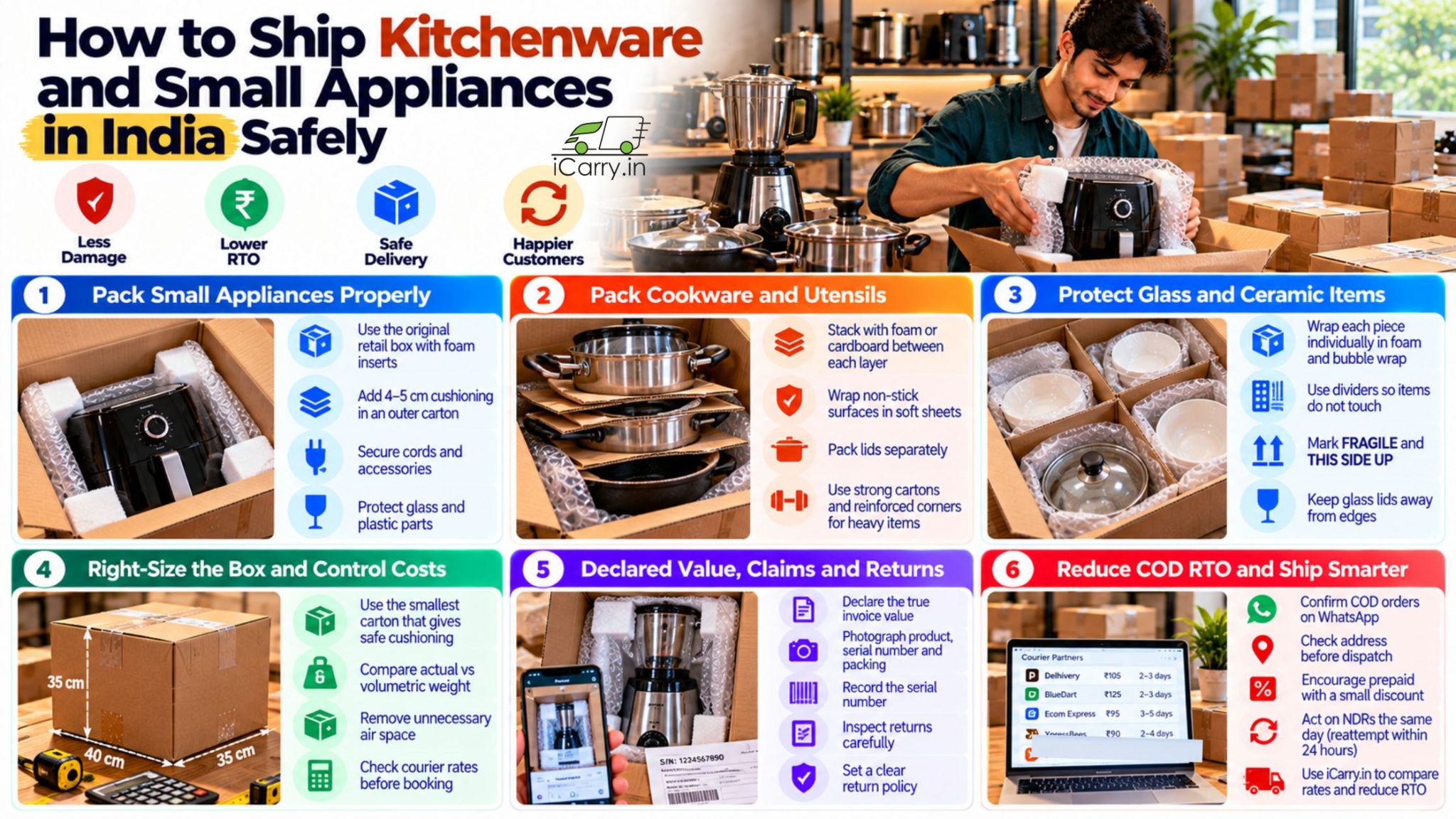
- Keep the original retail box: It is designed to hold the product. Do not remove foam inserts
- Place the retail box in a corrugated outer carton: Retail boxes are not shipping boxes. Add 4 to 5 cm of cushioning on all sides
- Secure cords and accessories: Tape or tie cords. Put jars, lids and attachments in their own compartments
- Protect glass and plastic parts: Wrap lids, jars and displays in foam or bubble wrap
- Use 5-ply corrugated for heavier items: Above 5 kg, 3-ply cartons often collapse or tear at the base
Cookware and Utensils (Steel, Aluminium, Cast Iron, Non-stick)
- Stack pots with foam or cardboard between each layer to avoid scratches and dents
- Wrap non-stick surfaces in soft sheets to protect the coating
- Separate lids from pots and wrap them individually
- Cast iron: pack in sturdy cartons and seal rust-prone surfaces with an oil film and paper
- Use strong tape and reinforced corners for heavy sets
Glass and Ceramic Kitchenware
- Wrap every piece individually in foam first, then bubble wrap
- Use dividers so pieces do not touch each other
- Mark FRAGILE and THIS SIDE UP
- Pack tempered glass lids away from edges where impact is likely
Storage Containers, Bottles and Lunch Boxes
- Nest containers only if they are protected with paper layers
- Ship with lids on but loosely, or wrap lids separately, to avoid pressure cracks
- Seal insulated bottles and use dividers to avoid denting
- Use right-sized cartons to cut volumetric weight
Knives and Sharp Tools
- Sheath or cap all blades and wrap them in cardboard
- Secure knives so they cannot shift inside the box
- Label the carton as containing sharp items for safe handling
Volumetric Weight and Right-Sizing
Appliances in retail boxes can have large volumetric weight. Check chargeable weight using length x breadth x height in cm divided by 5,000. An air fryer in a 40 x 35 x 35 cm carton has a volumetric weight of about 9.8 kg regardless of actual weight.
- Use the smallest outer carton that gives safe cushioning
- Remove unnecessary air space and fillers
- Test several carton sizes during packing trials and compare rates
Compare weight and volumetric charges across couriers with the iCarry® domestic rate calculator before you book.
Declared Value, Claims and Returns
- Declare the true value: A ₹6,000 appliance should be covered at its invoice value
- Photograph before sealing: Capture the product, serial number, packing and label
- Record the serial number: Helps with warranty disputes and swapped returns
- Inspect returns carefully: Check for used products, missing accessories and damage before refund
- Set a clear return policy: State whether opened or used appliances can be returned. Under the Consumer Protection (E-Commerce) Rules, sellers must display return, refund and exchange information
- Confirm COD orders: Send a WhatsApp confirmation for COD orders above ₹999. Heavy RTOs on appliances are expensive
How to Ship a Small Appliance in 6 Steps
- Keep the retail box and foam: It is designed to hold the product, so never remove the inserts
- Add a corrugated outer: Leave 4 to 5 cm of cushioning on all sides, because retail boxes are not shipping boxes
- Use 5-ply above 5 kg: Heavier items collapse 3-ply cartons at the base
- Check dimensions and weight: Confirm the courier limit before booking, since over-limit parcels attract surcharges
- Declare the true value: Do it at booking so a claim is paid at the real value
- Photograph and note the serial number: Take photos before sealing, since they decide any damage claim
How iCarry® Supports Kitchenware and Appliance Sellers
iCarry® is a courier aggregator that gives sellers access to multiple courier partners and tools to help manage shipping for heavier, fragile, and higher-value home goods.
- Courier Rate Comparison: Compare available courier options using your packed shipment's actual weight and dimensions before booking. Use the domestic shipping rate calculator to estimate shipping charges.
- Transit Loss Insurance: Choose to add Transit Loss Insurance during booking for eligible shipments. Review the applicable fee, coverage details, and terms before confirming.
- Weight Discrepancy Management: Review differences between declared and billed shipment weights and raise disputes with supporting evidence within the applicable dispute window.
- Delivery Boost: Get additional pre-delivery coordination to help reduce failed delivery attempts, especially when customers need to be available to receive heavier parcels.
- Two-way WhatsApp Engagement: Customers can confirm availability, update address details, or coordinate delivery, while sellers can view conversation history.
- Address Quality Scoring: Identify incomplete or potentially problematic delivery addresses before dispatch to help reduce avoidable delivery issues.
Start with the free Bronze plan, with no minimum shipment volume.
Frequently Asked Questions (FAQs)
How should I pack a mixer grinder or air fryer for courier?
Keep the original retail box with its foam inserts, place it inside a corrugated outer carton with 4 to 5 cm of cushioning on all sides, secure the cord and accessories, and protect glass or plastic parts. Use 5-ply corrugated for heavier items and mark FRAGILE and THIS SIDE UP.
Can heavy cookware be shipped by standard courier?
Yes, if each carton is within the courier's weight and dimension limits, usually around 25 to 30 kg. Use strong cartons, separate items with foam or cardboard, and reinforce tape. For heavier sets, split into multiple cartons or use a freight option.
Why does shipping an air fryer cost so much?
Appliances in retail boxes are bulky. Couriers charge on volumetric weight when it is higher than actual weight. A carton of 40 x 35 x 35 cm has a volumetric weight of about 9.8 kg. Reduce the outer carton size and remove unnecessary space to lower the chargeable weight.
Do I need declared value coverage for kitchen appliances?
Yes, for any appliance or cookware set above about ₹2,000. Default courier liability is usually far below product value. Declare the invoice value, photograph the product and carton before sealing, and keep the serial number and invoice for claims.
Kitchen products fail in different ways, so pack by type: keep an appliance's retail box and foam inside a corrugated outer with 4 to 5 cm of cushioning, use 5-ply above 5 kg, separate and wrap cookware layers, and wrap glass piece by piece with dividers. Right-size the carton, because an air fryer in a 40 x 35 x 35 cm box bills at about 9.8 kg volumetric, then declare the true invoice value and photograph the product and serial number before sealing.