
The Plant Shipping Problem in India
Live plants are one of the most difficult products to ship via courier. They are perishable, fragile, irregularly shaped, and often restricted by state regulations. A plant that survives 3 days in a dark courier box without water and light is the exception, not the rule - unless packaging and transit time are managed correctly.
Online plant sales in India have grown significantly, driven by the urban gardening trend. India's indoor plants market was valued at about USD 657 million in 2025, and sellers ship everything from indoor plants and succulents to herbs, ornamentals, and fruit saplings - each with different transit tolerances and packaging needs. Understanding what your plant can survive, and what your courier will accept, is the starting point for any plant shipping operation.
What Is Plant Shipping?
Plant shipping means sending live plants, saplings and cuttings to buyers so they arrive alive. It needs the right packing, a fast route, and permits for some species. Plants are perishable, so transit time matters more than it does for most products.
How to Ship Plants Without Losing Them in Transit
- Check permits first for fruit saplings, grafted plants and forest species - rules differ by state
- Choose bare-root where you can - succulents and cuttings survive 5 to 7 days
- Water potted plants 24 hours before dispatch - wet soil on dispatch day is heavy and shifts
- Stake tall plants and mark LIVE PLANT on every box - this stops stem snaps and rough handling
- Dispatch Monday to Wednesday only - plants then avoid sitting in a depot over the weekend
- Add a care card in every box - it helps the buyer revive the plant
State-Wise Permits - Do You Need One?
Rules for moving plants inside India depend mostly on your state agriculture and horticulture departments, plus national laws that protect certain species. For domestic shipment:
- Interstate movement of certain plant species: Some states require a phytosanitary certificate or plant movement permit for commercial interstate shipment of specific plants - particularly fruit saplings, forest species, and regulated agricultural crops
- Protected and scheduled species: Plants listed under the Wild Life (Protection) Act, 1972 (orchids, cycads, certain tree species) cannot be commercially sold or shipped without documentation. Selling scheduled plant species without permits is a criminal offence
- Nursery licence: Commercial nurseries selling plants must hold a valid nursery registration from the state horticulture or agriculture department in most states
Practical check: For common indoor plants (money plants, succulents, ferns, peace lily), interstate courier shipment is generally permitted without special documentation. For fruit saplings, grafted varieties, and any plant sourced from forest areas, verify with your state agriculture department before dispatching commercially.
Which Couriers Accept Live Plants?
This is the most important question before building a plant shipping business - and the answer varies:
- Most standard couriers: Do not explicitly accept live plants in their terms. Booking a plant under a generic description ('household goods', 'decor item') creates liability exposure if the plant dies in transit and you attempt a claim
- Specialist plant couriers: Some courier companies in India specifically accept live plants with express transit SLAs. Search for plant-specific courier services in your city - they exist in major plant-growing hubs like Pune, Bengaluru, and Tamil Nadu
- India Post Speed Post: Accepts live plants with appropriate packaging. Slower than private couriers but broader acceptance policy
- Hyperlocal (Borzo): For same-city plant delivery, hyperlocal couriers via iCarry® are the best option - same-day delivery eliminates the multi-day dark-box transit problem entirely
Key rule: Always declare that the shipment contains live plants when booking. If the courier accepts it, you have a valid booking.
How to Pack Plants for Transit Survival
Bare-Root Plants (Succulents, Cuttings, Bulbs)
- Remove from soil. Wrap roots in damp coconut coir or sphagnum moss - retains moisture without creating excess weight or mess
- Wrap the moss-root ball in polythene. Twist and seal at the stem
- Wrap the whole plant in newspaper for light protection and structural support
- Place in a corrugated box with the plant upright. Crumpled paper fill around the stem to prevent movement
Bare-root succulents and cuttings can survive 5 to 7 days in transit - the most courier-resilient plant format
Shipping hardy succulents or bare-root cuttings? Compare surface courier rates on iCarry® and read the live plant note when you create your account.
Potted Plants
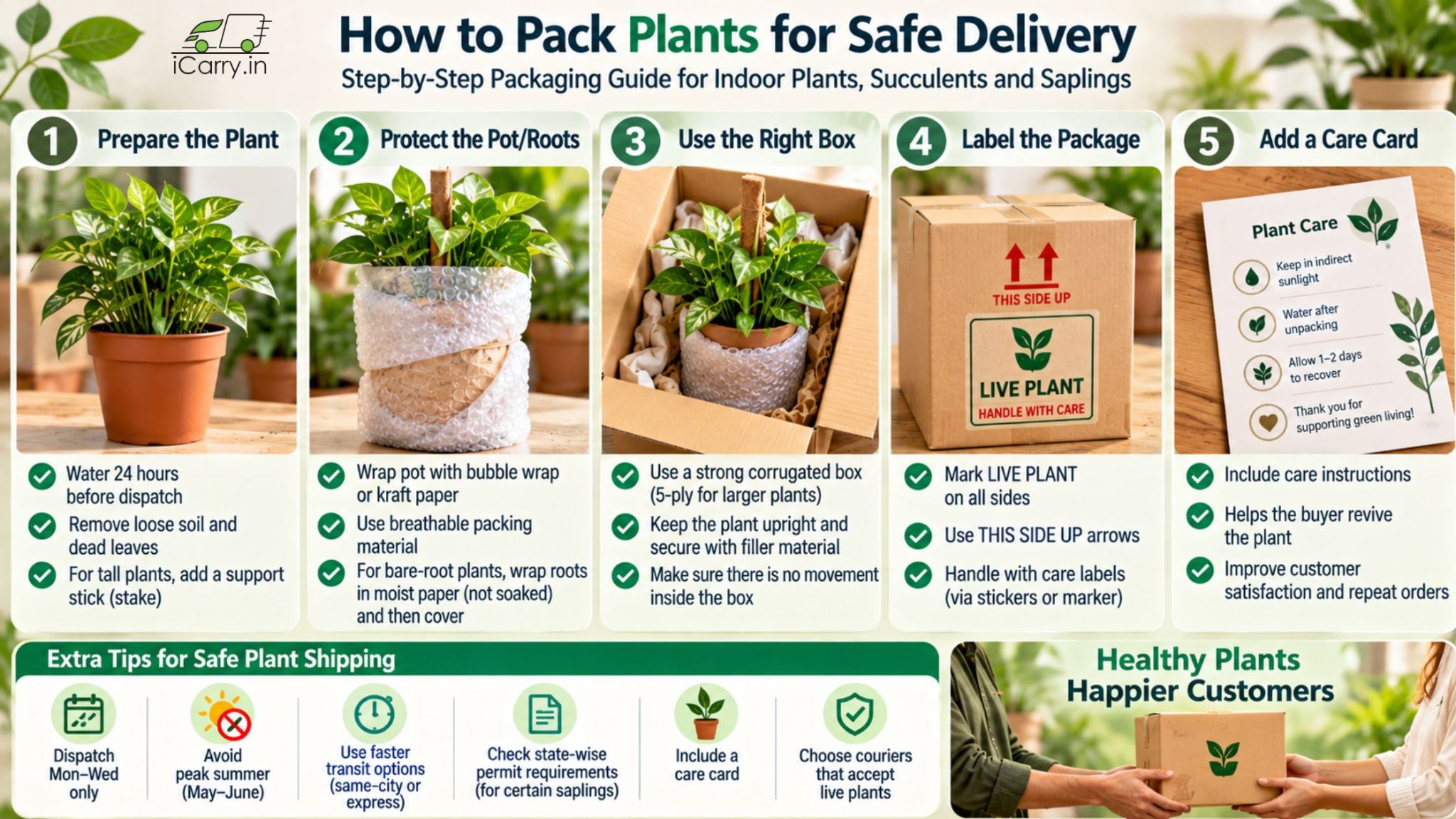
- Water 24 hours before dispatch - not on dispatch day. Wet soil is heavy and can shift, breaking stems
- Cover the pot top with polythene tied below the plant stem - prevents soil spillage if the box tilts
- Wrap the pot in bubble wrap. Secure the pot at the base of the box so it cannot tip
- Stake taller plants to a wooden skewer or stick before boxing to prevent stem snap
- Use a box sized to the pot - not too large.
- Mark THIS SIDE UP on all four sides. Mark LIVE PLANT - HANDLE WITH CARE on the outer box
Transit Time Limits by Plant Type
- Succulents and cacti: Up to 7 days bare-root. Very high tolerance
- Tropical indoor plants (pothos, philodendron): 3 to 4 days maximum in closed box
- Herbs and leafy plants: 2 to 3 days. Zone A and B dispatch only
- Fruit saplings: 2 to 4 days depending on species. Bare-root preferred
- Flowering plants in bloom: 1 to 2 days. Same-city hyperlocal only
How to Cut Plant Mortality in Transit
- Dispatch Monday to Wednesday only - avoid Thursday, Friday and Saturday dispatches that risk plants sitting in a depot over the weekend
- Avoid dispatching to Zone D during May to June (peak heat). Transit temperatures in closed vehicles exceed 45°C - fatal for most tropical plants
- Add a care card inside every box: 'Your plant has been in transit. Unpack immediately. Water lightly. Keep in indirect light for 2 days.' A customer who follows revival instructions has a better experience than one who does not
- Zone restrict during summer: same-city and Zone B only for most plant types between April and June
How iCarry® Supports Plant Sellers
iCarry® helps plant sellers manage shipping with access to multiple courier partners, while live plant shipments require extra care because courier acceptance and transit suitability can vary. Sellers should confirm product acceptance and select shipping based on the plant type, destination, and expected transit time.
- Multiple courier partners: Compare available courier options based on destination, serviceability, shipment requirements, and cost before booking.
- Rate comparison: Compare available courier rates before booking to choose a suitable option for each shipment.
- Delivery Boost: For time-sensitive plant orders, Delivery Boost supports additional pre-delivery coordination to help reduce avoidable delivery failures.
- Two-way WhatsApp Engagement: Customers can confirm availability, update address details, or coordinate delivery through WhatsApp engagement, helping reduce failed delivery attempts.
- Bulk booking: For sellers processing multiple plant orders, bulk shipment booking can simplify dispatch by allowing multiple shipments to be created together.
Free Bronze plan with no minimum shipment volume. Register at iCarry®.
Frequently Asked Questions (FAQs)
Do I need a permit to ship plants across states in India?
For common indoor ornamental plants, permits are generally not required for interstate courier shipment. For fruit saplings, grafted varieties, forest species, and plants listed under the Wildlife Protection Act, check your state agriculture or horticulture department requirements. Commercial nurseries must hold a valid nursery registration before selling plants commercially in most states.
Which plant format survives courier transit best?
Bare-root plants - particularly succulents, cacti, and hardy cuttings - have the highest transit survival rate. They can survive 5 to 7 days without soil, water, or light. Potted plants with soil are heavier, more fragile, and more moisture-dependent. If your plant species allows bare-root dispatch, it is always the better courier option over potted shipment.
Which days should I avoid dispatching plants?
Avoid dispatching Thursday, Friday, or Saturday. Plants dispatched late in the week risk sitting at a courier depot over the weekend with no movement, no light, and no water. Monday, Tuesday, and Wednesday dispatches reach customers by end of the same week or early the following week - minimising time in transit.
Can I ship flowering plants via courier?
Flowering plants in active bloom have a transit survival window of 1 to 2 days at most. They are only suitable for same-city hyperlocal delivery (Borzo or similar) where the delivery happens the same day. For interstate courier shipment, dispatch flowering plants only in bud stage - not in full bloom - so they open after delivery.
Can I ship live plants through iCarry®?
Yes, sellers can ship live plants through iCarry® at their own responsibility, provided they pack the plants appropriately for the expected transit conditions. Since live plants have limited shelf life, shipments may sometimes be delayed or held in transit, which can affect plant freshness or survival. iCarry® informs sellers about this shelf-life consideration when they create an account, so they can plan their packaging and shipping accordingly.
Plants survive courier transit on two variables: format and timing. Bare-root succulents and cuttings can hold on for 5 to 7 days; a flowering plant in bloom has barely 1 to 2. Dispatch Monday to Wednesday so nothing sits in a depot over the weekend, skip Zone D in peak summer heat, and check state permit rules before you ship fruit saplings or any protected species. Get the format, the timing and the paperwork right, and the plant that left your workshop is the plant that reaches the buyer's doorstep.