
A customer orders a dress from a new D2C brand. No shipping timeline is shown during checkout. The order ships three days later. It arrives in five days. Eight days total. The customer expected two or three days - because that is what large platforms have conditioned them to expect.
The brand did nothing wrong. The delivery was on time for what the brand is capable of. But the customer's expectation was never managed. The result: a negative review citing slow shipping, and a buyer who will not return.
A shipping policy prevents this. It sets the expectation before the order is placed. It tells the customer exactly when their order will ship, how long it will take to arrive, what it costs, and what happens if something goes wrong. As Indian eCommerce buyers become more experienced, their expectations for shipping transparency are rising. A clear, honest shipping policy is no longer a legal formality - it is a conversion and retention tool.
This guide covers what to include, how to write it, and where to place it so customers actually read it.
What Is a Shipping Policy?
A shipping policy is a published page that tells a customer exactly when their order will ship, how long delivery will take by region, what it costs, and what happens if something goes wrong - before they place the order. It sets the expectation the customer will judge the delivery against, which is why a specific, honest policy tends to reduce complaints even when actual delivery times don't change, while a vague or missing one leaves every delivery open to a mismatched expectation.
How to Check If Your Shipping Policy Covers These
- Processing time - how long before the order ships after placement
- Delivery time - by zone or by region, with honest estimates
- Shipping cost - how it is calculated or when it is free
- COD availability and any COD charges
- Pincodes you do not serve or serve at additional cost (ODA)
- What happens if a delivery fails or the order is returned
- International shipping availability and who pays import duties
- Contact details for shipping-related queries
Why a Shipping Policy Matters
It Reduces Disputes Before They Start
The majority of post-purchase customer complaints in Indian eCommerce trace back to expectation mismatch. A clear shipping policy aligns expectations at the point of purchase, before the order is placed. A buyer who read '5 to 7 business days for orders outside metro cities' and receives on day 6 has no grounds for complaint. A buyer who read nothing and expected 2 days has every reason to feel let down.
It Builds Trust With New Buyers
For brands selling to first-time buyers, a detailed shipping policy signals professionalism. It tells the buyer this is an organised business with defined processes. In a market where buyer trust in unknown D2C brands is still being built, this signal matters.
It Protects the Business in Disputes
If a customer raises a complaint with a payment gateway or consumer forum, a published shipping policy that the customer agreed to at checkout is your first line of defence. Vague or missing policies leave businesses exposed to refund demands that cannot be defended. The Consumer Protection (E-Commerce) Rules, 2020 already require e-commerce entities to clearly disclose delivery timelines and terms - a documented shipping policy is how you demonstrate that disclosure happened.
What to Include in Your Shipping Policy
1. Processing Time
The time between order placement and dispatch. The most overlooked and most complained-about element.
What to write: 'Orders are processed and dispatched within 1 to 2 business days. Orders placed after 2 PM on Friday or on weekends are processed the next business day.'
Be honest. If you need 3 days, say 3 days. A customer who knows the timeline waits without complaint. A customer who expected same-day dispatch complains when the order ships on day 3.
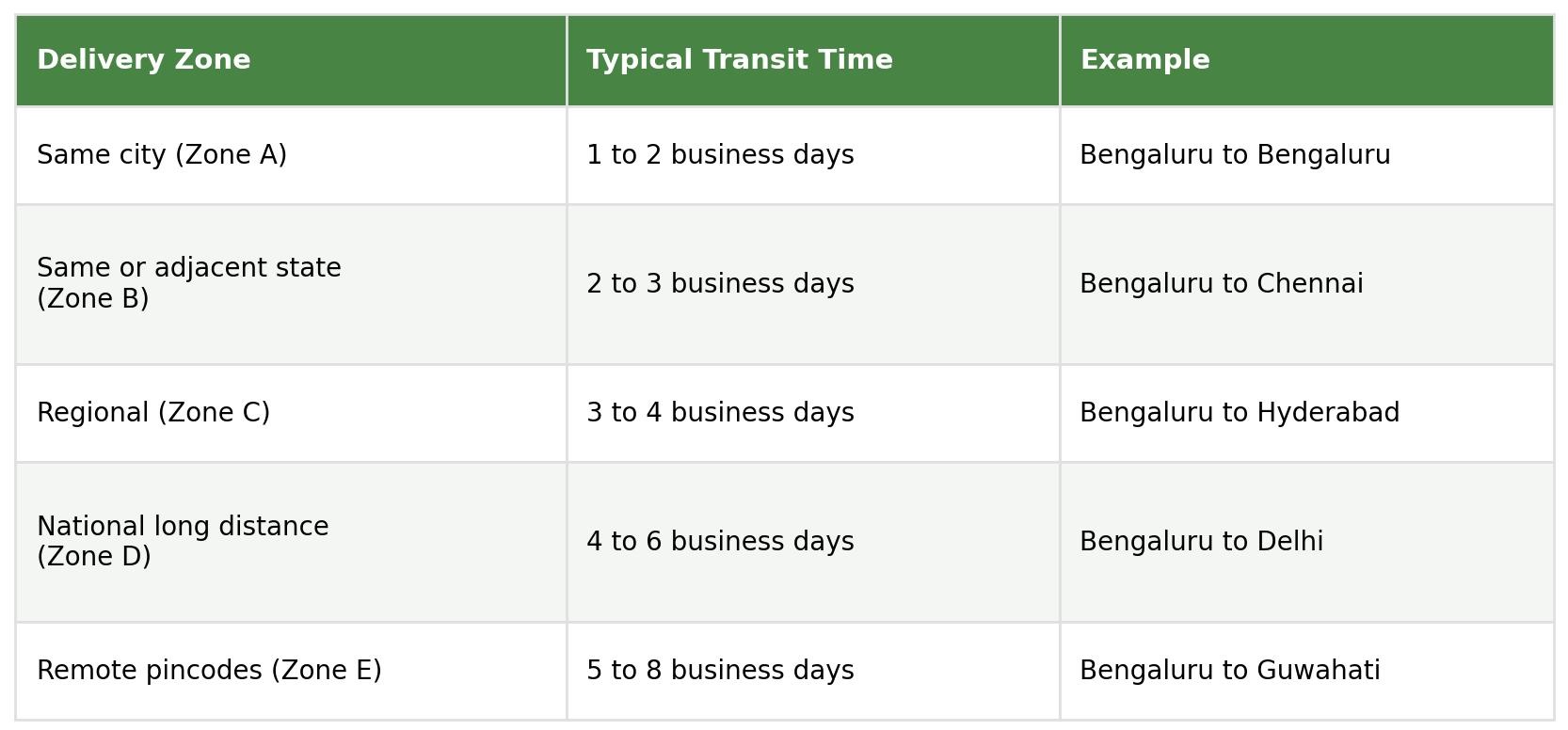
2. Delivery Timeline by Zone
Transit time varies significantly by delivery zone. A single quoted delivery time is inaccurate for everyone.
3. Shipping Cost
- Free shipping: State the threshold clearly and whether it applies to all pincodes or only specific zones
- Flat rate: '₹60 flat shipping on all orders.' Simple and predictable
- Calculated at checkout: 'Shipping cost is calculated based on your delivery pincode and order weight. The exact cost is shown at checkout before payment.'
- ODA surcharge: 'Orders to certain remote pincodes may attract an additional Out of Delivery Area surcharge of ₹30 to ₹100. This is calculated and shown at checkout.'
4. COD Policy
- Whether COD is available across all pincodes or select areas
- Whether there is a COD handling charge and how much
- Minimum or maximum order value for COD eligibility
- That COD orders require WhatsApp confirmation before dispatch, if applicable
5. Pincodes You Do Not Serve
List your service exclusions clearly rather than letting a customer complete checkout and then being called to cancel. Options: a pincode checker at checkout, or a note in the policy: 'If your pincode is not serviceable, you will be notified within 24 hours and a full refund issued.'
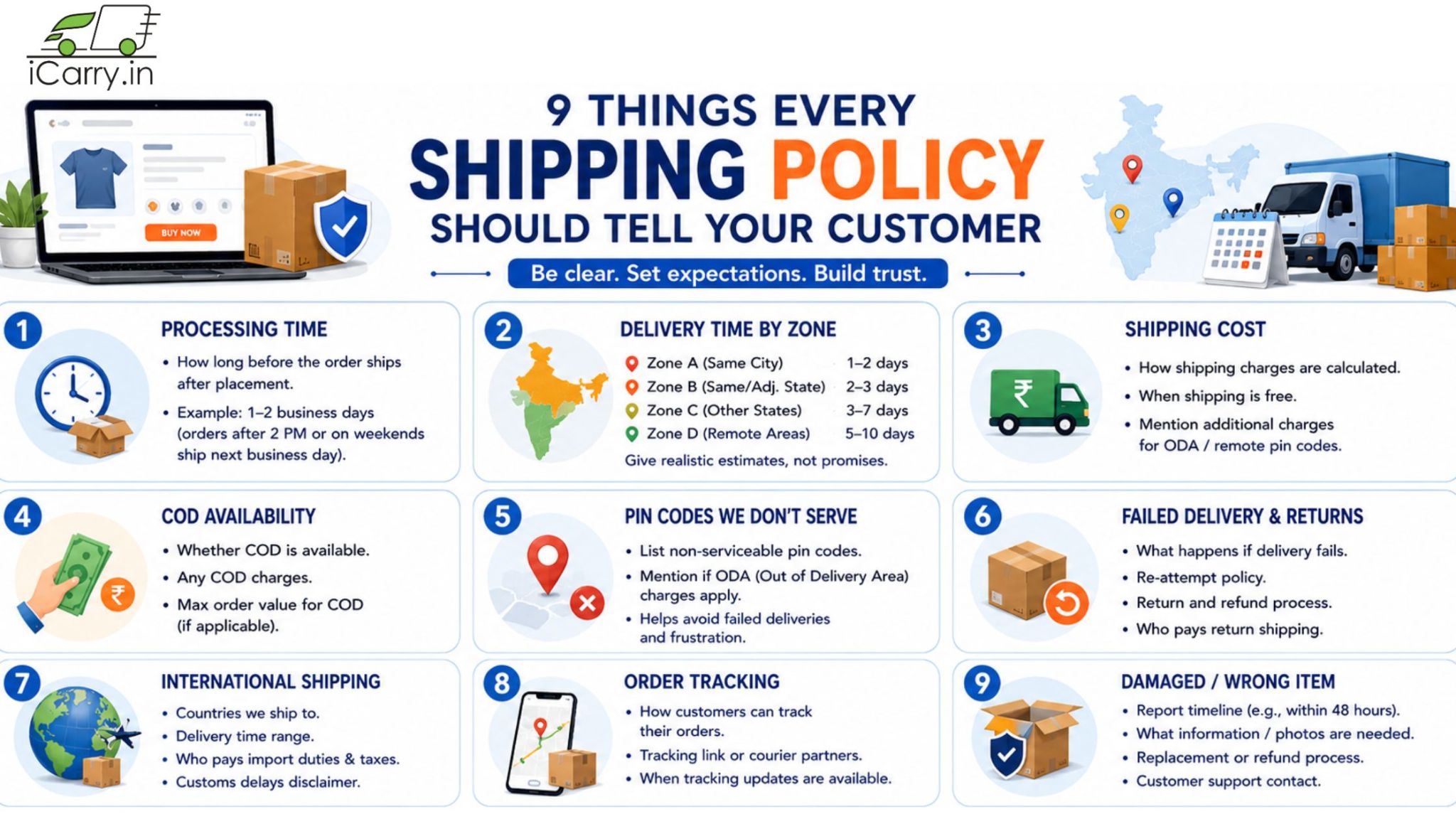
6. Failed Delivery and Return Policy
Example: 'Our courier will attempt delivery up to 3 times. If delivery is unsuccessful, the order will be returned to us. For prepaid orders, a full refund will be issued within 5 to 7 business days of the return arriving at our facility. Shipping charges are non-refundable.'
7. International Shipping
- Which countries you ship to
- Estimated transit times
- Whether the customer pays import duties (DDU) or you pay them (DDP)
- That customs delays are outside your control
8. Order Tracking
Example: 'Once your order ships, you will receive a WhatsApp message with your tracking number and courier name. Tracking typically activates within 4 to 6 hours of dispatch.'
9. Damaged or Wrong Item Received
Example: 'If your order arrives damaged or you receive the wrong item, contact us within 48 hours of delivery with your order number and a photograph. We will arrange a replacement or full refund at no cost to you.'
How to Write It - Tone and Language
- Use plain language: 'Your order ships within 2 business days' not 'Dispatch shall occur within two business days subject to stock availability'
- Use specific numbers: '4 to 6 business days for Delhi' not 'delivery timelines vary by location'
- Be honest about limitations: If Tier 3 delivery takes 8 days, say 8 days - do not say '3 to 8 days' hoping customers assume 3
- Write for mobile: Short sentences, clear headings, no walls of text
Where to Place Your Shipping Policy
- Dedicated page: Linked from your footer - where customers look for it
- Checkout page: A brief summary with a link to the full policy
- Product pages: Shipping timeline and cost visible before checkout
- Order confirmation email: Reiterate the expected delivery timeline
- Parcel insert: A printed card inside the parcel with policy summary and support contact
How iCarry® Supports Shipping Policy Execution
A shipping policy is only as credible as the logistics operation behind it. iCarry® is a courier aggregator that gives Indian businesses the delivery infrastructure to deliver on what their shipping policy promises:
- Dispatch SLA: Bulk booking and store integration ensure all orders are ready for pickup before your committed dispatch time
- Transit time comparison: Compare estimated transit times across couriers before booking to route each order to the option most likely to meet your stated delivery window. Compare rates and transit times before every booking
- Two-way WhatsApp engagement: Customers receive delivery updates and can reschedule, update their address, or flag an access issue - reducing failed deliveries that contradict your delivery promise
- Address Quality Scoring: Catches bad addresses before dispatch, preventing failures that force you to explain why the policy's timeline was not met
- COD remittance: Free automatic T+7 settlement on all plans including Bronze, with Early COD from T+0 so businesses can receive COD funds as early as the next day after delivery.
Final Thoughts
A shipping policy is a promise. Write it based on what you can actually deliver - not what sounds good. Customers who receive exactly what your policy said they would have no reason to complain. Customers who receive less than what was promised have every reason to.
The best shipping policies are specific, honest, and easy to find. They reduce support queries, reduce disputes, increase conversions from undecided buyers, and protect the business when things go wrong.
Write yours before your next customer asks where their order is - not after.
Frequently Asked Questions (FAQs)
Does an Indian D2C brand legally need a shipping policy?
There is no single law mandating a shipping policy in India, but consumer protection regulations require clear disclosure of delivery timelines and terms. A published shipping policy is also your primary evidence in payment gateway disputes and consumer complaints. For any business accepting online payments, it is practically essential.
What is the most important thing to include in a shipping policy?
Processing time and delivery timeline by zone. Most customer complaints about shipping from expectation mismatch. Being specific about when orders ship and when they arrive - by region - eliminates the most common source of post-purchase friction.
Should I promise free shipping in my policy?
Only if your margins support it after modelling the full shipping cost including freight, fuel surcharge, COD handling fee, packaging, and RTO provision. Free shipping above a threshold (₹499 to ₹799) is the most common approach - it increases average order value while being affordable on larger orders.
What should my policy say about COD orders?
State whether COD is available, any conditions, whether there is a COD handling charge, and that the courier makes up to 3 delivery attempts. For businesses using a WhatsApp confirmation step before dispatching COD orders, state this clearly - it sets the customer expectation for receiving a confirmation message.
How do I handle international shipping in my policy?
State which countries you ship to, estimated transit times, and who pays import duties. If you ship DDU (customer pays duties), state this clearly: 'International orders may be subject to import duties levied by the destination country. These charges are the buyer's responsibility.' Failure to disclose this leads to parcel refusals at the destination.
A shipping policy is a promise, and every promise you keep is a review you earn. Write it based on what you can actually deliver, not what sounds good - be specific about processing time, honest about delivery windows by zone, and clear about cost, COD, and what happens when something goes wrong. Then place it where customers actually look: checkout, product pages, and the confirmation email, not just a buried footer link.