Why Shipping Agricultural Inputs Is Different ?
Seeds, fertilisers, pesticides, and plant growth regulators are regulated products in India. Unlike standard eCommerce goods, agricultural inputs require specific certifications on labels, have courier acceptance restrictions, and in some cases need government permits before they can be sold or dispatched commercially.
Getting this wrong means two things: regulatory violation and returned shipments. Getting it right opens up a high-repeat, high-volume B2B and D2C market across India's farming communities.
What Is Agricultural Input Shipping?
Agricultural input shipping means sending seeds, fertilisers, pesticides and growth regulators to buyers while following label rules, dealer licence rules and courier acceptance limits. Seeds are shipped dry and sealed, while liquids and pesticides need leak-proof packing and a courier that accepts them. Getting the paperwork and packing right is what keeps a parcel from being returned.
How to Ship Seeds and Agricultural Inputs Without Compliance Issues
- Check every label before packing - notified seeds, pesticides and fertilisers each have their own label rules
- Keep your state dealer licence valid - it is needed to sell seeds, pesticides and fertilisers
- Ask your courier about pesticides before booking - many refuse liquid concentrates
- Seal seeds in airtight foil with a silica gel sachet - humidity cuts germination
- Use induction-sealed bottles, ziplock bags and KEEP UPRIGHT boxes for liquids - leaks can ruin the whole parcel
- Match the HS code on export papers - a mismatch holds the shipment at the port
Seed Labelling and Certification: What Sellers Must Follow
Seeds sold commercially in India must comply with the Seeds Act, 1966 and Seeds Control Order, 1983. The Central Seed Certification Board (or State Seed Certification Agencies) certifies seeds for germination percentage, purity, and varietal identity.
Mandatory on every seed packet label:
- Lot number, plus the certification tag and agency name if the seed is certified
- Variety name, crop, and class of seed (Foundation, Certified, etc.)
- Net weight, germination percentage, and purity percentage
- Name and address of producer or dealer
- Sell-by date (month and year beyond which seeds should not be sold)
Selling notified seed without a proper label is prohibited. Under the Seeds Act, 1966, certification is voluntary but labelling is compulsory. Selling seeds of notified varieties (paddy, wheat, maize, cotton, etc.) without a truthful label, or below the minimum germination and purity limits, is a legal offence. Always source from licensed seed producers or hold a valid seed dealer licence before selling and shipping seeds commercially.
Pesticides and Fertilisers - Licences Required
Selling and shipping pesticides and fertilisers requires state-issued dealer licences:
- Pesticides: Pesticides Act, 1968 mandates a dealer licence. Pesticide labels must show registration number, active ingredient, dosage, safety precautions, and first-aid instructions in English and one regional language
- Fertilisers: Fertiliser Control Order, 1985 governs quality standards and labelling. Labels must show nutrient content, batch number, date of manufacture, and net weight
- Dangerous goods classification: Many pesticides and concentrated fertilisers are classified as hazardous materials for transport. Check the specific product's MSDS (Material Safety Data Sheet) before booking courier
Phytosanitary Requirements for Seed Export
If you are exporting seeds or plant material internationally, a phytosanitary certificate from India's Plant Quarantine Authority is mandatory. Apply at the nearest Plant Quarantine Station with your export invoice and product samples. Processing takes 1 to 3 days. The HS code on the phytosanitary certificate must exactly match your shipping bill - a mismatch holds the shipment at the port.
Courier Restrictions on Agricultural Inputs
Not all courier partners accept all agricultural input categories:
- Seeds (dry, packaged): Accepted by most standard surface couriers. No dangerous goods declaration required for dry seed packets
- Fertilisers (dry, granular): Generally accepted as standard goods if non-hazardous. Liquid fertilisers require KEEP UPRIGHT marking and leak-proof primary seal
- Pesticides and herbicides: Many couriers restrict or prohibit pesticide shipments, particularly liquid concentrates. Check your courier's dangerous goods acceptance policy before booking. Some require a hazardous material declaration form
- Biological inputs (bio-fertilisers, bio-pesticides): Generally accepted as non-hazardous. Must maintain cold chain if live cultures require refrigeration
How to Pack Seeds and Agricultural Inputs for Couriers
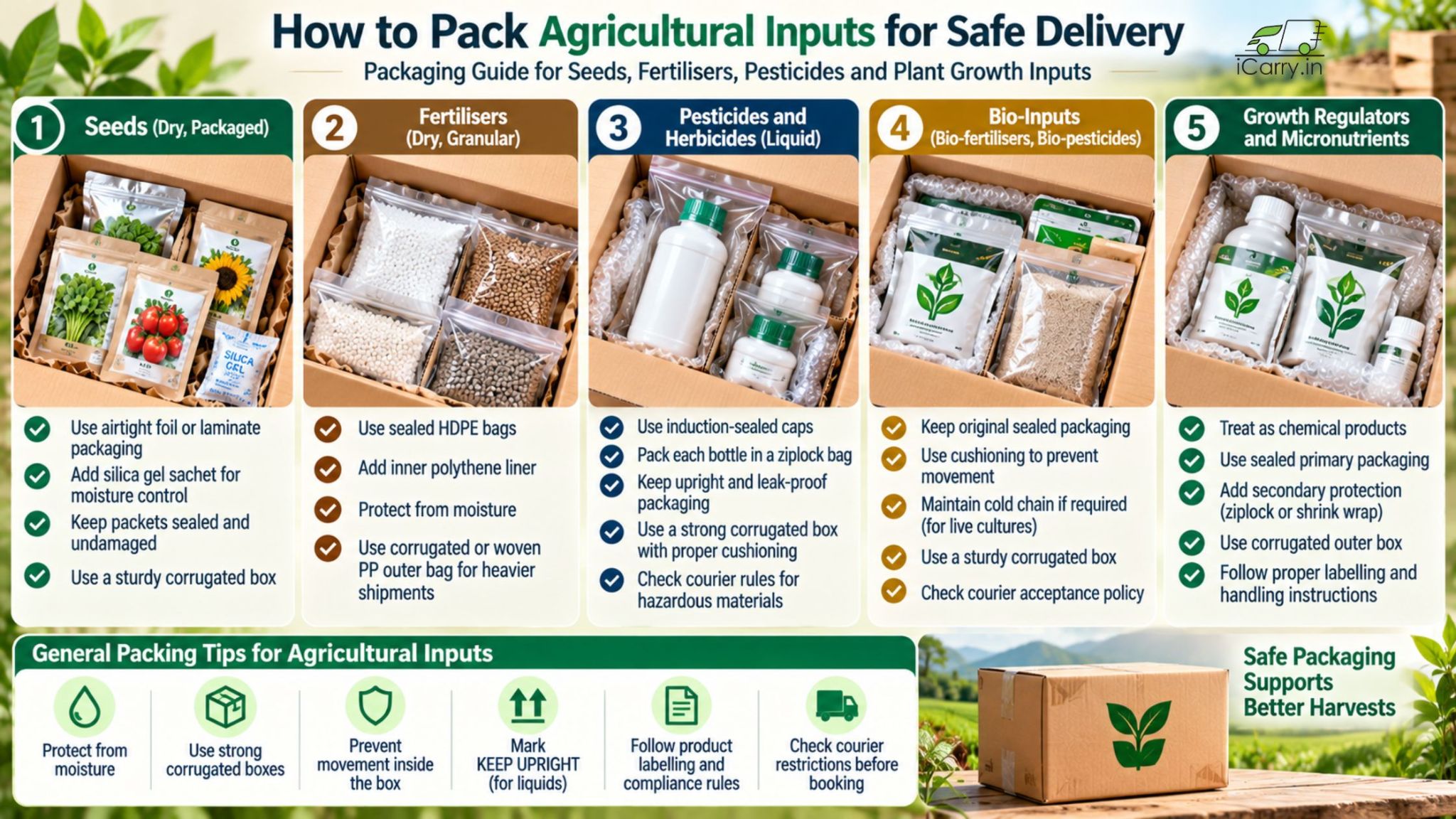
- Seed packets: Airtight foil or laminate primary packaging. Silica gel sachet inside the outer carton for moisture control. Seeds exposed to humidity lose germination percentage rapidly
- Liquid fertilisers and pesticides: Induction-sealed bottle, ziplock secondary containment bag, corrugated outer with KEEP UPRIGHT on all faces. Never poly mailers for any liquid agricultural input
- Granular fertilisers: Sealed HDPE bag with tight stitching. Inner polythene liner to prevent moisture entry. Corrugated or woven PP outer for heavier bags
- Growth regulators and micronutrients: Treat as chemicals - sealed primary packaging, corrugated outer, and appropriate labelling
Once packed, route dry seeds and fertilisers through the most cost-effective courier on iCarry®.
How iCarry® Supports Agricultural Input Businesses
iCarry® helps agricultural input businesses manage shipping through multiple courier partners from one account, with features that support delivery coordination, address accuracy, and cash flow management.
- Multiple courier partners: Compare available courier options and choose suitable services based on shipment weight, destination, serviceability, and cost. Confirm courier acceptance before booking restricted or regulated products.
- Rate comparison: Compare available courier rates before booking to help manage shipping costs across different regions.
- Address Quality Scoring: Identify incomplete or potentially problematic delivery addresses before dispatch, helping reduce avoidable delivery failures.
- Delivery Boost: Use Delivery Boost for additional pre-delivery coordination to help improve delivery success and reduce avoidable return-to-origin (RTO) shipments.
- Two-way WhatsApp Engagement: Communicate with customers before delivery so they can confirm availability, update address details, or coordinate delivery. Learn how WhatsApp engagement helps reduce failed deliveries.
- Bulk booking: Create bulk shipments using Excel or CSV uploads to simplify dispatch when processing multiple orders.
- COD remittance: Manage COD collections and settlements across courier partners through one account, with automatic T+7 settlement and Early COD options from T+0 for faster access to funds.
- Transit Loss Insurance: Where available, enable Transit Loss Insurance during booking to help protect eligible shipments against covered transit loss or damage. Review the coverage and applicable fee before confirming.
- Free Bronze plan with no minimum shipment volume.
Frequently Asked Questions (FAQs)
Do I need a licence to sell and ship seeds in India?
Yes. You must hold a valid seed dealer licence issued by your state agriculture department before selling seeds commercially. Under the Seeds Act, 1966, seeds of notified varieties must also carry a truthful label showing germination and purity. Certification by a State Seed Certification Agency is voluntary, but selling notified seeds without a proper label is prohibited.
Can pesticides be shipped via courier in India?
It depends on the specific product. Many couriers restrict or prohibit liquid pesticide concentrates due to dangerous goods classifications. Dry formulations are more widely accepted. Always check your courier partner's dangerous goods acceptance policy and provide an MSDS if required. Some liquid pesticides require a hazardous material declaration before the courier will accept the booking.
What packaging is required for shipping liquid fertilisers?
Induction-sealed primary bottle cap. Place each bottle in a ziplock bag as secondary containment. Use a corrugated outer box with KEEP UPRIGHT marked on all four sides and the top. Never use poly mailers for any liquid agricultural product. Ensure the corrugated outer is right-sized with no void space to prevent bottles shifting.
What is a phytosanitary certificate and when is it needed?
A phytosanitary certificate is issued by India's Plant Quarantine Authority confirming that plant material is free from regulated pests. It is mandatory for all international exports of seeds, plant propagating material, and certain processed plant products. Apply at your nearest Plant Quarantine Station. The HS code on the certificate must match your shipping documents exactly. More information at ppqs.gov.in.
Agricultural inputs are regulated products: keep your seed dealer licence and pesticide/fertiliser licences valid, label every pack correctly, check courier acceptance before booking liquids or concentrates, and get a phytosanitary certificate before exporting seeds internationally. Getting this right turns a high-repeat, high-volume farming market into a compliant, returns-free business.