The Sports and Fitness Shipping Challenge
India's fitness and sports equipment market has grown sharply since 2020, with home gym equipment, yoga accessories, and sportswear among the fastest-growing eCommerce categories. Demand is also spreading well beyond the metros - Tier 2+ cities accounted for around 65% of India's incremental online shoppers in 2025 , per IBEF - which is where heavy and oversized goods are most likely to meet ODA pincodes and courier weight limits. On the supply side, Indian manufacturers exported US$ 398.60 million of sports goods in FY26 , per IBEF, with cricket, boxing, and general exercise equipment among the main items - the same product types domestic sellers ship every day. The logistics challenge is that sports and fitness products span the entire weight and size spectrum - from a 100g resistance band to a 120 kg treadmill - and many products are simultaneously heavy and large, creating the worst-case volumetric weight billing scenario.
Getting shipping right in this category means understanding which products go via courier, which need freight, and how to package each correctly to avoid damage claims and return costs.
What Makes Sports and Fitness Equipment Hard to Ship?
Sports and fitness equipment is hard to ship because it spans the whole weight and size range - a 100g resistance band to a 120 kg treadmill - and many items are both heavy and bulky. That combination triggers volumetric weight billing, courier weight and length limits, and a higher damage risk for dense or awkwardly shaped gear. The first decision is therefore not which courier to use, but whether a product should go by courier, LTL freight, or white-glove delivery at all.
Quick Checklist - Before Shipping Sports and Fitness Equipment
- Have you calculated volumetric weight (L x B x H in cm / 5,000) for each product in its packed state?
- Is the packed carton within your courier's weight and longest-side limits (typically 25 to 30 kg per carton)?
- Can the product ship deflated, compressed, or disassembled to cut chargeable weight?
- Are heavy items in 5-ply corrugated with the weight in kg marked on the carton?
- For treadmills and bikes above 50 kg, is white-glove or LTL delivery arranged instead of standard courier?
The Courier vs Freight Decision
The first decision for any sports equipment seller is not which courier - it is whether to use courier at all:
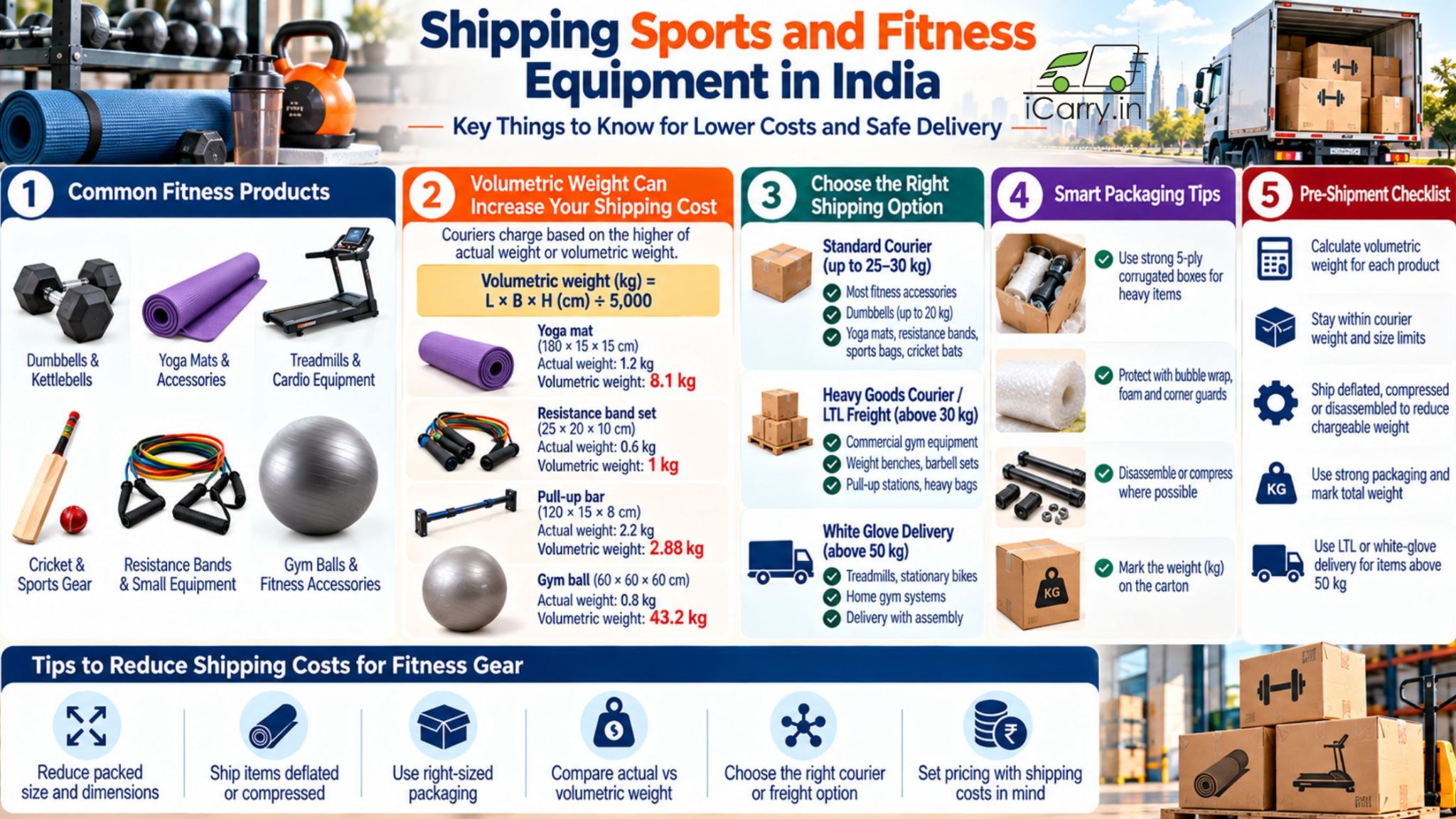
- Standard courier (up to 25 to 30 kg per carton): Suitable for most small to medium fitness accessories - dumbbells up to 20 kg, kettlebells, yoga mats, resistance bands, boxing gloves, sports bags, cricket bats, badminton rackets
- Heavy goods courier / LTL freight (above 30 kg): Required for commercial gym equipment, weight benches, barbell sets above 50 kg, pull-up stations, heavy punching bags. Most standard couriers will reject these or add severe overweight surcharges
- White glove delivery (treadmills, stationary bikes, home gym systems): Consumer fitness equipment above 50 kg almost always requires specialist delivery with assembly. Standard courier cannot handle this category
Volumetric Weight - The Biggest Cost Trap in Fitness Equipment
Bulky, lightweight fitness products create severe volumetric weight billing penalties. The formula: L x B x H (cm) / 5,000.
- Yoga mat (rolled, 180 x 15 x 15 cm): Volumetric weight: 8,100g. Actual weight: 1,200g. Bills at 8.1 kg
- Jump rope and resistance band set (in retail box, 25 x 20 x 10 cm): Volumetric weight: 1,000g. Actual weight: 600g. Bills at 1 kg - minimal penalty
- Pull-up bar (120 x 15 x 8 cm): Volumetric weight: 2,880g. Actual weight: 2,200g. Bills at 2.88 kg
- Inflatable gym ball (60 x 60 x 60 cm box): Volumetric weight: 43,200g. Actual weight: 800g. Bills at 43.2 kg - catastrophic without deflation
The solution for bulky lightweight products: Ship deflated, compressed, or disassembled where possible. A gym ball shipped deflated fits in a 30 x 25 x 10 cm box - 1,500g volumetric weight instead of 43,200g. Always calculate volumetric weight before setting your free shipping threshold or product price. iCarry® 's rate comparison lets you enter your packed dimensions and compare what each courier would bill before you confirm a booking.
Packaging by Product Category
Weights and Dumbbells
- Heavy, dense, and small - actual weight dominates billing. No volumetric penalty
- Pack in pairs. Wrap each dumbbell in foam sheet to prevent metal-to-metal contact and scratching
- 5-ply corrugated mandatory for sets above 5 kg per carton. Heavy metal in standard 3-ply corrugated breaks through the base on delivery
- Mark HEAVY - LIFT WITH CARE on the carton. Weight in kg on all four sides
- Single dumbbells above 10 kg: verify courier weight per parcel limit before booking
Yoga Mats and Exercise Mats
- Roll tightly and secure with 2 to 3 rubber bands or velcro strap before polythene outer wrap
- Poly mailer acceptable for mats under 1 kg. Corrugated tube or corrugated box for premium mats above 1.5 kg
- The rolled diameter is the key dimension for volumetric weight - a tighter roll significantly reduces billing
- Do not fold yoga mats. Fold marks in PVC or TPE mats do not recover and constitute a damage complaint
Fitness Accessories (Bands, Ropes, Gloves, Bottles)
- Right-size the box to the product. A resistance band set in an oversized box creates unnecessary volumetric billing
- Protein shakers and water bottles: liquid-tight cap required (even if empty). Poly mailer acceptable for single bottles under 500g
- Boxing gloves: correct-size corrugated box, stuffed with paper fill to maintain shape in transit
- Foam rollers: cylindrical dimensions create moderate volumetric weight. Ship in kraft paper tube or tight-wrapped corrugated
Cricket, Badminton and Racket Sports Equipment
- Cricket bats: length (typically 85 to 97 cm) is within the usual 120 cm single-side courier limit, but can exceed the stricter limits some couriers apply, particularly once packed in a sleeve. Verify before booking
- Wrap bats in a foam sheet to protect the blade edge and toe. Corrugated sleeve or tube packaging
- Badminton and tennis rackets: original retail bag or corrugated sleeve. String tension should be reduced for long-distance transport (10 to 15% below playing tension)
- Cricket balls and shuttlecocks: small, standard packaging. Corrugated box with adequate fill
B2B Sports Equipment Delivery - Schools, Gyms, Clubs
- B2B sports orders often involve multi-item consignments (a school cricket kit for 20 students, a gym equipment set). Book as linked multi-box B2B shipments
- Institutional buyers have specific delivery requirements - loading dock or ground floor delivery, daytime hours only
- For recurring B2B institutional orders, COD is not practical. Invoice-based payment with UPI or bank transfer is standard
- Bulk sports equipment to a single address (sporting goods retailer) is more cost-effective via LTL freight than per-unit courier rates
How iCarry® Supports Sports and Fitness Sellers
iCarry® is a courier aggregator that gives sports equipment and fitness brands access to multiple courier partners, with rate comparison to help select suitable shipping options.
- Volumetric rate comparison: Enter accurate shipment dimensions and compare courier rates before booking to understand how actual and volumetric weight can affect shipping costs.
- Multiple courier partners: Compare available courier services based on shipment weight, dimensions, destination, serviceability, and cost. Choose suitable options for heavy dumbbell sets, bulky fitness equipment, or large, lightweight products.
- Transit Loss Insurance: For premium fitness equipment, enable Transit Loss Insurance during booking. Review the available coverage and applicable fee before confirming.
- Delivery Boost: For high-value or time-sensitive orders, Delivery Boost supports additional pre-delivery coordination to help reduce avoidable delivery failures.
- Two-way WhatsApp Engagement: Customers can confirm availability, update address details, or coordinate delivery through WhatsApp engagement, helping reduce failed delivery attempts.
- Free Bronze plan with no minimum shipment volume.
Frequently Asked Questions (FAQs)
Can I ship a treadmill or stationary bike via courier in India?
Most standard couriers cannot handle treadmills and heavy stationary bikes - they exceed courier weight limits (typically 25 to 30 kg per carton) and require assembly at delivery. Use a specialist white-glove delivery service or LTL freight provider with delivery and installation capability. Standard courier is appropriate for fitness accessories, dumbbells up to 20 kg, and smaller gym equipment.
Why is shipping a yoga mat so expensive relative to its weight?
Yoga mats are shipped rolled, creating large volumetric dimensions (typically 180 x 15 x 15 cm). The volumetric weight at these dimensions is 8,100g against an actual weight of 800 to 1,500g. The courier bills on whichever is higher - in this case the volumetric weight at 8.1 kg. Roll the mat as tightly as possible, secure with bands, and use a tight polythene outer wrap to minimise the rolled diameter and reduce volumetric billing.
Can I ship cricket bats via standard courier?
Cricket bats range from 85 to 97 cm in length. Most standard couriers have a maximum single-dimension limit of 120 cm, so bats are within range. However, the length means cricket bats must be checked against each courier's specific dimension limits before booking. Wrap the blade and toe in a foam sheet to protect the wood. Corrugated sleeve or tube packaging prevents the bat from breaking through a standard corrugated box.
How do I calculate the correct shipping cost for bulky fitness equipment?
Calculate volumetric weight: L x B x H (in cm) / 5,000 for your product in its packaged state. Compare to actual packaged weight. The higher figure is your chargeable weight. Apply this to the courier's per-kg rate for the destination zone. For products like gym balls and yoga mats, deflating or compressing before packaging can reduce volumetric weight by 70 to 90%, dramatically lowering the shipping cost.
Sports and fitness equipment spans everything from a 100g resistance band to a 120 kg treadmill, so the first decision is courier, LTL freight or white-glove delivery. Calculate volumetric weight for every product in its packed state, ship bulky items deflated or compressed, and use 5-ply corrugated with the weight marked on heavy cartons.