A toy brand receives a marketplace delisting notice. Reason: the toy does not carry a BIS (Bureau of Indian Standards) certification mark, which became mandatory for a broad range of toys sold in India from 2021. The products are safe, well-made, and have been selling for two years. But without the certification mark on the product and packaging, the marketplace flags them as non-compliant.
Compliance was the problem. Not the product.
India's toys and baby products market is one of the fastest-growing consumer categories, driven by rising birth rates, increasing online purchase of children's products, and a growing middle class investing more in early childhood development. The sector is a priority for Indian manufacturing and retail growth, with the government actively promoting domestic toy production under the 'Vocal for Local' initiative.
For businesses selling and shipping toys and baby products, this growth comes with clear compliance requirements. BIS certification, age labelling, safety marking, and specific packaging considerations are all non-negotiable. This guide covers each one.
What Compliance Is Required to Ship Toys and Baby Products in India?
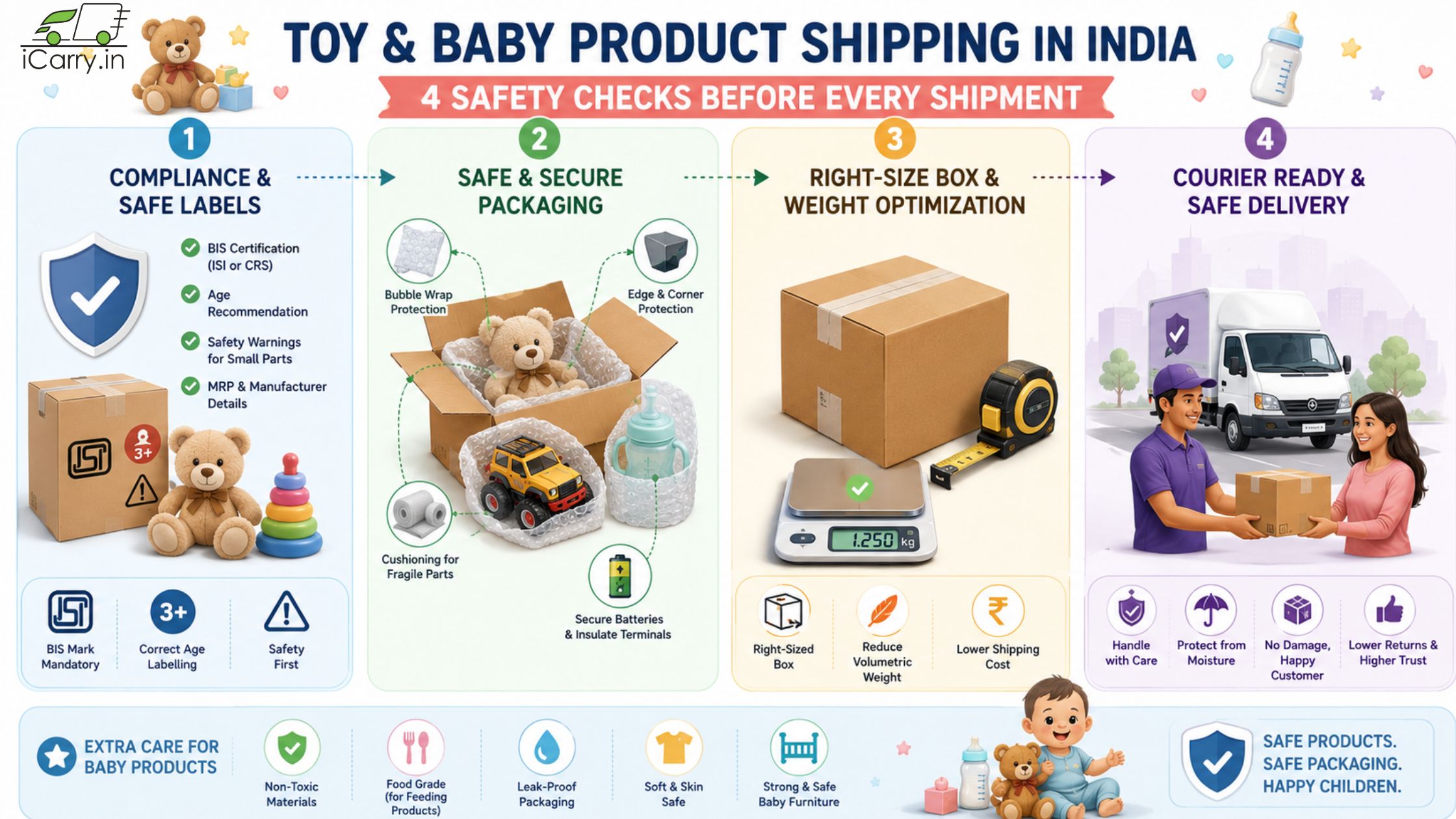
Shipping toys and baby products in India requires BIS (Bureau of Indian Standards) certification for most toys sold to children up to 14 years, under the Toys (Quality Control) Order, 2020 - either an ISI mark for domestically manufactured toys or BIS CRS registration for imports. Baby products carry additional rules depending on category: feeding products need BIS certification and food-grade materials, baby skincare is regulated as cosmetics under CDSCO, and baby clothing and furniture have their own safety standards. Selling or shipping without the required certification and labelling is the most common reason toy listings get delisted, regardless of how safe the product actually is.
How to Check Before Shipping Any Toy or Baby Product
- Does the toy carry the mandatory BIS ISI mark or BIS CRS certification where required?
- Is the age recommendation clearly labelled on the product and outer packaging?
- Are small parts warnings included where applicable?
- For battery-operated toys, are batteries secured and terminals insulated?
- Is the packaging right-sized to avoid volumetric weight penalties on lightweight toys?
- Have you checked marketplace compliance requirements separately from regulatory requirements?
- Is the MRP inclusive of all taxes printed on the packaging?
Compliance Requirements for Toys in India
BIS Certification - Mandatory for Most Toys
The Bureau of Indian Standards (BIS) mandates quality certification for toys sold in India under the Toys (Quality Control) Order, 2020. Under BIS regulations, toys for children up to 14 years of age sold in India must carry either the ISI mark (for domestically manufactured toys) or pass through the BIS Compulsory Registration Scheme (CRS) for imports.
The BIS ISI mark confirms the toy meets the relevant Indian Standard (IS) for safety - covering mechanical and physical properties, flammability, chemical properties, and electrical safety where applicable.
What this means for sellers: Any toy sold commercially - through marketplaces, D2C websites, retail, or distributors - must be from a BIS-certified manufacturer. If you are a brand sourcing toys from manufacturers, verify BIS certification before placing your first purchase order. If you are a manufacturer, apply for BIS certification before commercial sales begin.
Toys Exempt from BIS Certification
Not all products marketed to children require BIS toy certification. Exempt categories include:
- Toys for children above 14 years (board games, puzzles marketed to older children)
- Hobby craft products and educational kits with adult supervision requirement
- Sports equipment (excluded from the Toys QCO)
- Festive and decorative items not intended for play
Even exempt products must comply with general consumer product labelling requirements under the Legal Metrology Act.
Mandatory Labelling on Toy Packaging
Every toy sold in India must carry the following on its packaging:
- BIS mark: ISI mark with licence number for domestic manufacturers; CRS registration for imported toys
- Age recommendation: 'Suitable for ages 3+', '6 to 12 years' - must match the toy's actual design and safety assessment
- Small parts warning: 'Not suitable for children under 3 years - contains small parts' mandatory for any toy with components that could be swallowed
- Manufacturer details: Name and address of the manufacturer or importer
- Country of origin: 'Made in India' or country of manufacture
- MRP inclusive of all taxes: Required under Legal Metrology Act for consumer retail packaging
- Net weight or dimensions: For products sold by weight or measure
- Batch / lot number: For recall traceability - particularly important for toys given safety implications
Baby Products - Additional Compliance
Baby products (products for children below 2 years) carry additional compliance considerations beyond the Toys QCO:
- Feeding products (bottles, nipples, teethers): BIS certification applies. Materials must be food-grade and free from BPA and other regulated chemicals. Must display 'BPA Free' only if independently verified
- Baby skincare products: Regulated as cosmetics under CDSCO. Ingredient list, batch number, manufacturing date, and expiry date all mandatory. Dermatologically tested claims require evidence
- Baby clothing: Must meet flammability standards. No choking hazard attachments (small buttons, decorative items) for infant clothing
- Baby furniture (bouncers, high chairs, cots): BIS standards apply for structural safety. Weight limits must be clearly marked
Packaging Toys and Baby Products for Safe Courier Delivery
Toys and baby products present specific packaging challenges: they are often irregularly shaped, may have protruding components, and are frequently purchased as gifts where presentation quality matters as much as protection.
Rigid Plastic and Hard Toys
- Individual units: bubble wrap or foam sheet around any sharp edges or protruding components
- Corrugated outer box right-sized to the product - avoid empty space where the toy can shift and impact box walls
- For battery-operated toys: remove batteries or tape battery terminals before packaging to prevent short circuit during transit
- For toys in original retail boxes: the retail box is often not designed for courier transit - add a corrugated outer shipping box around the retail packaging
Soft Toys and Plush
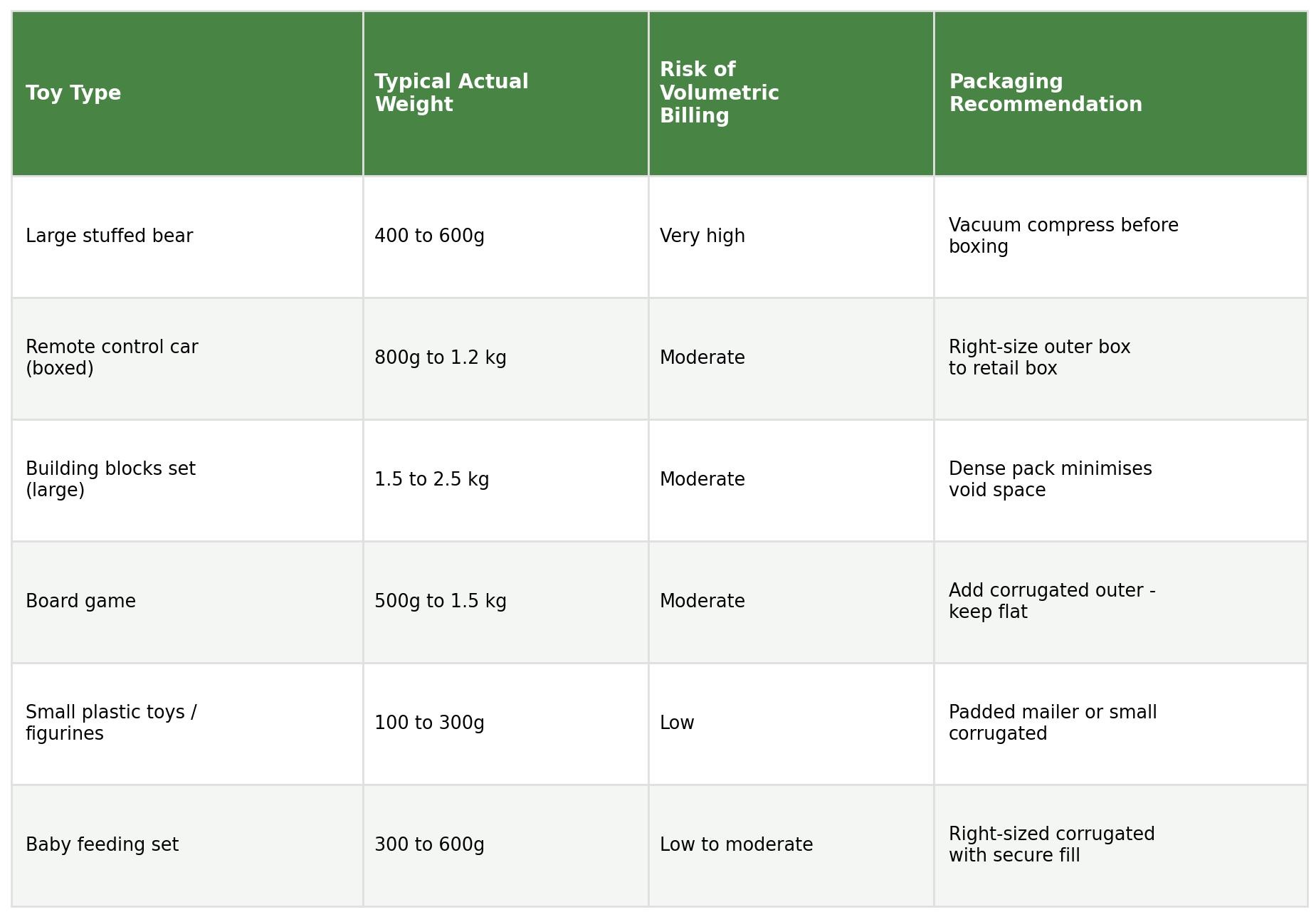
Soft toys are low damage-risk but high volumetric weight risk. A large stuffed bear in its original retail dimensions may have a volumetric weight of 3 to 5 kg despite weighing 400g.
- Compress soft toys in a vacuum bag or tight poly bag before boxing to reduce volumetric weight
- Ensure compression does not permanently deform the toy - test with a sample before applying to all stock
- Poly mailers are acceptable for flat soft toys under 500g with no rigid components
- Corrugated outer for any soft toy above 1 kg or with rigid accessories
Board Games, Puzzles, and Box Sets
- Retail box is the primary packaging - add a corrugated outer for all board games, as retail boxes are not designed for courier handling
- Seal the retail box with tape on all edges before placing in the outer corrugated - puzzle pieces that escape from an unsealed box create a customer complaint
- Mark KEEP FLAT on the outer box for puzzle boxes to prevent stacking that warps the box
Baby Products - Feeding, Skincare, Clothing
- Feeding products with liquids (baby food): Leak-proof primary seal, ziplock secondary seal, corrugated outer - never poly mailers
- Glass baby bottles: Treat as fragile - foam wrap, corrugated box with no void space, FRAGILE marking
- Baby skincare (lotions, oils): Upright orientation only - KEEP UPRIGHT marking on outer box. Inner ziplock seal as secondary containment
- Baby clothing: Poly mailer acceptable for soft items. Add a rigid card insert to prevent folding damage on items where crease-free delivery matters
Volumetric Weight Management for Toys
Toys are one of the highest-risk categories for volumetric weight billing penalties. Large, lightweight toys - remote control cars, doll houses, building block sets - have significant volume relative to their actual weight. Volumetric weight billing (L x B x H in cm / 5,000) can bill a 600g toy at 4,000g or more if the box is not right-sized.
Marketplace Compliance for Toys and Baby Products
Marketplaces in India have their own compliance requirements on top of regulatory requirements. Non-compliance with marketplace policies can result in listing suspension, account suspension, or removal of products.
- BIS mark verification: Marketplaces require BIS certification documents at onboarding for toys. Keep your BIS licence or CRS registration number accessible for listing and audit purposes
- Age labelling in listings: The age recommendation must appear in the product listing, not just on the packaging. Marketplaces flag toys listed without age recommendation as potentially non-compliant
- Safety warning in listing: Small parts warnings, supervision requirements, and material disclosures must be in the product description
- Image compliance: Product images must show the actual product clearly. For baby products, images that imply safety claims the product cannot support create compliance exposure
How iCarry® Supports Toy and Baby Product Businesses
iCarry® is a courier aggregator that serves Indian businesses across all product categories including toys and baby products:
- Multiple courier partners: Route lightweight, low-value toys via the most cost-effective surface courier. Route high-value gift sets or premium baby products via Express couriers for fewer handling points and better presentation on delivery
- Rate comparison before booking: Compare rates across couriers before every booking. Estimate your shipment cost accounting for actual vs volumetric weight for your toy packaging dimensions
- Delivery Boost: For high-value toy gift sets and premium baby product orders, Delivery Boost ensures pre-delivery coordination - reducing the failed delivery that means an expensive gift arrives after the occasion it was purchased for
- Two-way WhatsApp engagement: Customers can reschedule or update delivery details directly - particularly useful for gift deliveries where the recipient may need advance notice
- Address Quality Scoring: Pre-dispatch address validation prevents failed deliveries on time-sensitive gift orders
- COD remittance: Free automatic T+7 settlement on all plans including Bronze, with Early COD from T+0 so businesses can receive COD funds as early as the next day after delivery.
Free Bronze plan, no minimum volume. Register at iCarry®.
Final Thoughts
Toys and baby products carry a higher compliance burden than most consumer categories - and for good reason. Products for children must be safe, accurately described, and correctly labelled. Getting BIS certification right, applying accurate age recommendations, and including mandatory warnings is not just a regulatory requirement - it is the foundation of customer trust in a category where parents are making safety-critical purchasing decisions.
On the logistics side, toys require more packaging attention than most categories. Irregular shapes, large but light products, and gift presentation requirements all demand specific packaging decisions. Right-sizing is particularly important - volumetric weight billing on large lightweight toys is one of the most consistent cost leaks in the toy category.
Get compliance right first. Then optimise packaging and courier selection. A well-packaged, correctly labelled, BIS-certified toy that arrives on time is the foundation of a positive review and a repeat customer in one of India's most loyal consumer categories.
Frequently Asked Questions (FAQs)
Is BIS certification mandatory for toys sold in India?
Yes. Under the Toys (Quality Control) Order, 2020, toys for children up to 14 years must carry BIS certification - ISI mark for domestically manufactured toys, and BIS CRS (Compulsory Registration Scheme) for imported toys. Selling or listing toys without BIS certification can result in marketplace delisting, regulatory action, and penalties. Check your product's certification status at BIS portal.
What labelling is mandatory on toy packaging in India?
Mandatory labels include the BIS certification mark, age recommendation, small parts warning (for toys with components a child under 3 could swallow), manufacturer name and address, country of origin, MRP inclusive of all taxes, and batch or lot number. All must appear on the outer retail packaging before the product is sold commercially.
How do I reduce volumetric weight costs when shipping large toys?
Compress soft toys in vacuum or compression bags before boxing. Right-size the corrugated outer box to the minimum dimensions that allow safe transit - eliminate unnecessary void space. Compare volumetric weight across box size options before committing to a standard shipping box for a new product. The volumetric formula is L x B x H (in cm) divided by 5,000.
Do baby feeding products need BIS certification?
Yes. Baby feeding products including bottles, nipples, and teethers are covered under BIS quality standards. Materials must be food-grade and free from regulated chemicals. Products displaying 'BPA Free' claims require independent verification to support that claim. Baby skincare products are regulated separately under CDSCO as cosmetics.
Can I ship toys using a poly mailer?
Only for soft, flat toys with no rigid components - small cloth toys, fabric books for infants, or flat plush items under 500g. All hard plastic toys, battery-operated toys, boxed toys, and any toy with rigid or sharp components must be shipped in corrugated boxes. Poly mailers provide no protection against the compression and impact forces in courier sorting centres.
How does iCarry® support toy gift deliveries to arrive on time?
iCarry®'s Delivery Boost provides pre-delivery customer contact to ensure the recipient is available - critical for gift deliveries where a failed first attempt means the gift arrives after the occasion. Two-way WhatsApp engagement allows gift recipients to confirm receipt timing or update delivery details. Address Quality Scoring catches incomplete delivery addresses before dispatch.
Toys and baby products carry a higher compliance bar than most categories, and that bar exists for good reason. BIS certification, accurate age labelling, and mandatory safety warnings are not optional extras - they are what keeps a listing live and a parent's trust intact. Get compliance right first, then right-size the packaging: volumetric weight is one of the most consistent and most avoidable cost leaks in this category.