
Introduction
In the fast-growing eCommerce ecosystem, delivery reliability is directly linked to customer satisfaction. Businesses shipping hundreds or thousands of orders daily must ensure consistent courier performance and reliable delivery timelines.
This is where Service Level Agreements (SLAs) in courier contracts become essential. An SLA defines the performance standards, service commitments, and accountability between businesses and logistics providers.
In today's competitive eCommerce environment, shipping performance is directly tied to customer satisfaction. Global research on customer experience shows that delivery reliability and shipping transparency play a major role in post-purchase satisfaction. Customers expect fast deliveries, accurate tracking updates, and reliable service. For businesses shipping hundreds or thousands of orders every day, ensuring consistent courier performance and maintaining delivery SLA standards across shipping operations is critical, especially when evaluating how courier aggregators help businesses manage multiple shipping partners efficiently. Studies show that delivery reliability influences more than 70% of customer satisfaction in eCommerce shipping experiences.
This is where Service Level Agreements (SLAs) become essential.
An SLA is a formal contract between an eCommerce business and a courier or logistics provider that defines service expectations, performance standards, and accountability mechanisms. Service Level Agreements are widely used across industries to define measurable service standards between providers and clients. Without clear SLAs, businesses may face issues such as delayed deliveries, lost shipments, poor tracking visibility, and increased logistics costs.
In India's rapidly growing logistics ecosystem, where multiple courier partners operate across different regions, SLAs help ensure that logistics partners meet defined delivery timelines, service quality standards, and operational commitments through structured multi-courier allocation strategies used by modern eCommerce businesses.
For eCommerce founders, logistics managers, and operations teams, understanding how SLAs work in courier contracts is crucial for maintaining delivery reliability and optimizing shipping performance.
This guide explains SLA meaning, key clauses, important performance metrics, and best practices for managing courier service agreements effectively.
What is an SLA in Courier Services?
An SLA (Service Level Agreement) in courier logistics is a formal contract between a business and a courier provider that defines measurable service commitments such as:
- delivery timelines
- pickup schedules
- shipment tracking standards
- issue resolution timelines
- performance metrics
In simple terms:
An SLA defines what service a courier partner must deliver and how their performance will be measured.
If the courier fails to meet these agreed standards, the contract may include penalties, service credits, or corrective actions.
Why Service Level Agreements Matter in Courier Contracts
SLAs play a critical role in logistics operations because they create clear expectations and accountability between businesses and courier providers.
1. Ensures Delivery Reliability
SLAs define expected delivery timelines, ensuring shipments reach customers within promised timeframes.
2. Improves Customer Experience
Clear service standards help minimize delays, lost packages, and delivery failures by improving last-mile delivery performance across courier networks.
3. Creates Accountability
Courier partners are obligated to meet agreed performance benchmarks.
4. Reduces Operational Disputes
Defined service standards reduce misunderstandings between businesses and logistics providers.
5. Enables Data-Driven Vendor Management
SLAs allow businesses to evaluate courier partners based on objective performance metrics.
Key Components of a Courier Service Level Agreement
Courier service level agreements usually include several key components that define delivery performance standards and operational commitments.
1. Service Scope
This section defines the type of services the courier provider will offer.
Examples include:
- Domestic shipping
- Express shipping
- Reverse logistics
- Cash-on-delivery (COD) services
- International shipping
2. Delivery Time Commitments
Courier contracts specify expected delivery timelines for different shipping zones.
| Shipping Type | Typical SLA Delivery Time |
|---|---|
| Metro to Metro | 1 - 2 days |
| Metro to Tier-2 city | 2 - 3 days |
| Inter-state shipping | 3 - 5 days |
| Remote locations | 4 - 7 days |
3. Pickup SLA
This defines how quickly courier partners must pick up shipments from the seller's warehouse.
Typical benchmarks:
| Pickup Type | SLA |
|---|---|
| Same-day pickup | Within 4 - 6 hours |
| Next-day pickup | Within 24 hours |
4. Shipment Tracking & Visibility
Courier companies must provide:
- real-time tracking updates
- shipment status notifications
- delivery confirmation
Modern logistics systems increasingly rely on digital tracking technologies to improve shipment visibility and customer communication. Tracking accuracy is essential for customer communication.

Delivery Attempt Policy
This clause defines how many delivery attempts must be made before returning a shipment.
Typical policies include:
- 2 - 3 delivery attempts
- customer contact verification
- rescheduling options
Issue Resolution Timelines
Courier SLAs often define timelines for resolving issues such as:
- lost shipments
- damaged parcels
- delivery disputes
Industry frameworks for logistics service quality emphasize structured escalation and resolution timelines in service contracts. Typical resolution windows range from 5 - 10 business days.
Important Courier SLA Metrics Businesses Should Track
Courier performance is usually measured through specific logistics KPIs.
1. On-Time Delivery Rate
Measures the percentage of shipments delivered within promised timelines.
Benchmark:
95% or higher
2. First Attempt Delivery Success Rate
Tracks how often deliveries succeed on the first attempt.
Benchmark:
85 - 90%
3. Shipment Damage Rate
Measures the percentage of shipments that arrive damaged.
Benchmark:
Below 1%
4. RTO (Return-to-Origin) Rate
Measures how many shipments are returned due to delivery failures.
Typical Range in India:
15 - 30% for COD shipments
5. Pickup Adherence Rate
Measures how consistently courier partners pick up shipments on time.
Benchmark:
95% or higher
How to Manage Courier SLAs Effectively (Step-by-Step)
Businesses can follow a structured approach to manage courier agreements effectively.
Step 1: Define Logistics Requirements
Identify operational needs such as:
- delivery speed
- geographic coverage
- shipment volumes
Step 2: Negotiate SLA Terms
Negotiate performance standards with courier partners.
Key negotiation areas include:
- delivery timelines
- pickup schedules
- service penalties
Step 3: Document Service Commitments
Ensure all SLA terms are clearly written in the courier contract.
Step 4: Track Courier Performance
Monitor logistics metrics regularly using dashboards or analytics tools.
Step 5: Conduct Performance Reviews
Evaluate courier partners periodically based on SLA metrics.
Underperforming partners may require corrective actions.
Real-World Business Examples
Example 1: Improving Delivery Reliability
An Indian D2C fashion brand implemented stricter SLAs with courier partners requiring 95% on-time delivery performance.
Within three months, customer complaints related to delivery delays dropped by 30%.
Example 2: Reducing Pickup Delays
A beauty brand faced delayed courier pickups affecting order dispatch times.
After negotiating a same-day pickup SLA, order processing speed improved significantly.
Example 3: Managing RTO Costs
An eCommerce electronics brand added SLA clauses requiring courier partners to make three delivery attempts before marking shipments as RTO, reducing failed deliveries.
SLA vs Standard Courier Agreements
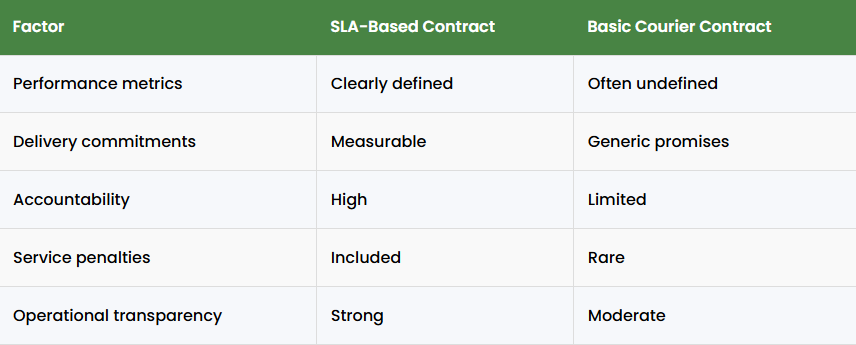
SLAs create structured accountability, while basic agreements may lack enforceable service standards.
Benefits of Courier SLAs
Reliable Delivery Performance - Defined expectations ensure consistent service quality.
Better Vendor Management - Businesses can compare courier partners based on performance.
Reduced Logistics Disruptions - Clear service standards help prevent operational delays.
Improved Customer Experience - Faster and more predictable deliveries improve customer satisfaction.
Challenges in Managing Courier SLAs
Despite their importance, implementing SLAs effectively can be challenging.
Courier Network Limitations
Some regions may have infrastructure constraints affecting delivery timelines.
Data Visibility Issues
Incomplete tracking data can make SLA monitoring difficult.
Multi-Courier Complexity
Managing SLAs across multiple courier partners requires strong analytics systems.
Common Mistakes Businesses Make
Not Defining Clear Metrics
Vague SLA definitions create confusion.
Ignoring Regional Delivery Differences
Delivery timelines vary across metro, tier-2, and rural areas.
Lack of Regular Performance Reviews
Many businesses fail to analyze courier performance consistently.
Over-Reliance on a Single Courier Partner
Using only one courier increases operational risk.
Practical Best Practices
Businesses can improve SLA management by following these strategies.
Use Multi-Courier Logistics Strategy
Using multiple courier partners improves delivery reliability, helps businesses meet courier SLA performance benchmarks, and reduces operational risk by avoiding dependency on a single courier provider for nationwide shipping operations.
Track Logistics KPIs Regularly
Monitor performance metrics weekly or monthly.
Align SLAs with Customer Promises
Ensure courier delivery timelines match website delivery commitments.
Automate Performance Monitoring
Logistics dashboards can help track courier performance in real time.
Data-Driven Logistics Insights
Some common logistics performance benchmarks for Indian eCommerce include:
| KPI | Industry Benchmark |
|---|---|
| On-time delivery | 95% |
| Order accuracy | 99% |
| Pickup adherence | 95% |
| Delivery success rate | 85 - 90% |
| Shipment damage rate | <1% |
Companies that actively monitor SLA metrics often achieve 10 - 20% improvements in logistics efficiency.
Conclusion
Service Level Agreements are essential tools for managing courier partnerships in modern eCommerce logistics. By clearly defining service expectations, performance metrics, and accountability standards, SLAs help businesses maintain consistent delivery performance and operational efficiency.
For eCommerce brands operating in India's highly competitive market, well-structured courier SLAs ensure reliable shipping, better customer experiences, and improved logistics cost control.
India's rapidly expanding eCommerce ecosystem continues to drive demand for reliable logistics infrastructure and standardized service performance.
Businesses that actively track SLA performance and optimize courier partnerships are better positioned to scale operations and maintain high service standards.
Improve Logistics Efficiency with Smarter Shipping
Managing courier partnerships effectively requires visibility into shipping performance and service quality. By implementing structured SLAs and tracking logistics metrics, businesses can build more reliable and efficient shipping operations.
Courier management platforms such as iCarry help businesses manage multiple courier partners, monitor delivery performance, and optimize logistics workflows for smarter shipping decisions.
iCarry SLA Framework
Logistics management platforms such as iCarry.in help businesses monitor courier performance, track SLA compliance, and maintain consistent shipping standards across multiple courier partners.
When working with multiple logistics providers, structured SLA frameworks help define expectations around key operational areas such as:
- Delivery time commitments across shipping zones covering 29000+ pincodes in India
- Pickup scheduling and warehouse collection timelines
- Shipment tracking visibility and status updates
- First-attempt delivery success benchmarks
- Issue resolution timelines for lost or damaged shipments
- Escalation processes for service disruptions
These service standards help businesses measure courier partner performance objectively and ensure consistent delivery experiences for customers.
Operational visibility becomes even more important as shipping volumes grow. Logistics management systems that provide centralized monitoring of courier performance, such as those used within iCarry.in, allow operations teams to track SLA adherence, identify delivery bottlenecks, and maintain consistent shipping performance across multiple courier partners.
Here are some specific SLA benchmarks tracked and followed at iCarry.in:
1. Pickup Turnaround Time (TAT)
Once a shipment is booked, a pickup request is automatically generated.
The assigned pickup executive will contact the shipper to confirm readiness.
Non-regular pickups: Completed within 1 - 2 business days.
Same-day / Next-day pickup: Shipments booked before 11:00 AM are usually picked up the same day or next business day.
Pickup window: Typically from afternoon until ~8:00 PM.
2. Support Ticket Response Time
All support tickets receive a response within 24 business hours.
3. KYC / Account Activation
KYC verification and account activation is completed within 24 hours (maximum).
4. WhatsApp Chat Support
Response time: Within 15 - 20 minutes during business hours.
5. Next-Day COD Payout
Cash on Delivery (COD) collections are remitted to the merchant the next business day after shipment delivery confirmation.
Final Thoughts
In modern eCommerce logistics, courier performance cannot rely on informal expectations alone. Structured Service Level Agreements provide measurable accountability, enabling businesses to monitor delivery reliability, control logistics costs, and improve operational transparency.
As shipping volumes grow and customer expectations continue to rise, well-defined courier SLAs become an essential foundation for building scalable and reliable logistics operations.
Many businesses use logistics management platforms such as iCarry to monitor courier performance, analyze SLA compliance, and manage multi-courier shipping operations more efficiently.
Frequently Asked Questions (FAQs)
What is an SLA in courier services?
An SLA (Service Level Agreement) is a contract that defines the expected service performance of a courier provider, including delivery timelines, pickup schedules, and shipment handling standards.
Why are SLAs important in logistics contracts?
SLAs create clear service expectations and accountability, helping businesses ensure reliable shipping performance and consistent customer experiences.
What metrics are commonly included in courier SLAs?
Common metrics include on-time delivery rate, pickup adherence, delivery success rate, shipment damage rate, and issue resolution timelines.
What happens if a courier company fails to meet SLA commitments?
If a courier partner fails to meet SLA terms, contracts may include penalties, service credits, or corrective actions depending on the agreement.
How often should courier SLA performance be reviewed?
Businesses should review courier performance monthly or quarterly to ensure service standards are maintained.
Can eCommerce businesses negotiate courier SLAs?
Yes. Businesses with consistent shipment volumes can negotiate delivery timelines, pickup schedules, and performance commitments with courier partners.
What is the difference between an SLA and KPI in logistics?
A Service Level Agreement defines the contractual service standards a courier provider must meet, while logistics KPIs measure the operational performance of shipments and delivery operations.
What is a good delivery SLA for eCommerce shipping?
Most eCommerce businesses target an on-time delivery SLA of 95% or higher to maintain customer satisfaction and reliable shipping performance.
What is an SLA penalty in courier contracts?
SLA penalties are financial or service-based compensations applied when courier providers fail to meet agreed delivery timelines or performance standards.
How do courier aggregators help manage SLAs?
Courier aggregators allow businesses to monitor delivery performance across multiple logistics partners and compare SLA compliance using centralized dashboards.
An SLA (Service Level Agreement) in courier contracts is a formal agreement that defines measurable service commitments including delivery timelines, pickup schedules, tracking standards, and issue resolution processes—helping eCommerce businesses maintain delivery reliability, reduce operational disputes, and evaluate courier partner performance through structured accountability frameworks.