A D2C wellness brand receives a customer's Instagram story: a photograph of their unboxing, with the caption 'Beautiful product but why so much plastic?' The customer shows three nested poly bags, two sheets of bubble wrap, and a foam peanut fill around a 200ml glass bottle. The bottle arrived safe. The six layers of plastic were a disposal problem, and a sign the brand was far from sustainable packaging. The customer photographed it and shared it with 12,000 followers.
The packaging did its job. But it also became the brand's public sustainability statement - and it was not the statement the brand intended.
India's Plastic Waste Management Rules (amended 2022) and growing consumer awareness have made packaging sustainability a business requirement, not just an aspiration. With India generating over 4.1 million tonnes of plastic waste every year, eCommerce packaging is a visible and growing contributor. Extended Producer Responsibility (EPR) obligations now apply to brand owners, producers and importers of plastic packaging (micro and small enterprises are exempt), and marketplace and regulatory pressure on single-use plastic is increasing.
Here is a practical plan for Indian eCommerce businesses that want to switch to sustainable packaging - without weaker product protection or a big jump in per-order cost.
What Is Sustainable Packaging?
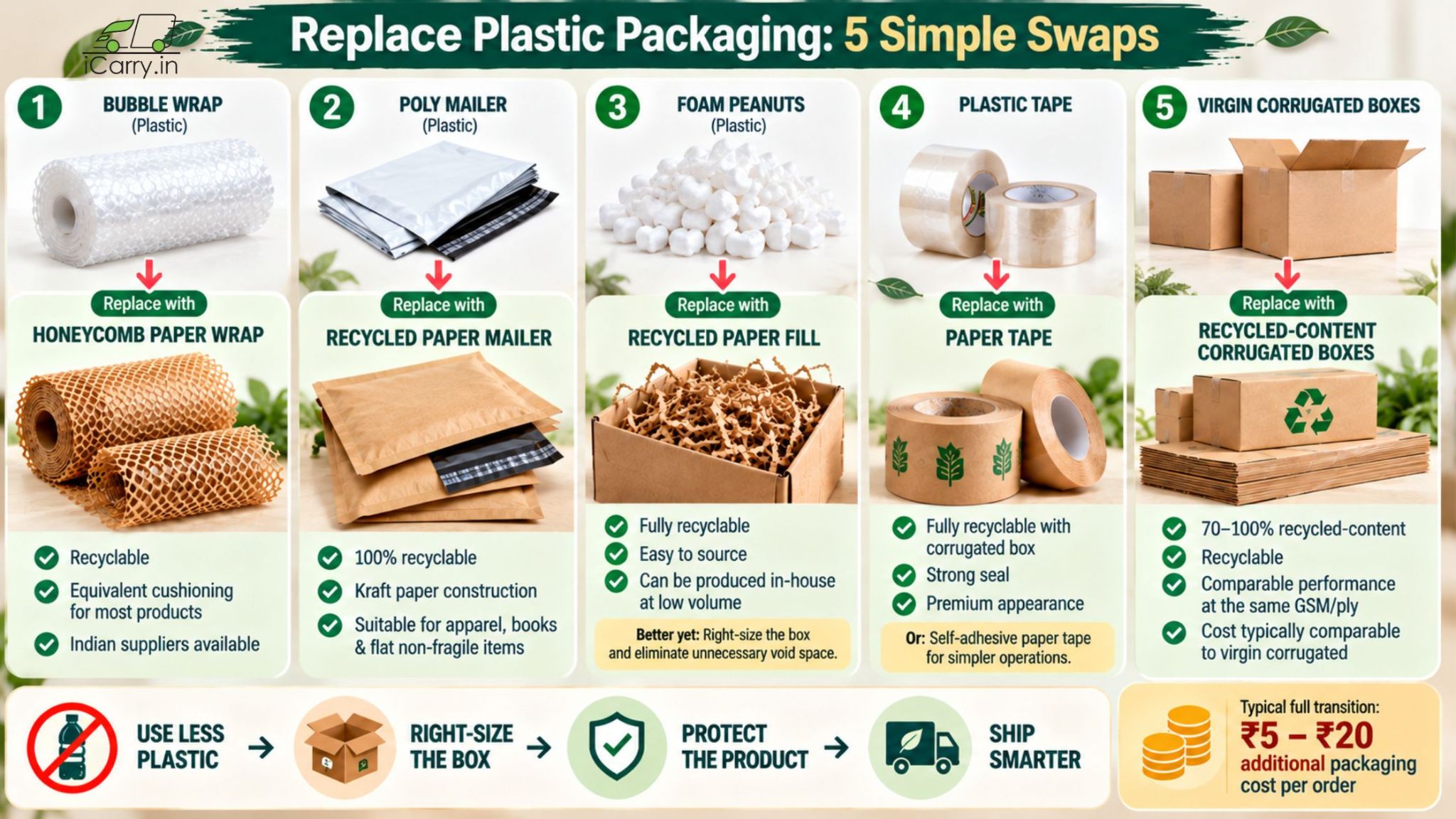
Sustainable packaging is packaging made from recycled, recyclable or compostable materials that protects your product with less plastic and less waste. For Indian eCommerce sellers, it means swapping bubble wrap, poly mailers, foam peanuts and plastic tape for paper-based options, while following India's Plastic Waste Management Rules. For most brands, the full switch adds only ₹5 to ₹20 per order.
How to Check If Your Packaging Is Sustainable-Ready
- Do you know what percentage of your current packaging by weight is single-use plastic?
- Have you checked whether your business needs to register for EPR under India's Plastic Waste Management Rules?
- Have you identified sustainable alternatives for each of your current plastic packaging components?
- Do you have Indian suppliers for sustainable packaging materials (to avoid import cost and transit emissions)?
- Are you communicating your packaging choices to customers on the packaging itself or in order communications?
India's Plastic Packaging Regulations - What Businesses Must Know
India's Plastic Waste Management (PWM) Rules, with amendments through 2022, set specific requirements for businesses using plastic packaging:
- Single-use plastic prohibition: Plastics below specified thickness are prohibited for use as packaging material. The prohibited list includes certain plastic bags, polystyrene items, and single-use cutlery items. Check the current CPCB (Central Pollution Control Board) notification for the specific product list as it is updated periodically
- Extended Producer Responsibility (EPR): Producers, importers and brand owners of plastic packaging must register on the CPCB EPR portal and meet annual plastic waste collection and management targets. Micro and small brand owners are exempt from EPR obligations
- Compostable plastics standard: Plastics marketed as 'compostable' must meet IS 17088 (the Indian standard for compostable plastics). Using 'compostable' or 'biodegradable' on packaging without IS 17088 certification is a compliance violation
- Recycled content targets: PWM Rules set increasing targets for recycled plastic content in packaging over a phased timeline. Brands using plastic packaging should track these targets and adjust sourcing accordingly
Sustainable Alternatives: Component by Component
Replacing Plastic Bubble Wrap
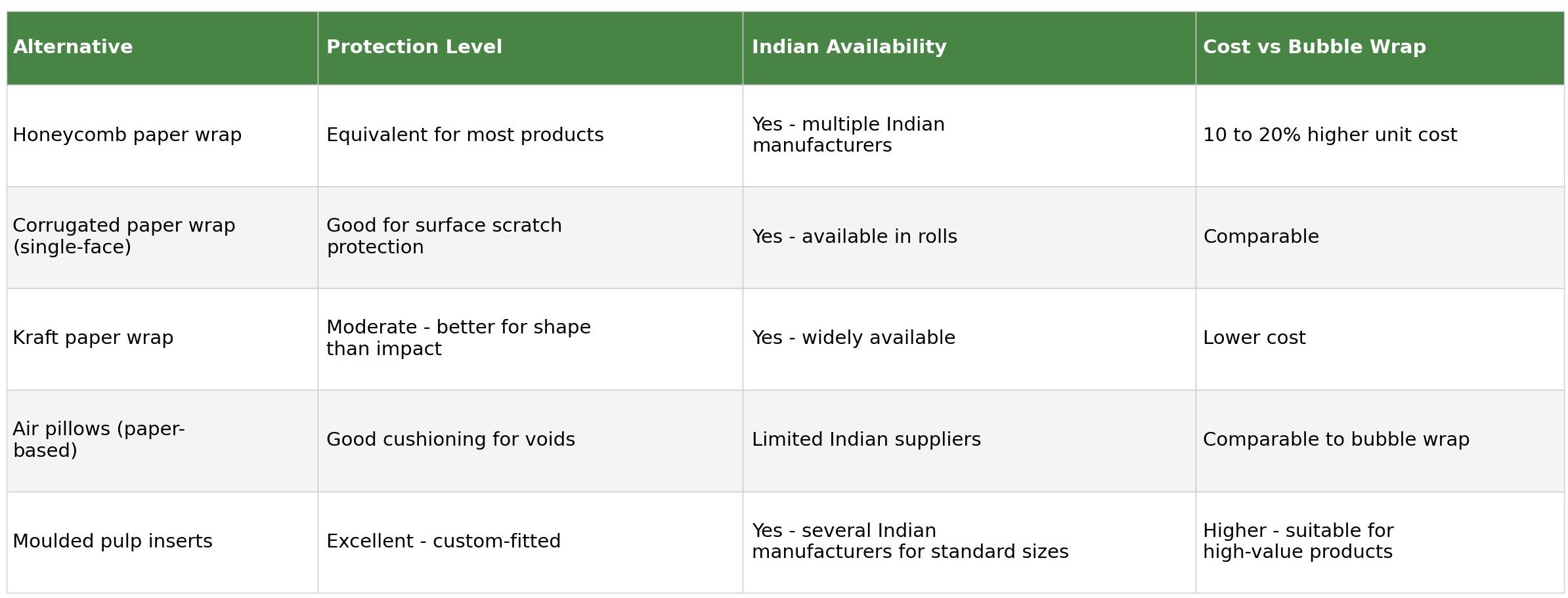
Recommended transition: Start with honeycomb paper wrap as a direct bubble wrap replacement. It provides equivalent cushioning for most fragile products and is fully recyclable. Available from Indian manufacturers in Delhi NCR, Bengaluru, and Mumbai. Order a test batch of 100 metres before committing to full transition.
Replacing Poly Mailers
- Recycled paper mailers: 100% recyclable, kraft paper construction, available with peel-and-seal closure. Suitable for apparel, accessories, books, and flat non-fragile items. Multiple Indian manufacturers offer custom printing at reasonable MOQs
- Compostable mailers (IS 17088 certified): Compostable under industrial conditions. Must carry IS 17088 certification if marketed as compostable. Cost is 30 to 50% higher than standard poly mailers but conveys a strong brand sustainability message
- Upcycled fabric bags: For premium brands - cotton or jute packaging bags that customers reuse. Higher upfront cost but creates a brand artefact the customer keeps rather than discards
Replacing Foam Peanuts and Loose Fill
- Recycled paper fill (shredded or crumpled): Fully recyclable, easily sourced from recycled paper suppliers. Can be produced in-house from recycled paper with a paper shredder if volume is low
- Biodegradable starch peanuts: Dissolve in water. Identical performance to polystyrene foam peanuts. Available from Indian importers and a growing number of domestic manufacturers. Cost is 20 to 40% higher than foam peanuts
- Right-sizing the box: The most effective 'replacement' for void fill is eliminating the void space that requires it. Right-sizing boxes reduces or eliminates the need for fill material entirely - and saves on box material and volumetric freight cost simultaneously
Replacing Plastic Tape
- Gummed paper tape (water-activated): Creates a stronger seal than plastic tape on corrugated paper. Fully recyclable with the box. Requires a water-activation dispenser (one-time investment of ₹2,000 to ₹5,000). Preferred by premium brands for the premium sealing look
- Self-adhesive paper tape: No dispenser needed. Recyclable. Slightly weaker seal than gummed tape but adequate for most eCommerce parcels. Available from Indian packaging suppliers
Corrugated Boxes - Recycled Content
Corrugated boxes are already recyclable. The sustainable upgrade is switching from virgin fibre to recycled content corrugated:
- 70 to 100% recycled content corrugated is available from most major Indian corrugated manufacturers
- Performs identically to virgin corrugated at the same GSM (grams per square metre) and ply rating
- Cost is typically comparable to virgin corrugated - sometimes lower depending on supplier and volume
- Can carry FSC (Forest Stewardship Council) certification if the recycled fibre is from FSC-certified sources - relevant for brands that want third-party certified sustainability claims
- Smaller boxes also cut volumetric weight charges. Use the shipping cost calculator on iCarry® to see the difference before you order new boxes.
Indian Supplier Landscape for Sustainable Packaging
Sourcing sustainable packaging from Indian manufacturers is critical for three reasons: cost (imports add 20 to 40% landed cost), lead time (domestic suppliers deliver in 3 to 7 days vs 30+ for imports), and sustainability coherence (importing packaging from China to use in an eco-friendly Indian brand creates its own emissions inconsistency).
- Honeycomb paper wrap: Multiple manufacturers in Delhi NCR, Pune, and Bengaluru. Search 'honeycomb paper packaging India' and contact at least 3 suppliers for samples and quotes
- Recycled content corrugated: All major Indian corrugated manufacturers (including many regional ones) offer recycled content options. Ask specifically for 70% or 100% recycled fibre and request the GSM and ply rating to verify performance equivalence
- Compostable mailers: A growing number of Indian manufacturers produce IS 17088-certified compostable mailers. Verify the IS 17088 certificate before purchasing any mailer marketed as compostable
- Recycled paper mailers: Kraft paper mailers are widely available from Indian packaging suppliers in standard sizes with custom printing options at reasonable MOQs (typically 500 to 1,000 units)
- Moulded pulp: Custom moulded pulp inserts (for fragile product protection) are available from Indian manufacturers for standard product dimensions. Custom tooling cost applies but is amortised over volume
Cost Reality Check - Sustainable Packaging Is Not Always More Expensive
The common assumption that sustainable packaging costs more than conventional plastic is not universally true:
- Recycled content corrugated: Comparable to virgin corrugated. No significant cost increase
- Paper tape: Slightly higher per roll than plastic tape, but comparable per metre
- Recycled paper fill: Lower cost than foam peanuts if produced in-house from recycled paper. Comparable from suppliers
- Honeycomb paper wrap: 10 to 20% higher than bubble wrap per metre. The additional cost is typically ₹2 to ₹8 per order depending on wrapping requirements
- Compostable mailers: 30 to 50% higher than poly mailers. The most significant cost increase in the sustainable transition
For most product categories, the total additional packaging cost of a full sustainable transition is ₹5 to ₹20 per order. At average D2C order values of ₹600 to ₹1,500, this is 0.3 to 3.3% of order value. A marginal premium that most brands can absorb or partially pass through as a sustainability premium.
Communicating Sustainable Packaging to Customers
Sustainable packaging that is not communicated generates no brand benefit. The investment is complete only when the customer knows about it:
- On the box: Simple, specific language: 'This box is made from 100% recycled content. Please recycle or reuse.' A printed or stamped message costs ₹0.50 to ₹2 per box and creates a visible sustainability statement at the moment of highest customer attention
- On the mailer: For compostable mailers: 'This mailer is compostable under industrial composting conditions - IS 17088 certified.' For paper mailers: 'This mailer is 100% recyclable. Place it in your paper recycling bin.'
- In the order confirmation: 'We have packed your order in sustainable packaging made from recycled materials. Our packaging is plastic-free and fully recyclable.'
- On your website: A dedicated packaging sustainability page that explains what materials you use, why you chose them, and how customers can dispose of them correctly. Link to it from your FAQ and checkout page
Avoid vague claims: 'eco-friendly packaging' without specifics is marketing language that informed consumers increasingly dismiss. 'Made from 70% recycled content corrugated, sealed with paper tape, cushioned with honeycomb paper wrap' is specific, verifiable, and credible.
How iCarry® Supports Sustainable Packaging Decisions
iCarry® helps businesses evaluate the shipping cost impact of different packaging choices, making it easier to balance packaging efficiency with shipping costs:
- Rate comparison at actual dimensions: Enter the actual weight and dimensions of your sustainable packaging at booking and compare available courier rates before confirming. This helps businesses assess the cost impact of right-sized packaging.
- Volumetric weight transparency: Packaging choices can affect both actual and volumetric weight. Using lighter, right-sized materials can help businesses manage shipping costs while reducing unnecessary packaging.
- Weight discrepancy management: Enter the accurate sealed shipment weight at booking to reduce discrepancies between declared and measured weight and avoid unexpected charges.
- Multiple courier partners: Compare available courier options through one iCarry® account and select a suitable service based on shipment weight, dimensions, destination, and cost.
- B2B and LTL shipping: For businesses shipping larger quantities or heavier consignments, iCarry® also supports B2B multi-box and LTL shipping options.
Free Bronze plan with no minimum shipment volume.
Final Thoughts
Sustainable packaging is not a single decision - it is a series of component-level substitutions, each evaluated for protection equivalence, cost impact, supplier availability, and customer communication value. No single transition covers all products or all packaging needs.
Start with the highest-volume packaging component in your operation. For most Indian eCommerce businesses, that is either the outer corrugated box (switch to recycled content), the void fill (switch to paper fill or right-size the box to eliminate void space), or the mailer (switch to recycled paper). Make one change, measure the cost and protection outcome for one month, then move to the next component.
Brands that make the switch early build stronger supplier relationships, better packaging know-how and more customer trust. In a market where buyers care more about sustainability, that is a real advantage.
Frequently Asked Questions (FAQs)
What sustainable packaging alternatives work for fragile products in Indian courier transit?
Honeycomb paper wrap provides equivalent cushioning to bubble wrap for most fragile products and is fully recyclable. Moulded pulp inserts provide the highest protection for fragile items and are available from Indian manufacturers. Right-sizing the corrugated box to eliminate void space is the most effective single action - a product that cannot move inside a correctly sized box survives normal courier transit without multiple cushioning layers.
What is EPR for plastic packaging and does it apply to my business?
Extended Producer Responsibility (EPR) requires producers, importers and brand owners of plastic packaging to register on India's EPR portal and meet annual plastic waste collection and management targets. Micro and small brand owners are exempt. Check the current Ministry of Environment guidelines and CPCB notifications for the registration requirements for your business size.
Are compostable mailers genuinely sustainable?
Compostable mailers certified under IS 17088 (India's standard for compostable plastics) are genuinely compostable under industrial composting conditions. They are not compostable in a home compost bin or in landfill - customers need access to industrial composting facilities, which are limited in most Indian cities. If you use compostable mailers, communicate this accurately: 'Compostable under industrial composting conditions (IS 17088 certified)' rather than simply 'compostable'.
How do I find Indian suppliers for sustainable packaging?
Search for honeycomb paper packaging, recycled paper mailers, kraft paper packaging, and compostable packaging with 'India' or your nearest major city. Request samples and IS 17088 certificates (for compostable products) before placing orders. Contact at least 3 suppliers per category for quotes and samples. Minimum order quantities typically range from 500 to 2,000 units depending on the product type and supplier. Local manufacturing clusters in Delhi NCR, Pune, Bengaluru, and Mumbai have the highest supplier density.
Does sustainable packaging cost significantly more?
Not across all categories. Recycled content corrugated is comparable to virgin corrugated. Recycled paper fill is comparable to or cheaper than foam peanuts. Honeycomb paper wrap is 10 to 20% more expensive than bubble wrap per metre. Compostable mailers are 30 to 50% more expensive than poly mailers. For most product categories, the total additional cost per order of a full sustainable transition is ₹5 to ₹20 - typically 0.3 to 3.3% of order value.
Sustainable packaging is a component-by-component substitution, not a single switch - honeycomb paper for bubble wrap, recycled or compostable mailers for poly bags, paper fill or a right-sized box for foam peanuts, and recycled-content corrugated for virgin boxes. Most of these changes cost little or nothing extra, the full transition typically runs ₹5 to ₹20 per order, and the EPR and compostability rules under India's Plastic Waste Management Rules apply the moment you cross micro/small enterprise size. Start with your highest-volume component, measure the outcome for a month, and move to the next.