A D2C skincare brand is processing 400 orders a day from a rented space in their home city. The founder is spending three hours every afternoon packing orders. They have run out of storage space twice in six months. They are considering moving to a fulfillment center - but are not sure if what they actually need is just a larger warehouse with better organization.
This is one of the most common decisions growing Indian businesses face. And it is frequently made on incomplete understanding of what these two facilities actually do and what they cost.
The terms 'warehouse' and 'fulfillment center' are often used interchangeably - even by people in the logistics industry. India's e-commerce warehousing market is projected to grow from roughly $10 billion in 2025 to $39 billion by 2034 . As Indian commerce expands across geographies and categories, understanding the distinction between the two is increasingly relevant for businesses making decisions about where to store inventory and how to fulfil orders.
This guide explains the real difference, what each facility does, which type your business actually needs, and how the choice affects your logistics operation and cost structure. Whichever model you land on, the shipping platform underneath it matters just as much - a platform like iCarry® works whether you're self-managing, running a warehouse, or booking from a fulfillment center.
What Is a Warehouse?
A warehouse is a facility designed primarily for the storage of goods. Its core function is holding inventory safely and efficiently until it is needed. Warehouses are built around the requirements of storage - racking systems, climate control where needed, security, loading docks for bulk inbound and outbound, and inventory management systems that track what is where.
In its traditional form, a warehouse receives goods in large quantities, stores them, and releases them in large quantities to the next point in the supply chain - a retailer, a distributor, a manufacturing facility, or another warehouse. The emphasis is on storage efficiency: how many units can be stored per square foot, how accurately inventory is tracked, and how quickly bulk consignments can be received and dispatched.
A warehouse is not designed to process individual customer orders. It does not have a packing station. It does not generate shipping labels for thousands of individual parcels. It does not manage returns from end customers.
What Is a Fulfillment Center?
A fulfillment center (also called an FC or fulfillment centre) is a facility designed to receive inventory, pick individual items against customer orders, pack and label those orders, and dispatch them to end customers. It is a warehouse with order processing built in.
The fulfillment center is optimised for throughput of individual orders - how many orders can be processed per hour, how accurately items are picked, how quickly a parcel moves from order confirmation to courier handover. Racking is laid out for pick path efficiency, not just storage density. Staff are trained in pick and pack, not just bulk loading. Returns come back here and are inspected, graded, and restocked.
Fulfillment centers typically serve D2C brands, marketplace sellers, and any business shipping individual consumer orders at scale.
How to Decide: Warehouse or Fulfillment Center? Quick Checklist
- Are you processing individual customer orders that need picking, packing, labelling, and dispatch? - Points toward fulfillment center
- Are you storing bulk inventory that ships in large quantities to retailers, distributors, or other businesses? - Points toward warehouse
- Do you want to outsource all post-order operations including returns? - Fulfillment center
- Do you need raw material or finished goods storage with no order management requirement? - Warehouse
- Is operational cost per order your primary metric, or is storage cost per pallet your primary metric?
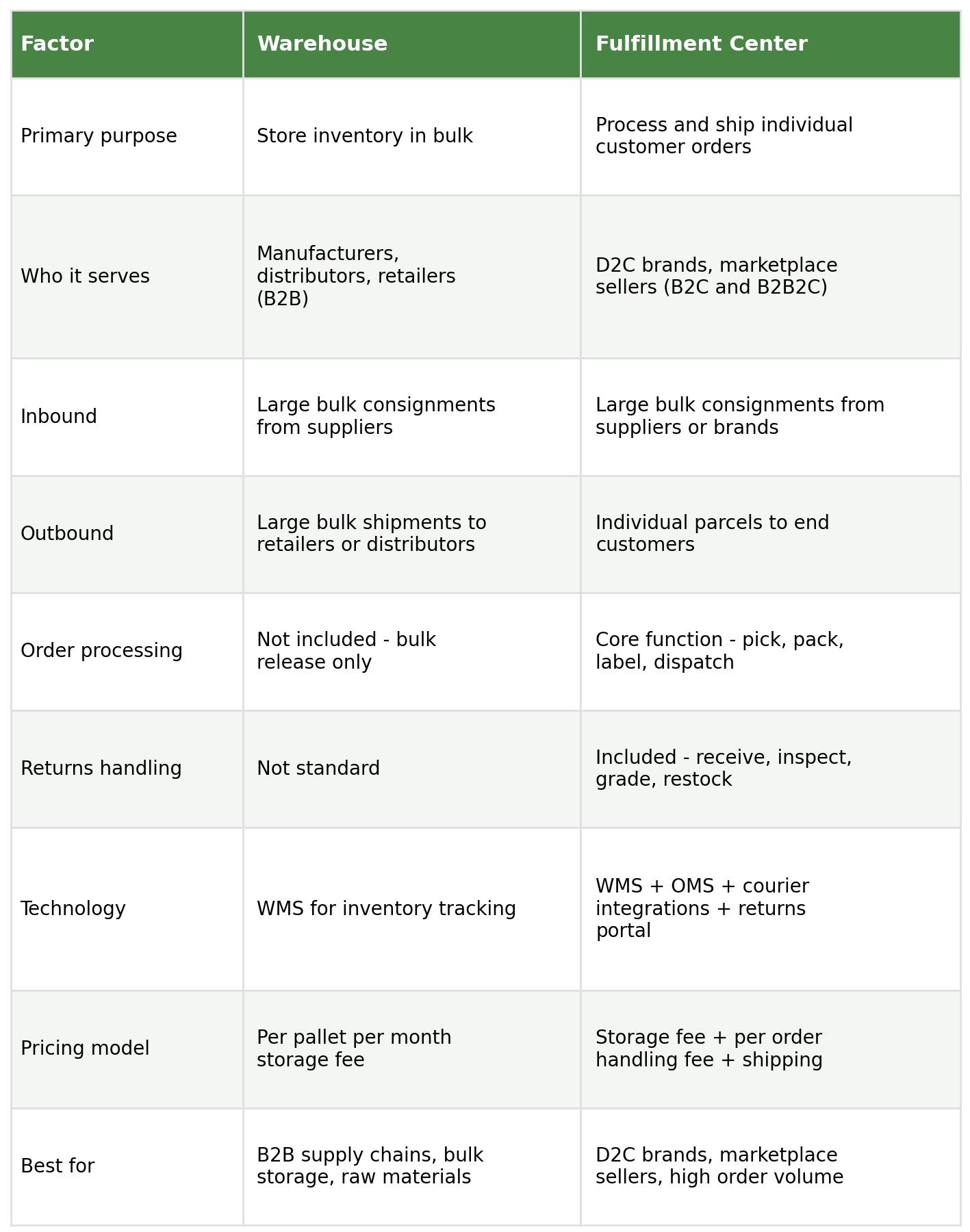
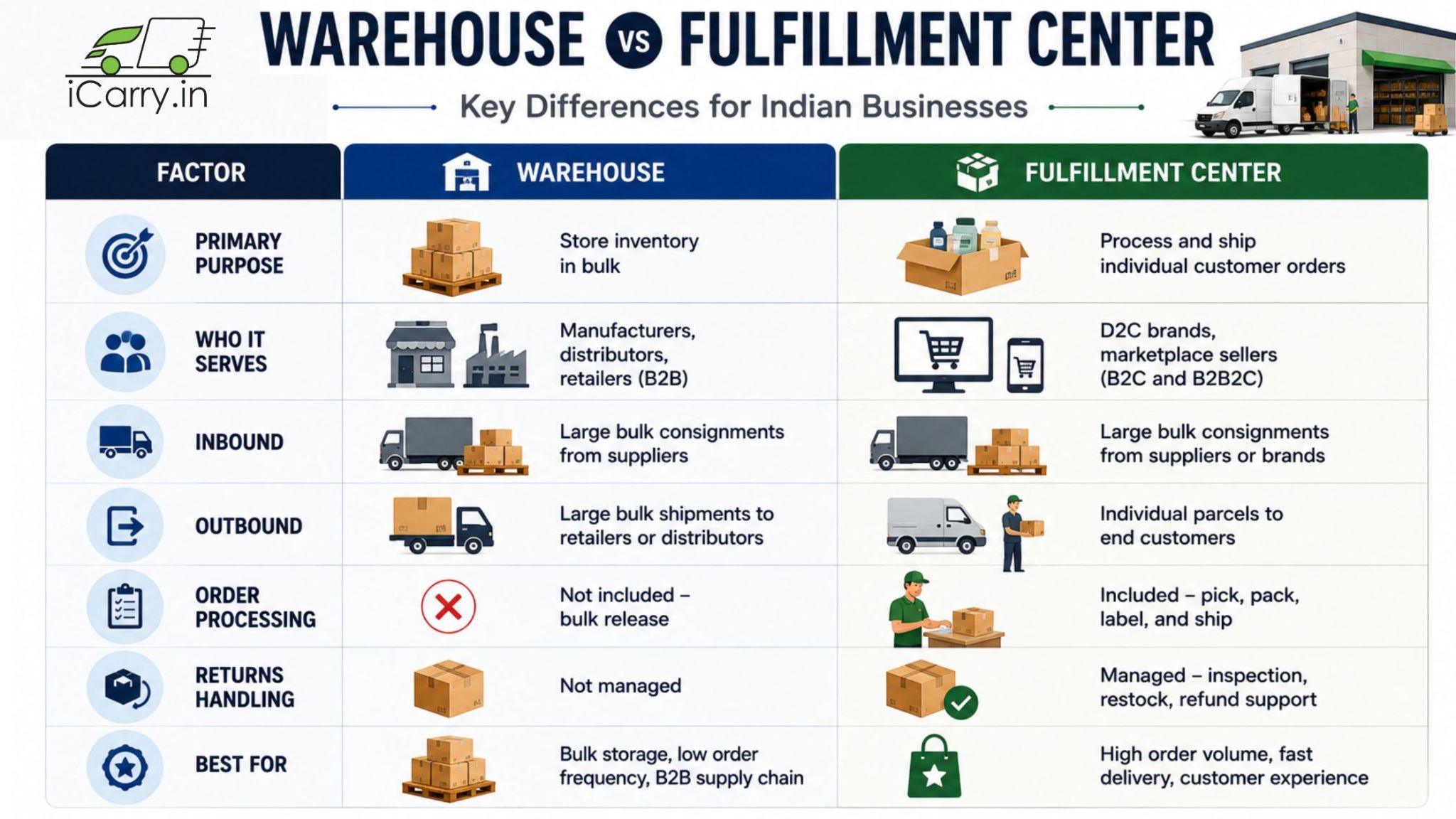
Side-by-Side Comparison
The Hybrid Model - Fulfillment Warehouse
Many Indian third-party logistics providers operate what is effectively a hybrid - a warehouse that also offers fulfillment services. This is sometimes called a fulfillment warehouse. It stores inventory and also processes individual orders, but is not purpose-built for either function at the level of a dedicated fulfillment center.
For businesses that need both bulk B2B dispatch and individual B2C order fulfillment from the same inventory, a hybrid 3PL provider can serve both needs. The trade-off is that neither function is as efficient as a dedicated facility.
Marketplace Fulfillment Programs - A Special Category
Amazon's Fulfilled by Amazon (FBA) and Flipkart's Fulfilled by (FBF) are fulfillment centers operated by the marketplace platform for their sellers. You send inventory to the marketplace's FC. They pick, pack, and ship on your behalf when orders come in.
These are fulfillment centers in every operational sense - but they come with the marketplace's specific rules, fees, and constraints. You gain the delivery speed badge and reduced logistics management overhead. You lose packaging control, return visibility, and flexibility on courier selection.
For sellers on both marketplace and D2C channels, using a marketplace FC for marketplace orders and a separate fulfillment provider or self-managed setup for D2C orders is a common split.
When an Indian Business Needs a Warehouse
- Manufacturers: Storing finished goods before bulk dispatch to distributors or retailers. The emphasis is on inbound receiving from production and outbound in full or half pallet loads.
- Importers: Holding imported goods at a bonded or general warehouse near the port before distribution inland.
- Distributors: Holding inventory for regular replenishment of retail networks. Outbound shipments are large, route-based, not individual consumer orders.
- Raw material storage: Manufacturing businesses storing inputs before production. No order processing required - just secure, organised storage with accurate inventory counts.
- Seasonal businesses: Businesses that need large-scale storage during peak production or import periods and minimal capacity off-season.
When an Indian Business Needs a Fulfillment Center
- D2C brands at scale: Once daily order volume consistently exceeds 200, self-managed fulfillment from a home or small office creates bottlenecks that a purpose-built FC resolves
- Marketplace sellers with high volume: Sellers who do not want to use the marketplace's own FC but cannot manage self-fulfillment at their order volume
- Multi-channel businesses: Selling across website, marketplaces, and wholesale simultaneously from one inventory pool requires an FC that can serve all channels
- Businesses expanding geographically: Using regional FCs to place inventory closer to customer concentrations reduces zone-level shipping cost and transit time
- Businesses with complex kitting or assembly: Subscription boxes, gift sets, and customised orders that require assembly before dispatch benefit from an FC with kitting capability
Cost Structure Comparison
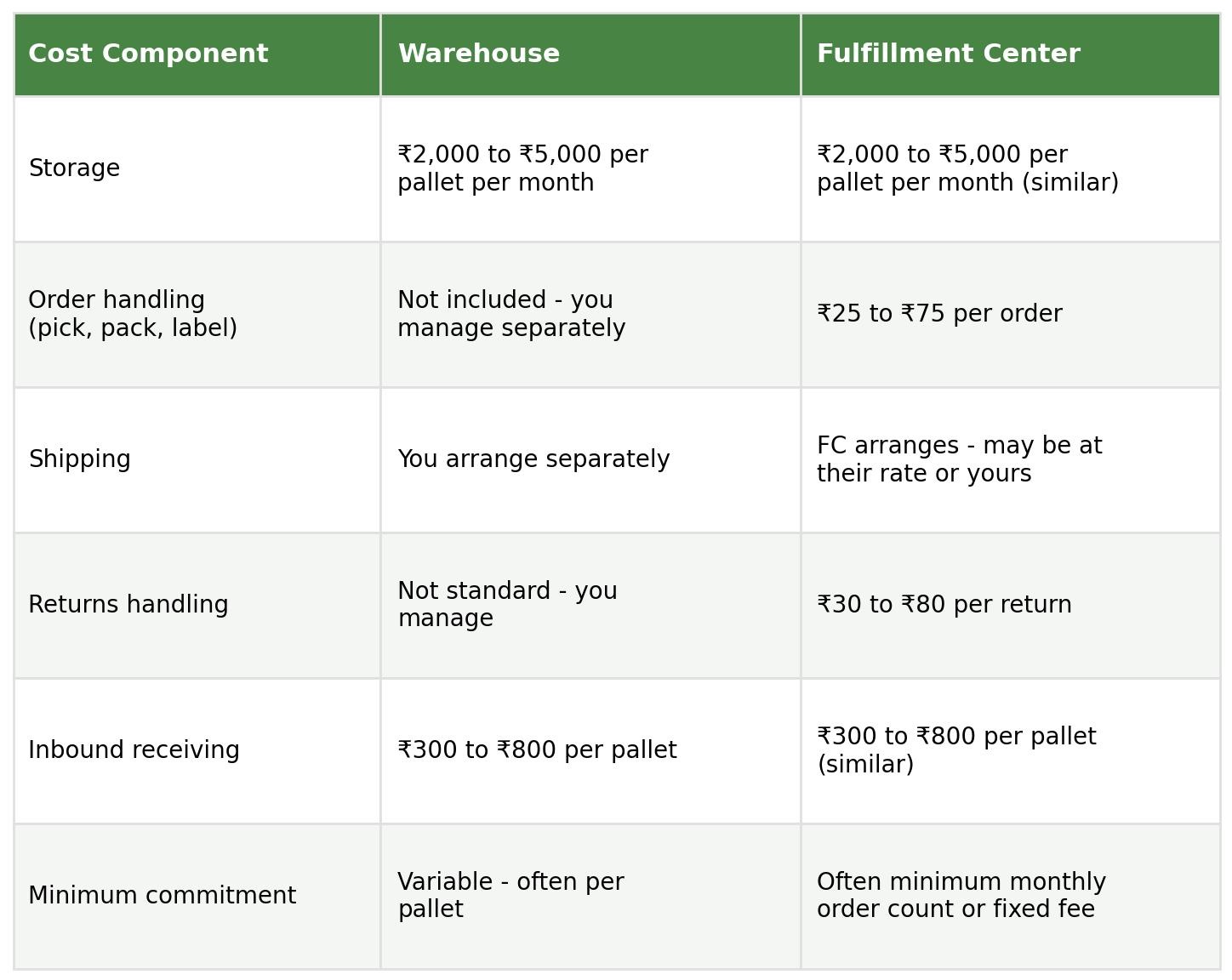
Key insight: A fulfillment center costs more per order than self-managed dispatch at low volumes. At high volumes (300+ daily orders), the per-order cost of an FC is often lower than self-managed when you account for staff cost, space cost, and error rate.
The Self-Managed Option - When It Makes Sense
Not every business needs an FC or a warehouse. Many Indian businesses - particularly at early to mid scale - self-manage from their own space with a courier aggregator handling the shipping leg. This is the right model when:
- Daily order volume is below 200 and manageable by a small team
- Product range is simple and SKU count is low
- You want to maintain full packaging and quality control
- Margins are thin enough that FC handling fees would be prohibitive
- You have space at reasonable cost and the management bandwidth to run operations
For self-managed businesses, the shipping platform becomes the critical infrastructure. A courier aggregator that gives multi-courier access, bulk booking, and delivery management tools reduces the operational overhead of self-managed fulfilment significantly.
How iCarry® Supports Both Models
iCarry® works for Indian businesses regardless of whether they self-manage, use a warehouse, or operate through a fulfillment center.
- For self-managed businesses: Multi-courier access at pre-negotiated rates, bulk booking, store integration, Delivery Boost, two-way WhatsApp engagement, and Address Quality Scoring - all from the free Bronze plan
- For fulfillment center operations: Multiple pickup addresses for each FC location, full REST API for OMS integration, real-time tracking across all active shipments from any location
- For warehouse-based B2B dispatch: B2B multi-box booking,surface freight access for bulk consignments, COD management for distributor COD orders
Watch Overview of My Account > My Shipments to see how shipments from multiple pickup locations are tracked across all couriers in one view.
Final Thoughts
The warehouse vs fulfillment center decision is not about which is better - it is about which matches what your business actually does. A warehouse stores bulk goods. A fulfillment center processes individual orders. Many businesses need both at different stages or in different parts of their operation.
The decision becomes clear when you answer one question: what does your outbound shipment look like? If it is pallets going to retailers, you need a warehouse. If it is individual parcels going to customers, you need fulfillment capability - whether self-managed, through a 3PL FC, or through a marketplace program.
Get this right and the rest of your logistics decisions - courier selection, packaging, returns management - become significantly easier to make.
Frequently Asked Questions (FAQs)
What is the main difference between a fulfillment center and a warehouse?
A warehouse stores goods in bulk and releases them in large quantities to retailers or distributors. A fulfillment center also stores goods but additionally processes individual customer orders - picking, packing, labelling, and dispatching each order separately. A warehouse is built for storage efficiency; a fulfillment center is built for order processing throughput.
Does a fulfillment center replace a warehouse?
Not always. A fulfillment center serves B2C individual orders. A warehouse serves B2B bulk supply chains. Manufacturers and distributors typically need warehouses. D2C brands and marketplace sellers typically need fulfillment centers. Businesses that do both need either a hybrid 3PL provider or separate facilities for each function.
When should an Indian D2C brand move to a fulfillment center?
When daily order volume consistently exceeds 200 and logistics management is consuming a significant share of the founder's or operations team's time. When storage space at the current location is consistently at capacity. When order error rates or dispatch delays are affecting customer experience and seller scores.
What does an order handling fee at a fulfillment center cover?
The per-order handling fee at a fulfillment center typically covers picking the items from storage, packing in appropriate packaging, generating and applying the shipping label, and handing over to the courier. It does not include the shipping cost itself, which is charged separately either at the FC's courier rate or at the brand's own courier aggregator rate.
Is Amazon FBA a fulfillment center?
Yes. Amazon's FBA (Fulfilled by Amazon) is a fulfillment center service where sellers send inventory to Amazon's facilities and Amazon handles pick, pack, shipping, and customer returns. It is a fulfillment center with the additional benefit of Amazon's fast delivery badge - but with the constraints of Amazon's packaging requirements, fees, and return policies.
Can I use iCarry® if I operate through a fulfillment center?
Yes. Register your fulfillment center location as a pickup address in your iCarry® account. The FC packs the orders and hands them to the iCarry® courier agent for collection. You retain control of courier selection, COD remittance, and delivery management tools regardless of where physical packing happens.
The warehouse vs fulfillment center decision is not about which is better - it is about which matches what your business actually does. A warehouse stores bulk goods and ships in large quantities to retailers or distributors. A fulfillment center processes individual orders - picking, packing, labelling, and dispatching each one. Answer what your outbound shipment actually looks like, and the rest of your logistics decisions become significantly easier to make.