Introduction
If you are selling on Amazon India, you already know that getting the order right is only half the job. The other half is getting it to the customer-fast, undamaged, and on time.
Amazon seller shipping in India refers to the process of storing, packing, and delivering orders using three fulfillment models: FBA (Amazon handles everything), Easy Ship (seller packs, Amazon delivers), and Self Ship (seller manages end-to-end logistics). The choice affects delivery speed, costs, and seller performance metrics.
Shipping performance on Amazon is not just an operational detail. It directly affects whether you win the Buy Box, how visible your listings are, and whether customers come back. Amazon India delivered 41 crore items with Same-Day or Next-Day service for Prime members in 2024-a 26% jump over the previous year. That is the benchmark customers now expect.
For sellers, this raises a practical question: which fulfillment model gives you the best balance of speed, cost, and control? This guide breaks it all down-FBA, Easy Ship, and Self Ship-so you can make the right call for your business. We will also break down how Amazon seller shipping works in India, including fulfillment models, cost structures, policies, and actionable best practices.
You can also explore optimised shipping strategies to improve delivery performance across models.
What is Amazon Seller Shipping?
Amazon seller shipping refers to how orders placed on Amazon get stored, packed, and delivered to customers. Depending on the model you choose, Amazon handles some or all of this-or you handle it entirely yourself using third-party courier services.
The basic workflow is the same across all models: customer places an order, the order gets processed and packed, and it gets shipped and tracked to delivery.
What changes is who does each of those steps-and how much it costs you.
Why Shipping Matters More Than Most Sellers Realise
Shipping performance has a direct impact on customer retention and repeat purchases. But it also affects several Amazon-specific metrics that determine how well your listings perform.
Buy Box Eligibility
The Buy Box is the default 'Add to Cart' button on a product listing. Winning it consistently can make or break your sales volume. Faster, more reliable delivery-especially through FBA and Prime-significantly improves your chances of holding the Buy Box over competing sellers.
Customer Ratings and Reviews
Late or damaged deliveries are one of the top reasons for negative reviews on Amazon. A 3-star review mentioning slow delivery can hurt your conversion rate for months. Sellers with consistent delivery performance tend to accumulate better ratings-and those ratings compound over time.
Return Rates
Delayed shipments often trigger cancellations or refusals at delivery-especially for COD orders. A customer who waited too long may simply reject the package. This turns into a return cost for you even though the product was never used.
Seller Performance Metrics
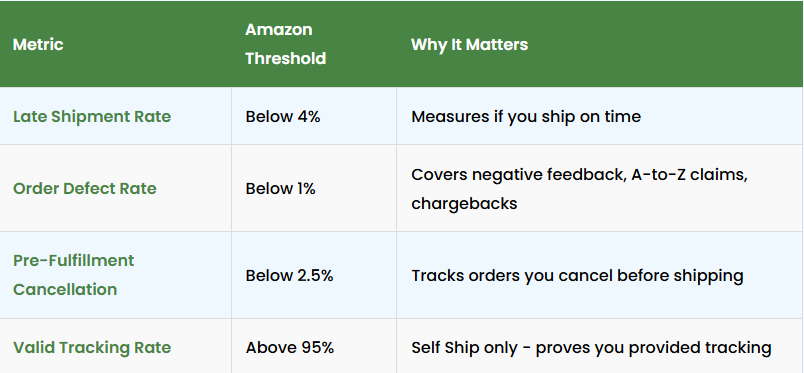
Amazon tracks your fulfillment closely. Breaching thresholds on key metrics can lead to listing suppression or account suspension. The table below shows what Amazon monitors and why it matters:
Amazon Fulfillment Models in India
Amazon offers three fulfillment models in India. Each suits a different type of seller, product, and business setup. Here is how they work-and where each one makes the most sense.
1. Fulfillment by Amazon (FBA)
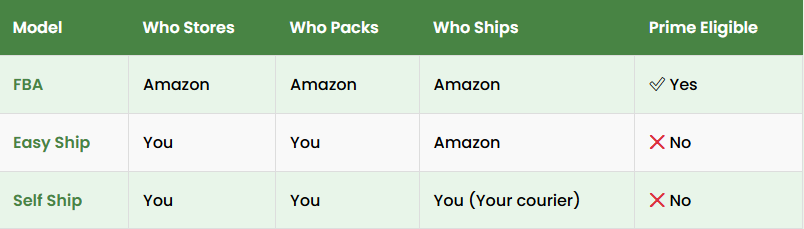
With Fulfillment by Amazon (FBA), you send your inventory to Amazon's fulfillment centers across India. Amazon then handles storage, packing, shipping, customer service, and returns on your behalf.
Your products become Prime-eligible, which means faster delivery and higher visibility for customers with Prime subscriptions. According to seller data, FBA listings typically see significantly higher conversion rates compared to non-Prime alternatives-because Indian Prime customers actively filter for fast delivery.
FBA works best for:
- Fast-moving products
- Items with consistent demand
- Sellers who want to remove logistics from their plate entirely
The trade-off:
- FBA comes with fulfillment fees, monthly storage fees, and long-term storage charges for slow-moving inventory
- Costs went up in 2024, with pick-and-pack, storage, and weight handling fees all revised upward
- Managing your inventory carefully-avoiding overstock and clearing slow movers-is essential to keeping FBA profitable
2. Easy Ship
With Easy Ship, you store your inventory at your own location and pack the orders yourself. Amazon then picks up the packed order from you and handles delivery to the customer. This gives you more control over how products are packed and presented, while still letting Amazon manage the last-mile delivery-which is often the most complex part of the process.
Easy Ship works best for:
- Sellers with moderate order volumes
- Products that need careful or branded packaging
- Businesses that want Amazon to handle delivery without giving up full inventory control
The trade-off:
- You are dependent on Amazon's pickup slots, which can be limited during peak seasons like festive sales
- If your order is not packed and ready when the pickup agent arrives, it gets rescheduled-and that can push your shipment into the late category
3. Self Ship (Merchant Fulfilled Network)
With Self Ship, you manage everything-storage, packing, and delivery. You choose your own courier partners and handle the full logistics process. This model gives you maximum flexibility, including the ability to manage logistics operations across multiple platforms, not just Amazon. You can also negotiate rates directly with couriers and optimise costs as your volume grows.
Self Ship works best for:
- Sellers with high operational capability
- Those already running multi-channel eCommerce
- Businesses with products that are too large or too fragile for standard FBA handling
The trade-off:
- Delivery speed is typically slower than FBA or Easy Ship
- Your seller metrics-particularly Valid Tracking Rate and Late Shipment Rate-depend entirely on your courier's performance
- A single bad courier partner can tank your account health
Fulfillment Models at a Glance
Amazon Shipping Costs in India
Shipping costs on Amazon vary by fulfillment model, product category, size, weight, and delivery distance. Here is a cost breakdown based on current Amazon India fee structures:
FBA Cost Components
FBA fees in India include: pick-and-pack fees (per unit), monthly storage fees (based on cubic space used), weight handling charges, and referral fees (a percentage of the selling price, which varies by category). For items stored longer than 365 days, long-term storage fees apply-these can get expensive fast if you are not moving inventory regularly.
From September 2025, Amazon India revised several referral fee slabs. Items priced below ₹300 now attract 0% referral fee, while categories like apparel, electronics, and home goods saw adjustments to fee rates. Always check Amazon Seller Central for the current fee schedule before pricing a new product.
Easy Ship Costs
Easy Ship charges are based on shipment weight and delivery zone. Amazon manages the pickup and delivery, and the fee is deducted from your settlement. Charges are generally competitive for standard-size products but can add up for heavier items or deliveries to remote pin codes.
Self Ship Costs
Self Ship costs depend entirely on which courier partner you use and what rates you have negotiated. The advantage is that you can shop around for the best rate. The risk is that you absorb the full cost of failed deliveries and RTOs-including both forward and return shipping.
Here is a rough guide to typical shipping cost ranges across delivery zones in India:
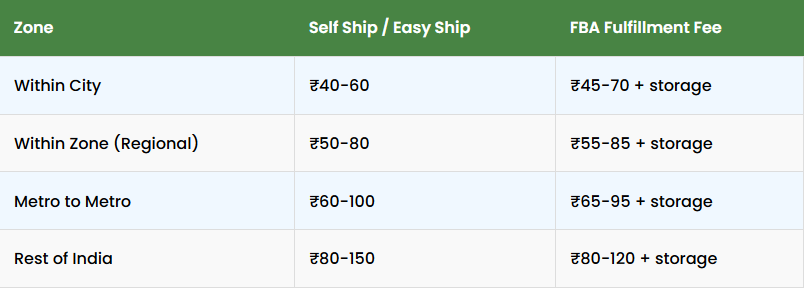
Note: All fees are exclusive of GST (18% applicable). Actual rates vary by product size, weight tier, and courier partner.
Amazon Shipping Policies Every Seller Must Know
Amazon enforces strict Service Level Agreement (SLA) requirements across all fulfillment models. These are not suggestions-breaching them consistently leads to listing suppression or account action.
Delivery SLA Compliance
Every order has an Expected Ship Date and an Expected Delivery Date. Missing these repeatedly-even by a day or two-pushes up your Late Shipment Rate. For Easy Ship and Self Ship sellers, this is one of the most common account health issues.
Order Defect Rate (ODR)
ODR covers negative feedback, A-to-Z Guarantee claims, and chargeback disputes. Amazon requires this to stay below 1%. A single spike-usually triggered by a batch of bad deliveries or a product quality issue-can put your account under review.
Pre-Fulfillment Cancellation Rate
If you cancel orders before shipping-because of stockouts, incorrect listings, or other reasons-your cancellation rate goes up. Amazon requires this to stay below 2.5%. Sellers running Self Ship with poor inventory management often run into this issue during high-demand periods.
Valid Tracking Rate
Self Ship sellers must provide valid tracking information for at least 95% of orders. If your courier partner does not update tracking in Amazon's system, this metric suffers-even if the delivery was successful.
Common Mistakes Amazon Sellers Make with Shipping
Most shipping problems on Amazon are avoidable. These are the ones that come up most often:
- Choosing the wrong fulfillment model for the product: FBA makes sense for small, fast-moving items but can be expensive for bulky or slow-moving products. Many sellers end up paying high storage fees because they sent the wrong products into FBA.
- Not accounting for all FBA costs when pricing: Referral fees, fulfillment fees, storage fees, and weight handling all add up. Sellers who calculate margins based on selling price alone often discover their products are unprofitable only after months of selling.
- Poor inventory planning during festive season: FBA storage at Amazon's fulfillment centers fills up fast during the October-November festive period. Sellers who do not plan inventory in advance run out of stock at peak demand-or end up with too much left over and pay long-term storage fees.
- Ignoring seller performance metrics until they become a problem: Many sellers only look at their account health when Amazon sends a warning. By then, the metrics have already affected Buy Box eligibility and listing visibility.
- Single-courier dependency for Self Ship: Relying on one courier for all Self Ship orders is risky. If that courier has a service outage, strike, or operational issue in your key delivery areas, your Late Shipment Rate spikes immediately.
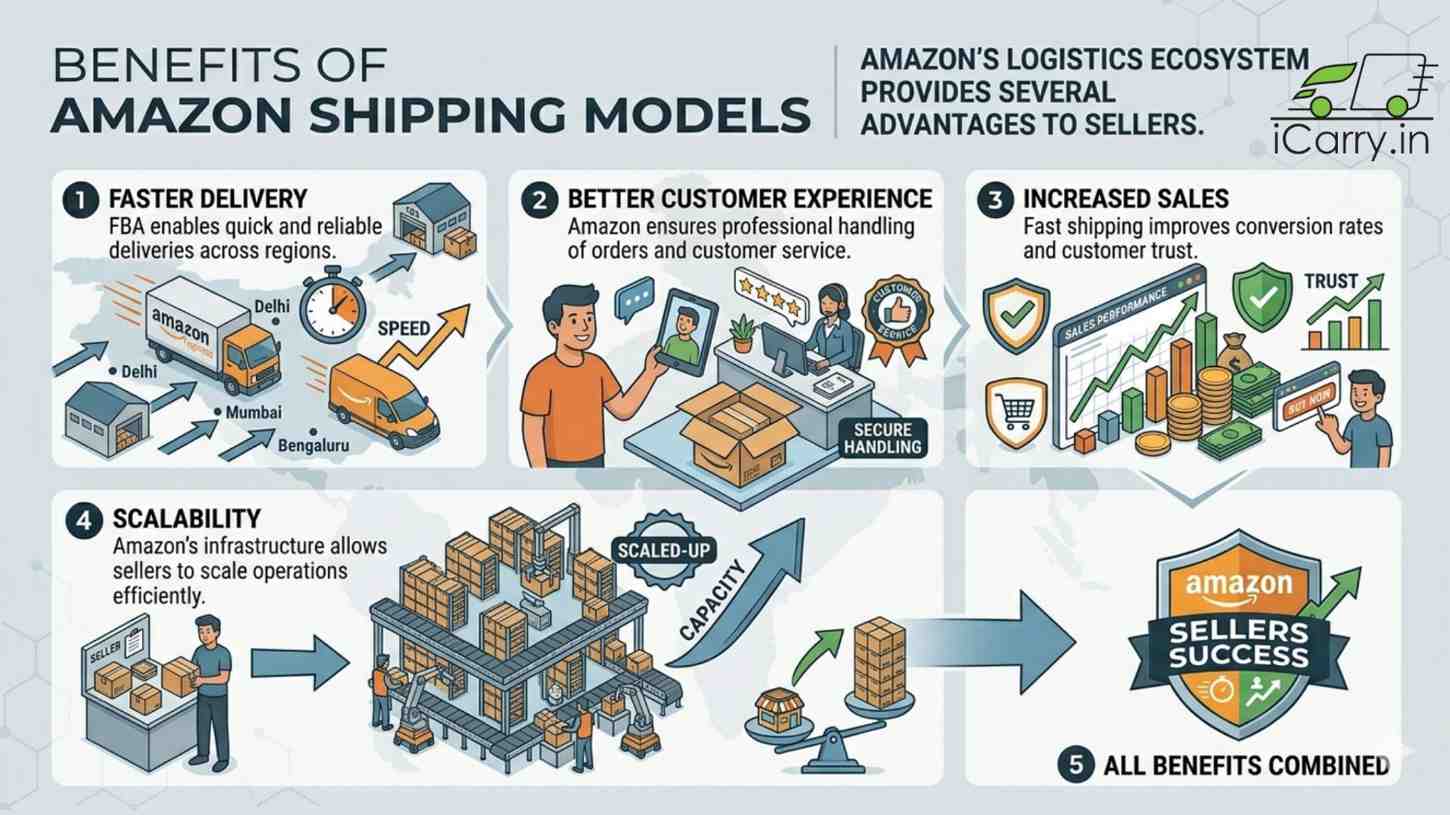
Benefits of Amazon Shipping Models
Each fulfillment model on Amazon offers distinct advantages-and when used correctly, they can make a real difference to your sales and customer experience.
Prime Eligibility and Higher Conversions
FBA gives your listings the Prime badge, which is one of the strongest conversion drivers on Amazon India. FBA can boost conversions by up to 24% and Buy Box wins by up to 66%-because Indian Prime customers actively filter for fast delivery, being Prime-eligible puts you ahead of most competing listings.
Faster Delivery Across India
Amazon's fulfillment network spans hundreds of locations across India. FBA sellers can offer same-day or next-day delivery in metro cities-something very few Self Ship operations can match consistently.
Better Customer Experience
Whether you use FBA, Easy Ship, or Self Ship, Amazon's tracking system keeps customers informed at every stage. Reliable updates reduce customer anxiety and lower the chances of a delivery refusal or return.
Flexibility to Scale
As your order volumes grow, you do not need to build your own logistics infrastructure from scratch. FBA and Easy Ship let you handle significantly higher volumes without a proportional increase in operational effort.
Challenges for Amazon Sellers
Shipping on Amazon is not without its difficulties. Here are the most common ones sellers in India run into:
FBA Fees Can Eat Into Margins
Fulfillment fees, storage fees, weight handling charges, and long-term storage penalties add up quickly-especially if your products are slow-moving or bulky. Sellers who do not model their FBA costs carefully often find their margins much thinner than expected.
Limited Control Over Inventory in FBA
Once your stock is inside Amazon's fulfillment center, you have limited visibility and control over how it is handled. Damage, misplacement, or delays in processing can happen-and resolving them requires raising cases through Amazon Seller Central.
Easy Ship Slot Availability During Peak Season
During the festive season, Amazon's Easy Ship pickup slots get fully booked quickly. If you miss your slot or are not ready when the pickup agent arrives, your shipment is rescheduled-pushing your Late Shipment Rate up.
Strict Policy Compliance
Amazon's thresholds for Late Shipment Rate, ODR, and cancellation rate leave little room for error. A few bad days-caused by a courier failure, a stockout, or a product issue-can have a lasting impact on your account health and Buy Box eligibility.
High Competition on Delivery Speed
As more sellers join Amazon India and more of them use FBA, the bar for delivery speed keeps rising. Sellers on Self Ship who cannot consistently meet customer delivery expectations will find it increasingly difficult to compete on visibility and conversions.
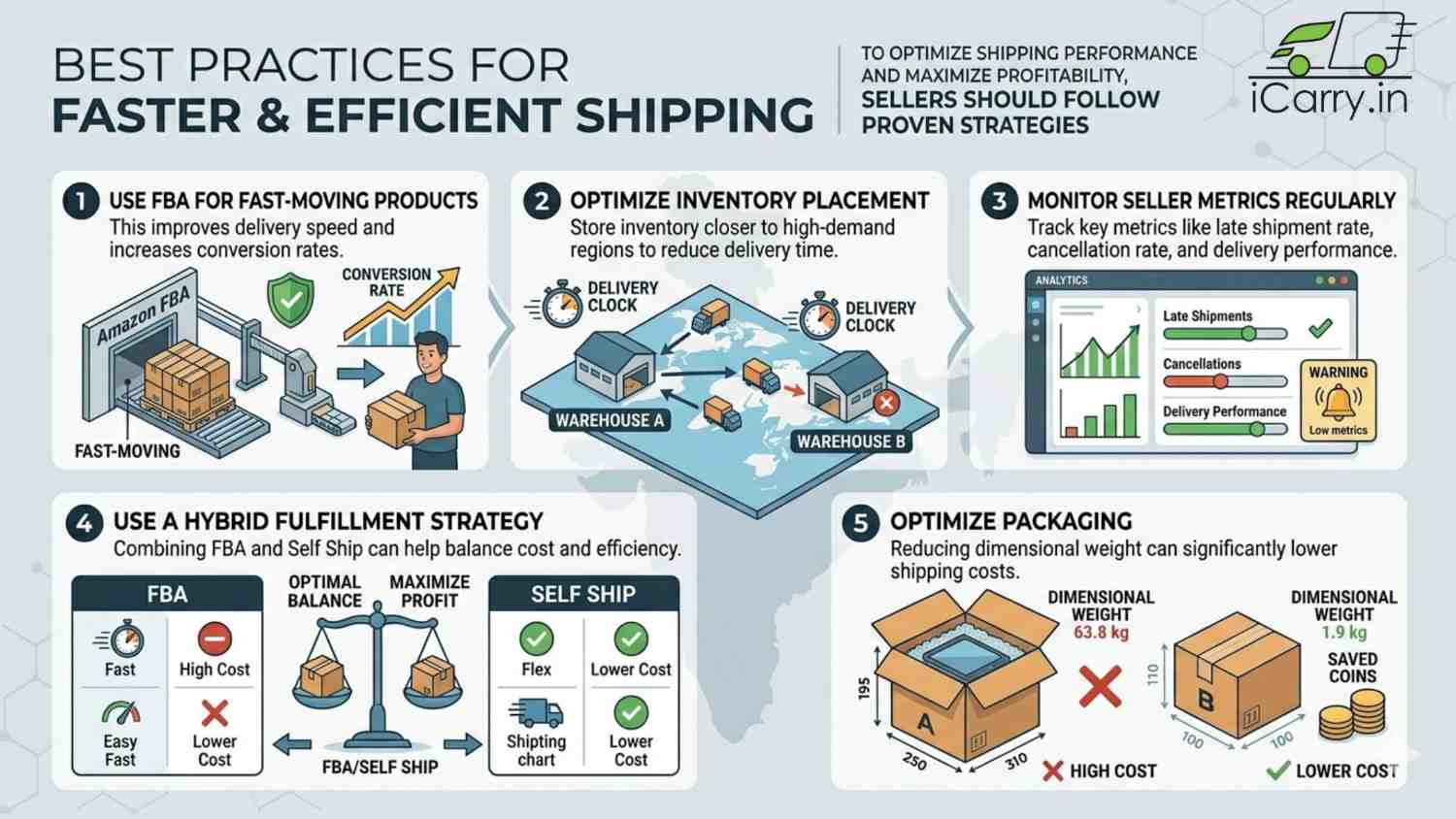
Best Practices for Faster and More Profitable Shipping
1. Match Your Fulfillment Model to Your Product
FBA is not the right answer for every product. Run the numbers before you decide. High-velocity, lightweight products with strong Prime demand tend to perform well in FBA. Heavier items, niche products, or products with seasonal demand patterns may be better served by Easy Ship or Self Ship.
2. Monitor Your Seller Metrics Weekly
Do not wait for Amazon to flag an issue. Check your Late Shipment Rate, ODR, and cancellation rate at least once a week. Catching a spike early gives you time to fix the problem before it affects your account health or Buy Box position.
3. Use a Hybrid Fulfillment Strategy
Many experienced Amazon sellers in India run FBA for their top-selling SKUs and Self Ship for the rest. This reduces FBA storage costs while keeping high-demand products Prime-eligible. It takes more coordination, but the cost savings are meaningful at scale.
4. Optimise Your Packaging
Dimensional weight is how Amazon and most couriers calculate shipping fees for lightweight but bulky items. Reducing your package size-even slightly-can move you into a lower weight tier and reduce fees meaningfully across thousands of shipments.
5. Use Multiple Courier Partners for Self Ship
Single-courier dependency is one of the most common operational risks for Self Ship sellers. A multi-courier allocation system lets you route each order to the best-performing courier for that pin code and zone-improving delivery rates and reducing RTOs at the same time.
6. Treat Delivery as Part of Your Product Experience
A customer who receives a damaged or late order will not blame the courier-they will blame your brand. Investing in seamless delivery experiences-through better packaging, proactive tracking updates, and reliable courier partners-builds the kind of trust that drives repeat orders and positive reviews.
The Future of Amazon Shipping in India
Amazon India is investing heavily in faster delivery. According to IBEF, Amazon delivered 41 crore items with Same-Day or Next-Day service for Prime members in 2024-a 26% year-on-year increase. That pace is not slowing down.
For sellers, this means delivery speed expectations will only keep rising. Customers in metros are already accustomed to next-day delivery. As Amazon expands same-day capabilities to more cities, sellers who cannot match that speed will find it harder to compete-especially in categories where multiple sellers offer similar products.
Building reliable, flexible shipping operations now-whether through FBA, Easy Ship, Self Ship, or a combination-puts you in a much stronger position as competition on the platform intensifies.
How iCarry® Helps Amazon Sellers
For Self Ship sellers especially, managing deliveries across multiple courier partners is genuinely complex. You have different rates, different serviceability areas, and different performance levels across pin codes-and you are trying to track all of it while also running your business.
iCarry® is a logistics management platform built for eCommerce businesses in India, including Amazon Self Ship sellers. Using intelligent courier allocation, it helps you:
- Automatically route each order to the best courier based on pin code, cost, and historical delivery performance
- Reduce shipping costs by comparing rates across multiple courier partners in real time
- Improve delivery success rates and keep your Late Shipment Rate and Valid Tracking Rate within Amazon's required thresholds
- Upload Amazon bulk shipments directly using tab-delimited TXT files-saving time on high-volume order days
- See all your orders in one dashboard, without logging into multiple courier portals separately
The goal is simple: less time managing logistics, better delivery performance, and healthier margins.
Watch the complete step-by-step walkthrough of Amazon bulk shipment upload on iCarry®: Click here to watch.
See how iCarry® helps Amazon Self Ship sellers reduce RTO & shipping costs →
Conclusion
Amazon seller shipping in India is not one-size-fits-all. FBA gives you speed and Prime eligibility at a cost. Easy Ship gives you delivery support while keeping inventory control with you. Self Ship gives you full flexibility-but puts the responsibility of logistics performance squarely on your shoulders.
The right choice depends on your product, your volumes, and your operational capability. Many successful Amazon sellers use a combination of all three-and review their setup regularly as their business grows.
What does not change across any model: delivery performance matters. It affects your Buy Box, your ratings, your return rate, and ultimately your growth on the platform.
If you are running Self Ship and struggling to manage multiple couriers efficiently, iCarry® is designed to solve exactly that problem-built specifically for the Indian eCommerce market, where pin code coverage, COD management, and RTO reduction are everyday realities.
Frequently Asked Questions
What is the difference between FBA, Easy Ship, and Self Ship?
FBA means Amazon stores and ships your products from their fulfillment centers-your listings become Prime-eligible and conversions typically improve. Easy Ship means you store and pack, but Amazon picks up and delivers. Self Ship means you manage the entire process including choosing your own courier. Each model has different cost structures, delivery speeds, and levels of operational control.
Which Amazon fulfillment model is best for new sellers in India?
Easy Ship is often the most practical starting point for new sellers. It removes the complexity of managing courier partners while letting you stay in control of your inventory and packaging. As volumes grow, many sellers transition high-performing SKUs to FBA for the Prime eligibility boost.
- FBA → Best for fast-moving, high-volume products
- Easy Ship → Best for growing sellers who want delivery handled
- Self Ship → Best for cost control and multi-channel sellers
How much does Amazon shipping cost in India?
Costs vary by model, product size, and delivery zone. Self Ship and Easy Ship deliveries typically range from ₹40-150 per shipment depending on distance and weight. FBA adds fulfillment fees per unit (₹45-100+), monthly storage fees, and weight handling charges on top of referral fees. GST at 18% applies to all Amazon fees.
How does shipping performance affect my Amazon seller account?
Amazon tracks Late Shipment Rate (must stay below 4%), Order Defect Rate (below 1%), Pre-Fulfillment Cancellation Rate (below 2.5%), and Valid Tracking Rate (above 95% for Self Ship). Breaching these thresholds consistently leads to reduced Buy Box eligibility, suppressed listings, or account suspension.
How can I reduce RTOs on Amazon Self Ship orders?
The most effective strategies are: using address verification tools at checkout, sending delivery confirmation messages to customers before the shipment arrives, incentivising prepaid payments over COD, and using a multi-courier platform that routes each order to the best-performing courier for that pin code. Tracking NDR (Non-Delivery Report) resolution closely also helps catch and address failed delivery attempts before they become RTOs.
Can I use iCarry® for Amazon Self Ship orders?
Yes. iCarry® supports Amazon Self Ship sellers with bulk shipment upload, multi-courier allocation, and a unified dashboard for tracking all orders. It helps sellers maintain the Valid Tracking Rate and Late Shipment Rate thresholds that Amazon requires, while reducing the manual effort of managing multiple courier partners.
Amazon seller shipping in India operates through three fulfillment models-FBA (Amazon handles storage, packing, shipping with Prime eligibility and 24% higher conversions but includes fulfillment, storage, and long-term fees), Easy Ship (seller packs, Amazon delivers with moderate costs but limited peak-season slots), and Self Ship (full seller control with flexible courier selection but requires maintaining Late Shipment Rate below 4%, ODR below 1%, and Valid Tracking above 95% to avoid account issues)-with successful sellers often using hybrid strategies matching FBA to fast-moving SKUs while using Self Ship with multi-courier platforms for cost control.