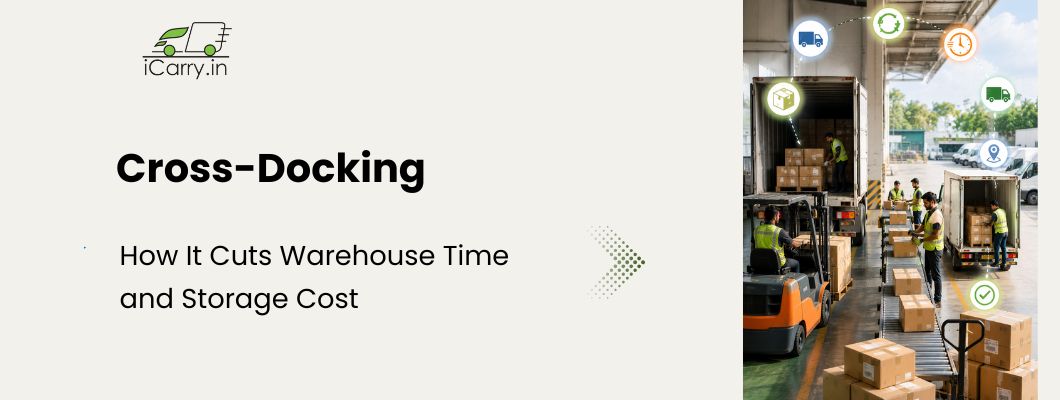
A consumer goods distributor in Pune receives a full truck of 40 different SKUs from a manufacturer. Instead of unloading everything into warehouse racking, checking it into inventory, and waiting for orders to pick against it, the receiving team sorts the incoming goods directly onto outbound vehicles - 12 SKUs go to Nashik, 9 to Aurangabad, 8 to Kolhapur, the rest to local retailers. The truck is unloaded and re-loaded in 4 hours. The goods are never put away in a warehouse location. They never sit in storage.
That is cross-docking. Goods flow through a facility rather than sitting in it.
For Indian businesses in distribution, retail supply chains, and time-sensitive logistics, cross-docking is a strategy that directly reduces two of the highest costs in logistics - storage time and handling cost - while also speeding up delivery. It is not new, but it is increasingly accessible to mid-sized Indian businesses as logistics infrastructure improves under PM Gati Shakti and as courier aggregators make multi-point distribution more manageable. The outbound leg still needs to keep pace with the sorting - a platform like iCarry® lets you book every outbound cross-dock consignment across multiple couriers from one dashboard.
What Is Cross-Docking?
Cross-docking is a logistics practice where incoming goods are transferred directly from inbound transport to outbound transport with minimal or no storage time in between. The receiving facility - the cross-dock - acts as a transfer point rather than a storage point.
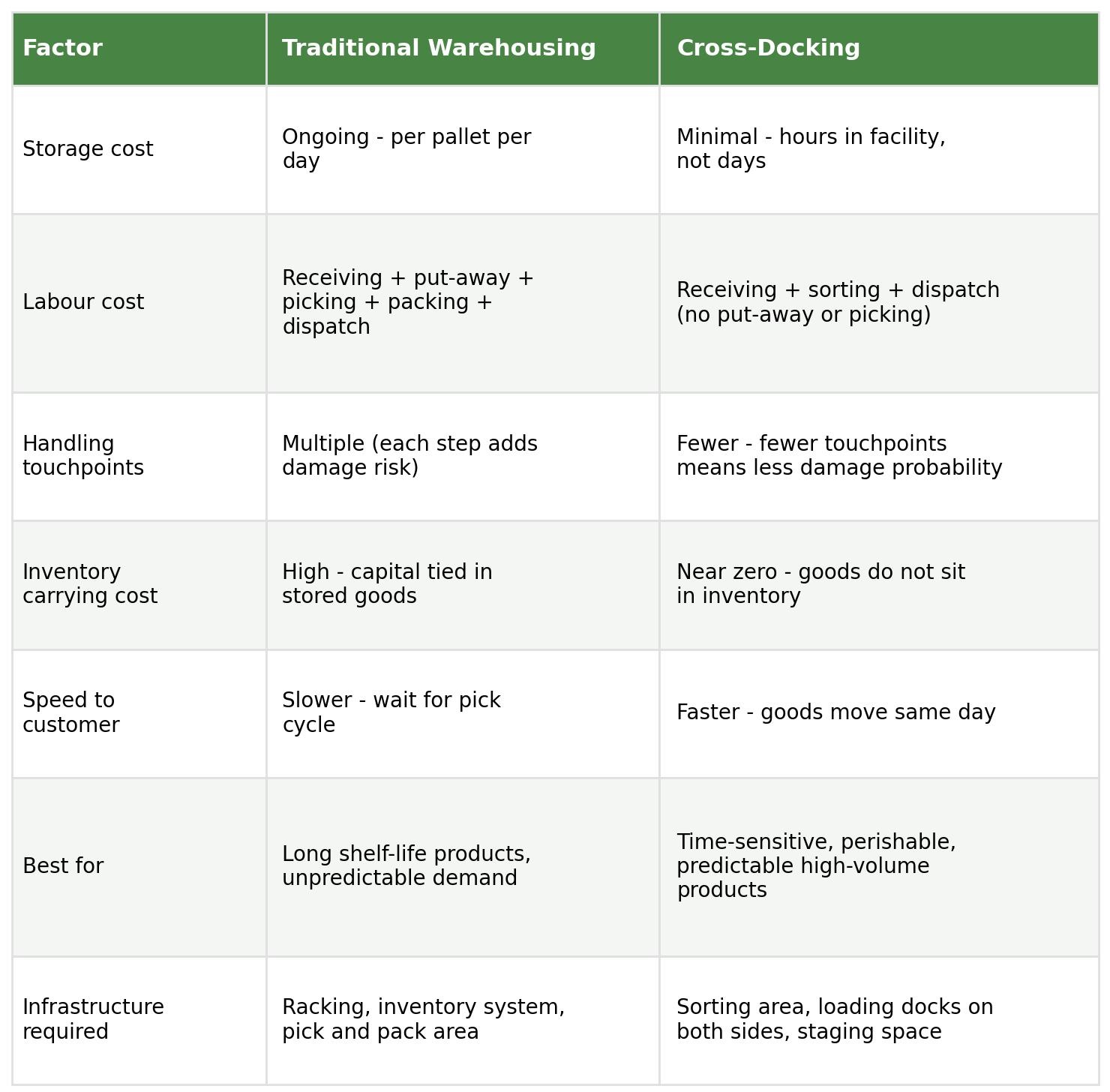
In a traditional warehouse model, goods arrive, are put away into storage locations, and are later picked when an order is placed. This sequence involves receiving, put-away, storage, picking, packing, and dispatch - each step adding time and cost.
In a cross-docking model, goods arrive pre-sorted or are sorted on arrival, and move directly to outbound vehicles for delivery. Storage time is measured in hours rather than days or weeks. Put-away and picking are eliminated or minimised.
How to Tell If Cross-Docking Is Relevant for You: Quick Checklist
- Do you receive large inbound shipments that need to be broken down and redistributed to multiple destinations?
- Is your product time-sensitive - perishables, seasonal goods, fast-moving consumer products?
- Do you have predictable, regular inbound and outbound flows that can be synchronised?
- Is your current warehouse cost a significant share of your logistics spend?
- Do you have or can you access a facility with both inbound receiving and outbound loading capability?
How Cross-Docking Works - Step by Step
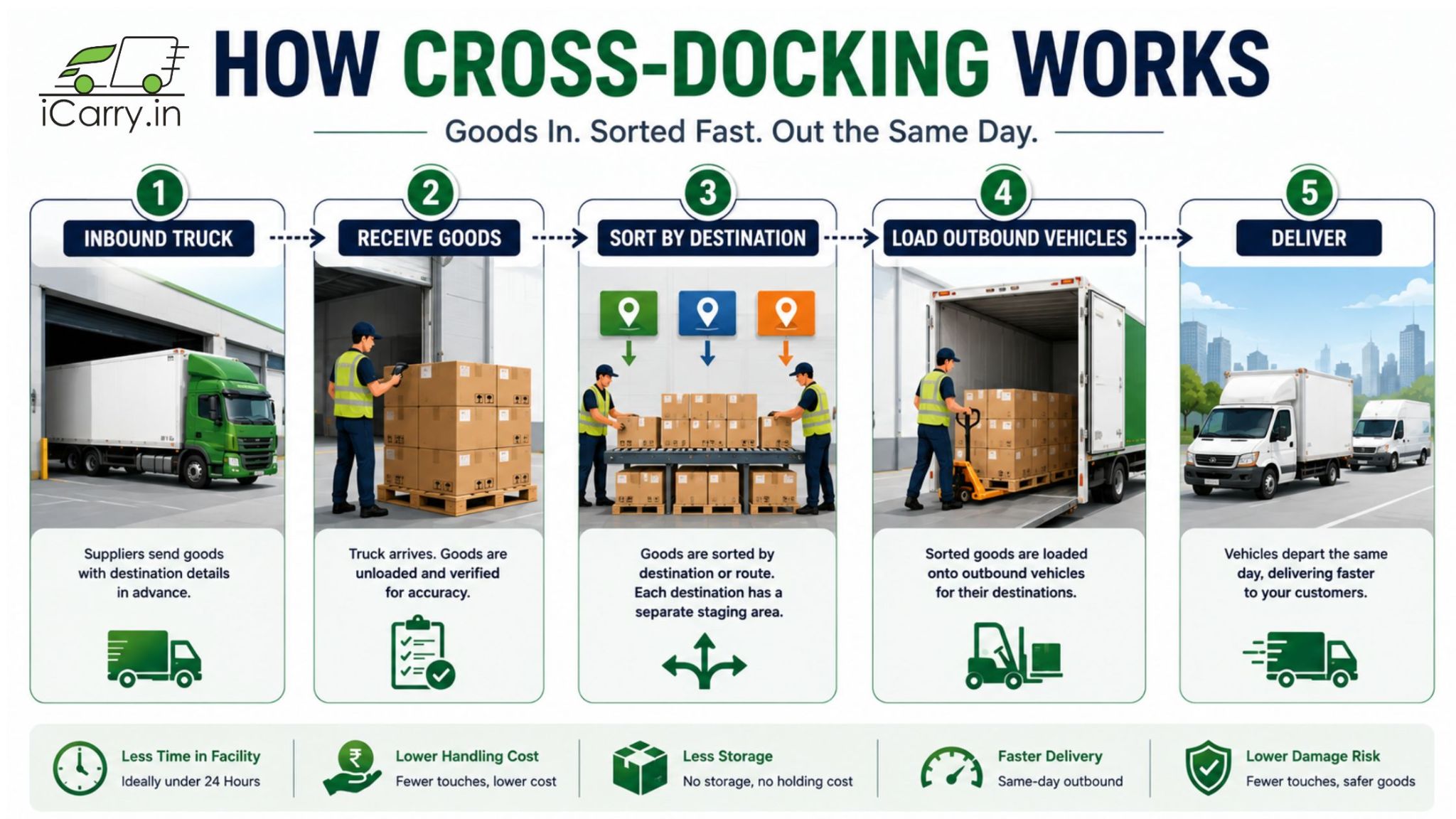
- Step 1 - Inbound planning: Inbound shipment details (supplier, SKUs, quantities, destination) are known in advance. Outbound vehicles and routes are scheduled to match inbound arrival
- Step 2 - Receiving: Inbound truck arrives at the cross-dock facility. Goods are unloaded and verified against the purchase order or transfer note
- Step 3 - Sorting: Goods are sorted by destination - either manually or through conveyor and scanning systems in larger operations
- Step 4 - Staging: Sorted goods are staged in temporary holding areas or directly on outbound loading docks - each area corresponding to a specific outbound route or vehicle
- Step 5 - Outbound loading: Outbound vehicles are loaded with the sorted goods and dispatched to their destinations
- Time in facility: Ideally under 24 hours. In efficient operations, 2 to 4 hours from inbound to outbound
Types of Cross-Docking
1. Pre-Distribution Cross-Docking
The supplier or manufacturer pre-sorts and labels goods by destination before dispatch. The cross-dock facility simply transfers the pre-sorted units to outbound vehicles. Minimal handling at the cross-dock. Requires strong coordination between supplier and distributor.
Example: An FMCG company ships pre-sorted route-specific pallets to a regional distributor. The distributor's cross-dock loads each route's pallet directly onto the corresponding delivery vehicle.
2. Post-Distribution Cross-Docking
Goods arrive in bulk and are sorted at the cross-dock facility based on current demand or outbound orders. More flexible than pre-distribution but requires more handling at the cross-dock.
Example: A fashion brand receives a bulk container of mixed styles from a manufacturer and sorts them at a cross-dock facility by retail destination before loading onto outbound courier vehicles.
3. Opportunistic Cross-Docking
Not a planned regular operation but an ad-hoc transfer when an inbound shipment can be directly matched to a known outbound order. Common in retail and B2B environments where large orders can be cross-docked to avoid put-away.
Example: A wholesaler receives a bulk order of 500 units of a fast-moving product. A retail customer's order for 200 units is already confirmed. Those 200 units are cross-docked directly rather than being put away and picked again.
Cross-Docking vs Traditional Warehousing - Cost Comparison
When Cross-Docking Makes Sense for Indian Businesses
Perishable and Time-Sensitive Goods
Fresh produce, dairy, pharmaceuticals, and other perishables cannot afford storage time. Cross-docking gets these products from supplier to retailer or end customer in the shortest possible time, reducing spoilage and maintaining product integrity.
High-Volume FMCG Distribution
Consumer goods distributors handling large volumes of fast-moving products with predictable demand patterns are ideal cross-docking candidates. If a distributor knows every Monday they receive 5,000 units and distribute them to 80 retailers by Thursday, a cross-dock model eliminates four days of storage cost on 5,000 units every week.
That same weekly run to 80 retailers is also 80 outbound bookings - bulk booking through a platform like iCarry® turns that into one session instead of eighty.
Retail Supply Chains
Organised retail chains use cross-docking extensively for replenishment. A central distribution centre receives supplier shipments and cross-docks to individual store delivery vehicles. The store receives pre-sorted deliveries of exactly what each branch needs rather than receiving bulk and redistributing internally.
E-Commerce Fulfilment at Scale
For high-volume businesses with predictable order patterns, cross-docking can be used to sort inbound supplier stock directly to outbound courier pickups for pre-confirmed orders. Particularly effective during peak sale periods when large quantities of pre-sold products arrive and need to ship immediately.
Import Distribution
Businesses receiving imported goods at a port city can use cross-docking at a nearby facility to sort and redistribute to multiple inland destinations without routing everything to a central warehouse first.
When Cross-Docking Does NOT Work
- Unpredictable demand: If you cannot predict what will sell and when, goods cannot be pre-assigned to outbound destinations. Storage is necessary.
- Large SKU count with low volume per SKU: Cross-docking is efficient when volumes per destination are meaningful. 50 units sorted across 200 SKUs creates sorting complexity that erodes the efficiency gain.
- No inbound-outbound synchronisation: If inbound arrivals are irregular and outbound vehicles cannot be scheduled to match, goods will sit waiting - eliminating the storage cost benefit.
- Products requiring inspection or quality control: Goods that need to be opened, inspected, or reworked before redistribution cannot be efficiently cross-docked.
Cross-Docking in India - Practical Considerations
Infrastructure
True cross-docking requires a facility designed for flow - inbound docks on one side, outbound docks on the other, with a sorting area in between. Most Indian businesses do not have purpose-built cross-dock facilities. However, many distribution centres can operate a simplified cross-docking model in a designated staging area. India's PM Gati Shakti programme is developing Multimodal Logistics Parks (MMLPs) across major corridors that will provide cross-docking capable infrastructure for businesses of all sizes.
Technology Requirements
Effective cross-docking requires advance shipment notice (ASN) from suppliers - knowing what is arriving before it arrives. Barcode or RFID scanning for fast sorting. And outbound route assignment logic that can match inbound items to outbound vehicles in real time. Simpler versions can be managed with spreadsheets and manual scanning at low volume.
Supplier Coordination
Pre-distribution cross-docking requires your suppliers to label and sort goods by destination before dispatch. This is a meaningful operational ask. Building this into supplier contracts and providing clear labelling specifications upfront reduces friction at the cross-dock.
How iCarry® Fits Into Cross-Docking Operations
iCarry® is a courier aggregator that supports the outbound leg of cross-docking operations - the moment sorted goods are handed to couriers for last-mile delivery to retailers, distributors, or end customers.
For businesses using cross-docking to speed up distribution, the outbound courier step must match the efficiency of the cross-dock itself. Booking multiple courier shipments simultaneously, routing each consignment to the best available carrier for each destination, and tracking all outbound deliveries from one dashboard are all operationally important when the cross-dock is dispatching hundreds of consignments per day.
- Bulk booking: Book all outbound shipments from a cross-dock run in one session rather than individually
- Multi-courier routing: Route each outbound consignment to the best courier for its specific destination pincode
- Multiple pickup addresses: Register your cross-dock facility as a pickup address separate from your main warehouse
- Real-time tracking: Monitor all outbound cross-dock shipments in one view
Final Thoughts
Cross-docking is not a complex concept. It is simply the discipline of keeping goods moving rather than letting them sit. The value is in what is eliminated - storage time, put-away labour, picking labour, and the inventory carrying cost of goods that could be on their way to the customer instead of sitting on a rack.
For Indian businesses in distribution, retail supply chains, perishables, and high-volume FMCG - the conditions that make cross-docking viable are increasingly present. The infrastructure is improving. The technology is accessible even at mid-scale. The coordination requirements are manageable with the right supplier relationships.
If your logistics cost is dominated by warehouse storage and your products are time-sensitive or fast-moving, cross-docking is worth evaluating seriously. Start with a pilot on your highest-volume, most predictable flow and measure the storage cost and handling cost reduction before committing to a full model change.
Frequently Asked Questions (FAQs)
What is cross-docking in simple terms?
Cross-docking is a logistics method where incoming goods are transferred directly to outbound vehicles with little or no storage time in between. Instead of storing goods in a warehouse and picking them later, they flow through a sorting facility and ship out the same day - reducing storage cost, handling labour, and transit time.
What types of businesses use cross-docking in India?
FMCG distributors, organised retail chains, fresh produce and perishable goods suppliers, pharmaceutical distributors, e-commerce businesses at scale, and import distribution operations. Any business with predictable high-volume inbound flows that can be matched to known outbound destinations benefits from cross-docking.
What is the difference between cross-docking and traditional warehousing?
In traditional warehousing, goods are stored until an order is placed, then picked and dispatched. In cross-docking, goods are transferred from inbound to outbound in hours - there is no storage, no put-away, and no picking from racking. Cross-docking eliminates storage cost but requires predictable, synchronised inbound and outbound flows.
Does cross-docking reduce delivery time?
Yes, significantly in the right conditions. By eliminating warehouse storage time, goods reach the customer faster. A product that would spend 3 to 5 days in a warehouse before being picked and shipped moves through a cross-dock in 2 to 4 hours. The total transit time from supplier to end customer is shorter.
What infrastructure does cross-docking require?
A facility with inbound receiving docks and outbound loading docks, a sorting area between them, and enough floor space for staging sorted goods by destination. Purpose-built cross-dock facilities have inbound on one side and outbound on the other. Simpler operations can use a section of a standard warehouse designated for cross-docking.
Can small and mid-sized Indian businesses use cross-docking?
Yes, at appropriate volume. Small businesses with very low inbound volumes do not benefit enough to justify the coordination overhead. But mid-sized distributors handling regular high-volume supplier deliveries to multiple retail destinations can implement simplified cross-docking without large infrastructure investment - using existing facility space and manual sorting processes.
Cross-docking is simply the discipline of keeping goods moving rather than letting them sit. The value is in what is eliminated - storage time, put-away labour, picking labour, and the inventory carrying cost of goods that could be on their way to the customer instead of sitting on a rack. If your logistics cost is dominated by warehouse storage and your products are time-sensitive or fast-moving, start with a pilot on your highest-volume, most predictable flow before committing to a full model change.