A furniture manufacturer in Rajasthan spends 14% of product cost on logistics. A food brand in Tamil Nadu watches 30% of perishable shipments arrive late due to transit delays. An apparel exporter in Gujarat faces a 6-day customs clearance process for a shipment that should take 2.
These are not isolated problems. They are symptoms of a structural inefficiency in Indian logistics that has been documented, studied, and finally addressed through two of the most significant policy interventions in the country's economic history - PM Gati Shakti and the National Logistics Policy.
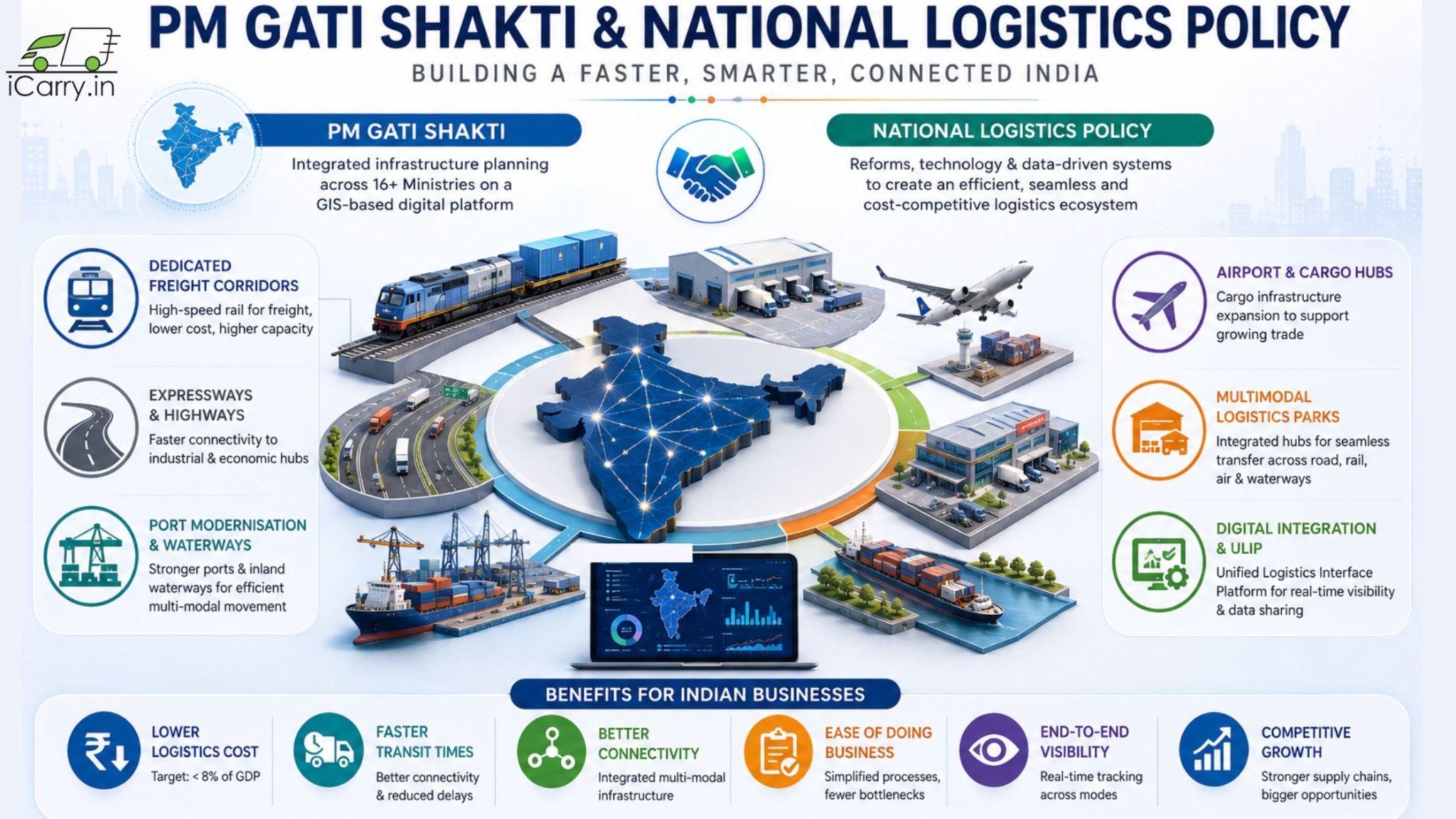
India's logistics cost as a percentage of GDP has historically been 13 to 14%, compared to 8 to 9% in developed economies. The Government of India's logistics sector development program aims to bring this number down to below 8% by developing integrated infrastructure, reducing transit times, and creating a data-driven national logistics ecosystem.
For Indian businesses of every type - manufacturers, distributors, exporters, and growing brands - understanding what these policies mean and how they are changing the logistics landscape is increasingly relevant to operational and strategic planning.
What Is PM Gati Shakti?
PM Gati Shakti (PM GS) is a national master plan launched by the Government of India in October 2021, designed to transform India's infrastructure through coordinated, integrated planning across 16 ministries and departments. The name translates roughly to Prime Minister Speed Force - reflecting its objective of accelerating infrastructure delivery.
At its core, PM Gati Shakti is a GIS-based digital platform that maps existing and planned infrastructure across roads, railways, ports, airports, waterways, and pipelines onto a single dashboard. This allows infrastructure projects to be planned in coordination rather than in isolation - ending the historical problem of a road being built without considering the railway line it should connect to, or a port being expanded without planning the highway linking it to industrial zones.
For Indian logistics, PM Gati Shakti is the infrastructure backbone. The National Logistics Policy (NLP), launched in September 2022, is the complementary policy framework - defining the processes, technology standards, and institutional mechanisms that will run on top of the infrastructure PM Gati Shakti is building.
How to Check If PM Gati Shakti Affects Your Business?
- Do you know which PM Gati Shakti infrastructure projects are being built in your primary shipping corridors?
- Are you tracking logistics cost as a percentage of revenue and benchmarking against sector targets?
- Do you know how the National Logistics Policy's Unified Logistics Interface Platform (ULIP) affects your shipment visibility?
- Are you positioned to benefit from the multimodal logistics parks being developed along PM Gati Shakti corridors?
The National Logistics Policy (NLP) - What It Covers
The Infrastructure Being Built - What Matters for Indian Businesses
Multimodal Logistics Parks (MMLPs)
PM Gati Shakti includes development of 35+ Multimodal Logistics Parks across India by 2025 to 2027. These are large integrated facilities that allow cargo to transfer between road, rail, and other modes in one location - with warehousing, cold storage, customs clearance, and value-added services co-located. As of August 2025, 293 infrastructure projects worth ₹13.59 lakh crore had already been evaluated through the PM Gati Shakti Network Planning Group mechanism (PIB).
For Indian businesses, MMLPs reduce the time and cost of mode shifting. A manufacturer in Pune currently moving goods by road to Mumbai port, loading onto a container, and managing the entire chain across different facilities and providers can eventually move through one integrated hub with reduced handling, better traceability, and lower cost per tonne.
Dedicated Freight Corridors (DFCs)
The Eastern and Western Dedicated Freight Corridors - long in planning, now increasingly operational - are high-speed, high-capacity rail corridors exclusively for freight. The Eastern DFC (Ludhiana to Kolkata) and Western DFC (Delhi to Mumbai) create rail alternatives to road freight that are faster and significantly cheaper per tonne-kilometre.
For businesses currently shipping heavy freight by road between Delhi, Mumbai, Kolkata, and the industrial states they connect - the DFC makes rail a genuinely competitive alternative, particularly for B2B bulk cargo that is not time-sensitive enough to require express road.
Road and Highway Development
PM Gati Shakti's integrated approach is accelerating Bharatmala Pariyojana - the national highway development program. New expressways and improved highways reduce road transit time on key corridors. For businesses shipping by surface courier, shorter highway transit times translate directly to faster zone-level delivery and lower dwell time at courier transit hubs on those routes.
Port and Airport Modernisation
Integrated port planning under PM Gati Shakti is improving cargo handling capacity and reducing port dwell time - the time containers sit at port before clearing customs and moving inland. For Indian exporters, reduced port dwell time directly affects the total lead time from factory to foreign buyer.
What ULIP Means for Businesses Shipping in India
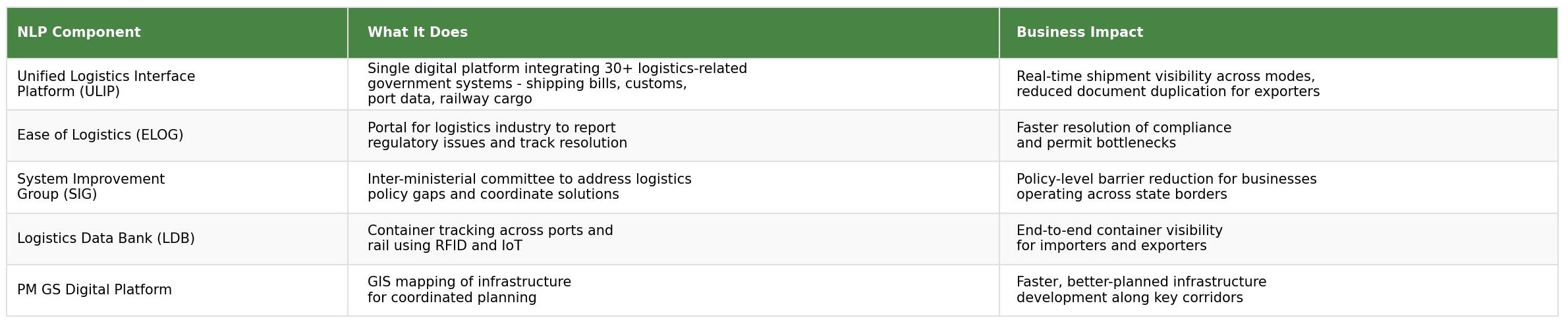
The Unified Logistics Interface Platform is one of the most practically significant NLP components for Indian businesses. ULIP integrates data from customs (ICEGATE), shipping lines, port authorities, airlines, railways, and other systems into a single interface.
For exporters and importers this means: real-time visibility of a shipment's position across the entire multimodal journey, single-window document submission that eliminates the current practice of submitting the same information to multiple systems separately, and faster customs processing as pre-arrival information reaches customs before the cargo arrives.
For domestic shippers, integration with ULIP-connected logistics providers improves supply chain visibility and exception management - knowing where a delay is occurring before it becomes a missed delivery rather than after.
How These Changes Affect Logistics Costs for Indian Businesses
The policy's stated goal of reducing India's logistics cost from 13-14% of GDP to below 8% will not happen overnight, but the trajectory is clear:
Surface courier transit times on DFC-served corridors: As more cargo shifts from road to DFC rail on Delhi-Mumbai and Delhi-Kolkata routes, road congestion on those corridors decreases, reducing transit time for surface courier shipments that still move by road
Warehousing costs near MMLPs: Integration of customs, cold chain, and warehousing at MMLP hubs creates competition in logistics services near these nodes, which typically reduces prices for businesses locating operations nearby
Export documentation time: ULIP-driven single-window systems reduce the administrative time required to export - directly cutting the cost of export compliance for smaller Indian exporters
Insurance and damage rates: Better roads, better handling at integrated facilities, and improved container tracking reduce cargo damage rates, which reduces insurance premiums over time
The Gap Between Policy and Ground Reality
It is important to be clear: the benefits described in this guide are in progress, not complete. As of 2026, PM Gati Shakti and the NLP are live and delivering measurable improvements on specific corridors and at specific facilities - but the full network effect of integrated infrastructure is still years from realisation.
For most Indian businesses shipping today, the day-to-day logistics reality is still one of variable courier performance, inconsistent last-mile reliability, significant RTO rates, and high logistics cost relative to product value. PM Gati Shakti addresses the macro infrastructure. The operational logistics decisions businesses make today - which couriers to use, how to manage COD, how to reduce RTO - remain as important as they have always been.
The businesses that will benefit most from India's logistics transformation are those building operational discipline now, not waiting for infrastructure improvements to solve problems that better logistics management can address today.
What Indian Businesses Should Do Now
Follow PM Gati Shakti corridor development near your key shipping routes: New expressways, DFC connectivity, and MMLP locations will affect where you should place inventory and which logistics partners will have the best network access on key corridors
Register on ULIP: Businesses that integrate with ULIP gain better visibility of their shipments across modes and access to pre-arrival customs processing for exports
Consider DFC for applicable B2B freight: If you are shipping bulk cargo between Delhi and Mumbai or Delhi and Kolkata, DFC rail is becoming a genuinely competitive alternative to road freight on cost per tonne-kilometre
Build logistics cost benchmarking into your monthly review: If the national goal is below 8% logistics cost as a percentage of revenue, knowing where you are relative to that benchmark helps quantify the opportunity
Do not wait for macro improvements to fix micro problems: Better roads do not reduce RTO. Better ports do not fix weight discrepancy charges. The operational improvements available to Indian businesses today - multi-courier access, active delivery management, COD management - are independent of infrastructure timelines
The Role of Courier Aggregators in India's Evolving Logistics Landscape
As India's logistics infrastructure develops under PM Gati Shakti, the ability to access multiple courier partners - each with different network strengths across the new infrastructure - becomes more valuable, not less. A courier aggregator that provides access to multiple courier partners allows businesses to automatically benefit from each courier's infrastructure improvements as they happen - without changing platforms or renegotiating contracts.
As DFC connectivity improves Delhivery's transit time on the Delhi-Mumbai corridor, or as MMLP development in a specific city improves Ekart's last-mile capability, businesses using multi-courier allocation automatically route orders to the best-performing option at that moment - capturing the benefit of infrastructure improvement in real time.
iCarry® gives Indian businesses access to multiple courier partners from one account - with rate comparison before every booking, delivery management tools, and daily COD remittance. As India's logistics infrastructure improves, the platform's multi-courier access becomes the mechanism through which businesses capture those improvements operationally. Get started with iCarry.in and simplify your shipping operations.
Final Thoughts
PM Gati Shakti and the National Logistics Policy represent the most ambitious logistics infrastructure investment in India's history. The direction is right, the investment is significant, and the early results on specific corridors are measurable.
For Indian businesses, the policy creates two types of opportunity: the macro opportunity to benefit from improving infrastructure as it comes online, and the immediate operational opportunity to build logistics discipline that compounds regardless of infrastructure timeline.
The businesses that build both - operational efficiency today and strategic positioning for infrastructure improvements tomorrow - will be the ones best placed when India achieves its logistics cost targets.
Frequently Asked Questions (FAQs)
What is PM Gati Shakti?
PM Gati Shakti is a national master plan launched in October 2021 to transform India's infrastructure through coordinated planning across 16 ministries. It uses a GIS-based digital platform to map and plan infrastructure projects - roads, railways, ports, airports, and pipelines - in an integrated way rather than in isolation.
What is the National Logistics Policy?
The National Logistics Policy (NLP), launched in September 2022, is the complementary policy framework to PM Gati Shakti. It covers the digital platforms, institutional mechanisms, and process standards for India's logistics ecosystem - including ULIP (Unified Logistics Interface Platform), the Logistics Data Bank, and the Ease of Logistics portal.
How does PM Gati Shakti affect Indian businesses?
Through faster, better-connected infrastructure: Dedicated Freight Corridors for rail freight, Multimodal Logistics Parks for integrated handling, improved highways reducing road transit time, and modernised ports reducing export dwell time. These improvements reduce logistics cost and transit time across India's key trade corridors.
What is ULIP and how does it help Indian exporters?
ULIP (Unified Logistics Interface Platform) integrates data from 30+ government systems - customs, ports, shipping lines, railways, airlines - into a single interface. For exporters, ULIP enables real-time shipment visibility across modes, single-window document submission, and faster customs processing through pre-arrival information submission.
What are Dedicated Freight Corridors and who benefits?
Dedicated Freight Corridors (DFCs) are high-capacity rail lines exclusively for freight. The Eastern DFC (Ludhiana to Kolkata) and Western DFC (Delhi to Mumbai) allow faster and cheaper rail freight on these corridors. Businesses shipping bulk cargo between these industrial hubs benefit from DFC as a competitive alternative to road freight on cost per tonne-kilometre.
Does PM Gati Shakti affect my daily shipping operations?
Indirectly and over time. Improved highways reduce courier transit time on key corridors. DFC reduces road congestion as cargo shifts to rail. MMLP development creates better warehousing options near logistics hubs. These improvements are real but gradual. Day-to-day shipping decisions - courier selection, RTO management, COD handling - remain as operationally important as ever.
PM Gati Shakti and the National Logistics Policy represent the most ambitious logistics infrastructure investment in India's history - integrating Multimodal Logistics Parks, Dedicated Freight Corridors, highway development, port modernisation, and the ULIP digital platform to bring India's logistics cost down from 13-14% of GDP toward the below-8% target. While these macro improvements are real but gradual, Indian businesses benefit most by building operational logistics discipline today - multi-courier access, active RTO management, and COD handling - rather than waiting for infrastructure timelines to solve problems better logistics management can address now.