Your shipment leaves the warehouse on Monday morning. The courier picks it up by noon. By Tuesday afternoon, tracking still shows 'In Transit - Origin Hub'. Wednesday: same status. Thursday: it moves. The customer's expected delivery was Wednesday.
What happened between Tuesday and Thursday was dwell time - the period when your consignment sat stationary at a courier facility, not moving toward the customer. It was not lost. It was not delayed by the weather. It was simply waiting - consuming time and, in some cases, incurring costs - for no reason visible to you or the customer.
Dwell time is one of the least discussed but most impactful variables in Indian logistics. India's logistics costs run about 14% of GDP, against just 8-9% in developed economies (IBEF) - idle time at hubs and terminals is a major reason why. In India, where courier consignments pass through three to six handling facilities between dispatch and delivery, the cumulative dwell time across all these points directly determines whether a shipment arrives on the promised date - or doesn't.
This guide explains what dwell time is, where it occurs in Indian logistics, how it raises costs, and what businesses can measure and manage to reduce its impact.
What Is Dwell Time in Logistics?
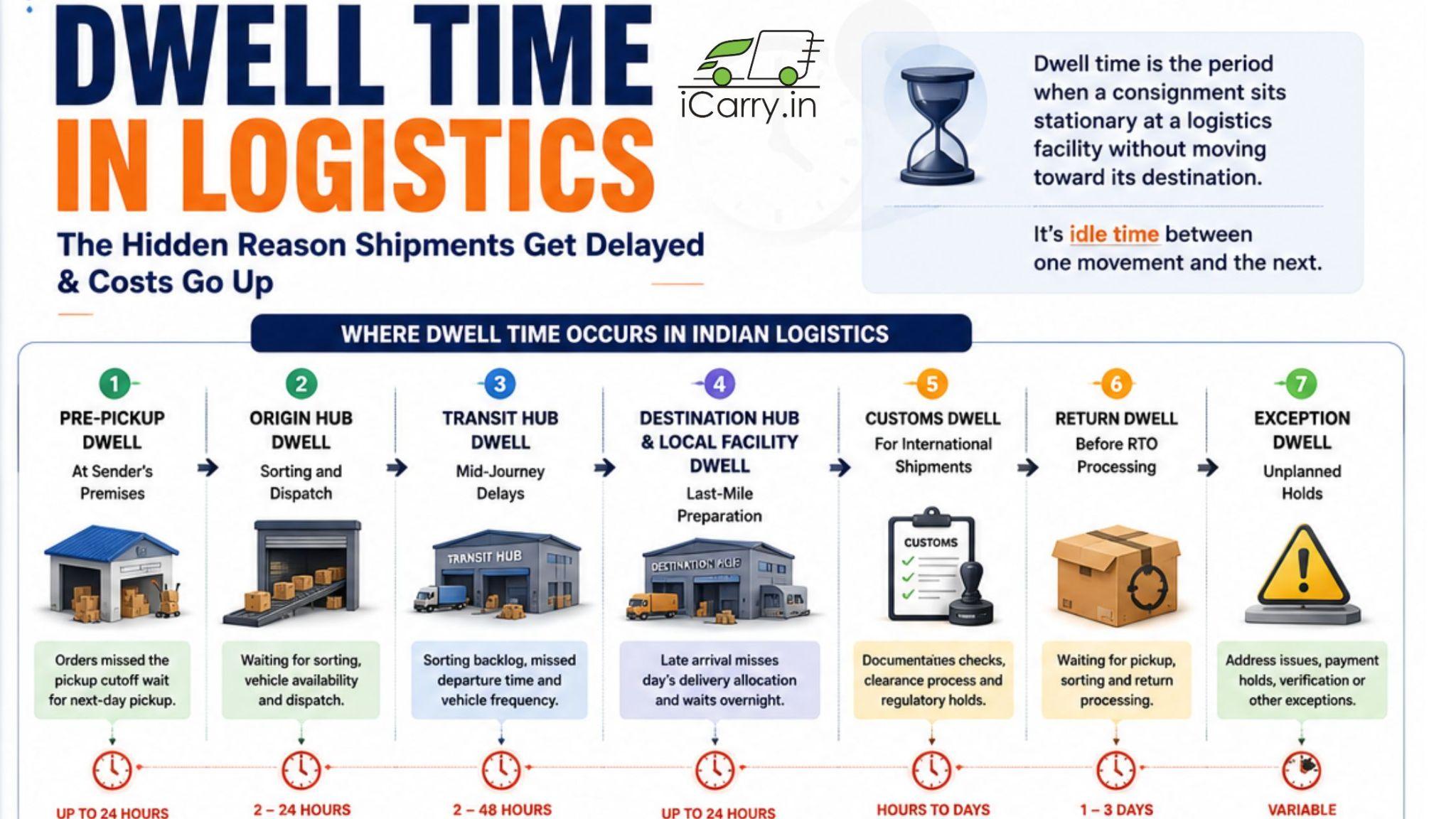
Dwell time is the period during which a consignment sits stationary at a Indian logistics facility - a warehouse, courier hub, customs point, or port - without progressing toward its destination. It is the idle time between one movement and the next.
Dwell time is distinct from transit time. Transit time is the duration of active movement - the hours the consignment spends in a vehicle. Dwell time is everything else - the waiting, the queue, the processing delay, the unplanned hold.
In Indian domestic courier logistics, a standard pan-India surface consignment passes through:
- Seller's premises - pickup
- Origin courier hub - sorting
- Line haul vehicle - transit
- One or more transit hubs - re-sorting
- Destination courier hub - last-mile preparation
- Local delivery facility - assignment to executive
- Customer's address - delivery
Dwell time can occur at any of these points. Each hour of dwell time at a transit hub is an hour added to total delivery time - and for time-sensitive consignments, each additional day of transit increases the probability of customer dissatisfaction, NDR, and ultimately RTO.
How to Tell If Dwell Time Is Affecting Your Shipments
- Do your tracking logs frequently show 24 to 48 hours at a single courier hub with no status change?
- Do you have shipments that were picked up on time but consistently arrive 1 to 2 days later than the SLA?
- Are you tracking transit time at the leg level - origin hub to transit hub, transit hub to destination hub - or only overall?
- Do you know which courier hubs in your shipments' routes consistently add dwell time?
- For import/export consignments, are you tracking customs dwell time separately from courier transit time?
Where Dwell Time Occurs in Indian Logistics
1. Pre-Pickup Dwell - At the Sender's Premises
The first dwell point is often at the sender's own facility. Orders processed late in the day miss the pickup window and sit overnight before the courier collects. Orders packed correctly but not handed over before the pickup cutoff add 24 hours to total transit time before the consignment has left the building.
Indian context: Most courier partners in India accept same-day pickup for orders confirmed before 11 AM. Orders confirmed after the cutoff wait for next-day pickup. For businesses with 2 PM to 4 PM peak order volume, a large share of daily orders systematically experiences one full day of pre-pickup dwell.
2. Origin Hub Dwell - Sorting and Dispatch
Once collected, consignments travel to the courier's origin hub for sorting. At this point, volumes, vehicle availability, and sorting capacity all determine how long a consignment waits before loading onto the line haul vehicle to the next destination.
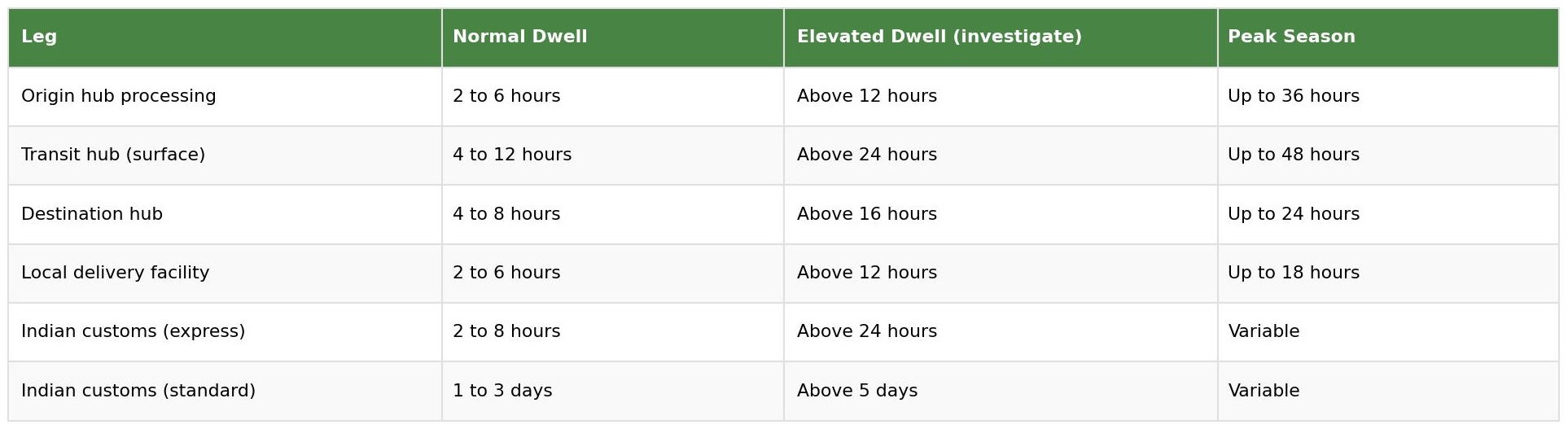
Origin hubs dwell in Indian courier networks typically range from 2 to 8 hours for express shipments and 8 to 24 hours for surface. During festive season peaks - Diwali, end-of-financial-year - origin hub dwell can extend to 36 to 48 hours as sorting capacity is overwhelmed by volume.
3. Transit Hub Dwell - Mid-Journey Delays
Large courier networks in India operate hub-and-spoke models. A consignment from Chennai to Jaipur may pass through a mega-hub in Bengaluru or Mumbai before heading north. Each transit hub is a sorting and re-routing facility - and each is a potential dwell point.
Transit hub dwell is the hardest for businesses to predict or control. It depends on vehicle frequency on that leg, sorting backlog at the hub, and whether the consignment missed the departure time of the vehicle for the next leg.
4. Destination Hub and Local Facility Dwell
Once at the destination city, a consignment waits at the destination hub for processing and then moves to the local delivery facility where it is assigned to a delivery executive. This final hub dwell is frequently where 24-hour delays occur - consignments that arrive at the destination hub late in the day miss that day's delivery allocation and wait overnight for the next morning's route assignment.
5. Customs Dwell - For International Shipments
For import and export consignments, customs clearance adds a separate dwell category entirely. Indian customs processing times vary from a few hours for pre-approved express shipments to several days for consignments flagged for physical examination or with documentation issues.
Incorrect HS codes, incomplete commercial invoices, or missing certificates of origin are the most common triggers for customs-related dwell. Each documentation error can add 3 to 10 days to total transit time and may trigger additional customs handling charges that appear as hidden costs on the import or export invoice.
How Dwell Time Raises Shipping Costs in India
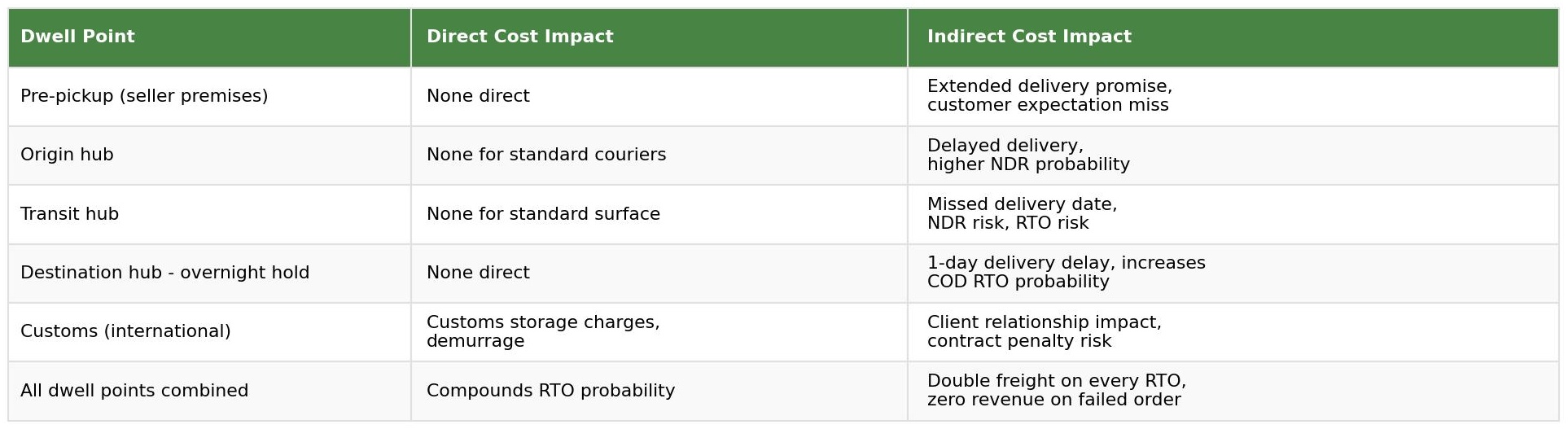
The indirect cost pathway is the critical one. Longer transit times mean higher NDR rates. Higher NDR rates mean more RTOs. More RTOs mean forward freight plus return freight paid with no revenue received. For a business with 20% RTO rate and ₹80 round-trip freight on 500 monthly COD orders, the monthly freight loss is ₹8,000. Reducing transit time through dwell reduction reduces NDR rate and therefore reduces this loss directly.
Dwell Time vs Transit Time - The Measurement Problem
Most Indian businesses track total shipment transit time - from pickup to delivery. Very few track dwell time at individual legs. This matters because:
- Total transit time hides where the delay is occurring
- A courier with 2-day total transit time may have 6 hours of actual movement and 40 hours of dwell
- Without leg-level data, businesses cannot identify which courier hub or route is causing systematic delays
- Without this data, switching couriers or routes to reduce transit time is guesswork
Shipment tracking data from courier APIs provides the raw material for dwell analysis. Each tracking event has a timestamp and location. The gap between consecutive events at the same location is dwell time. Analysing this across a month of shipments reveals which hubs, which couriers, and which routes have systemic dwell problems.
Dwell Time Benchmarks for Indian Courier Networks
How to Reduce Dwell Time Impact for Indian Businesses
1. Dispatch Before the Pickup Cutoff Every Day
The most controllable dwell point is pre-pickup time at the sender's facility. Pack and hand over all consignments before 11 AM for same-day pickup. Any order processed after the cutoff experiences 24 hours of unnecessary dwell before the courier has even touched it. Build dispatch cutoff as a non-negotiable daily operational commitment.
2. Choose Couriers With Fewer Transit Hub Hops
For specific routes, some couriers route consignments through more transit hubs than others. A consignment from Mumbai to Lucknow via three hubs has three dwell opportunities compared to one via a direct line haul. Ask your courier aggregator for the number of transit points on high-volume routes and compare between available Couriers.
3. Use Express Mode for Time-Critical High-Value Consignments
Express courier services have lower dwell at each hub because of higher service frequency and priority sorting. For consignments where on-time delivery directly affects customer satisfaction or revenue, the additional express cost is often less than the customer service cost of a delayed delivery.
4. Monitor Leg-Level Transit Time by Courier and Route
Build a monthly dwell analysis from your shipment tracking data. For each courier and each major route, calculate average time at each hub. Couriers with consistently elevated destination hubs dwelling on specific routes should be replaced by alternatives for those routes. Tracking logistics KPIs at the leg level - not just total transit time - is what makes this analysis actionable.
5. For International Shipments - Prepare Documentation Perfectly
Customs dwell is almost entirely documentation-driven for standard commercial consignments. Correct HS code, complete commercial invoice with all required fields, accurate declared value, and correct Incoterms eliminate the documentation errors that trigger physical examination and extended customs holds. Verify documentation against the destination country's import requirements before every first shipment to a new market.
6. Manage NDR Actively - Reduce the Cost of Dwell-Caused Delays
When dwell time causes a delivery delay and the consignment arrives a day or two after the promised date, the NDR probability increases - customers who have moved on or made alternative arrangements are more likely to refuse. Active NDR management within 24 hours of every failed attempt limits the damage. Reducing RTO from dwell-delayed shipments requires the same tools as general RTO reduction - but the trigger is different.
Dwell Time and Its Effect on COD Operations
Dwell time has a specific compounding effect on COD operations that is worth understanding separately.
COD consignments that arrive later than the delivery promise generate higher doorstep refusal rates than those that arrive on time. A customer who confirmed a COD order expecting 2-day delivery but receives it on day 4 or 5 has had additional time to find the same product elsewhere or simply change their mind.
The dwell-time to COD RTO pathway:
- Dwell at transit hub adds 1 day to delivery time
- Delivery arrives day 4 instead of promised day 3
- Customer refuses at doorstep - found alternative in the gap
- RTO triggered - forward freight + return freight paid, zero revenue
For businesses with high COD volumes, a 1-day reduction in average transit time through dwell management often translates to a 2 to 4 percentage point reduction in COD RTO rate. On 500 monthly COD orders at ₹80 round-trip freight, a 3-point RTO reduction saves ₹1,200 per month directly from dwell reduction.
How iCarry® Helps Businesses Monitor and Reduce Dwell Time Impact
iCarry® is a courier aggregator that gives Indian businesses the tools to manage the downstream effects of courier dwell time - and to make informed courier selection decisions that minimise dwell exposure.
Real-time tracking across all couriers: Every shipment's location and status updates are visible in My Shipments. Extended dwell at any hub is visible immediately - watch a full walkthrough of the tracking dashboard.
Multi-courier rate and transit comparison: Compare transit time estimates across available couriers for each route before booking. How to Estimate Shipment Cost shows how rate and transit comparison works in practice.
Delivery Boost for dwell-delayed consignments: When a delivery arrives later than promised, the NDR risk rises. Delivery Boost agents proactively contact consignees, audit NDR claims, and coordinate reattempts - limiting the RTO conversion rate from dwell-caused delays.
Two-way WhatsApp communication: When a consignment is delayed and the delivery window shifts, iCarry®'s coordination team can communicate with the consignee via two-way WhatsApp to update the expected delivery, confirm continued availability, and prevent a refusal based on the delay alone. All conversations are logged and visible to the sender.
Address Quality Scoring: Pre-dispatch address validation prevents first-attempt failures that compound the cost of dwell-extended transit times.
iCarry® serves all types of Indian businesses - manufacturers, distributors, exporters, and growing brands - from a free Bronze plan with no minimum volume. Register at iCarry®.
Final Thoughts
Dwell time is invisible to most businesses until it becomes a delivery failure. By then the cost is already incurred - in a missed delivery window, a customer who refused at the door, or a customs hold that delayed an important shipment.
The businesses that manage dwell time well treat it as a measurable logistics variable - not an accepted fact of courier transit. They track transit time at the leg level, identify systemic dwell problems by courier and route, choose couriers based on actual performance data rather than claims, and dispatch before the pickup cutoff every day without exception.
These are not complex interventions. They are operational disciplines that, applied consistently, reduce transit time, reduce NDR rates, reduce RTO, and improve the delivery experience for every customer.
iCarry® gives Indian businesses multi-courier visibility, delivery management tools, and the tracking data needed to identify and address dwell time's downstream effects. Register for free on iCarry® and start shipping today.
Frequently Asked Questions (FAQs)
What is dwell time in logistics?
Dwell time is the period when a consignment sits stationary at a logistics facility - courier hub, warehouse, or customs point - without progressing toward its destination. It is the waiting time between active transit movements. Dwell time adds to total delivery duration without adding value.
How does dwell time affect shipping costs in India?
Directly, dwell time adds to transit duration which increases NDR rates and, through them, RTO rates. Every RTO costs forward freight plus return freight at zero revenue. Indirectly, extended transit time reduces customer satisfaction and increases the probability of COD doorstep refusals. Customs dwell on international shipments and add storage charges directly to the shipment cost. Understanding the full picture is covered in hidden shipping charges in India.
Where does dwell time occur in Indian domestic courier shipments?
At the sender's premises (pre-pickup), at the origin hub (sorting), at one or more transit hubs (re-sorting), at the destination hub (last-mile preparation), and at the local delivery facility (executive assignment). A typical pan-India surface shipment passes through 5 to 7 dwell points before delivery.
How can businesses reduce dwell time in Indian logistics?
Dispatch before the courier pickup cutoff daily. Choose couriers with fewer transit hub hops on high-volume routes. Use express mode for time-critical consignments. Monitor transit time at the leg level to identify systemic dwell problems by courier and route. For international shipments, prepare documentation correctly to avoid customs dwell.
What is the connection between dwell time and COD RTO in India?
COD consignments that arrive later than promised have higher doorstep refusal rates because customers have had more time to find alternatives or change their mind. A 1-day reduction in average transit time through dwell management typically translates to a 2 to 4 percentage point reduction in COD RTO rate.
How does iCarry® help businesses manage dwell time?
iCarry® provides real-time tracking across all couriers to make dwell at any hub immediately visible, multi-courier transit time comparison before booking to help choose lower-dwell routes, Delivery Boost for proactive NDR management on dwell-delayed shipments, and two-way WhatsApp communication to update consignees when delivery windows shift due to transit delays.
Dwell time - the idle waiting period at courier hubs, warehouses, and customs points - is one of the most overlooked cost drivers in Indian logistics, silently extending transit times and increasing NDR and RTO rates without any direct visibility until a delivery fails; businesses that track transit time at the leg level, dispatch before pickup cutoffs, choose couriers with fewer transit hub hops, and use tools like real-time multi-courier tracking, Delivery Boost, and two-way WhatsApp communication can identify and address dwell-caused delays before they compound into doorstep refusals and lost revenue.