Two identical skincare brands. Same formulation. Same price point. Same paid acquisition cost per customer.
Brand A ships in a plain brown box, no inserts, no communication until the tracking link in the confirmation email. The order arrives in 5 days. The customer opens it, uses the product, moves on.
Brand B ships in a matte black branded box with a personalised note from the founder, a printed QR code to a 'how to use' video, and a ₹50 off card for the next order. A WhatsApp message arrives the moment the order ships, another when it is out for delivery, and a third the day after delivery asking if the customer loved it.
Same product. Radically different experience. Brand B's repeat purchase rate at 90 days is 2.3x Brand A's. Not because the product is better. Because the delivery experience told the customer: this brand sees me, values me, and wants me back. As Indian D2C brands compete in increasingly crowded categories, the delivery experience - from the moment an order ships to the moment the customer opens the parcel - has become the primary battleground for retention.
This guide covers exactly how packaging, speed, and communication work together to convert first-time buyers into loyal repeat customers. Speed and communication depend on the logistics layer underneath the brand - a platform like iCarry® is where most of that layer actually gets built.
What Is Delivery Experience, and Why Does It Drive Retention?
Delivery experience is everything a customer sees and feels between the moment an order ships and the days after it arrives - packaging, dispatch speed, courier communication, and post-delivery follow-up. It drives retention because it is the brand's first physical, real-world interaction with the customer, arriving after the sale is already made - when there is nothing left to sell, only a relationship left to build.
How to Tell If Your Delivery Experience Is a Retention Tool: Quick Checklist
- Does your packaging reflect the same brand quality as your product?
- Do customers receive a WhatsApp dispatch message with tracking number and courier name?
- Is there an out-for-delivery notification on delivery day?
- Is there a post-delivery touchpoint - a message, a review request, a reorder offer?
- Does your unboxing experience include a personalised element - a note, a recommendation, a story?
- Do you know your first-order-to-second-order conversion rate?
Why Delivery Experience Determines Retention
Most D2C brands measure acquisition cost obsessively and retention rate inadequately. The repeat purchase rate - how many first-time buyers come back for a second order within 90 days - is the single most powerful indicator of unit economics.
The maths: Acquiring a new customer costs ₹150 to ₹400 through paid channels for most Indian D2C brands. Retaining an existing customer costs ₹0 to ₹30 in retention marketing. A first-time buyer who purchases twice generates the same revenue as two new customers at a fraction of the acquisition cost. At scale, the brands with 30% 90-day repeat rate are structurally more profitable than brands with 12% repeat rate - even if their gross margins are identical.
The delivery experience is the last impression of the purchase journey and the first impression of the brand relationship. A customer who receives a thoughtfully packaged order with proactive communication and a post-delivery check-in has been shown - repeatedly, in data - to repeat at 1.8 to 2.5x the rate of one who receives a plain box with no communication.
This is not about grand gestures. It is about specific, repeatable delivery experience decisions that any Indian D2C brand can implement without significant budget.
Element 1: Packaging as a Retention Tool
Packaging is not what the product comes in. For a D2C brand, packaging is the first physical manifestation of your brand that the customer touches. It communicates before the product is even opened.
The Unboxing Moment
The moment a customer opens your parcel is the highest-attention moment in the entire customer journey. They are physically engaged, emotionally anticipatory, and completely focused on your brand for 30 to 60 seconds. Nothing about your marketing, social media, or email campaigns captures this quality of attention.
What Retention-Focused Packaging Includes
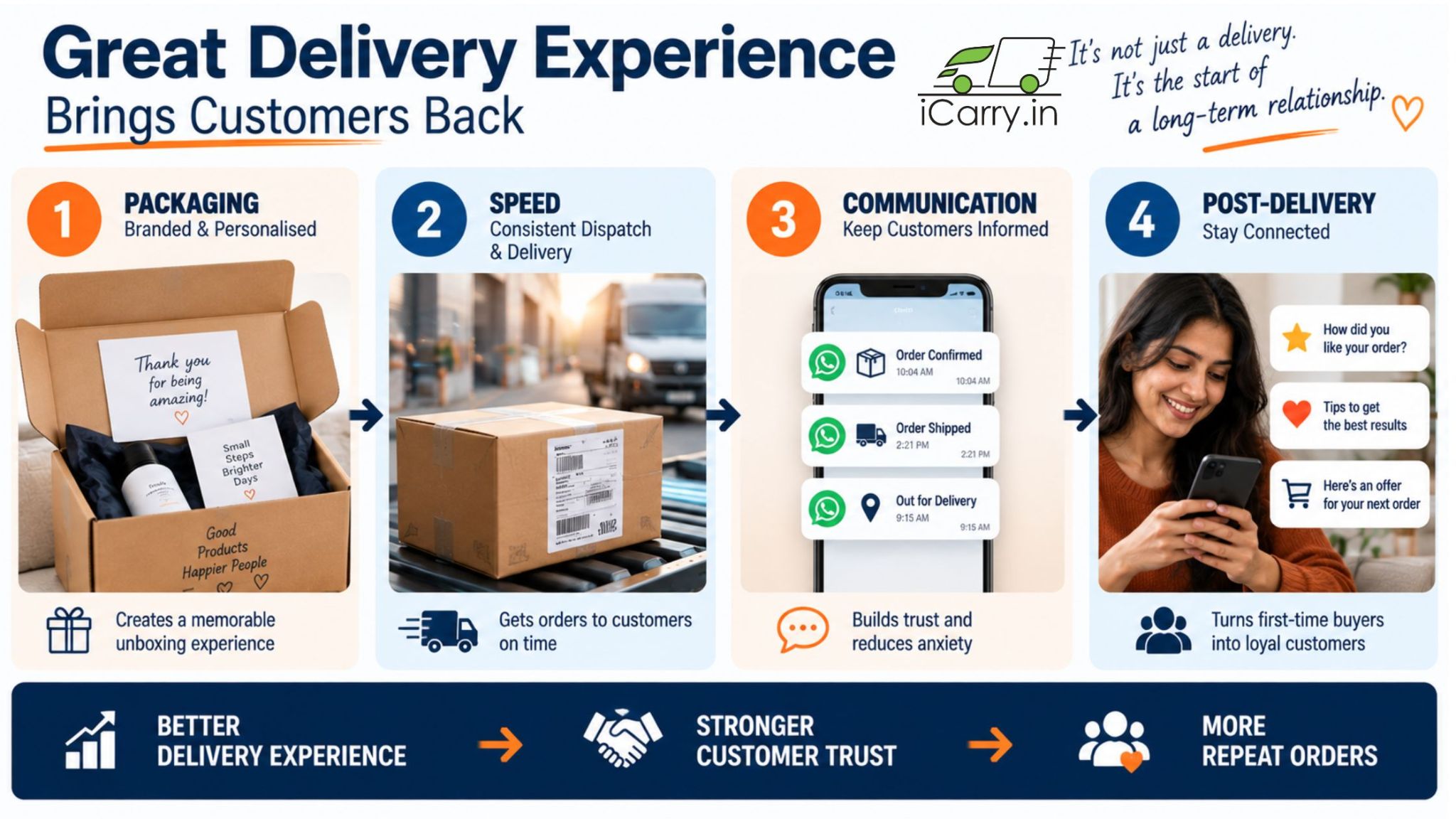
- Branded outer packaging: Even a simple custom-printed corrugated box or branded tape on a plain box signals that the brand cares about presentation. Cost: ₹3 to ₹15 per order more than plain corrugated. Retention impact: measurable in first-order-to-second-order conversion
- A handwritten or personalised printed note: 'Hi [Name], thank you for your first order. We made this [product] with [specific ingredient/craft detail]. We hope you love it. - [Founder name].' Personalised by name using order data. Cost: ₹1 to ₹5 per card. Impact: one of the highest-retention-per-rupee investments available to any D2C brand
- Product usage insert: A printed card showing how to use the product for best results, or a QR code to a video tutorial. Addresses the most common reason customers don't repeat: they received the product but weren't sure how to use it optimally
- A reorder offer: A physical card with a discount code for the next order - '₹50 off your next order, valid 30 days.' The physical card creates more attention than an email discount code. The 30-day window creates urgency
- Tissue paper or branded inner wrap: For fashion and lifestyle brands, tissue paper inside the branded box transforms a functional delivery into a gifting moment. Cost: ₹1 to ₹3 per order
What to avoid: Excessive packaging that takes 5 minutes to open and generates a pile of waste. Packaging that signals premium on the outside but is poorly executed inside. A hand-stamped logo on a plain box that smudges. Measure your packaging investment by whether the customer would photograph it and share it - that is the retention signal you are looking for.
Element 2: Delivery Speed as a Retention Signal
Speed communicates respect for the customer's time and confidence. A D2C brand that consistently delivers within the promised window tells customers: we are organised, we are reliable, and we will not disappoint you next time either.
Conversely, a brand that regularly dispatches 2 to 3 days after the committed window trains customers to order only when they have plenty of time - which dramatically reduces impulse repurchase behaviour.
Dispatch SLA Consistency
The commitment: State your dispatch SLA on your website and in your order confirmation. For example: "Orders dispatched within 1 to 2 business days."
The delivery: Meet that commitment consistently. Not 80% of the time. Every order.
Dispatch SLA consistency, not speed alone, is what builds customer trust and supports retention. A brand that takes 3 days to dispatch but consistently takes 3 days is more predictable and trustworthy than a brand that promises 1 day but delivers anywhere from 1 to 5 days.
Speed Segmentation by Order Value
Invest more in delivery speed for high-value orders where the retention signal is most valuable. A customer who spent ₹2,499 on their first order is worth a premium delivery experience to secure them as a repeat buyer.
- Standard orders: surface courier, standard transit time.
- High-value orders (above ₹1,499): express courier where transit time is significantly shorter, Delivery Boost for pre-delivery coordination, OTP Verified Delivery for premium orders
Element 3: Communication as a Retention Tool
Proactive, warm delivery communication converts anonymous logistics updates into branded customer touchpoints. Every message is an opportunity to reinforce the brand relationship.
The Communication Sequence That Builds Retention
- Order confirmation (immediate): 'Your order is confirmed! We're preparing it now. Dispatch in 1 to 2 business days. Reply here if you have any questions.'
- Dispatch notification (the moment the order ships): 'Your order is on its way! Track with AWB [number] via [courier name]. Expected delivery: [date range]. Excited for you to try it!'
- Out-for-delivery (delivery day): 'Your order is out for delivery today! Keep ₹[amount] ready if COD. Reply if you need to update timing or address.'
- Post-delivery (day after delivery): 'Hope you're loving [product name]! If you have any questions, we're right here. And if you love it - [review link]. Your opinion means everything to us.'
- Reorder nudge (day 14 to 21): 'Running low on [product]? Your next order gets [loyalty offer]. [Order now link]'
This five-message sequence creates six branded touchpoints across a two-week window for the cost of WhatsApp messages. Each message is warm, human, and directly useful to the customer. Each one builds the brand relationship that makes the next order a natural continuation rather than a fresh acquisition.
Two-Way Communication for Retention
The dispatch and out-for-delivery messages must be messages the customer can reply to. A brand that sends one-way broadcast notifications has missed the relationship-building opportunity that two-way WhatsApp provides.
When a customer replies - 'Can I change the delivery timing?' or 'Is this suitable for my skin type?' - the response to that message is the moment the customer relationship is built or lost. Respond warmly, helpfully, and within 2 hours.
iCarry®'s WhatsApp Engagement enables two-way communication between your customers and iCarry®'s coordination team - so rescheduling, address updates, and delivery coordination are handled proactively on your behalf. Every conversation is logged and visible to the seller. The customer's delivery issue is resolved; the seller's team capacity is preserved.
Element 4: Post-Delivery Touchpoints
The post-delivery phase is where most D2C brands go silent. It is where the most important retention work happens.
Review Request (Day 2 to 3 Post-Delivery)
A specific, warm review request sent 2 to 3 days after delivery - enough time for the customer to have used the product once - converts at significantly higher rates than generic 'leave a review' emails.
Example: 'Hi [Name], you've had your [product] for a couple of days now. We'd love to know how you're finding it. Would you take 2 minutes to share your experience? [Link]. Your honest review helps others find us - and helps us improve.'
Usage Guidance (Day 5 to 7 Post-Delivery)
A WhatsApp or email with a specific tip for getting the most from the product they purchased. Not a promotional message - a genuinely useful one.
Example for a skincare brand: 'For best results with your [product], apply to damp skin right after washing. The active ingredients absorb 40% better on slightly wet skin. Let us know if you have any questions!'
This message positions the brand as genuinely invested in the customer's results - not just in the sale. Customers who receive post-purchase value are more likely to return.
Reorder Prompt (Day 14 to 30 Post-Delivery)
Timed to the point at which the customer is likely to be running low on the product or considering their next purchase. The message should reference the specific product they bought.
Example: 'How's the [product] going? Most customers find they need a refill around now. Order today and we'll add a sample of our new [product] to your order. [Reorder link]'
Measuring Delivery Experience Impact on Retention
How iCarry® Enables a Better Delivery Experience
iCarry® is a courier aggregator that gives Indian D2C brands the logistics infrastructure to deliver a consistent, reliable, retention-building delivery experience:
- Multi-courier access and rate comparison: Route each order to the best courier for its zone. Consistent on-time delivery requires consistent courier selection - not defaulting to the same courier regardless of performance
- Two-way WhatsApp Engagement: Customers receive proactive delivery updates and can respond to reschedule, update address, or coordinate delivery. All conversations visible to the seller. The customer feels heard and managed - a retention signal in itself
- Delivery Boost: For high-value first orders where retention is most important, Delivery Boost ensures pre-delivery customer contact and NDR prevention. A first order that delivers perfectly is the foundation of every repeat order
- OTP Verified Delivery: For premium orders, OTP Verified Delivery eliminates fake delivery claims and creates a premium delivery event
- Address Quality Scoring: Pre-dispatch address validation prevents the delivery failure that breaks customer trust - particularly damaging on first orders
- Real-time tracking: Monitor all active shipments in My Account > My Shipments to identify any delivery anomaly before the customer notices it
- Free Bronze plan, no minimum volume.
Final Thoughts
Customer acquisition gets the customer to buy once. The delivery experience is what makes them buy again. These are two different problems requiring two different investments - but most D2C brands allocate 90% of their attention and budget to acquisition and treat delivery as a cost to minimise.
The brands that win retention - 30%+ 90-day repeat purchase rates on D2C - have figured out that every touchpoint from dispatch to post-delivery is a brand interaction. They have invested in packaging that delights, communication that is warm and proactive, and delivery that is reliable enough to be trusted.
None of these investments are expensive. A personalised note costs ₹2. A WhatsApp dispatch message costs ₹0. A review request on day 3 costs nothing. The compounding effect of these habits, applied to every order, every month, is the repeat purchase rate that makes D2C unit economics work.
Frequently Asked Questions (FAQs)
How does delivery experience affect D2C customer retention?
The delivery experience is the last impression of the purchase journey and the first impression of the brand relationship. Research consistently shows that customers who have a positive unboxing experience and receive proactive delivery communication repeat at 1.8 to 2.5x the rate of those who receive a plain box with no communication. The delivery experience directly determines 90-day repeat purchase rate.
What should I include in D2C packaging to improve retention?
A personalised note addressed to the customer by name, a product usage insert or QR code to a tutorial video, a reorder discount card with a 30-day validity window, branded tissue or inner wrap, and a QR code for a review. Total additional cost: ₹5 to ₹18 per order. Retention impact: measurable in your first-to-second-order conversion rate within 90 days.
What is the post-delivery communication sequence that builds retention?
Day 1 after delivery: a warm check-in message asking if they received the order and love it, with a review link. Day 5 to 7: a specific usage tip for the product they bought. Day 14 to 21: a personalised reorder prompt referencing the specific product, with a loyalty offer. Five touchpoints across the full purchase-to-reorder cycle converts significantly more first-time buyers than a single post-purchase email.
How do I measure whether my delivery experience is improving retention?
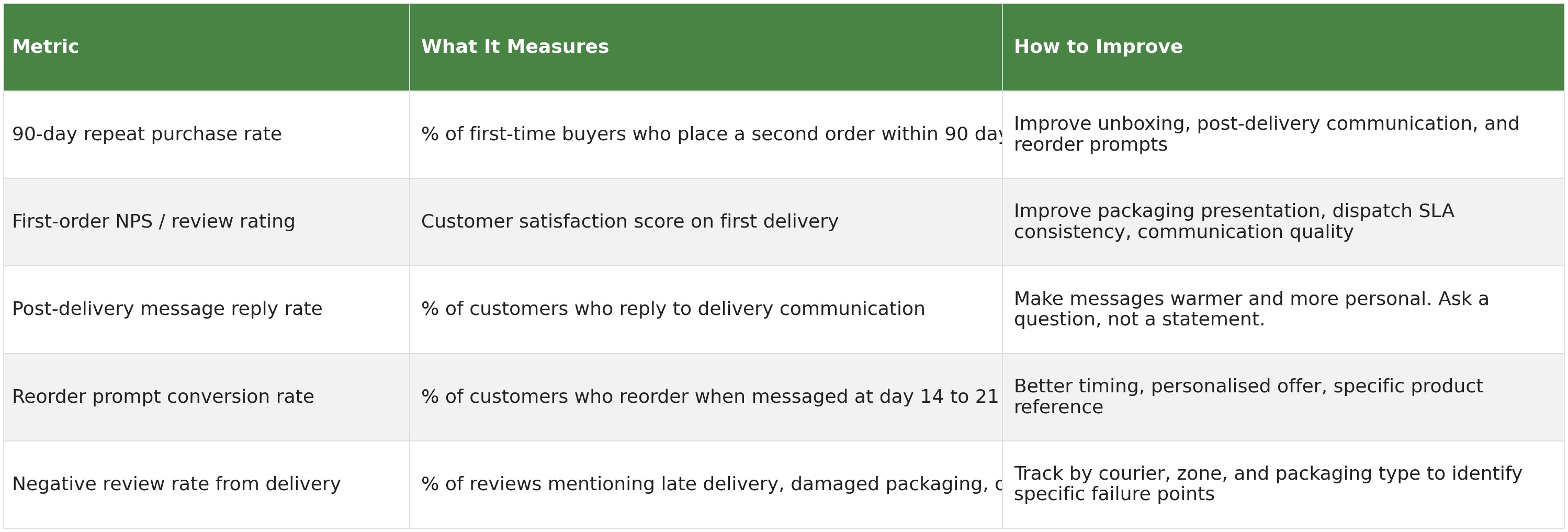
Track 90-day repeat purchase rate monthly - the percentage of first-time buyers who place a second order within 90 days. Track first-order review rating and negative review content (logistics mentions indicate delivery experience failures). Track reorder prompt conversion rate. Track post-delivery message reply rate. These four metrics together give a complete picture of delivery experience impact on retention.
Does delivery speed matter more than packaging for retention?
Both matter but in different ways. Delivery speed consistency builds trust - customers who can rely on a specific dispatch timeline repeat more reliably than those who face unpredictable timing. Packaging and communication build emotional connection. The highest retention brands combine both: reliable, on-time delivery with a memorable unboxing experience and proactive communication. Neither alone delivers the full retention impact.
Customer acquisition gets the customer to buy once - the delivery experience is what makes them buy again. The brands that win retention have figured out that every touchpoint from dispatch to post-delivery is a brand interaction, investing in packaging that delights, communication that is warm and proactive, and delivery that is reliable enough to be trusted. None of these investments are expensive - the compounding effect of these habits, applied to every order, every month, is the repeat purchase rate that makes D2C unit economics work.