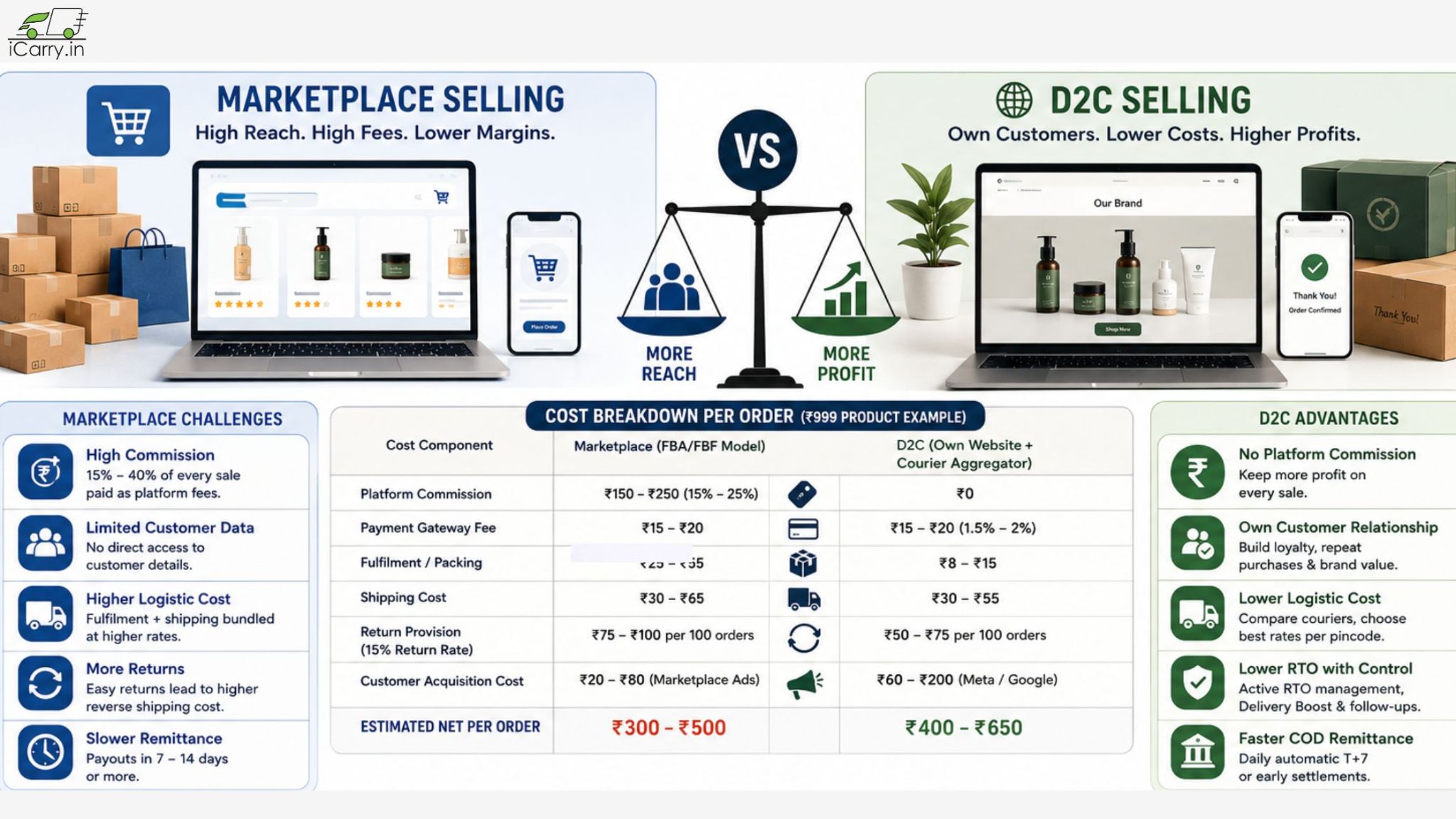
A skincare brand lists on a marketplace. Sells a ₹999 moisturiser. After commission, payment gateway, packaging, shipping, and return provisions, the brand nets ₹340. The same product sold on their own website through a courier aggregator - after marketing cost, shipping, and payment gateway - nets ₹490.
Different channels, same product, ₹150 different net margin per unit. Multiplied across 1,000 monthly orders, that is ₹1.5 lakh per month. Per year, ₹18 lakh.
The D2C vs marketplace decision is one of the most consequential commercial decisions Indian brands make - and most make it based on reach and convenience rather than actual unit economics. This guide builds the full cost model for both, including the logistics costs that most comparisons leave out.
What Is D2C vs Marketplace Selling? The Two Models Defined
Marketplace Selling
You list your product on a marketplace platform. The platform provides buyer traffic, checkout infrastructure, payment processing, and (for fulfilled models) logistics. In exchange, the marketplace charges commission on every sale - typically 5 to 40% depending on category - plus payment gateway fees, fulfilment fees, and advertising costs. Indian marketplaces overall are projected to scale to USD 100 billion in sales by 2030 (IBEF).
The buyer relationship belongs to the platform. You are a seller within their ecosystem, following their pricing rules, return policies, and account health requirements.
D2C (Direct-to-Consumer)
You sell from your own website, social commerce, or WhatsApp storefront. You own the customer relationship and data. You manage your own marketing, logistics, and customer service. No platform commission - but you pay for traffic acquisition, payment processing, and shipping directly. India's D2C market itself is growing fast enough that brands are betting their entire model on it (Statista).
How to Prepare Before Comparing D2C and Marketplace Costs
- Do you know your exact marketplace commission rate by category for your specific products?
- Have you calculated your D2C customer acquisition cost from paid social and search?
- Do you know your RTO rate separately for marketplace orders vs D2C orders?
- Have you modelled your return rate by channel - marketplace returns are typically higher due to easier return policies?
- Are you accounting for the logistics cost difference between marketplace-managed shipping and self-managed courier aggregator shipping?
Full Cost Breakdown - Marketplace vs D2C
Using a ₹999 skincare product as the base example. Shipping weight: 250g. Zone B/C order.
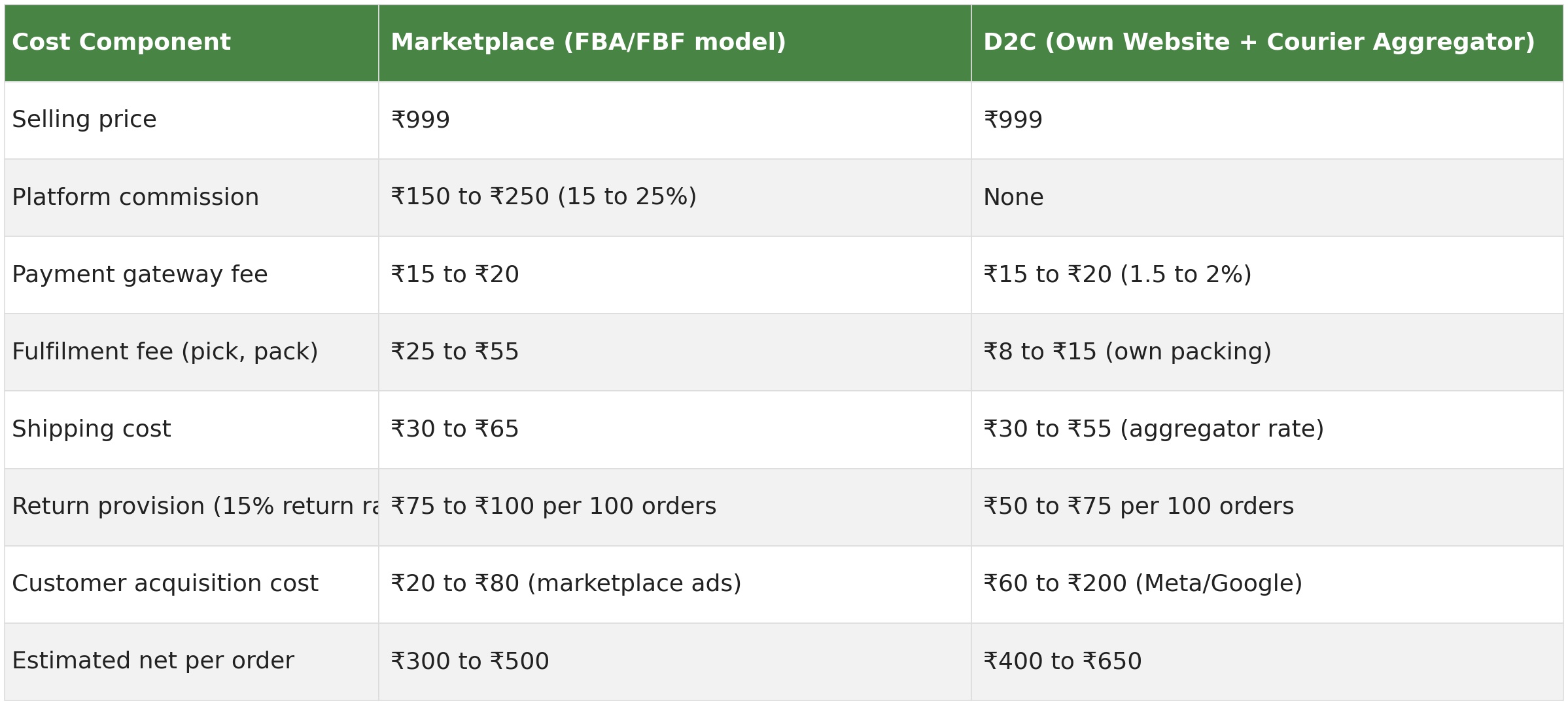
Key insight: Marketplace wins on discovery and conversion cost early-stage. D2C wins on margin at scale once customer acquisition cost reduces through organic traffic and repeat purchases.
The Logistics Cost Difference in Detail
Marketplace Logistics
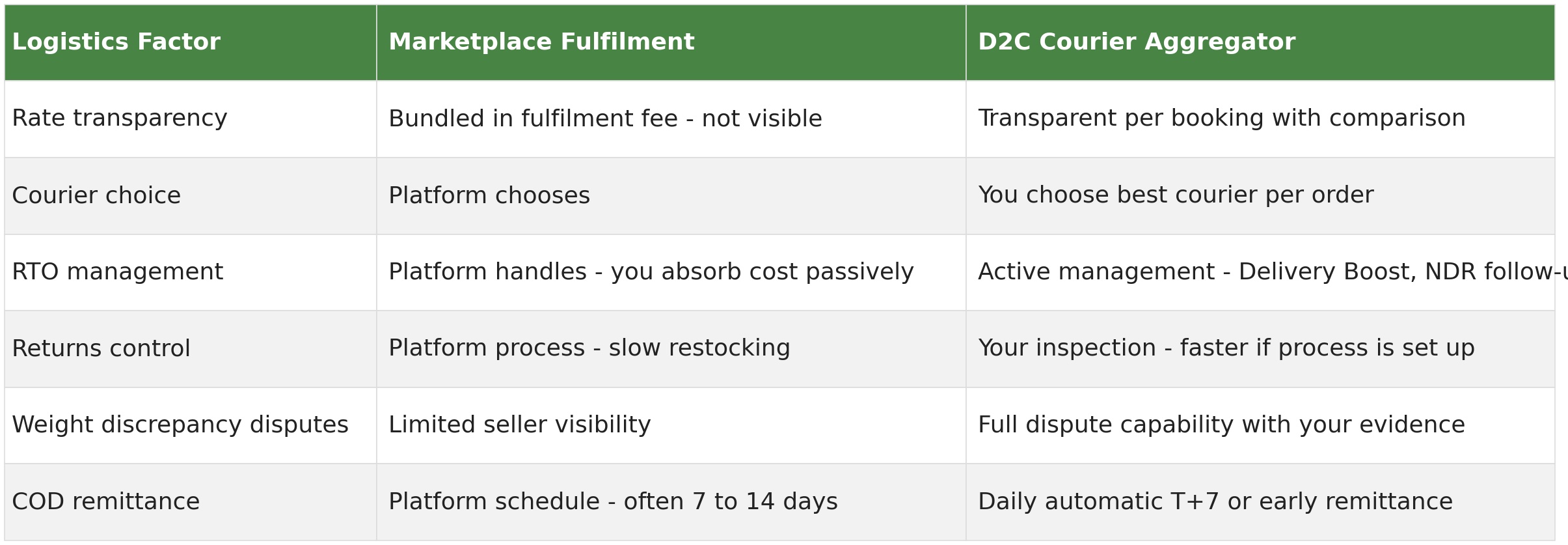
For marketplace-managed fulfillment, the platform handles pickup, packing, delivery, and returns. The cost appears as a fulfilment fee - bundling pick-and-pack, shipping, and returns handling into one number that is often higher than what a direct courier aggregator relationship achieves for the same route. Returns may take weeks to be inspected and restocked, creating inventory visibility problems that cost money even without a direct fee.
D2C Self-Managed Logistics
For D2C brands using a courier aggregator, logistics cost is transparent and typically more efficient. Rate comparison before every booking, multi-courier routing by pincode, and active RTO management reduce effective per-delivered-order cost below what marketplace embedded rates typically achieve.
RTO Rate Difference: Marketplace vs D2C

Active RTO management on D2C - COD confirmation, Delivery Boost, two-way WhatsApp engagement- is not available to marketplace sellers. Reducing RTO on D2C orders is a margin lever that only exists when you control your logistics.
Return Rate and Cost Comparison
Working Capital Comparison
- Marketplace COD: Payment settled to seller 7 to 14 days after delivery. Capital locked longest.
- Marketplace prepaid: Settled typically on a 7 day cycle from order confirmation.
- D2C prepaid (UPI): Instant settlement to payment gateway, cleared T+1 to T+3. Best position.
- D2C COD via aggregator: T+7 from delivery by default. Early remittance T+0 (Next day after delivery) to T+4 available at nominal fee.
Marketing Cost: The D2C Disadvantage That Reduces Over Time
Early-stage, D2C customer acquisition cost (CAC) is high - sometimes ₹150 to ₹400 per first-order customer. What changes over time:
- Repeat purchase rate: D2C customers repurchase at significantly higher rates. Second and subsequent orders have near-zero acquisition cost
- Owned database: D2C brands own customer contact for email and WhatsApp re-marketing. Marketplace sellers cannot contact their buyers directly
- SEO compounding: D2C website content reduces paid traffic dependency as the brand grows
- Lifetime value: A D2C customer retained for 3 purchases at ₹490 margin delivers ₹1,470 LTV vs ₹1,020 for marketplace at ₹340 - and D2C owns the relationship for future sales
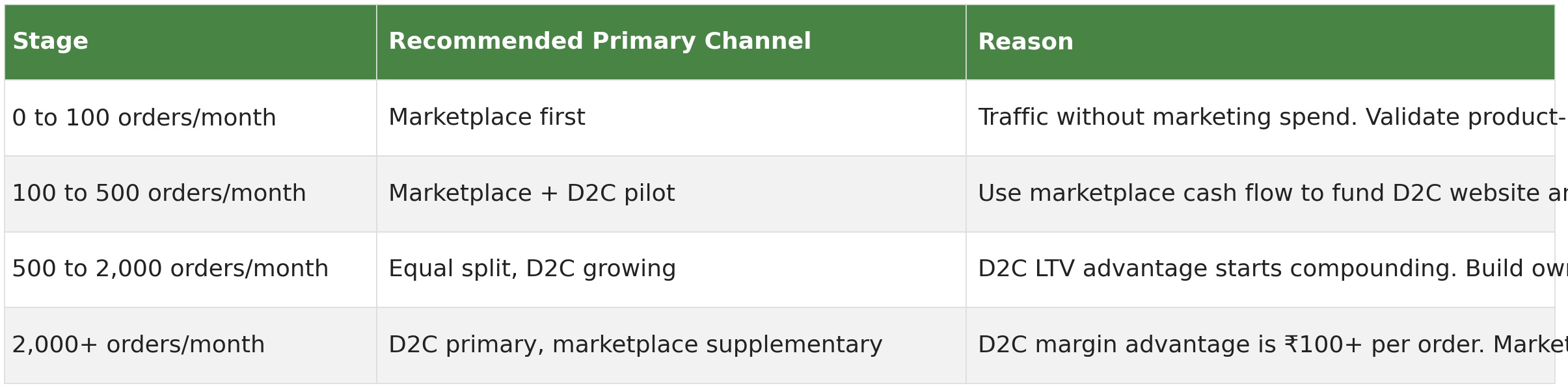
The Right Model by Business Stage
How iCarry® Improves D2C Logistics Economics
For brands building D2C, iCarry® closes the logistics gap with marketplace fulfilment while giving control that marketplace never allows. iCarry® is a courier aggregator serving all Indian businesses - D2C brands, manufacturers, distributors, and enterprises:
- Pre-negotiated multi-courier rates from day one: No volume threshold. Compare rates before every D2C booking
- Delivery Boost: Reduces D2C COD RTO to 10 to 18% vs marketplace 25 to 40%. Most direct margin improvement for COD-heavy brands
- Two-way WhatsApp engagement: Customers reschedule, update address, confirm delivery. Full seller visibility of all conversations
- Address Quality Scoring: Pre-dispatch address validation - not offered to sellers by marketplace fulfilment
- OTP Verified Delivery: For high-value D2C prepaid orders- eliminates fake delivery claims
- Daily COD remittance: Free automatic T+7. Early remittance to T+0 (Next day after delivery) available - better than most marketplace COD settlement cycles
- Shopify / WooCommerce / other platform API: Automatic order sync from your D2C store
Free Bronze plan, no monthly fee, no minimum. Start your shipping journey at iCarry.
Final Thoughts
D2C and marketplace are complementary stages and channels for most Indian brands. Use marketplaces to acquire customers and build cash flow early, then invest in D2C capability that generates better unit economics at scale.
The logistics cost comparison consistently shows that well-managed D2C logistics outperforms marketplace embedded logistics on effective per-delivered-order cost. That advantage compounds with every RTO reduction and every repeat customer who buys without acquisition cost.
Model your own numbers with your actual commission rate, RTO rate, acquisition cost, and repeat purchase rate. The case for building D2C alongside the marketplace is financially compelling for most Indian brands well before the 1,000 order-per-month mark.
Frequently Asked Questions (FAQs)
Is D2C or marketplace selling more profitable for Indian brands?
At scale, D2C is typically more profitable per order - no commission (15 to 25%), better RTO management, lower return rates, and owned customer relationships that generate repeat purchase at near-zero acquisition cost. Early stage, marketplace wins because it provides traffic without marketing spend.
What is the commission structure on Indian marketplaces?
Commission rates vary by category. Fashion typically attracts 15 to 25%, electronics 5 to 10%, home and lifestyle 12 to 20%, beauty 15 to 22%. Payment gateway fees, fulfilment fees, and advertising costs add significantly to the effective take rate beyond the base commission.
Why is D2C RTO rate lower than marketplace RTO?
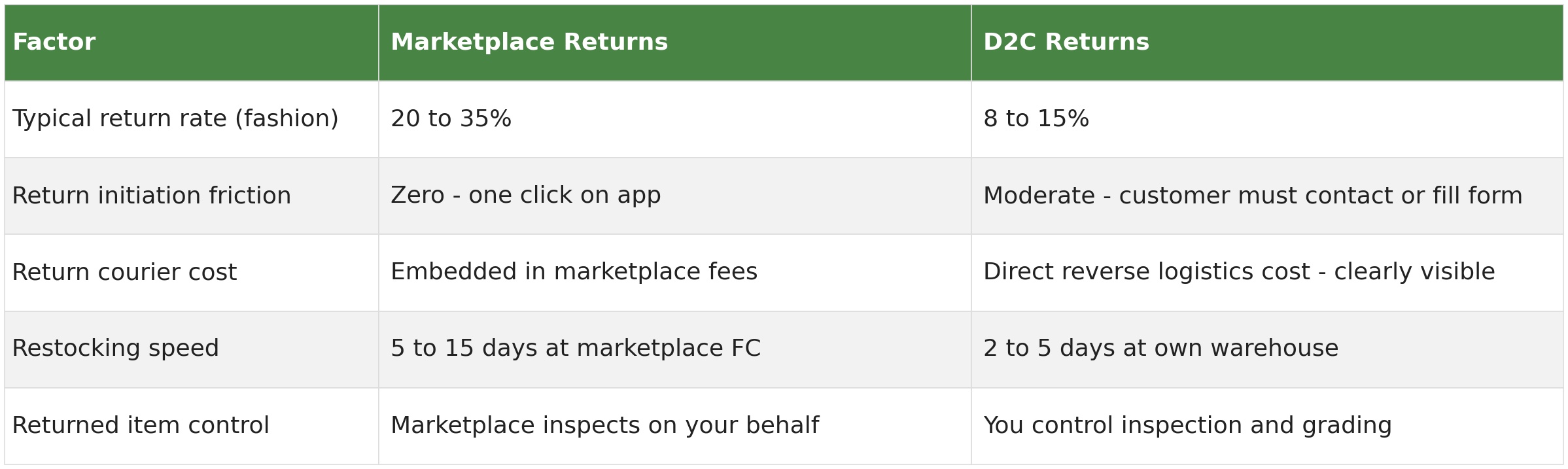
Marketplace platforms make returns extremely easy - one click initiates a return, reducing friction that prevents low-commitment refusals. D2C buyers self-selected the brand with higher purchase intent, and return initiation requires more effort. Result: typically half the return rate and 8 to 15 percentage points lower COD RTO for D2C.
How does a courier aggregator improve D2C logistics?
Multi-courier access at pre-negotiated rates, rate comparison before every booking, Delivery Boost for active RTO management, two-way WhatsApp delivery coordination, Address Quality Scoring, daily COD remittance, and platform integrations - all capabilities marketplace fulfilment does not offer sellers.
When should an Indian brand start D2C alongside the marketplace?
Earlier than most brands expect - typically once 100 to 200 monthly marketplace orders confirm product-market fit. Use marketplace cash flow to fund D2C website and first acquisition campaigns. Run both channels simultaneously rather than waiting until ready to leave the marketplace.
What is the lifetime value difference between D2C and marketplace customers?
D2C customers repurchase 2 to 3 times more frequently because you own the contact relationship for re-marketing. A D2C customer retained for 3 orders at ₹490 net margin delivers ₹1,470 lifetime margin vs ₹1,020 for a marketplace customer at ₹340 - and the D2C brand owns that relationship for all future sales.
D2C and marketplace are complementary stages and channels for most Indian brands - use marketplaces to acquire customers and build cash flow early, then invest in D2C capability that generates better unit economics at scale. The logistics cost comparison consistently shows that well-managed D2C logistics outperforms marketplace embedded logistics on effective per-delivered-order cost, and that advantage compounds with every RTO reduction and every repeat customer who buys without acquisition cost.