
You receive a courier invoice with a weight discrepancy charge. Your 3PL mentions your RTO rate is above SLA. A marketplace flags your FBF compliance. Your freight forwarder asks for the Incoterms on your commercial invoice.
If any of these sentences left you uncertain about what is actually being said, this glossary is for you.
Indian logistics has its own vocabulary - a mix of global shipping terminology, GST-era compliance terms, and India-specific courier industry shorthand. As Indian commerce scales rapidly - Indian ecommerce is projected to grow at a 27% CAGR to reach USD 163 billion by 2026 (IBEF), sellers who understand the language of logistics make better decisions, catch billing errors faster, and negotiate more effectively with couriers, 3PLs, and freight partners.
Here are 50 terms, explained clearly, in the context Indian sellers actually encounter them.
What Is an Ecommerce Logistics Glossary?
An ecommerce logistics glossary is a reference list of the shipping, compliance, and fulfillment terms that appear on courier invoices, marketplace dashboards, and 3PL reports - terms like AWB, RTO, NDR, volumetric weight, and Incoterms. For Indian sellers, this vocabulary blends global shipping standards with GST-era compliance terms and India-specific courier shorthand, so knowing it precisely is what lets you read a bill correctly, catch an overcharge, or push back on a courier partner with confidence.
How to Use This Glossary
- Keep this page bookmarked and search it (Ctrl/Cmd+F) when a courier invoice or marketplace report uses an unfamiliar term
- Start with Chargeable Weight, RTO, and NDR - these three terms explain most billing disputes and delivery failures
- Share this glossary with your dispatch and customer service team so everyone uses the same vocabulary
- Cross-check Incoterms (DDP, DDU/DAP, FOB) before finalising any international shipment - the wrong term shifts cost and liability
- Use the A-F, F-M, and N-Z sections to jump straight to the term you need instead of reading top to bottom
A to F
Actual Weight: The physical weight of a sealed parcel measured on a scale, in grams or kilograms. Couriers compare actual weight against volumetric weight and bill whichever is higher. Always weigh after sealing, not before.
Address Quality Scoring: A pre-dispatch feature that evaluates the delivery address for completeness and accuracy before the shipment is booked. Flags incomplete or high-risk addresses so they can be corrected before the order ships.
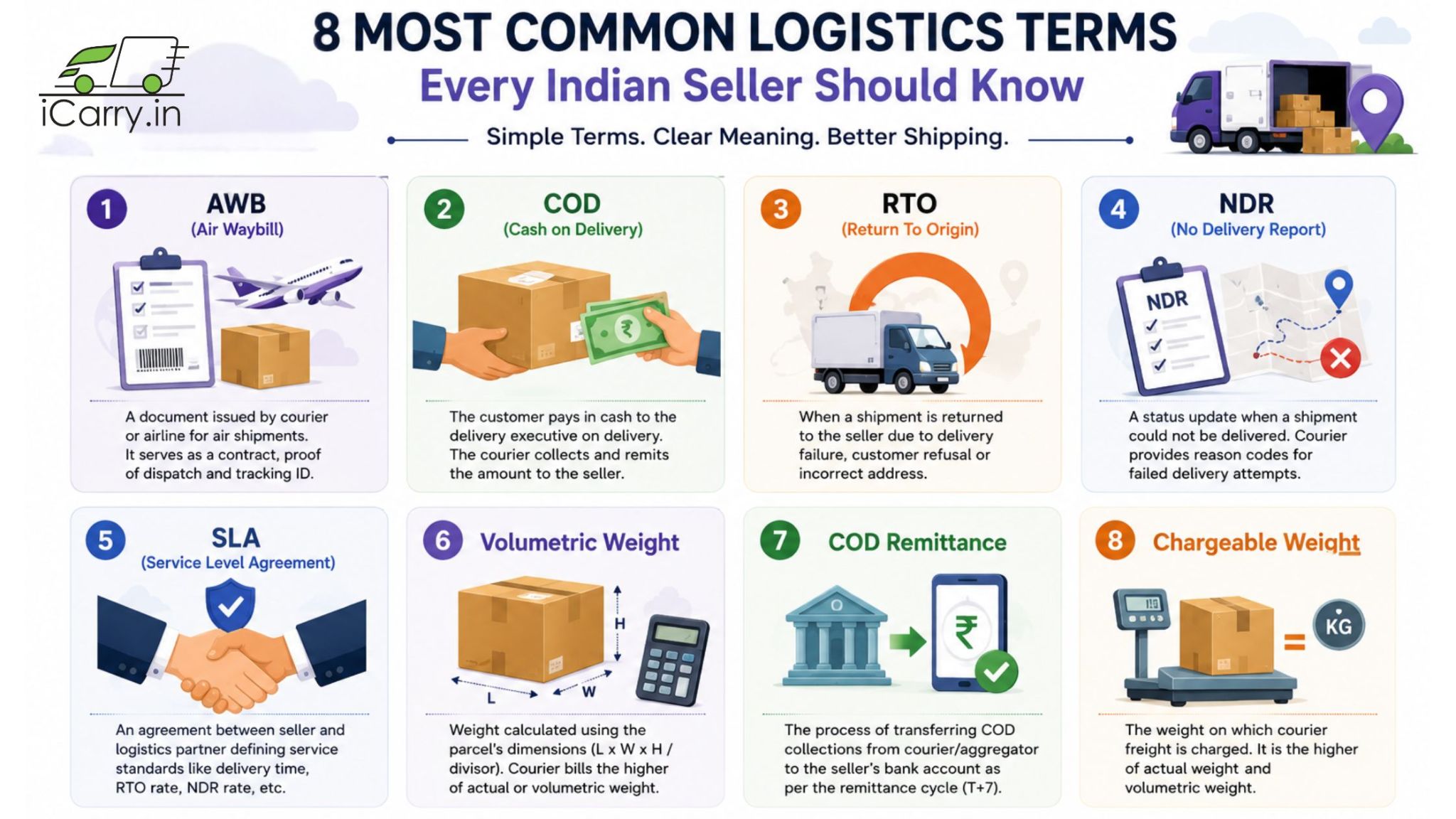
Air Waybill (AWB): A document issued by an airline or express courier for air freight shipments. Serves as the shipment contract, proof of dispatch, and tracking reference. Unlike a bill of lading, an AWB is non-negotiable - it names a specific consignee.
Batch Picking: A warehouse picking method where one picker collects items for multiple orders in a single warehouse walk, then sorts them by order at the packing station. More efficient than single-order picking for businesses processing 30 to 200 daily orders.
Bill of Lading (BOL / B/L): A legal document issued by an ocean carrier for sea freight shipments. Serves simultaneously as a receipt for goods, a transport contract, and a document of title. The party holding the original BOL has the right to take delivery of the cargo.
Bonded Warehouse: A licensed facility where imported goods can be stored without paying import duty until the goods are cleared for domestic use or re-exported. Useful for importers who want to defer duty payment.
Bulk Booking: Booking multiple shipments simultaneously in one action rather than individually. Reduces the time taken to process large daily dispatch volumes. Available through courier aggregator platforms including iCarry®.
Cash on Delivery (COD): A payment method where the customer pays in cash to the delivery executive when the order arrives at their door. The courier collects the cash and remits it to the seller after a defined settlement cycle.
Chargeable Weight: The weight on which the courier charges freight. Always the higher of actual weight and volumetric weight. Understanding chargeable weight is the key to avoiding billing surprises.
COD Handling Fee: An additional charge applied by the courier on every COD order, covering the cost of collecting cash and remitting it to the seller. Typically ₹15 to ₹25 fixed plus 1 to 2% of the declared order value.
COD Remittance: The process by which a courier aggregator or courier settles COD collections to the seller's bank account. The standard cycle is T+7 (seven business days after delivery). Early remittance from T+0 to T+4 is available at a nominal fee on platforms like iCarry®.
Commercial Invoice: A formal document issued by the seller to the buyer recording the details of a sale - product description, quantity, value, HS code, Incoterms, and country of origin. The primary customs document for international shipments.
Consignee: The person or entity named as the recipient of a shipment. The consignee's address on the shipping label is the delivery destination.
Courier Aggregator: A platform that connects businesses to multiple courier partners through one dashboard. Businesses access pre-negotiated bulk rates, compare couriers before every booking, and manage all shipments from one account. Examples include iCarry®.
Cross-Docking: A logistics method where incoming goods are transferred directly from inbound to outbound transport with minimal or no storage time. Goods flow through a facility rather than sitting in it, reducing storage cost and transit time.
D2C (Direct to Consumer): A sales model where a brand sells directly to the end customer through its own website or channel, without going through a marketplace or retailer as an intermediary.
Declared Value: The monetary value of the goods in a shipment as stated by the sender at booking. Used by couriers to determine liability limits, by customs to assess import duty, and for COD orders to determine the collection amount.
Delivery Attempt: Each occasion the courier executive tries to deliver a shipment to the consignee's address. Most couriers make 2 to 3 attempts before triggering RTO if delivery is not successful.
Delivery Boost: A service offered by iCarry® where trained agents proactively call consignees before delivery, audit Non-Delivery Reports, and open tickets for fake non-deliveries. Agents communicate in the consignee's regional language.
DDP (Delivered Duty Paid): An Incoterm where the seller pays all costs including international shipping, insurance, and destination import duties. The buyer receives the goods with no additional charges. Recommended for D2C international exports.
DDU / DAP (Delivered Duty Unpaid / Delivered at Place): An Incoterm where the seller pays shipping but the buyer pays import duties at the destination. Common for B2B international exports where buyers are aware of applicable duties.
Dispatch SLA: The committed time window within which an order must be shipped after being placed. Marketplace sellers face metric penalties for missing dispatch SLA. Typically 24 to 48 hours from order confirmation.
Dwell Time: The period a shipment sits stationary at a logistics facility - courier hub, warehouse, or customs point - without progressing toward its destination. Accumulated dwell time is the primary cause of delivery delays in multi-hub courier networks.
E-Way Bill: A GST compliance document required for movement of goods valued above ₹50,000 within India. Must be generated before goods leave the dispatch premises and must travel with the consignment. Generated through the GST portal.
Express Courier: A courier service offering faster transit times than standard surface delivery, typically using air freight or priority road networks. Higher cost per shipment but lower transit time and fewer handling points.
F to M
FEFO (First Expired First Out): An inventory management principle where products closest to their expiry date are dispatched first. Critical for food, pharmaceutical, and cosmetic products to prevent shipping near-expired goods.
FOB (Free on Board): An Incoterm where the seller is responsible for goods until they are loaded on the vessel at the origin port. The buyer pays ocean freight and all destination costs from that point.
Freight Forwarder: A company that organises and coordinates international shipments - booking cargo space with ocean carriers or airlines, managing customs clearance, and handling documentation. Does not typically own the ships or planes.
Fulfillment Center: A warehouse facility that also processes individual customer orders - picking, packing, labelling, and dispatching parcels to end customers. Designed for throughput of individual orders, not just bulk storage.
GST Invoice (Tax Invoice): A GST-compliant document required for all taxable transactions by GST-registered sellers in India. Must include GSTIN, HSN code, product description, and GST breakdown by CGST/SGST or IGST.
HS Code (Harmonised System Code): A 6-digit (or 8-digit in India) international product classification code used by customs to determine applicable import duty rates. Required on all commercial invoices for international shipments.
IEC (Import Export Code): A 10-digit registration number issued by DGFT, mandatory for commercial exports from India. Applied online through the DGFT portal. Lifetime validity costs ₹500 to register.
Incoterms: Internationally standardised trade terms that define who pays for shipping, insurance, and import duties in a transaction. Common Incoterms: DDP, DDU/DAP, FOB, CIF. Must be stated on the commercial invoice for international shipments.
ITC (Input Tax Credit): The GST mechanism that allows registered businesses to offset GST paid on inputs (including courier services) against GST collected on sales. Courier invoices from GST-registered aggregators carry 18% GST claimable as ITC.
Last-Mile Delivery: The final leg of a shipment's journey from the local delivery hub to the customer's address. Last-mile is the most expensive and most failure-prone portion of the delivery chain.
LCL (Less than Container Load): Ocean freight where a shipper's cargo occupies less than a full container. Multiple shippers' cargo is consolidated by a freight forwarder into one container. Cost-effective for exporters whose shipment volume does not justify a full container.
LTL (Less than Truckload): Surface freight where a shipper's cargo does not fill a full truck. Multiple consignments from different shippers are combined. Used for B2B bulk shipments that are too large for standard courier but too small for a full truck.
Manifest: A document listing all shipments included in a courier pickup. The courier signs the manifest on collection, confirming receipt of each parcel. Serves as proof of handover from seller to courier.
MRP (Maximum Retail Price): The maximum price at which a pre-packaged product can be sold to consumers in India. Must be printed on the product label as inclusive of all taxes. A product cannot legally be sold above the printed MRP.
N to Z
NDR (Non-Delivery Report): A report generated when a courier executive is unable to complete delivery. Reasons include customer unavailable, address not found, or refused at door. Each NDR starts a clock - act within 24 hours to maximise reattempt success.
ODA (Out of Delivery Area): A surcharge applied when the destination pincode falls outside a courier's standard service area. Typically ₹30 to ₹100 per shipment. Always check ODA applicability before accepting orders from remote pincodes.
OMS (Order Management System): Software that centralises order information from all sales channels - Shopify, marketplace, wholesale - and coordinates fulfilment, inventory, and shipping from one interface.
OTP Verified Delivery: A delivery confirmation method where the consignee must enter a one-time password before the courier marks the shipment as delivered. Available on iCarry® for Prepaid shipments. Eliminates fake delivery claims.
Pick and Pack: The warehouse process of selecting the correct items for a customer order from storage (picking) and preparing them for shipment in appropriate packaging with a shipping label (packing).
POD (Proof of Delivery): Documentation confirming that a shipment was delivered to the consignee. Can be a physical signature on the delivery challan, a digital signature on a handheld device, or an OTP record for OTP Verified Delivery.
RTO (Return to Origin): A shipment that could not be delivered and is being returned to the sender. RTO costs forward freight plus return freight with zero revenue. Active NDR management and delivery tools reduce RTO rates.
Shipping Bill: An Indian customs document filed electronically for every export shipment. Acts as proof of export and is required for claiming GST refunds on zero-rated exports. Filed through the ICEGATE system.
SKU (Stock Keeping Unit): A unique identifier assigned to a specific product variant - a specific size, colour, and style combination. Used in inventory management to track stock levels for each distinct item.
SLA (Service Level Agreement): A defined standard for service delivery - for example, a courier's commitment to deliver within 3 business days for Zone D, or a seller's commitment to dispatch within 24 hours of order placement.
Surface Courier: Shipments transported by road (truck, van) rather than air. Slower than air express but significantly cheaper per kg for heavier or lower-urgency shipments. Preferred for Zone D and Zone E shipments where transit time is acceptable.
Volumetric Weight: A calculated weight based on parcel dimensions: L x B x H (in cm) divided by 5,000. If volumetric weight exceeds actual weight, the courier bills at volumetric weight. Right-sizing packaging eliminates unnecessary volumetric billing.
WMS (Warehouse Management System): Software that manages warehouse operations - inventory location, receiving, put-away, picking, packing, and dispatch. Tracks every item in the warehouse and coordinates with OMS for order fulfilment.
Zone: A geographic classification used by Indian couriers to determine freight rates. Zone A is the same city (cheapest). Zones B through E represent increasing distance from the dispatch pincode (most expensive). Zone classification is relative to the dispatch location.
Zone Skipping: A logistics strategy where parcels destined for the same region are consolidated into a bulk transfer, moved at freight rates to near that region, and injected into the local delivery network at Zone A rates - reducing per-parcel shipping cost significantly.
How iCarry® Puts These Terms Into Practice
iCarry® is a courier aggregator that gives Indian businesses access to multiple courier partners from one platform. Every term in this glossary is part of how iCarry® operates daily - from Address Quality Scoring before dispatch to COD remittance after delivery, from NDR management on failed attempts to weight discrepancy disputes on billing errors.
Understanding these terms is the first step to using iCarry®'s tools more effectively. Reducing shipping cost starts with knowing the difference between actual weight and volumetric weight. Reducing RTO starts with understanding what NDRs are and why acting within 24 hours matters.
Final Thoughts
Logistics has a language. And like any language, fluency comes with practice. The 50 terms in this glossary cover the vocabulary a seller needs to read their courier invoice correctly, understand their 3PL's performance report, manage compliance requirements, and make better decisions about packaging, courier selection, and cost management.
Bookmark this page. Share it with your dispatch team. The seller who knows what an NDR is and acts on it within 24 hours has a meaningfully lower RTO rate than the seller who does not. That difference compounds across thousands of monthly orders into a real margin advantage.
Frequently Asked Questions (FAQs)
What is RTO in logistics?
RTO stands for Return to Origin. It occurs when a shipment cannot be delivered and is returned to the sender. RTO costs forward freight plus return freight at zero revenue. It is one of the highest logistics costs for Indian sellers, particularly on COD orders.
What is the difference between actual weight and volumetric weight?
Actual weight is the physical weight of the sealed parcel on a scale. Volumetric weight is calculated from parcel dimensions: L x B x H (in cm) divided by 5,000. Indian couriers bill based on whichever is higher. Right-sizing packaging to reduce volumetric weight is the most direct way to lower courier cost per order.
What does COD remittance T+7 mean?
T+7 means COD collections are remitted to the seller's bank account seven business days after delivery. T is the delivery date. T+7 means seven business days from that date. Early remittance options (T+0 to T+4) allow faster access to COD collections at a nominal fee.
What is an NDR and how should I respond to it?
NDR (Non-Delivery Report) is generated when the courier fails to deliver on an attempt. You should act on every NDR within 24 hours - update delivery instructions, confirm the customer is available, and request a reattempt. NDRs that are not acted on within the courier's window convert to RTO.
What is a courier aggregator and how is it different from a direct courier?
A courier aggregator gives businesses access to multiple courier partners at pre-negotiated bulk rates through one account. A direct courier relationship gives access to only one courier at rack rates unless you have sufficient volume to negotiate a discount. Aggregators give better rates, more flexibility, and multi-courier comparison from day one.
Logistics has a language, and fluency comes with practice. This glossary covers the vocabulary a seller needs to read their courier invoice correctly, understand their 3PL's performance report, manage compliance requirements, and make better decisions about packaging, courier selection, and cost management. Bookmark this page and share it with your dispatch team - the seller who knows what an NDR is and acts on it within 24 hours has a meaningfully lower RTO rate than the seller who does not.