Your customer just sent you a photo. The box is crushed, the product is broken, and the message says: "I want a refund." You packed it carefully. The courier delivered it in pieces.
Damaged shipments are one of the most expensive problems in Indian eCommerce - not just because of the replacement cost, but because of what happens next. Lost customer trust. A courier dispute that goes nowhere. A claim rejected because you missed the 3-day filing window by one day.
This guide walks you through exactly what to do when a shipment arrives damaged, what evidence you need, how to file a claim that actually gets resolved, and how to prevent damage from happening in the first place.
What Is a Damaged Shipment?
A damaged shipment is any parcel that arrives at the buyer in worse condition than when it was dispatched by the seller - crushed packaging, broken product, leaked contents, or missing items. In Indian eCommerce, courier transit damage is handled through a separate courier damage claim process rather than a product return or warranty. The outcome depends on whether you have transit insurance, photographic evidence, and whether damage was reported within the claim window.
Quick Checklist - Are You Handling Damaged Shipments Correctly?
- Do you ask customers to photograph damaged packaging and product before discarding the box?
- Are you filing courier damage claims within 3 days of the delivery confirmation date?
- Do you have product images and weight documentation pre-uploaded before dispatch?
- Are you using packaging that matches the fragility and weight of each product category?
- Do you know your specific courier's damage liability limit and claims process?
- Have you checked whether your shipment was covered under transit insurance at booking?
- Are you tracking damage patterns by courier and route to identify repeat issues?
If you answered no to three or more, your damage claim process has gaps that are costing you money.
What Counts as a Damaged Shipment in Indian eCommerce?
A damaged shipment is any parcel that arrives at the customer's address in a condition that makes the product unusable, broken, or materially different from what was dispatched.
This includes physically broken items, crushed or wet packaging, missing parts from a multi-component product, and products showing clear signs of mishandling in transit. It is important to distinguish between damage caused in transit and damage caused by inadequate packaging - because couriers treat these very differently when processing claims.
Transit damage is generally the courier's responsibility. Packaging-related damage is the seller's. Knowing which category applies before you file saves significant time and prevents claim rejection.
Why Damaged Shipments Cost More Than Just the Product Value
The direct cost of a damaged shipment is the product replacement or refund. The indirect cost goes much further.
A customer who receives a damaged product is unlikely to reorder. If they share the experience publicly, the reputational cost multiplies. And if your damage claim rate rises above courier thresholds, you may face stricter scrutiny on future claims across all your shipments.
Research consistently shows that last-mile delivery experience - including damage - is one of the top drivers of customer churn in eCommerce. A single bad delivery experience can end a customer relationship that took significant acquisition spend to build.
Step-by-Step: How to Handle a Damaged Shipment in India
Step 1: Ask the Customer to Document Everything Immediately
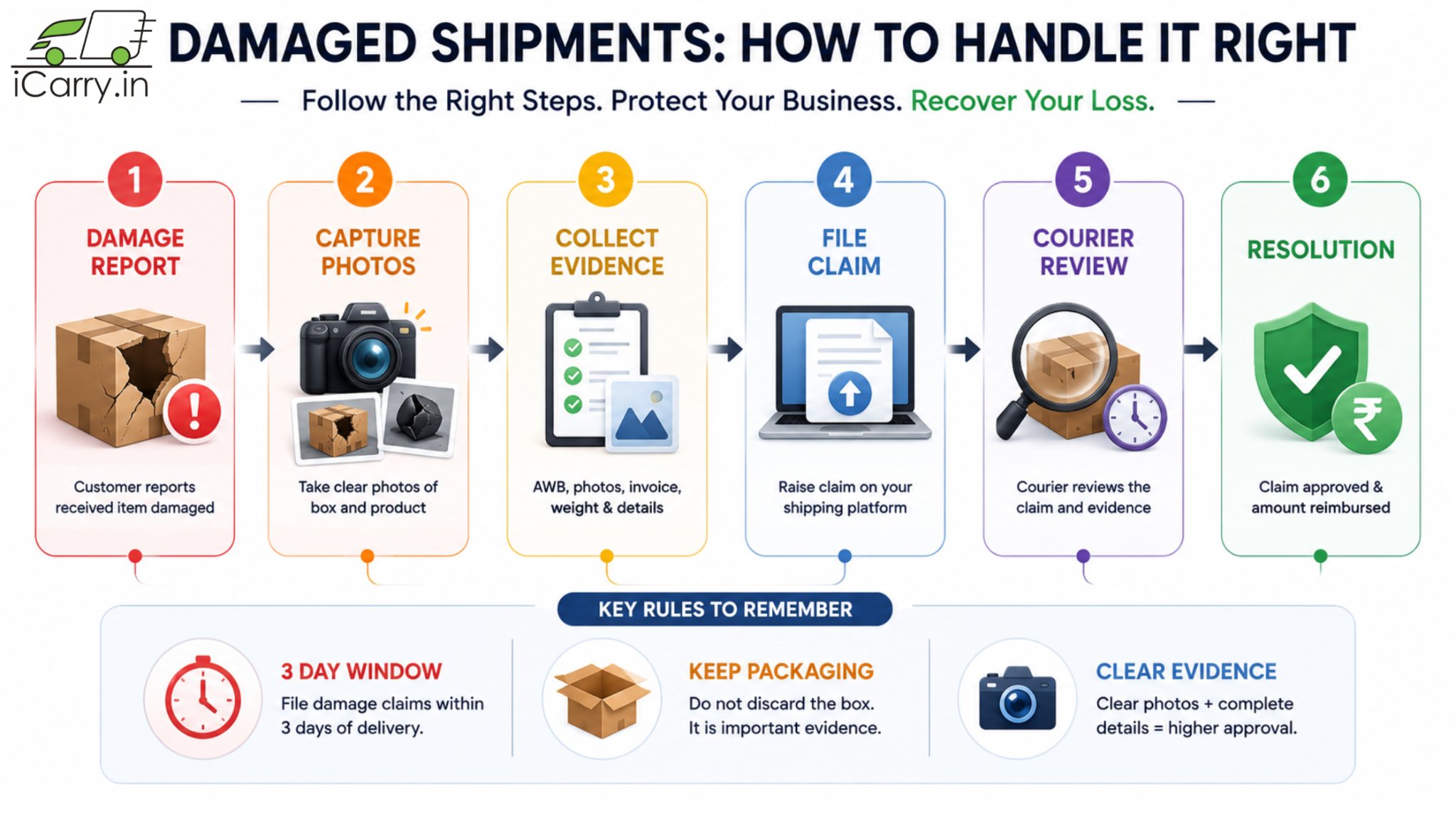
The moment a customer reports a damaged shipment, ask them to photograph the parcel before doing anything else. You need photos of the outer packaging showing the damage, photos of the product inside, and the AWB number clearly visible on the shipping label.
Tell them not to discard the box. The outer packaging is evidence. Couriers reject claims where the damaged packaging has been thrown away because they cannot verify that the damage happened in transit rather than after delivery.
A simple WhatsApp message to the customer - "Please send photos of the box and product before discarding anything, I will sort this out for you" - is all it takes at this stage.
Step 2: Check Your Courier's Damage Claim Window
Every courier has a specific window within which damage claims must be filed. For most Indian courier partners, this window is 3 days from the delivery date. Some couriers allow up to 7 days for concealed damage - where the outer packaging appears intact but the product inside is broken.
Missing this window means your claim will be rejected regardless of how strong your evidence is. This is the step most sellers get wrong - they focus on the customer refund first and forget the courier claim until it is too late.
Build a reminder into your operations: any damage report from a customer triggers a same-day courier claim task, not a next-week task.
Step 3: Gather Your Evidence Before Filing
Before you raise a formal claim, compile everything you have. This includes your pre-dispatch product images, the declared weight and dimensions at booking, the customer's damage photographs, the AWB number, and the invoice value of the damaged item.
Pre-uploading product images on your shipping platform before dispatch is the single most important protection you can build into your operations. When images are already on record before the shipment was booked, it is significantly harder for couriers to argue that damage was pre-existing. Watch how to save images for standard SKUs on iCarry® to set this up before your next dispatch.
Step 4: Raise a Formal Dispute on Your Shipping Platform
Once you have your evidence, raise the dispute through your shipping platform's dispute management section.
iCarry®'s dedicated dispute dashboard gives sellers a clear view of all open claims with evidence attached. This removes the back-and-forth of email-based dispute management and creates an auditable trail for each case. You can simply navigate to My Shipments, select the shipment ID, upload your evidence images, and submit the dispute.
Step 5: Follow Up Within the Resolution Window
Courier damage claims in India are rarely resolved immediately. Most take 7 to 21 business days depending on the courier and the claim value. Set a follow-up reminder for day 7 and again for day 14.
If the courier rejects the claim, check the stated reason carefully. Common rejection reasons include insufficient evidence, claim filed outside the window, damage attributed to packaging rather than handling, and item value exceeding the declared coverage limit.
Each rejection reason has a specific counter-response. A blanket appeal without addressing the stated reason rarely succeeds.
Managing claims across multiple courier partners becomes difficult as shipment volume grows. Platforms like iCarry® help sellers centralise evidence, disputes, and courier communication from one dashboard.
What Transit Insurance Covers - and What It Does Not
Transit insurance is the seller's primary protection against damage liability that exceeds the courier's default coverage. Understanding what it covers prevents unpleasant surprises when a claim is filed.
iCarry®'s Bronze plan includes free transit coverage up to ₹1,000 per shipment. For higher-value shipments, paid coverage options are available at the time of booking. Coverage limits apply to the declared value at booking - you cannot increase the declared value after damage has occurred.
Most transit insurance policies in India cover physical damage caused by handling in transit. They typically exclude damage from inadequate packaging, items broken due to inherent fragility without additional protection, and product categories outside covered listings. Always check the specific exclusions before assuming a high-value shipment is covered.
How to Prevent Damaged Shipments Before They Happen
Use the Right Packaging for Each Product Category
The most effective damage prevention measure is right-sized, category-appropriate packaging. Fragile items need double-wall corrugated boxes with internal void fill. Electronics need anti-static padding. Liquids need sealed inner pouches inside waterproof outer packaging.
Using whatever box is available at packing time is the most common cause of avoidable damage. Understanding the difference between packaging types is the foundation of damage prevention - Cardboard vs Corrugated Box explains which type suits different product categories and weight ranges.
Seal Packaging Securely
Tape all seams, not just the top opening. Use H-taping on box tops and bottoms - three strips across the top, three across the bottom. A box that opens in transit is a damaged shipment waiting to happen.
For heavy items, reinforce the base of the box with extra tape before adding product weight. A box rated for 5kg carrying 4.5kg with only single-strip top taping will frequently fail under the compression loads typical of Indian courier sorting facilities.
Declare Weight and Dimensions Accurately
Accurate weight and dimension declaration at booking does more than prevent hidden shipping charges - it also establishes your shipment's baseline record. When couriers handle a parcel labelled at 2kg that actually weighs 4kg, it is frequently misrouted to lighter-load handling streams, increasing damage risk significantly.
Choose the Right Courier for the Product Type
Different couriers have different handling standards for different product categories. A courier that performs well on fashion and soft goods may have higher damage rates on fragile electronics. Routing fragile or high-value shipments to couriers with proven handling standards for those categories reduces damage rates meaningfully.
Using multiple courier partners and routing each shipment to the best available option for that product type and destination is one of the most effective damage prevention strategies for Indian eCommerce sellers. Top Courier Aggregators in India 2026 covers how aggregator platforms give you access to multiple courier partners from a single dashboard, making smarter routing practical rather than theoretical.
How Damage Claims Differ from Weight Discrepancy Claims
Sellers often confuse damage claims and weight discrepancy disputes, but they go through different processes with different evidence requirements and resolution timelines. A damage claim challenges the physical condition of the product upon delivery. A weight discrepancy dispute challenges the courier's revised weight measurement after shipment. How to Reduce Weight Discrepancy covers the specific dispute process for weight-based charges in detail.
Both require photographic evidence, both have strict filing windows, and both benefit from pre-uploaded product documentation. On iCarry®, both types of disputes are managed from the same dashboard, so nothing gets missed regardless of the dispute type.
What to Tell Your Customer While the Claim Is Being Processed
Managing customer expectations during a damage claim is as important as the claim process itself. Most customers want two things: acknowledgement and a timeline.
Acknowledge the damage immediately and confirm you are processing a replacement or refund. Give a specific timeline rather than an open-ended "we are looking into it." For high-value orders, consider issuing a replacement before the courier claim resolves - the courier recovery may take 2 to 3 weeks and customer retention is worth more than that wait.
Be transparent without oversharing. The customer does not need to know the details of your courier dispute process. What they need to know is that you take responsibility and are fixing it.
How to Handle a Damaged Shipment: Seller vs Customer
The damage handling process depends on whether you are the seller managing the claim or the customer reporting the issue.
As a Seller:
- Ask the customer for clear photos or unboxing video of the damaged package, product, and shipping label.
- Verify whether the damage happened during transit or due to packaging issues.
- File a courier damage claim within the allowed claim window with supporting evidence.
- Keep pre-dispatch product images, packing details, and shipment records ready to improve claim approval chances.
- Arrange a replacement or refund while tracking the courier claim separately.
As a Customer:
- Do not discard the packaging before sharing evidence.
- Take photos of the outer box, shipping label, and damaged product immediately.
- Inform the seller as soon as possible with order details and images.
- Follow the seller's return, replacement, or refund process.
A faster exchange between customer and seller, supported by proper evidence, improves claim resolution and reduces unnecessary delays.
Common Mistakes Sellers Make with Damage Claims in India
Most damage claim rejections trace back to a small set of avoidable errors. Filing after the claim window has closed is the most common. Insufficient photographic evidence is the second. Declared value lower than actual product value at booking is the third - if you declared ₹500 on a ₹3,000 product to reduce insurance cost, your recovery is capped at ₹500 regardless of actual loss.
The fourth mistake is inconsistent packaging standards. If you file a damage claim and the courier's investigation shows your packaging did not meet minimum standards for the product type, the claim is typically rejected in full. Last-Mile Delivery Challenges in India explains why damage rates are structurally higher in certain geographies and how routing decisions can reduce your exposure.
Building a Damage Claim System That Scales with Your Business
India's eCommerce sector is growing rapidly. According to Invest India, the sector is projected to reach USD 350 billion by 2030. At that scale, a damage handling process that works at 100 orders per month will not work at 1,000.
Damage claim losses also compound with volume. The Economic Times has reported that logistics inefficiency costs Indian businesses significantly more than the headline freight rates suggest, with damage and dispute losses forming a material share of that gap.
Build the right system now: product images pre-uploaded before dispatch, packaging standardised by category, claim windows tracked in your operations calendar, and a shipping platform that gives you a consolidated dispute dashboard. This is significantly easier to build at 100 orders per month than at 1,000.
How iCarry® Helps Sellers Manage Damage Claims
iCarry® gives sellers a dedicated dispute management dashboard where damage and discrepancy claims are tracked in one place across multiple courier partners. Pre-uploading product images for standard SKUs enables automatic evidence support - when a damage claim arrives for a product with pre-uploaded images, the evidence is already on record.
The free Bronze plan includes transit coverage up to ₹1,000 per shipment, with higher coverage options available at the time of booking for valuable items. Sellers can also opt for transit insurance while booking the shipment, with claim coverage available up to ₹15,000 at a nominal cost, and the exact price will be visible at the time of booking the shipment. All dispute management, claim tracking, and courier follow-up happens from one dashboard without logging into each courier portal separately.
Final Thoughts
Damaged shipments are unavoidable in Indian eCommerce at scale. But damage claim rejections, unrecovered losses, and customer churn from poor damage handling are avoidable - when you have the right process in place.
Start with documentation. Pre-upload product images before the next shipment leaves your warehouse. Standardise your packaging by product category. Know your courier's claim windows and build a reminder into your NDR process. Use a platform that gives you a consolidated dispute dashboard so nothing falls through the cracks.
iCarry® gives sellers pre-dispatch image storage, a dedicated dispute dashboard, free lost in transit coverage on the Bronze plan, and access to multiple courier partners for smarter routing decisions.
Frequently Asked Questions (FAQs)
What should I do if my customer receives a damaged shipment?
Ask the customer to photograph the damaged outer packaging and product immediately without discarding the box. Then file a damage claim with the courier within their specific window to raise claims (mostly 3 days of the delivery date). Compile evidence including your pre-dispatch product images, the AWB number, and the customer's damage photographs before submitting.
How long do I have to file a damage claim with a courier in India?
Most Indian couriers require damage claims to be filed within 3 days of delivery. Some allow up to 7 days for concealed damage where the outer packaging appeared intact. Check your specific courier's claim policy - missing the window results in automatic rejection regardless of evidence quality.
Does transit insurance cover all types of shipment damage?
Transit insurance covers physical damage caused by courier handling in transit. It typically does not cover damage from inadequate packaging, inherent fragility without additional protection, or product categories excluded from the policy. Always declare the full product value at booking - you cannot increase it after damage has occurred.
Can I file a damage claim if I did not take pre-dispatch photos?
You can still file a claim, but approval chances are significantly lower. Couriers use pre-dispatch documentation to verify that damage occurred in transit rather than before handover. Without pre-existing photos, the courier can argue the damage was pre-dispatch. Pre-uploading product images on iCarry® before booking creates an automatic record for all future claims.
How is a damage claim different from a weight discrepancy dispute?
A damage claim challenges the physical condition of the product upon delivery. A weight discrepancy dispute challenges the courier's revised weight measurement after shipment. Both require photographic evidence and have strict filing windows, but they are processed through different courier departments with different resolution timelines.
What packaging should I use to prevent shipment damage in India?
Use double-wall corrugated boxes for fragile items, anti-static packaging for electronics, and sealed inner pouches for liquids. Tape all seams using H-taping on tops and bottoms. Right-size the box to the product - oversized boxes allow product movement during transit, which is a leading cause of impact damage.
Does iCarry® help with damage claim disputes?
Yes. iCarry® provides a dedicated dispute management dashboard where sellers can upload evidence, track claim status, and manage all open disputes across multiple courier partners from one platform. Pre-uploading product images for standard SKUs on iCarry® enables automatic evidence support when a damage claim is filed.
What photos and evidence should I collect when a customer reports a damaged shipment?
Collect: (1) outer packaging before opening - showing crush marks, tears or punctures; (2) inner packaging and void fill; (3) damaged product from multiple angles; (4) courier label with AWB number; (5) weight sticker if visible. All photos must be timestamped. Ideally ask the customer to video-record unboxing - this is the hardest evidence for a courier to dispute and significantly improves claim success rate.
Damaged shipments are unavoidable in Indian eCommerce at scale - but rejected claims and unrecovered losses are not. Pre-upload product images before dispatch, standardise packaging by product category, know your courier's 3-day claim window, and use iCarry®'s consolidated dispute dashboard to manage all claims across all couriers from one place. These four practices recover real money and protect customer relationships without requiring a courier change or volume increase.