The courier invoice arrives and the total is ₹40,000 more than you expected. You scan through the line items - base freight looks right, but there are charges labelled FS, WD, ODA, COD-H, and a few others you have never seen before. You do not know which ones are legitimate, which are errors, and which you can actually challenge.
Most Indian eCommerce sellers pay courier invoices in full every month without ever questioning them. The ones who read their invoices carefully and dispute incorrect charges consistently recover significant money - often ₹15,000 to ₹50,000 per month at mid-scale volumes.
This guide decodes every line item on an Indian courier invoice, explains what you can dispute, and gives you the exact process to do it.
Quick Checklist - Do You Actually Read Your Courier Invoice?
- Do you reconcile your courier invoice against your shipment data every week?
- Do you know what FS, WD, ODA, and COD-H mean on your invoice?
- Are you disputing weight discrepancy charges within the 5-day window?
- Do you have pre-dispatch parcel photos for every order to support disputes?
- Do you track your average per-shipment cost monthly to catch rate changes quickly?
Why Most Sellers Overpay on Courier Invoices
Indian courier invoicing is complex by design. Multiple charge types, variable fuel surcharges, zone-based billing, and weight discrepancy adjustments all appear as separate line items. Most sellers glance at the total and pay it.
The reality: hidden shipping charges in India accumulate across every invoice. Systematic invoice review identifies 3 to 8% of charges that are either errors or disputable - recoverable money that most sellers simply absorb.
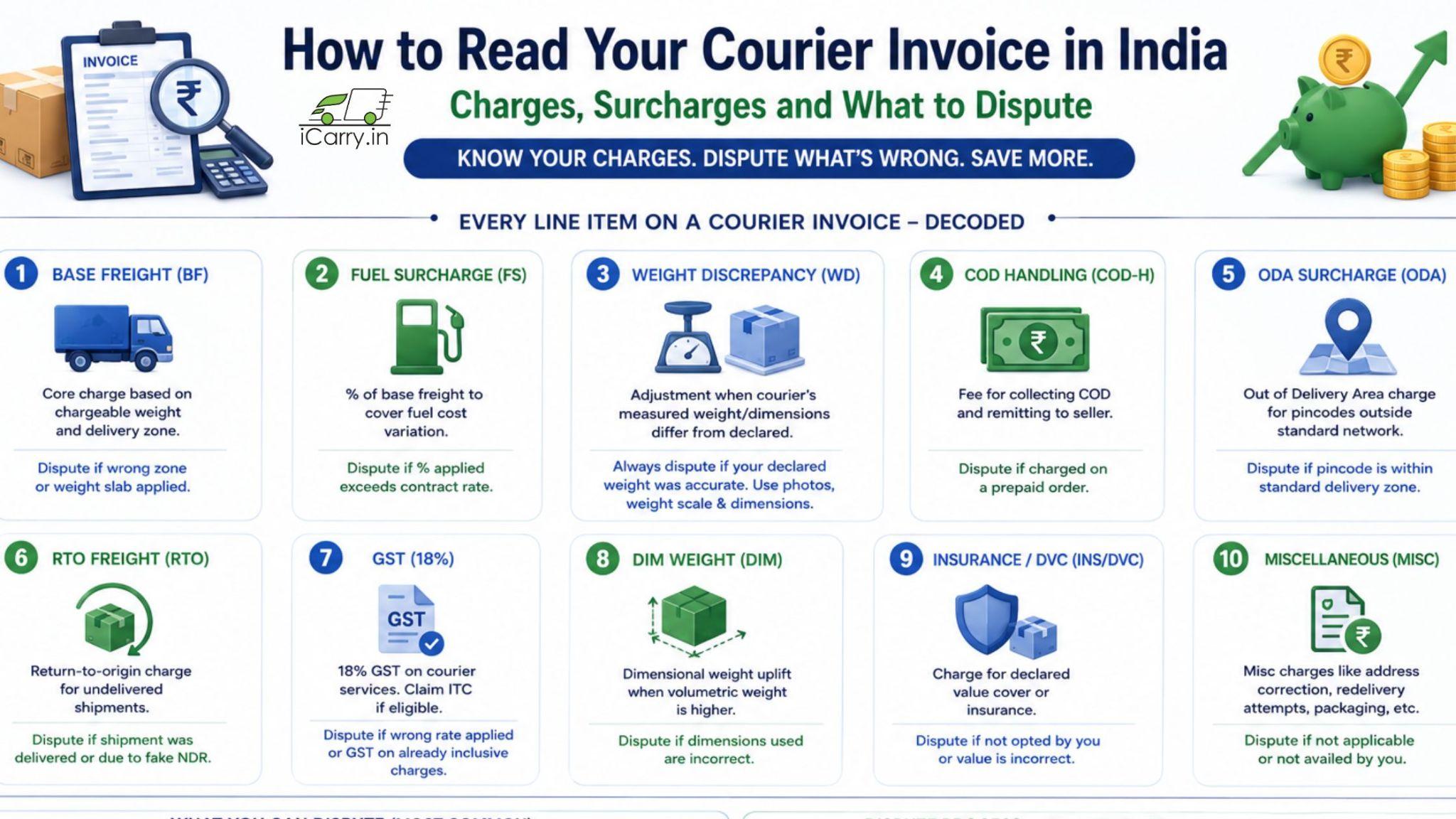
Every Line Item on a Courier Invoice - Decoded
1. Base Freight (BF)
The core per-shipment charge calculated on chargeable weight (higher of actual vs volumetric) and delivery zone. This is the only charge most sellers focus on - and it is usually correct.
When to dispute: If the zone applied is wrong (e.g. billed as Zone D when shipment was Zone C), or if the weight slab applied is higher than your actual chargeable weight.
2. Fuel Surcharge (FS)
A percentage of base freight applied to cover fuel cost variation. Revised monthly by most couriers. Typically ranges from 10 to 22% of base freight. Appears as a separate line item or embedded in the total freight charge.
When to dispute: If the fuel surcharge percentage applied exceeds what your courier contract specifies for that month. Always check the current applicable rate against your agreement.
3. Weight Discrepancy (WD)
The most disputed charge on Indian courier invoices. Raised when the courier's measurement of your parcel weight or dimensions differs from what you declared at booking. Billed as an adjustment to bring the invoice to the courier's measured weight.
When to dispute: Always challenge WD charges where your declared weight was accurate. You need: sealed parcel photo with AWB visible, weight scale reading, and dimensions. Submit within 5 business days of the charge notification.
Watch How to Resolve Weight Discrepancies in iCarry® for the exact dispute process. Full guide to reducing weight discrepancy charges covers prevention and dispute in detail.
4. COD Handling Fee (COD-H)
Applied on all cash-on-delivery orders. Covers courier cost of collecting cash at delivery and remitting to seller. Typically ₹15 to ₹50 fixed or 1 to 2% of declared order value - whichever is higher.
When to dispute: If COD-H is applied on a prepaid order. Rare but happens on incorrectly tagged shipments. Cross-check COD-H charges against your prepaid order list.
5. ODA Surcharge (ODA)
Out of Delivery Area surcharge for pincodes outside the courier's standard delivery network. ₹30 to ₹100 per shipment. Should only appear on shipments actually delivered to ODA pincodes.
When to dispute: If ODA is charged on a pincode that is within the courier's standard zone. Check the courier's published ODA list against the pincode in question.
6. RTO Freight (RTO)
Return-to-origin charge when a shipment is returned after failed delivery. Equal to forward freight in most cases. Appears as a separate line item for each returned shipment.
When to dispute: If RTO freight is charged on a shipment that was actually delivered. Cross-check RTO charges against your delivered shipment records. Also dispute if RTO occurred due to a fake NDR - provide Delivery Boost call recordings or GPS evidence.
7. GST (18%)
As per GST rules for courier and logistics services, you can claim Input Tax Credit (ITC) on this GST if your business is GST-registered.
When to dispute: If GST is applied on a charge that was already GST-inclusive, or if the GST rate applied differs from 18%. Also ensure you receive a valid GST invoice to claim ITC.
8. Dimensional Weight Adjustment (DIM)
Some couriers bill dimensional weight adjustment as a separate line rather than including it in the weight discrepancy charge. This is the uplift from actual weight to volumetric weight when volumetric is higher.
When to dispute: If DIM is applied using incorrect dimensions. Your pre-dispatch parcel measurements (in sealed condition) are your evidence.
9. Insurance / Declared Value Cover (INS/DVC)
If you have opted for additional declared value coverage or insurance at booking, this appears as a separate line. Verify that it matches what you selected at the time of booking - not a default added without your consent.
10. Special Handling Charge (SH)
Applied for fragile, oversized, or items requiring special handling. Should only appear if you selected special handling at booking or if the shipment meets the courier's criteria for mandatory special handling (usually above defined dimensions or weight).
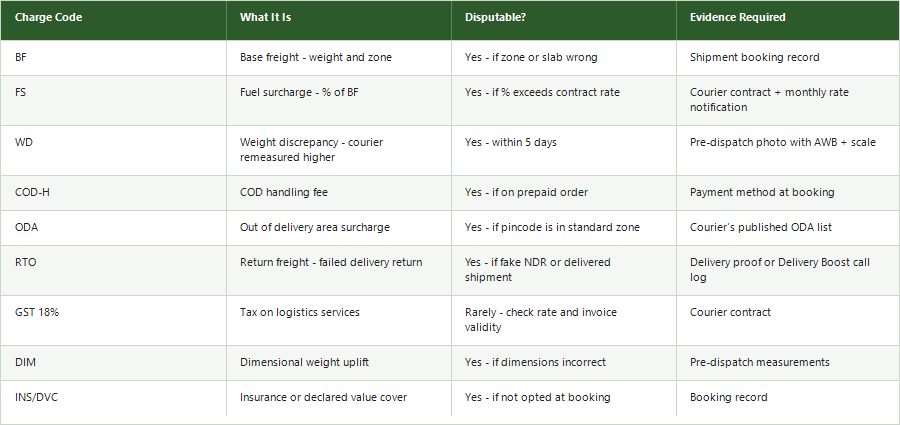
Invoice Line Items Summary
How to Reconcile Your Courier Invoice through iCarry®
- Step 1: Download your monthly courier invoice and your shipment report from iCarry®.
- Step 2: Match each AWB on the invoice to your booking record. Flag any AWBs that appear in the invoice but not in your bookings.
- Step 3: Check base freight zone and weight slab against your declared details for the 10 highest-value line items.
- Step 4: List all WD charges. For each, check against your pre-dispatch parcel photos and declared dimensions. Flag for dispute if the variance exceeds 10%.
- Step 5: Cross-check COD-H charges against your prepaid order list. Any COD-H on a prepaid shipment is an error.
- Step 6: Check RTO charges against your delivered shipment report. Flag any RTO charge on a delivered AWB.
- Step 7: Submit disputes through your iCarry® dashboard within the 5-day window for WD and 7 days for other charge types.
Watch Overview of My Account > My Shipments to see how the iCarry® dashboard surfaces weight discrepancies, RTO events, and charge details in one place for efficient invoice reconciliation.
How iCarry® Makes Invoice Management Easier
- Weight discrepancy dashboard: Every WD charge appears with old vs new weight side by side. Accept or dispute per shipment. Auto-dispute triggered for products with pre-uploaded images.
- Sync shipment charges: Pull final billing data via API or dashboard for automated reconciliation against your order records.
- Helpdesk tickets: Raise formal disputes with courier partners through iCarry®'s Helpdesk - creating a documented escalation trail for every challenge.
- Pre-upload product images: Upload sealed product photos for your standard SKUs. When a WD arrives on that SKU, iCarry® auto-triggers the dispute without any manual action.
Track all charge anomalies as part of your wider logistics KPI monitoring - weight discrepancy rate, ODA charge rate, and RTO freight cost per month are three KPIs that invoice review directly improves.
What You Can Actually Recover
Sellers who implement systematic weekly invoice review can generally recover:
- 3 to 8% of total monthly freight in weight discrepancy disputes
- 1 to 3% from ODA charges on non-ODA pincodes
- 0.5 to 2% from COD-H on prepaid orders and incorrect zone billing
On ₹5,00,000 monthly freight spend, that is ₹22,500 to ₹55,000 in recoverable charges per month. The habit that unlocks this is invoice review - not a rate negotiation, not a platform change. Reducing total shipping cost starts with knowing exactly what you are already paying.
Final Thoughts
Your courier invoice is not a fixed number. It is a bill with multiple adjustable components - some correct, some errors, some legitimately disputable. Sellers who read it carefully and dispute within the window consistently recover more money per month than most rate negotiations deliver.
Build a weekly invoice review habit. Pre-upload product images. Act on WD disputes within 5 days. Cross-check RTO charges against delivered shipment records. These four practices recover real money without requiring a courier change or volume increase.
iCarry® surfaces weight discrepancies, charge anomalies, and RTO events in one dashboard - making invoice reconciliation practical at any order volume. Start your shipping journey by registering for free.
Frequently Asked Questions (FAQs)
What are the most common unexpected charges on Indian courier invoices?
Weight discrepancy (WD), fuel surcharge (FS), ODA surcharge, and COD handling fees are the most common unexpected charges. Weight discrepancy is the most frequently disputed and recoverable.
How do I dispute a weight discrepancy charge in India?
Submit within 5 business days of the charge notification with: sealed parcel photo showing AWB and weight scale reading, and declared dimensions. On iCarry®, raise a dispute through the Weight Discrepancies section in My Shipments. Pre-uploaded product images enable auto-dispute for standard SKUs.
Can I claim ITC on courier invoice GST?
You can check the GST portal or consult your accountant to confirm eligibility based on your business type.
What is a fuel surcharge on a courier invoice?
A fuel surcharge (FS) is a variable percentage of base freight revised monthly based on fuel price index. Typically 10 to 22% of base freight. It should match the rate specified in your courier contract for that billing month.
How do I check if my courier's ODA charge is correct?
Request your courier's current ODA pincode list and cross-check the delivery pincode against it. If the delivery pincode is not on the ODA list, the charge is an error and should be disputed through your courier helpdesk or iCarry®'s Helpdesk Ticket system.
How does iCarry® help with courier invoice disputes?
iCarry® provides a Weight Discrepancies dashboard where every WD charge appears with old vs new weight for review, a Helpdesk Ticket system for formal courier escalations, and pre-upload product image capability that auto-triggers disputes for standard SKUs without manual action.
Can manufacturers and B2B sellers dispute courier invoice charges?
Yes - any business with a courier account can dispute charges: D2C brands, manufacturers, distributors, and B2B exporters all have the same right to challenge weight discrepancies, zone errors, and ODA charges. The process is identical regardless of business type. A photo of the sealed parcel on a weighing scale at dispatch is the most effective evidence for weight-related disputes.
How far back can I raise a courier invoice dispute in India?
Most Indian couriers allow disputes within 30 to 60 days of the invoice date. After that, claims are rejected regardless of merit. Set a fixed monthly review date - do not wait until you notice a problem. An aggregator dashboard lets you see charges per shipment in real time, making monthly reconciliation significantly faster.
Your courier invoice has 8 to 10 distinct charge types - most sellers only look at base freight. Systematic weekly invoice review consistently recovers 3 to 8% of monthly freight spend through weight discrepancy disputes alone. Pre-upload product images on iCarry® before every dispatch, act on WD disputes within 5 days, and cross-check RTO charges against your delivered shipment report every week. These habits recover more money than most rate negotiations deliver.