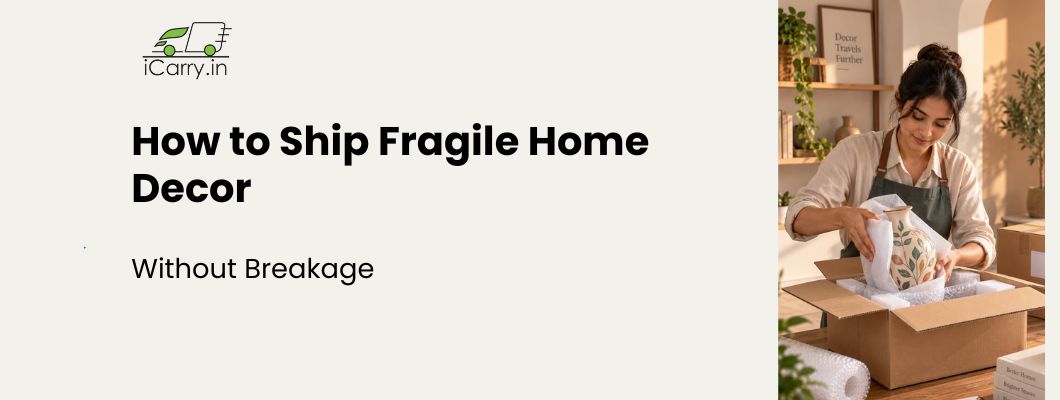
A customer orders a hand-painted ceramic vase for ₹3,200. The seller wraps it in bubble wrap, places it in a box with loose newspaper fill, and ships via surface courier. The vase arrives broken. The customer demands a refund. The seller absorbs the product cost, the forward freight, the return freight, and a 1-star review.
This is not a courier failure. It is a packaging failure that the courier's sorting centre revealed.
India's home decor market has grown significantly through D2C and marketplace channels, with consumers increasingly comfortable buying furniture accessories, decorative items, wall art, and lighting online. Home decor is one of India's fastest-growing eCommerce segments, driven by growing disposable incomes, urban housing upgrades, and gifting demand.The category is now valued at roughly US$ 25.50 billion, projected to reach US$ 40.80 billion by 2033 , per IBEF. But home decor also has the highest rate of transit damage of any major eCommerce category - because it combines three logistics challenges that rarely appear together: fragility, bulk, and high value.
This guide covers exactly how to address each of these challenges to ship home decor products safely, cost-effectively, and with a damage rate low enough to run a profitable business.
Why Does Home Decor Break So Often in Transit?
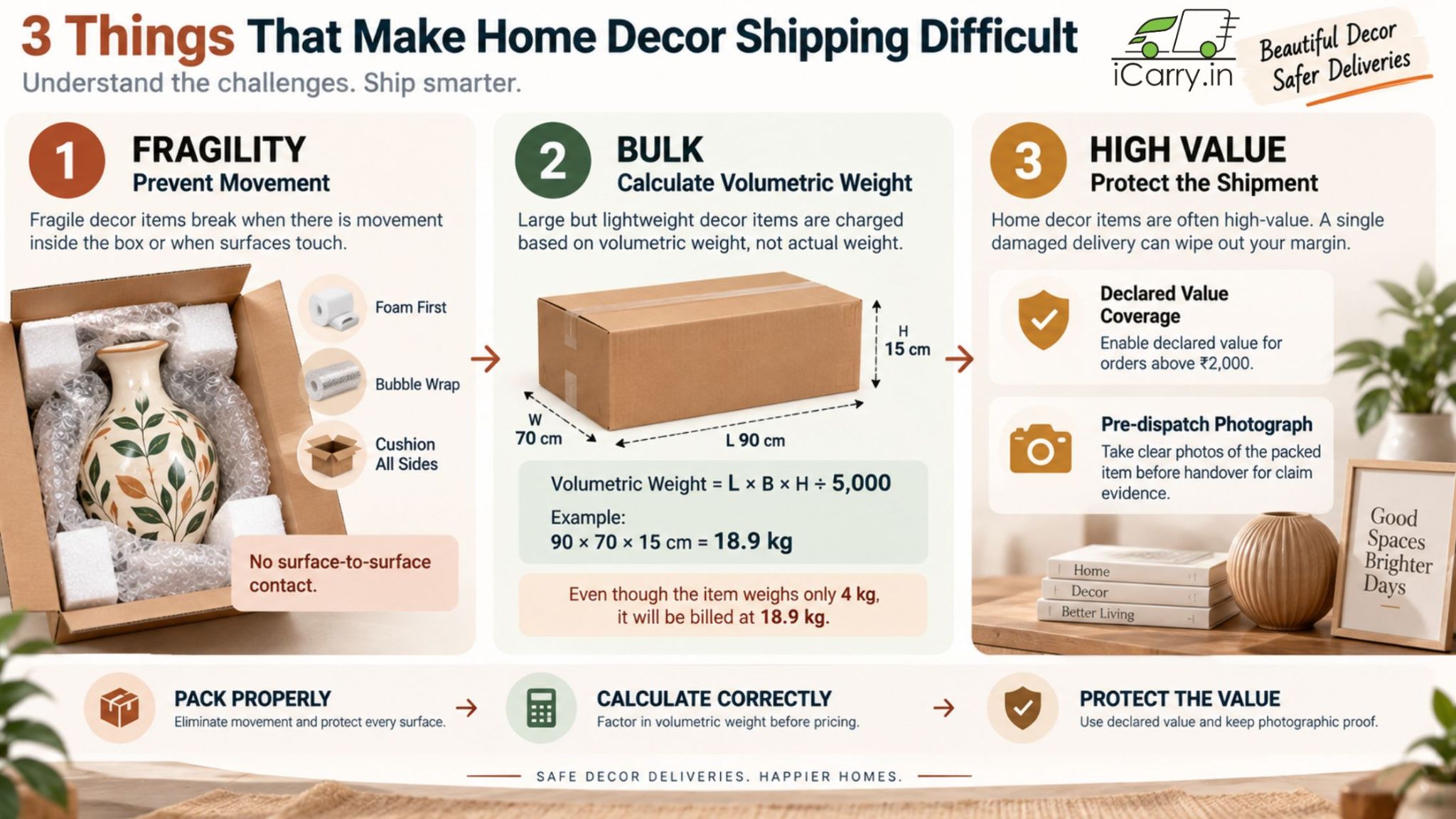
Home decor products break in transit more often than most other eCommerce categories because they combine three problems at once: fragility, bulk, and high value. A ceramic vase or framed mirror cannot survive movement inside its box, a large but lightweight item gets billed on volumetric weight rather than actual weight, and a single damaged high-value piece erases the margin from several successful orders. Fixing the packaging - not the courier - is what solves most of this.
Quick Checklist - Home Decor Shipping Essentials
- Is every fragile item individually wrapped in foam or bubble wrap with no surface-to-surface contact?
- Have you calculated the volumetric weight for bulky items and factored it into your pricing?
- Are you using 5-ply corrugated for items above 2 kg or with protruding elements?
- Is declared value coverage enabled for all orders above ₹2,000?
- Have you photographed each packed order before handover for damage claim evidence?
- Is FRAGILE and THIS SIDE UP marked on all faces of the outer box where applicable?
The Three Core Challenges in Home Decor Logistics
Challenge 1: Fragility
Home decor products break in transit for a consistent set of reasons: inadequate inner packaging, void space that allows the product to move, contact between surfaces during transit vibration, and compression from stacking weight in sorting centres.
The solution is not thicker bubble wrap. It is eliminating movement and contact. A product that cannot move inside its box and has no surface touching another surface will not break regardless of what the courier does with the outer box.
Challenge 2: Bulk and Volumetric Weight
Large home decor items - wall mirrors, floor lamps, decorative frames, large cushions, area rugs - have significant dimensions relative to their actual weight. Volumetric weight billing (L x B x H in cm / 5,000) creates the home decor category's most consistent financial surprise. A large decorative mirror weighing 4 kg in a 90 x 70 x 15 cm box has a volumetric weight of 18.9 kg. It bills at 18.9 kg, not 4 kg.
Volumetric weight must be calculated for every new SKU before pricing is finalised. A home decor business that prices shipping based on product weight without accounting for dimensions will discover the gap in its margin every time it ships.
Challenge 3: High Value
Handcrafted, artisanal, and premium home decor products often retail at ₹2,000 to ₹20,000+. At these price points, a single damaged delivery is a margin event, not an inconvenience. The financial consequence of an unprotected high-value home decor shipment going wrong - uninsured product loss plus double freight on the return - can represent multiple days of healthy order volume erased in one courier incident.
Packaging by Product Type
Ceramics, Glass, and Pottery
These are the highest-risk products in home decor. No surface-to-surface contact is the primary rule. Apply it absolutely:
- Wrap each piece in foam sheet first - bubble wrap alone allows the product to shift within the wrap
- Place foam-wrapped items in a box with at least 5 cm of cushioning on all sides
- For items with protrusions (handles, spouts, decorative elements): wrap each protrusion individually before wrapping the whole piece
- Use foam peanuts or crumpled kraft paper as void fill - no newspaper, which compresses and loses protection under vibration
- Shake test after sealing: if anything moves inside, open and add more fill
- 5-ply corrugated for all ceramic items above 500g
Wall Art, Frames, and Mirrors
- Corner protectors are mandatory for framed art and mirrors - corners are the most vulnerable point
- Glass faces must be protected with a foam sheet before any other wrapping. Never let bubble wrap touch glass directly without an intermediary layer
- Wrap the piece tightly in foam sheet, then bubble wrap, then secure with tape
- For mirrors above 60 cm: diagonal corrugated bracing inside the box prevents flex that cracks glass in transit
- Mark THIS SIDE UP and DO NOT BEND on all four sides of the outer box
- Corrugated should be custom-sized to the art piece - oversized boxes allow shifting
Lamps and Lighting
- Lamp base and shade must always be packed separately - shade inside the base's box is a breakage waiting to happen
- Bulbs must be removed before shipping - they are neither safe nor necessary to include
- For ceramic or glass lamp bases: individual foam wrap, corrugated with internal foam insert
- For metal lamp bases: wrap to protect the finish from scratches, then box
- For large floor lamps: custom corrugated tube packaging or a purpose-built telescope box
Cushions, Rugs, and Soft Furnishings
These are low damage-risk but high volumetric billing risk:
- Compress large cushions in vacuum compression bags before boxing to reduce volumetric weight significantly
- Rugs: roll tight, wrap in polythene, secure with tape. Do not fold rugs - fold marks may not recover
- Poly mailer is acceptable for soft cushions below 500g with no rigid elements
- For compressed cushions in boxes: right-size the box to the compressed dimensions, not the original dimensions
Volumetric Weight Management - The Financial Lever
Right-sizing packaging is the single most impactful cost action in home decor shipping. Most damage protection for fragile items requires only 4 to 6 cm of cushioning per side - not 15 cm of void fill in an oversized box.
Build a box size matrix for your product catalogue:
- Measure each SKU's wrapped dimensions (product + foam + bubble wrap)
- Add 4 to 6 cm on each dimension for minimum safe box sizing
- Calculate volumetric weight at those dimensions and compare to actual weight
- Build the cost into your product pricing before going live - not after your first month of shipping
For every home decor SKU, estimate the shipping cost at the correct dimensions before setting your retail price or free shipping threshold. -iCarry®'s rate comparison screen calculates volumetric weight against actual weight automatically for whatever dimensions you enter, so this check happens at the same time as booking rather than as a separate spreadsheet exercise. A ₹1,499 decorative mirror in a 70 x 50 x 10 cm box has a 7,000g volumetric weight. The shipping cost on that box is not a 500g cost.
Courier Selection for Home Decor
How iCarry® Supports Home Decor Businesses
iCarry® is a courier aggregator that gives home decor businesses the multi-courier access, rate transparency, and delivery management tools needed for this high-care category:
- Rate comparison by dimensions: Enter exact dimensions at booking to see accurate volumetric billing across all couriers before confirming. No post-dispatch billing surprises
- Declared value coverage: Enable at booking for all home decor orders above ₹2,000. Pre-upload product images per SKU so damage claims include visual evidence without manual submission each time
- Delivery Boost: For premium and high-value home decor orders, Delivery Boost ensures pre-delivery coordination - reducing the failed first attempts that mean a fragile item completes one extra transit journey unnecessarily
- Two-way WhatsApp engagement: Customers can reschedule or confirm delivery timing - important for large home decor items where the customer may need to be present to assist with unboxing
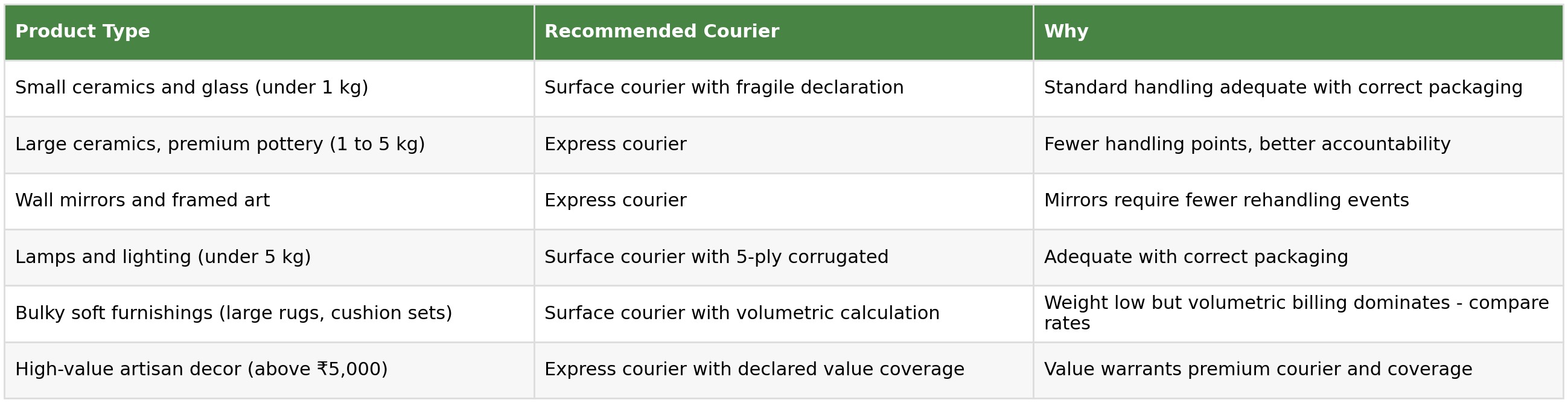
- Multiple courier partners: Route high-value or fragile items to Express couriers for fewer handling points. Route soft furnishings to the most cost-effective surface courier for the destination zone
- Free Bronze plan, no minimum volume.
Final Thoughts
Home decor is a rewarding category to sell in India - customers invest in their living spaces, appreciate quality, and repeat-purchase when they trust a brand. But the logistics of shipping fragile, bulky, high-value products requires specific knowledge that standard courier practices do not cover.
The three investments that make home decor logistics work: correct packaging per product type (foam first, no void space, right-sized box), accurate volumetric weight calculation before pricing, and declared value coverage for all orders above your damage-risk threshold. These three decisions, applied consistently, reduce the damage-driven return rate that erodes home decor margins more than any other cost factor.
Frequently Asked Questions (FAQs)
Why do home decor products break so often in courier transit?
The most common cause is not rough courier handling - it is packaging that allows the product to move inside the box. Movement during vibration and impact causes surface-to-surface contact, which causes chips, cracks, and breaks. The solution is foam-first wrapping that eliminates all internal movement. A product that cannot shift inside a correctly sized box will survive normal courier transit.
How do I calculate shipping cost for a large but lightweight home decor item?
Calculate volumetric weight: L x B x H (in cm) / 5,000. Compare to actual weight. Couriers charge based on whichever is higher. A large decorative cushion that weighs 800g but measures 60 x 50 x 30 cm has a volumetric weight of 18,000g. It bills at 18 kg, not 800g. Always calculate volumetric weight for every new home decor SKU before setting your retail price or free shipping threshold.
Should I use bubble wrap or foam for wrapping ceramics?
Foam sheet first, then bubble wrap over it. Foam sheet is dense and does not compress under vibration, providing stable surface protection. Bubble wrap alone allows the product to shift within the wrap when bubbles compress. The combination of foam contact layer and bubble wrap outer provides both surface protection and cushioning - which is what ceramics need in a courier sorting environment.
What should I do if a home decor product arrives damaged?
If declared value coverage was enabled at booking, file the damage claim within the courier's claim window (typically 7 to 15 days from delivery for domestic shipments). Submit the pre-dispatch photograph showing the item sealed in its box, the damage photographs, and the commercial invoice. Claims without pre-dispatch photographic evidence have significantly lower settlement rates. Always photograph before handover - this one habit determines whether your damage claim pays out.
How does iCarry® handle high-value home decor shipments?
iCarry® allows businesses to enable Transit Loss Insurance while booking high-value shipments, with the available coverage and applicable fee shown before confirmation. This can help protect valuable home decor items against covered transit loss or damage. For premium items, businesses can also choose suitable courier options based on weight, route, and service requirements. Delivery Boost supports pre-delivery coordination for high-value orders, helping reduce failed first attempts and unnecessary additional transit for fragile items.
Home decor logistics come down to three investments: correct packaging per product type (foam first, no void space, right-sized box), accurate volumetric weight calculation before pricing, and declared value coverage for every order above your damage-risk threshold - applied consistently, these reduce the damage-driven returns that erode home decor margins more than any other cost factor.