Why Leather Goods Need Careful Handling
Leather is durable but not indestructible. It scratches against rough surfaces, creases when folded, picks up colour from other items and reacts badly to moisture. A bag that looks perfect when packed can arrive with a dent, a crease line or a green patch of mould after a few damp days in transit.
Leather goods are a popular D2C and marketplace category, helped by India's expanding online retail market. Many sellers use soft packaging because leather items look sturdy. That is the main cause of returns and negative reviews: the product arrives deformed, scuffed or damp, even when the courier did nothing unusual.
What Is Leather Goods Shipping in India?
Leather goods shipping is the courier delivery of handbags, wallets, belts and travel bags, which scratch, crease and absorb moisture easily. It relies on a rigid carton, shape-holding fill, moisture control and declared value coverage rather than soft packaging.
Main Shipping Risks for Leather
- Moisture and mould: Leather absorbs humidity. Monsoon dampness in a sealed carton can cause mould and odour
- Deformation: Soft bags collapse or crease when compressed under stacking weight
- Scratches and scuffs: Rubbing against other items or rough outer packaging marks the surface
- Colour transfer: Dark dyes can stain light leather, fabric and tissue in humid conditions
- Hardware damage: Zips, buckles, clasps and chains scratch the leather around them
How to Pack Handbags and Travel Bags
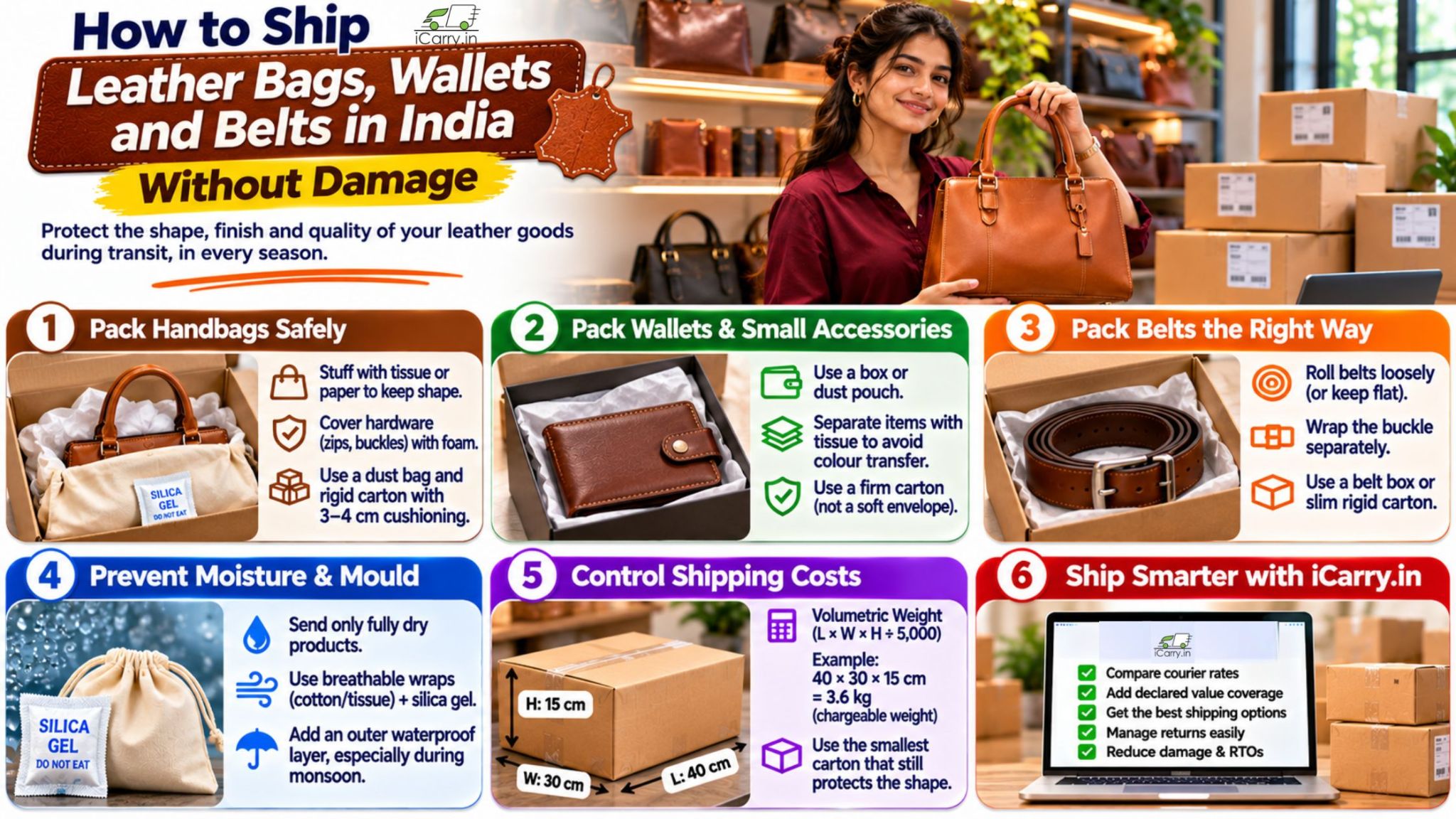
- Stuff the bag with tissue or paper: This holds the shape and prevents collapse. Use acid-free paper for light-coloured leather
- Cover hardware: Wrap zips, clasps, buckles and chains in foam or tissue to avoid scratching the leather
- Use the dust bag: A cotton dust bag protects the finish. Avoid placing leather directly in plastic for long periods
- Add moisture control: Place a silica gel sachet in the dust bag or carton, away from direct contact with the leather
- Pack in a rigid box: A corrugated carton with 3 to 4 cm of cushioning on all sides. Do not use a thin poly mailer for structured bags
- Prevent movement: Fill empty space so the bag does not shift or press against the walls
Packing Wallets, Cardholders and Small Accessories
- Place each wallet in its box or a small dust pouch to protect the surface
- Separate items with tissue so dyes do not transfer
- Use a small rigid carton or a firm mailer. A soft envelope bends the leather
- Do not overfill the wallet. Pressure can leave marks
- Add a care card so customers know how to maintain the leather
Packing Belts
- Roll belts loosely or lay them flat. Do not fold them sharply, because creases are permanent
- Use a belt box or a rigid sleeve and wrap the buckle separately
- Protect the buckle from scratching the leather strap
- Pack belts flat in a slim carton to keep volumetric weight low
Monsoon and Humidity Rules
- Pack only fully dry products. A damp bag sealed in plastic grows mould
- Use breathable inner wraps such as cotton or tissue, plus silica gel, and an outer waterproof layer
- Cover shipping labels with clear tape so they do not peel in humid conditions
- Dispatch early in the week to avoid weekend depot storage
- Tell customers to unpack and air the product on arrival in humid weather
Volumetric Weight and Packaging Size
Bags are bulky relative to their weight. Check chargeable weight using length x breadth x height in cm divided by 5,000. A handbag packed in a 40 x 30 x 15 cm carton has a volumetric weight of 3.6 kg even if the bag weighs 700 g. This is an illustrative example.
- Use the smallest carton that still protects the shape
- For soft leather totes that can be folded safely, check whether the manufacturer allows flat packing
- Pack small items such as wallets and belts in slim cartons
- Compare rates at your actual packed dimensions before setting shipping charges
Compare courier partners at your packed carton size with the iCarry® domestic rate calculator before you set shipping charges.
Declared Value, Evidence and Returns
- Declare the true invoice value: A ₹5,000 handbag should be covered at its invoice value
- Photograph before sealing: Capture the product, the dust bag, the packing and the label. This is your evidence in a damage claim
- Record unique identifiers: Record product codes or serial numbers where available
- Check returns carefully: Look for scratches, stains, odour, missing accessories and signs of use before refund or restock
- Set clear return terms: State that products must be unused and in original packaging with tags. Under the Consumer Protection (E-Commerce) Rules, 2019, sellers must display return, refund and exchange information
- Confirm COD orders: Send a WhatsApp confirmation for COD orders above ₹999, as refused orders can return damaged
Add declared value coverage to premium bags with a free iCarry® account.
How iCarry® Supports Leather Goods Sellers
iCarry® is a courier aggregator that gives leather goods sellers access to multiple courier partners and shipping tools to help manage premium bags, wallets, belts and gift sets.
- Rate Comparison at Packed Dimensions: Compare available courier rates using the actual packed dimensions of your shipment before booking.
- Transit Loss Insurance: Choose to add Transit Loss Insurance during booking for eligible shipments. Review the applicable fee, coverage details and terms before confirming.
- Pre-uploaded Product Images: Save images for standard SKUs to help support weight discrepancy disputes with relevant product and packaging evidence.
- Delivery Boost: Get additional pre-delivery coordination to help reduce failed delivery attempts.
- Two-way WhatsApp Engagement: Let customers confirm availability, update delivery details or reschedule, while keeping conversation history accessible.
- Address Quality Scoring: Identify incomplete or potentially problematic addresses before dispatch to help prevent avoidable delivery issues.
Use secure packaging, retain dispatch records and check the selected courier's acceptance and insurance terms before shipping premium leather goods.
Start with the free Bronze plan, with no minimum shipment volume.
Frequently Asked Questions (FAQs)
How should I pack a leather handbag for courier delivery?
Stuff the bag with tissue to hold its shape, wrap hardware in foam, place the bag in its cotton dust bag, add a silica gel sachet, and pack it in a rigid corrugated carton with 3 to 4 cm of cushioning. Fill empty space so it cannot move, and avoid thin poly mailers for structured bags.
How do I prevent leather from getting mouldy during monsoon shipping?
Pack only fully dry products, use breathable inner wraps such as cotton or tissue with a silica gel sachet, add a waterproof outer layer, and cover labels with clear tape. Avoid sealing leather directly in plastic, and dispatch early in the week so parcels do not sit in depots over the weekend.
Can I fold a leather belt for shipping?
Avoid sharp folds, because creases in leather are usually permanent. Roll the belt loosely or lay it flat in a slim box or rigid sleeve, and wrap the buckle separately so it does not scratch the strap.
Do leather goods need declared value coverage?
Yes, for any bag or premium accessory with meaningful value. Default courier liability is usually far below the invoice value. Declare the true value, photograph the packing before sealing and keep your invoice for claims.
Leather scratches, creases and absorbs moisture, so stuff bags with tissue, wrap hardware and use a dust bag with silica gel inside a rigid carton with 3 to 4 cm of cushioning. Pack only fully dry products in monsoon, size cartons tightly to control volumetric weight, and declare the true invoice value with photographs before sealing.