Introduction
A customer messages you saying they never received their order. Your courier dashboard shows it was delivered 3 days ago. You ask for the Proof of Delivery. The courier sends back a signature that is barely legible, or tells you POD is not available. Now you are stuck.
This situation plays out constantly across Indian eCommerce. Proof of Delivery is the document or digital record that confirms a shipment was handed over to the customer. When it is solid, it resolves disputes quickly. When it is missing or unreliable, the seller absorbs the cost.
This breakdown explains what POD is in Indian eCommerce, the different types available, when to request it, and how iCarry® helps sellers move beyond paper POD toward more reliable verification methods.
Quick Checklist - Is Your POD Setup Protecting You?
- Do you know the POD request deadline with each of your courier partners? (Usually 24 to 72 hours after delivery)
- Are you informing customers to record an unboxing video for high-value orders before opening?
- Have you enabled OTP Verified Delivery for Delhivery B2C Prepaid orders through iCarry®?
- Do you have a process to request POD within the window every time a customer raises a non-receipt complaint?
- Are you pre-photographing sealed parcels with the AWB visible before every handover?
- Do you know the difference between Proof of Delivery and proof of dispatch - and which one protects you in which scenario?
What Is Proof of Delivery (POD)?
Proof of Delivery (POD) is a document or digital record that confirms a shipment was successfully delivered to the consignee. It serves as evidence that the courier completed the delivery - and is the primary tool used to resolve disputes where a customer claims they did not receive their order.
In Indian eCommerce, POD has historically meant a physical signature on a paper run-sheet. But the format is evolving rapidly toward digital and OTP-based verification - which are more reliable, faster to retrieve, and harder to dispute.
Types of Proof of Delivery in India
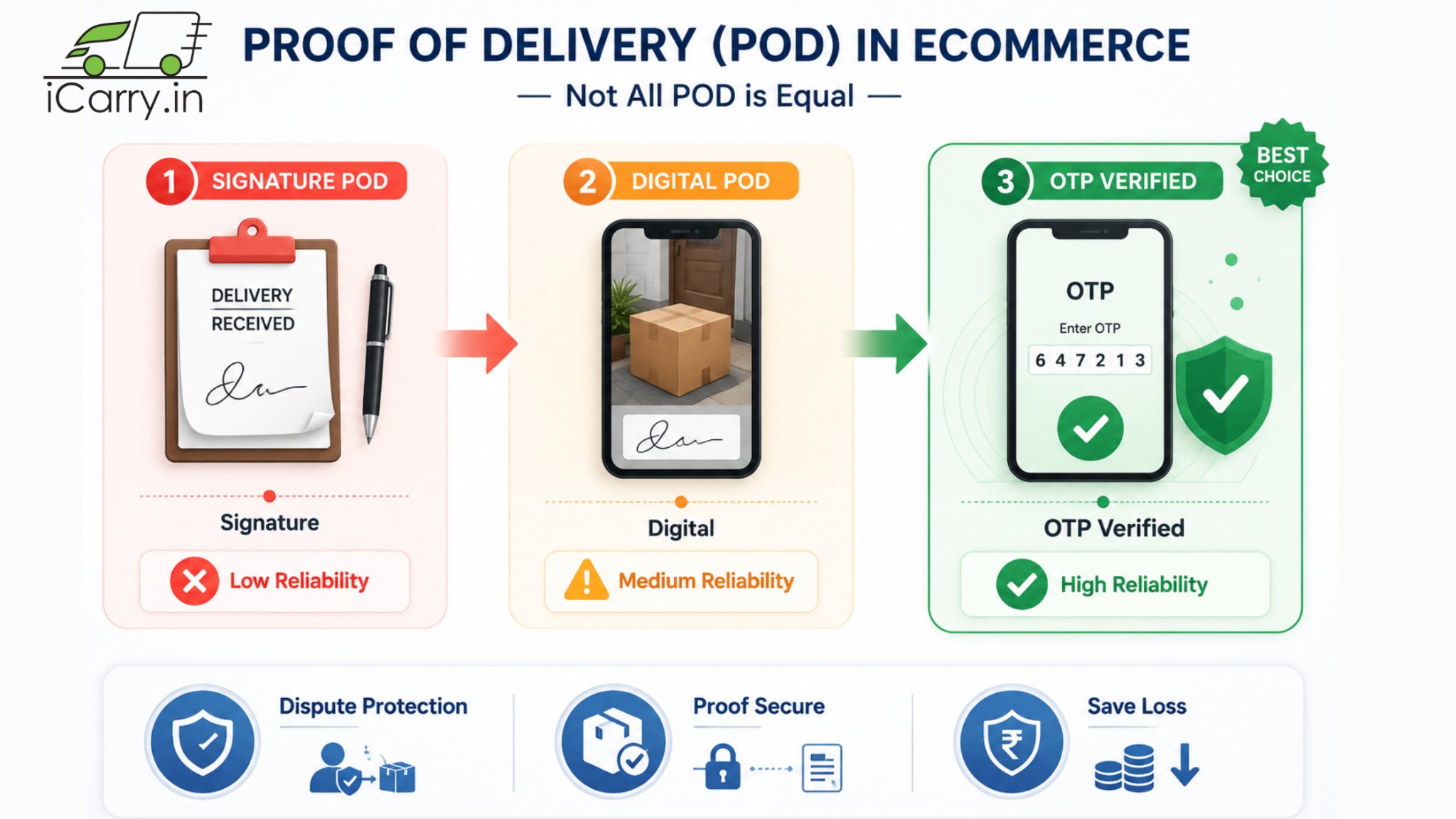
1. Signature POD (Paper)
The traditional POD - a physical signature collected from the consignee on the courier's delivery run-sheet at the time of handover. The courier keeps the physical copy and must retrieve it from their records when a seller requests it.
Limitations: Signatures can be illegible or forged. Paper run-sheets can be lost or take weeks to retrieve. The 24-to-72-hour request window is strict. Once expired, the POD is rarely recoverable.
2. Digital POD (Photo + Signature)
Many courier partners now capture a digital photo of the delivered parcel along with a digital signature on the delivery executive's handset. This is retrievable faster than paper and less likely to be lost.
Limitations: Still dependent on the delivery executive actually completing the step. Fake deliveries - where the courier marks delivered without handing the parcel over - can still be fraudulently completed in some systems.
3. OTP Verified Delivery
The most reliable form of proof available today. When OTP Verified Delivery is enabled, the courier can only mark a delivery as complete after the consignee provides a One-Time Password sent to their registered mobile number. No OTP entry means no delivery confirmation in the system. To see exactly how to set this up in iCarry®, click here to watch the OTP Verified Delivery setup video.
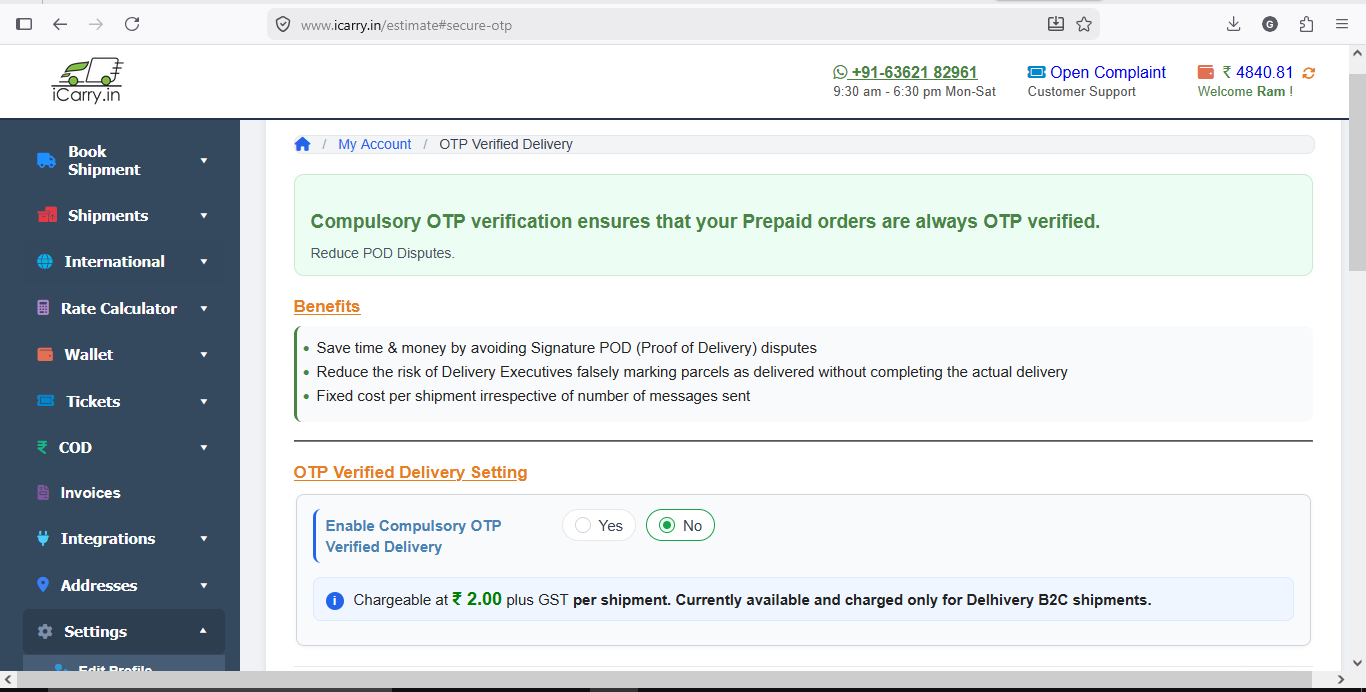
Key facts for Indian sellers: OTP Verified Delivery on iCarry® is currently available for Delhivery B2C Prepaid shipments only, at Nominal cost. Once OTP is verified, a paper signature POD cannot be separately requested - OTP is treated as the stronger proof.
4. Unboxing Video (Customer-Side Proof)
Not a formal courier POD - but critical for damage and mismatch disputes. When a customer records a video of themselves opening a sealed parcel, it establishes the condition of the product at the exact moment of opening. Without this, damage claims become a he-said-she-said dispute that sellers almost always lose.
Include a note in every parcel asking customers to record an unboxing video for electronics, high-value, and fragile products.
POD vs Proof of Dispatch - Know the Difference
| Proof of Dispatch | Proof of Delivery (POD) | |
|---|---|---|
| What it proves | You handed the shipment to the courier | The customer received the shipment |
| Who creates it | Seller at pickup - manifest, AWB receipt | Courier at delivery - signature, OTP, photo |
| When it protects you | If courier claims they never received the parcel | If customer claims they never received the order |
| How to get it | Keep manifest copy signed by pickup executive | Request from courier within 24-72 hours of delivery |
| Risk if missing | Cannot dispute courier's claim of non-receipt | Cannot disprove customer's claim of non-delivery |
When Sellers Need POD in India
Customer Claims Non-Receipt
The most common scenario. A customer says their order never arrived. Your tracking shows delivered. You need the courier's POD to confirm which address was delivered to, who signed, and when. Without it, you typically have to refund or replace.
Damage or Wrong Product Dispute
If a customer claims the product arrived damaged or was the wrong item, the POD alone is not enough. You need the POD combined with your pre-dispatch parcel photos and the customer's unboxing video to establish the timeline of events. Read more about how to handle these disputes in the guide on fake delivery attempts and mismatch product disputes.
Insurance Claims
For shipping insurance claims, the POD is part of the required documentation. A claim for a lost shipment requires confirmation from the courier that no POD exists - i.e. delivery was never completed. A claim for damaged goods requires POD showing delivery was completed alongside customer evidence of damage at receipt.
How Weight Discrepancies Relate to POD
A separate but related documentation issue: weight discrepancy charges require different proof - pre-dispatch parcel photos showing weight and dimensions, not POD. The dispute window for weight discrepancies is 5 business days from the notification. Watch How to Resolve Weight Discrepancies in iCarry for the exact evidence and process required.
Full guidance on reducing and disputing weight discrepancy charges is in the guide on how to dispute weight discrepancy charges.
How iCarry® Helps Sellers With POD and Delivery Verification
iCarry® does not just connect you to couriers - it gives you tools to reduce delivery disputes before they happen and resolve them faster when they do.
- OTP Verified Delivery: OTP Verified Delivery significantly reduces disputes caused by incorrect delivery claims because delivery completion requires customer verification.
- Delivery Boost: Under this service, trained agents call customers before and during delivery, audit courier claims, and open tickets for fake NDRs - creating a call log that serves as evidence in disputes
- WhatsApp Engagement: Two-way delivery notifications are sent from iCarry®'s official WhatsApp number (+91-63621-82961), allowing consignees to reply directly for updates, address changes, or delivery coordination. All interactions are recorded as timestamped logs, enabling sellers to view complete communication history and proof of customer notification within the iCarry® panel.
- Helpdesk Tickets: All POD requests and delivery disputes are managed through iCarry's Helpdesk Ticket system - creating a documented trail for every escalation
For sellers with recurring non-delivery disputes, reviewing NDR data to identify fake delivery patterns by courier and pincode reveals which combinations generate disproportionate problems - so you can reroute volume before disputes accumulate.
And for a systematic approach to reducing the RTO that often follows unresolved delivery failures, how to reduce RTO in Indian eCommerce covers the full operational framework.
Final Thoughts
When a customer says "I never received my order", the difference between losing money and resolving the case usually comes down to one thing: evidence. Paper signatures are becoming less reliable and harder to retrieve. Digital POD is better. OTP verification is the most reliable form currently available in India.
The shift to OTP Verified Delivery, combined with pre-dispatch parcel photos, customer unboxing video instructions, and WhatsApp message logs, gives sellers a documentation framework that resolves most disputes without escalation.
iCarry® supports all of this from one platform - OTP Verified Delivery, Delivery Boost, WhatsApp Engagement, and Helpdesk Ticket management. Start for free to get started.
Frequently Asked Questions (FAQs)
What is Proof of Delivery (POD) in eCommerce?
POD is a document or digital record confirming a shipment was handed over to the customer. It includes the delivery timestamp, delivery address, and evidence of receipt - a signature, OTP entry, or delivery photo.
What are the types of POD available in India?
The main types are paper signature POD (traditional), digital POD with photo and digital signature (increasingly standard), OTP Verified Delivery (most reliable - requires consignee to enter a code), and customer unboxing video (for damage and mismatch disputes).
What is OTP Verified Delivery on iCarry®?
OTP Verified Delivery is a feature where the courier must enter a One-Time Password received on the consignee's mobile number to mark a delivery as complete. It is currently available for Delhivery B2C Prepaid shipments. Once OTP is verified, no separate paper POD is required.
What happens if POD is not available from the courier?
If the courier cannot provide POD within the request window, the claim becomes very difficult to defend. In most cases, sellers end up issuing a refund or replacement. This is why pre-dispatch parcel photos, OTP verification, and WhatsApp delivery logs are critical - they provide seller-side evidence independent of the courier's POD system.
Can I use customer WhatsApp messages as proof of delivery?
WhatsApp Engagement through iCarry® creates a message log showing delivery notifications were sent and received, with timestamps. While not a formal POD, these logs serve as supporting evidence that the customer was notified of the delivery and did not raise an immediate complaint - strengthening the seller's position in disputes.
Is POD required for filing a shipping insurance claim?
India's insurance regulatory framework governs how transit insurance claims are processed, including what documentation is required.
How do I protect myself when a customer claims non-receipt?
Act immediately: check tracking, request POD through iCarry's Helpdesk Ticket within the window, cross-reference with your pre-dispatch parcel photos and any WhatsApp delivery logs. For future orders, consider enabling OTP Verified Delivery for high-value prepaid shipments. Consumer protection guidelines in India require sellers to handle such disputes fairly and within defined timelines.
Proof of Delivery (POD) is the primary tool to resolve delivery disputes in Indian eCommerce. Paper POD is becoming unreliable - digital POD is better, and OTP Verified Delivery is the most robust option currently available. Combined with pre-dispatch parcel photos, customer unboxing video instructions, and WhatsApp message logs, sellers have a multi-layer documentation framework that resolves most disputes without escalation.