Why Bakery and Confectionery Is a Tough Category to Ship?
Bakery and confectionery products fail in four ways: they crush, they melt, they go stale, and they arrive after the occasion they were bought for. A chocolate box that melts in a hot courier vehicle, a cake that tilts in transit or a mithai box that arrives after the festival is a failed order regardless of how good the product was.
Online bakery, confectionery and sweet brands are growing quickly, helped by India's expanding online retail market. The brands that succeed treat shelf life, temperature and delivery timing as product decisions, not afterthoughts.
What Is Bakery and Confectionery Shipping in India?
Bakery and confectionery shipping is the delivery of perishable and fragile foods such as cakes, cookies, chocolates and mithai. Each product has a shelf life and a heat limit, which decide how far it can travel and by which courier mode. Fresh items go same-day within the city, and long-life items can go pan-India by surface courier.
Start With Shelf Life: What Can Travel How Far
Match every product to the delivery range its shelf life and sensitivity allow:
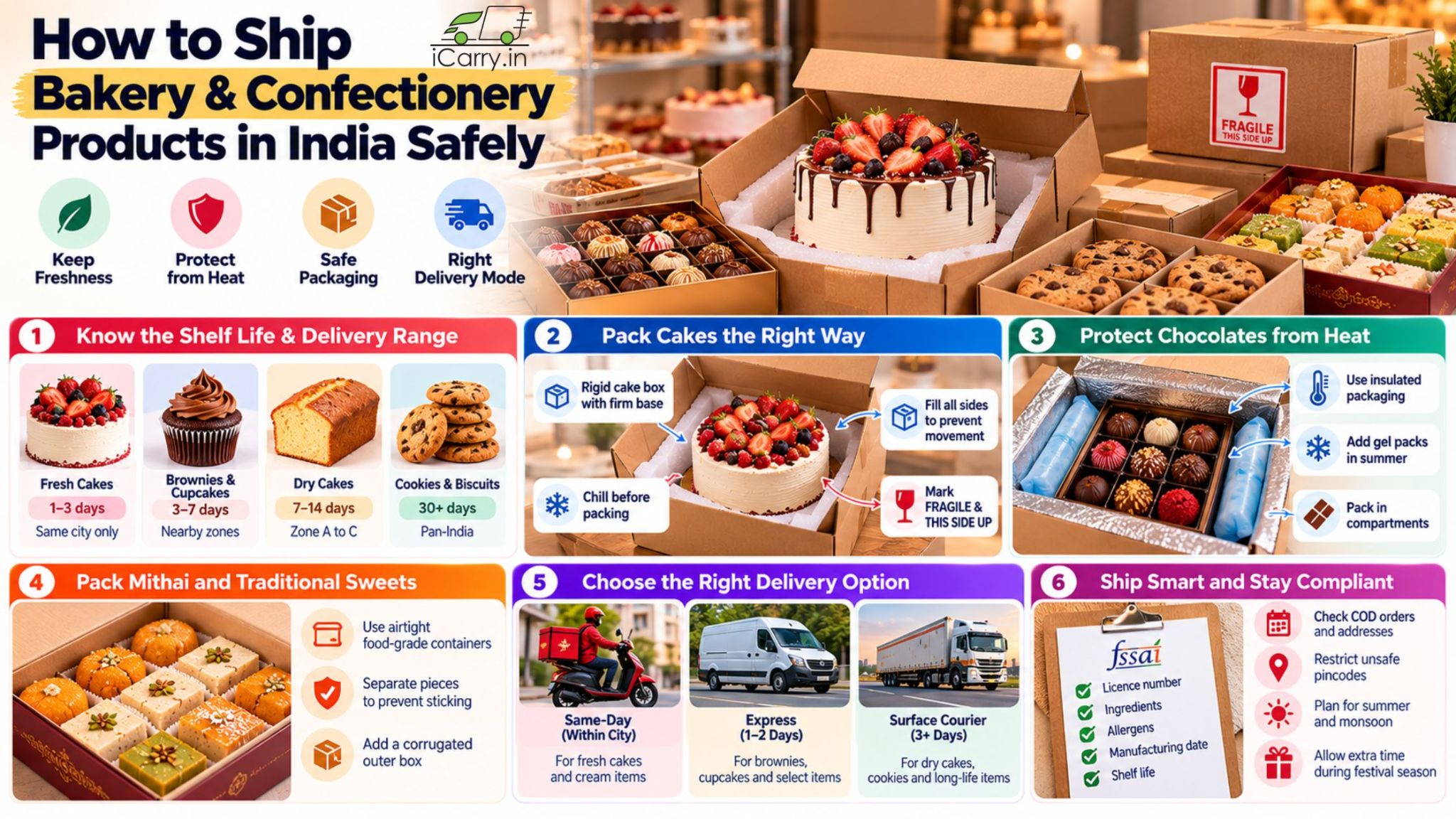
- Fresh cakes, cream pastries and fresh bakery (1 to 3 days): Same city only, delivered the same day. Standard courier is not suitable
- Brownies, cupcakes and soft cookies (3 to 7 days): Same city and adjacent zones, with 1 to 2 day delivery
- Dry cakes, tea cakes and pound cakes (7 to 14 days): Zone A to C with surface courier, if packed airtight
- Cookies, rusks, khakhra and biscuits (30+ days): Pan-India, with sturdy packaging to prevent breakage
- Chocolates and candy: Depends on season and temperature. See the heat section below
- Dry mithai and sweets (7 to 30 days): Varies by type. Milk-based sweets have a short shelf life. Dry fruit and besan sweets travel better
Rule: Do not dispatch a product if transit will use more than half of its remaining shelf life. Say clearly on the product page where you deliver, and restrict pincodes that your product cannot safely reach.
Packaging by Product Type
Cakes
- Use a rigid cake box sized to the cake with a firm base board, so the cake cannot slide
- Chill the cake before packing so it stays firm. Place in a corrugated outer with fill on all sides
- Mark THIS SIDE UP and FRAGILE on all faces.
- Same-day hyperlocal delivery is the right mode for cream and fresh cakes, not interstate courier
Brownies, Cookies and Cupcakes
- Wrap individual pieces or use a compartment tray so items do not rub together
- Use airtight inner wrap or sealed pouch to keep freshness, then a rigid box
- Cupcakes need individual cavities with a domed lid. Ship same day or next day only
- Fill any empty space completely. Movement causes crumbling
Chocolates and Truffles
- Chocolate begins to soften around 28 to 30°C and melts by 32°C. Indian summer vehicles routinely exceed this
- Use insulated packaging for Zone A and B deliveries. Thermocol or foil-lined boxes with frozen gel packs help for 1 to 3 days
- In peak summer, limit chocolate shipments to nearby zones or dispatch only early in the week
- Pack truffles and filled chocolates in individual cavities to avoid sticking and breakage
Mithai and Traditional Sweets
- Use airtight food-grade containers, not loose paper boxes, to preserve moisture balance
- Separate pieces with butter paper or cavity trays so syrupy sweets do not stick together
- Ship milk-based sweets only for same-day or next-day delivery within the city
- For gifting boxes, add a corrugated outer. Decorative boxes alone do not survive courier handling
Compare courier options for your zones with the iCarry® domestic rate calculator before you promise a delivery date.
Heat, Monsoon and Festival Season Risks
- Summer: Limit meltable products to nearby zones, use insulation and ice packs, and dispatch Monday to Wednesday to avoid weekend depot delays
- Monsoon: High humidity softens biscuits and cookies. Use airtight inner packaging and moisture-resistant outer wrap
- Festivals such as Diwali, Rakhi and Christmas: Courier networks run at higher volumes and transit times extend by 2 to 3 days. Dispatch earlier than usual and communicate realistic delivery dates
FSSAI and Labelling Basics
- FSSAI registration or licence number must be printed on every product label
- Show ingredients, allergen declaration, net weight, manufacture and best-before dates, MRP and storage instructions
- Declare allergens clearly for nuts, milk, eggs, gluten and soya, and note any shared equipment
- Print the veg symbol (green circle) or non-veg symbol (brown triangle) and nutritional information, as set out in the FSSAI labelling rules. Anything containing egg carries the non-veg symbol
- Show the same label details on your product page before the buyer pays, because FSSAI requires mandatory label declarations to be given before sale on e-commerce
- Home bakers and small businesses still need FSSAI registration or licence to sell commercially
Delivery Options and Timing
- Hyperlocal same-day: Best for cakes and fresh products inside a city
- Express courier: Suitable for gift boxes and chocolates to nearby zones with insulation
- Surface courier: Suitable for long-shelf-life cookies, biscuits and dry sweets
- Scheduled delivery: For birthdays and occasions, let the buyer choose a delivery date and notify them when the parcel is out for delivery
- COD: Confirm every COD order on WhatsApp before baking or dispatching. A refused fresh product cannot be resold
Need same-day delivery for cakes? Set up a free iCarry® account and book hyperlocal pickup in your city.
How to Ship Bakery Products in 6 Steps
- Match product to range: Check shelf life against the delivery zone, since transit must use less than half of it
- Pack by product type: Use a rigid box, firm base and full filler, because movement causes crumbling and smeared icing
- Protect from heat: Use insulation and gel packs for chocolates in summer, since courier vehicles exceed 32°C
- Print FSSAI details: Show the licence number, allergens and dates on every label, as the regulations require
- Pick the right mode: Use same-day hyperlocal for fresh cakes and surface courier for dry items
- Confirm before dispatch: Check COD orders and addresses on WhatsApp, because a refused fresh product cannot be resold
How iCarry® Supports Bakery and Confectionery Sellers
iCarry® is a courier aggregator that gives bakery and confectionery sellers access to multiple courier partners, helping them choose suitable shipping options for different products and delivery needs.
- Same-day hyperlocal delivery: Access available local delivery options, including Borzo through iCarry®, for eligible same-city deliveries of cakes and fresh bakery products. Confirm service availability before booking.
- Multiple courier partners: Compare available courier options for chocolates, gift boxes, and packaged bakery products based on destination, serviceability, and shipping cost.
- Delivery Boost: Get additional pre-delivery coordination to help reduce failed delivery attempts for time-sensitive orders.
- Two-way WhatsApp Engagement: Customers can confirm availability, update address details, or coordinate delivery, while sellers can view conversation history.
- Address Quality Scoring: Identify incomplete or potentially problematic addresses before dispatch to help reduce avoidable delivery issues.
- Bulk Shipment Booking: Use Excel or CSV bulk uploads to streamline dispatch when processing multiple orders.
For cakes and other highly perishable products, check the courier’s handling capabilities, delivery availability, and product acceptance policy before booking.
Frequently Asked Questions (FAQs)
Can I ship cakes by courier in India?
Fresh and cream cakes should only go by same-day hyperlocal delivery within the city. Dry cakes with a longer shelf life can travel by surface or express courier if packed airtight in a rigid box, with a firm base and filler, and delivered within the product's safe window.
How do I stop chocolates from melting during delivery?
Use insulated packaging with frozen gel packs, limit shipments to nearby zones in summer, dispatch early in the week, and avoid long transits. Chocolate softens around 28 to 30°C and melts by about 32°C, which courier vehicles often exceed during Indian summers.
What shelf life do I need to ship bakery products pan-India?
For pan-India delivery, aim for 30 or more days of shelf life, so the product still has most of its life when it reaches a customer in a distant zone. Do not dispatch if transit would use more than half of the remaining shelf life, and restrict pincodes your product cannot safely reach.
Do home bakers need FSSAI registration to sell online?
Yes. Anyone selling food commercially in India needs FSSAI registration or the appropriate licence, even from a home kitchen. Print the FSSAI number on every label along with ingredients, allergens, net weight, manufacture and best-before dates, MRP and storage instructions.
Bakery and confectionery products crush, melt, go stale and miss the occasion, so match every product to the delivery range its shelf life allows and never dispatch if transit would use more than half of the remaining shelf life. Pack by product type, protect chocolates from heat, print FSSAI details on every label, and use same-day hyperlocal delivery for fresh cakes.