A law firm in Delhi sends an original signed agreement to a client in Hyderabad. The envelope arrives 6 days later - and the seal appears to have been tampered with. The client refuses to acknowledge receipt. The firm has no way to prove the document arrived sealed and unread.
A financial services company dispatches welcome kits containing account numbers, card PINs, and KYC documents to 300 new customers. Twelve of the envelopes arrive torn or with broken security seals. The company's compliance team spends two weeks assessing the breach exposure and notifying affected customers.
Confidential documents and sensitive materials require a different approach to shipping than standard commercial parcels. The risks are not just physical - damage, loss, or delay - but also informational: the exposure of private, legally significant, or financially sensitive information during transit. As Indian businesses scale document-heavy operations - legal agreements, financial instruments, government documents, medical records, and compliance materials - the need for a structured approach to confidential document shipping has become a genuine operational requirement.That need is compounded by fragmentation - logistics technology providers now connect Indian merchants to more than 40 courier partners across over 19,000 pincodes per IBEF - which means a confidential document can pass through several different handling systems depending on which courier is chosen, making the choice of courier and service level a real part of the risk picture.
This guide covers how to package, seal, track, and handle confidential documents for courier transit in India - and what to do when things go wrong.
What Counts as a Confidential Document for Shipping Purposes?
A confidential document, for shipping purposes, is any physical item whose loss or exposure would cause harm beyond the cost of replacing the item itself - signed legal originals, financial instruments, KYC documents, medical records, and trade secrets are the most common examples. Unlike a standard parcel, the risk is not just damage or delay but also information exposure, which is why these shipments need tamper-evident packaging, discreet labelling, and a documented chain of custody that an ordinary parcel does not require.
Quick Checklist - Confidential Document Shipping Essentials
- Is the document in a tamper-evident envelope or sealed security bag?
- Is there a secondary outer envelope or corrugated cover for physical protection?
- Is the contents description on the outer label vague enough to not disclose the nature of the contents?
- Have you chosen an express or tracked courier with POD (Proof of Delivery)?
- Is the declared value appropriate for the document's replacement or legal cost?
- Have you photographed the sealed envelope before handover?
- Does the recipient know to expect the document and to report immediately if the seal is broken?
Categories of Confidential Documents and Sensitive Materials
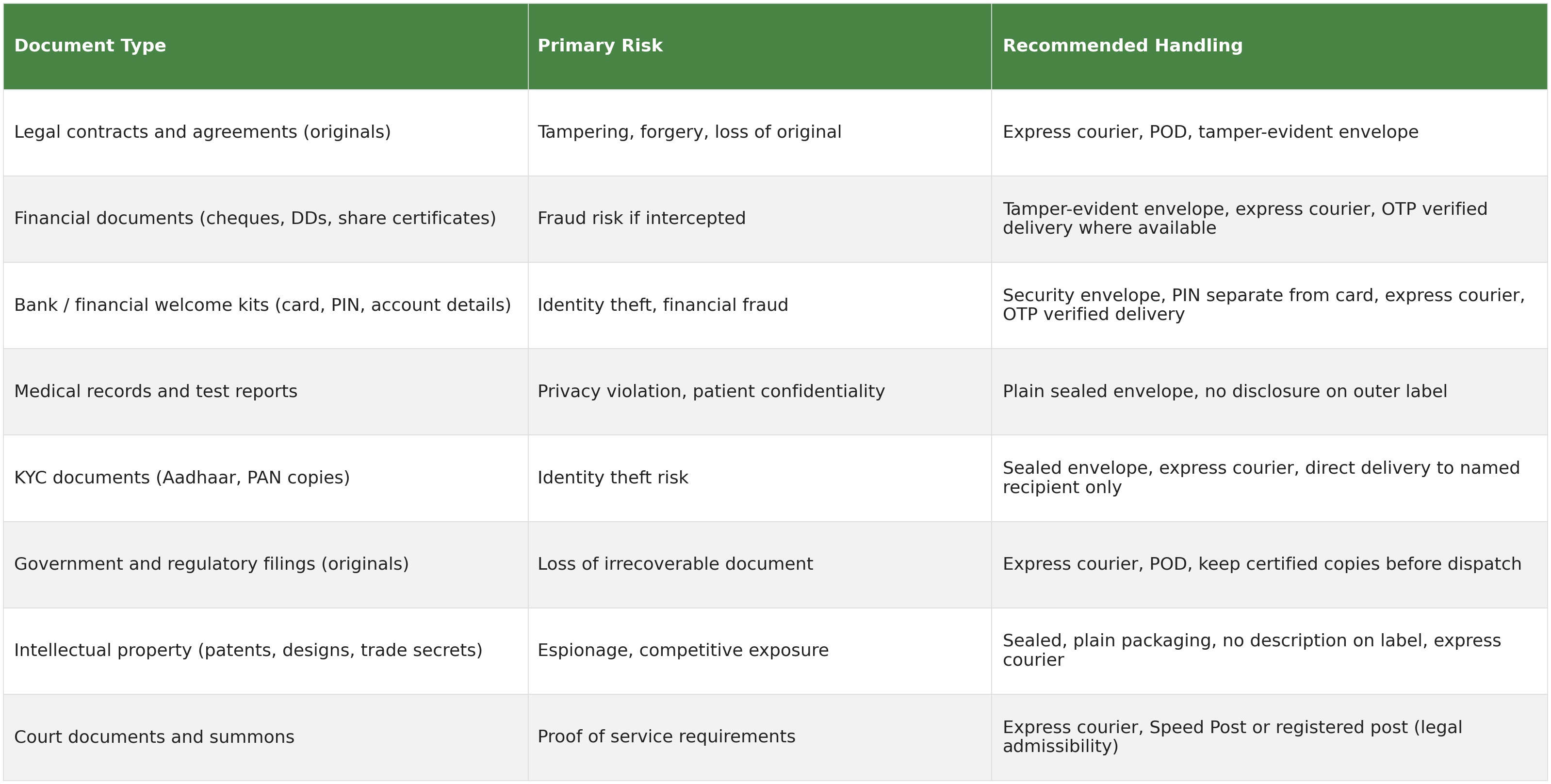
Different document types carry different risk profiles and may require different handling:
Packaging Confidential Documents Correctly
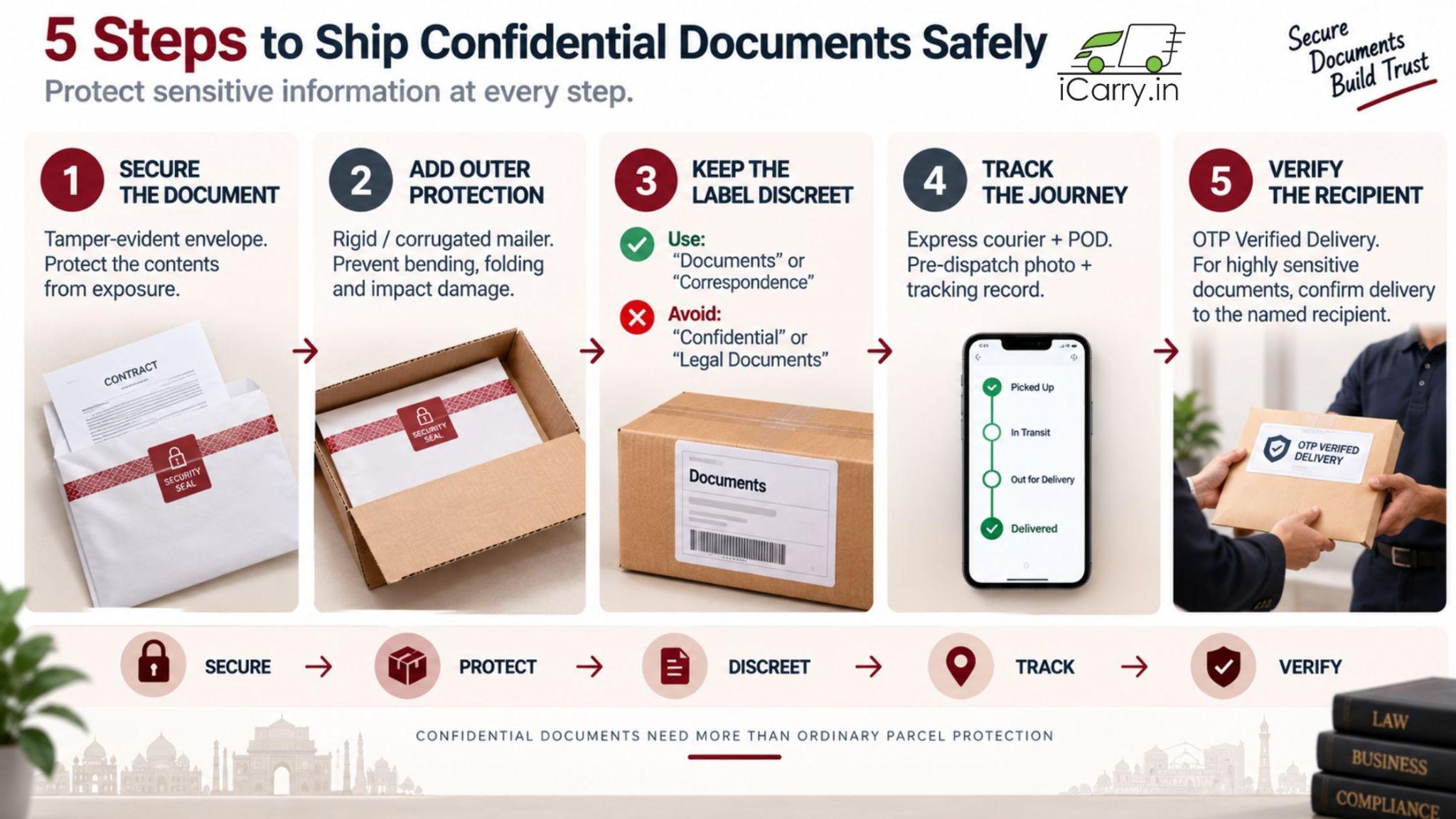
Step 1: The Inner Security Envelope
The first layer of protection is a tamper-evident security envelope. These envelopes have:
- A self-adhesive flap that cannot be reopened without visible evidence of tampering - the adhesive leaves a visible pattern or the envelope material tears when the seal is broken
- Security tinting on the inner surface that makes contents invisible even when the envelope is held to light
- Sequential numbering (on high-security versions) for chain-of-custody tracking
Tamper-evident security envelopes are available from office supply stores, courier companies, and specialist suppliers across India. For high-volume document dispatch (banks, insurance companies, law firms), they are a standard procurement item.
For documents with multiple pages: Seal each document separately if the documents relate to different matters. This contains a breach to one document rather than the entire parcel.
Step 2: The Outer Protective Envelope or Corrugated
For rigid document protection:
- A4 or C4 rigid cardboard mailers: Prevent the contents from bending or folding in transit. For contracts or certificates that must arrive flat and undamaged, rigid mailers are essential
- Bubble envelope (padded mailer): For documents that need some moisture protection and padding - slightly better than plain envelopes for documents being sent via surface courier
- Corrugated envelope or thin corrugated mailer: For high-value or irreplaceable documents. The corrugated provides structural protection against the compression and impact of courier sorting
Step 3: What to Write on the Outer Envelope
The outer label must balance deliverability (enough information for the courier to deliver) with discretion (not disclosing the sensitive nature of the contents):
- Do: Recipient name, full delivery address, sender's return address, contact number
- Do not: 'Contains original agreement', 'Legal documents', 'Financial instruments', 'Confidential'. These descriptions invite tampering and theft
- Acceptable description: 'Documents', 'Papers', 'Correspondence'. Generic enough to not attract attention, specific enough to be handled as non-fragile correspondence
- For bank and financial kits: Use the corporate name only, not 'Contains Bank Card and PIN' or similar. Most financial institutions have specific envelope and label standards for this reason
Choosing the Right Courier for Confidential Documents
Not all couriers are equally appropriate for confidential documents. The selection criteria differ from standard parcel shipping:
Express vs Surface Courier
Express courier is strongly preferred for confidential documents. Fewer handling points means fewer opportunities for tampering, interception, or misdelivery. An express courier with 2 to 3 handling points from origin to destination is significantly more secure than a surface courier with 5 to 6.
For documents that must arrive on a specific date (legal deadlines, compliance filings, court submissions), express courier also eliminates the transit time uncertainty of surface delivery.
Proof of Delivery (POD)
POD is the record of delivery - who signed for the document, at what time, and at which address. For confidential documents, POD is not optional. It is the evidence that:
- The document was delivered to the correct address
- A specific person received and signed for it
- Delivery occurred at a documented time
In legal and compliance contexts, POD may be required to establish that the recipient received the document on a specific date - particularly for notices, agreements, and time-sensitive legal communications.
OTP Verified Delivery
For highly sensitive documents where recipient identity must be positively confirmed, OTP Verified Delivery ensures that the consignee must enter a one-time password before the courier marks the delivery complete. This eliminates the possibility of a neighbour or office colleague signing on behalf of the intended recipient and the document never reaching the right person.
iCarry®'s OTP Verified Delivery is available for all shipments and is the most appropriate courier delivery mechanism for financial welcome kits, KYC documents, and sensitive personal correspondence.
Chain of Custody - Documenting the Document Journey
For the most sensitive documents - originals that cannot be replaced, legal instruments, financial securities - maintaining a documented chain of custody from dispatch to delivery protects all parties:
- Pre-dispatch photograph: Photograph the sealed, addressed envelope before handing it to the courier. This documents the document was sealed and intact at the point of handover
- Pickup receipt / manifest: Get the courier agent's signature on a pickup receipt or manifest confirming they received a sealed envelope at a specific time
- Tracking record: Maintain the complete tracking history from pickup to delivery as a printout or screenshot
- Delivery confirmation: The POD or OTP delivery confirmation is the final link in the chain
- Internal log: For regulated businesses (law firms, financial institutions, hospitals), maintain an internal dispatch log with: document description (not content), AWB number, dispatch date, recipient, and delivery confirmation date
What to Do If a Confidential Document Is Lost or Tampered With
If Lost
- File a trace request with the courier immediately. Include the AWB, dispatch date, and last known tracking location
- Assess whether the document can be duplicated (most commercial documents can be re-executed) or whether it is irreplaceable (some original signed documents, physical certificates, negotiable instruments)
- For negotiable instruments (cheques, DDs, share certificates): issue a stop-payment or stop-transfer notice immediately with the issuing bank or authority
- Notify the intended recipient of the loss so they can take precautionary measures
- File an FIR with local police if the document is a negotiable instrument or identity document - this creates a formal record of the loss that protects against fraudulent use
If Tampered With
- Photograph the tampered envelope before touching it. Preserve the evidence of tampering
- Note the AWB number and the last tracking location before the tampered delivery
- Report to the courier immediately with photographic evidence of the tampered seal.
- For financial documents: contact the issuing institution immediately and treat the situation as a potential data breach
- For legal documents: consult the relevant counsel on whether re-execution is required and whether the tampering has legal implications for the underlying transaction
Special Considerations by Document Type
Bank Cards and PINs
Financial institutions follow a specific protocol: the card and the PIN are never dispatched in the same envelope. The card ships first; the PIN ships 2 to 3 days later via a separate channel. Both use security envelopes. This ensures that interception of one envelope does not give the interceptor a usable financial instrument.
For businesses dispatching financial welcome kits, adopt the same practice: separate the card-equivalent material from the activation code equivalent, and ship in separate envelopes.
Aadhaar and PAN Copies
Aadhaar and PAN copies dispatched for KYC purposes are identity theft risk if intercepted. Additional protective measures:
- Use masked Aadhaar (with the first 8 digits masked) rather than full Aadhaar wherever possible
- Mark clearly on the inner document 'For [Company Name] KYC Purpose Only' - this limits the use of the document if intercepted
- Use OTP Verified Delivery to ensure the document reaches the named person only
Court and Legal Documents
Service of legal documents (summons, notices, pleadings) in India has specific procedural requirements. Verify with your legal counsel which mode of service is appropriate for each document type. Registered Post is often the only mode of postal service that courts accept as legally valid proof of service.
How iCarry® Supports Confidential Document Shipping
iCarry® is a courier aggregator that provides the access to multiple courier partners, express courier access, delivery confirmation tools, and tracking visibility that confidential document shipping requires:
- Express courier access: Blue Dart, FedEx, and Aramex available for same-day and next-day express delivery of confidential documents with fewer handling points
- OTP Verified Delivery: Ensures the named recipient - not a proxy - receives the document.The OTP record creates an verifiable delivery confirmation
- Real-time tracking: Monitor sensitive document shipments from dispatch to delivery in My Shipments. Track all active shipments in one dashboard across all couriers
- POD access: Proof of delivery records are accessible through the courier's system and referenced via iCarry®'s shipment records
- Two-way WhatsApp engagement: Keep customers informed and coordinate delivery or pickup through two-way WhatsApp engagement, allowing them to confirm availability, respond to delivery messages, update their address, or reschedule when needed.
- Address Quality Scoring: Check the quality of customer addresses before dispatch to identify incomplete or potentially problematic addresses and reduce avoidable delivery attempts and NDRs, which can be particularly important when serving remote or difficult-to-service locations.
- COD remittance: COD collections are settled automatically, with Early COD options from T+0 allowing businesses to receive COD funds as early as the next day after delivery. This helps businesses maintain cash flow even when serving customers across longer-distance delivery routes.
- Free Bronze plan, no minimum volume.
Final Thoughts
Confidential documents are not standard parcels. The consequence of a standard parcel going missing is inconvenience. The consequence of a confidential document going missing or being tampered with can be financial fraud, identity theft, legal consequences, or regulatory breach.
The investment in a tamper-evident security envelope (₹5 to ₹15), an express courier with POD (₹40 to ₹120), and a pre-dispatch photograph (zero cost) provides a level of protection that is adequate for most confidential document types. For the most sensitive categories - financial instruments, original legal agreements, identity documents - add OTP Verified Delivery and maintain a documented chain of custody.
Build the process before the first high-stakes dispatch. The confidential document that goes missing without a documented chain of custody is the one that teaches you why the process matters.
Frequently Asked Questions (FAQs)
What is a tamper-evident envelope and where can I get one in India?
A tamper-evident security envelope has a self-sealing adhesive flap that cannot be reopened without visible evidence of tampering - the adhesive leaves a distinctive pattern when the seal is broken, or the envelope material tears visibly. They are available from office supply stores, large stationery retailers, courier companies, and specialist security packaging suppliers across major Indian cities.
What should I write on the outer envelope of a confidential document?
Write only: recipient name, full delivery address, sender's return address, and a contact number. Do not write 'Confidential', 'Legal Documents', 'Financial Instruments', or any description that advertises the sensitive nature of the contents. Use 'Documents' or 'Correspondence' as the generic description if required.
What should I do if a confidential document is lost in transit?
File a trace request with the courier immediately. For negotiable financial instruments, issue a stop-payment or stop-transfer notice with the issuing bank. Notify the intended recipient so they can take precautionary measures. File an FIR with local police if the document is a negotiable instrument or identity document - this creates a formal record that protects against fraudulent use.
How is OTP Verified Delivery helpful for confidential documents?
OTP Verified Delivery requires the named recipient to enter a one-time password before the courier marks the delivery as complete. This ensures the document physically reaches the intended person - not a neighbour, office colleague, or building security guard who signs on their behalf. The OTP record creates an verifiable, timestamped delivery confirmation. Available on iCarry® for shipments.
Can I ship original documents via courier if they are irreplaceable?
Yes, but with maximum precautions. Keep certified copies or digital scans before dispatching any irreplaceable original. Use express courier with POD and declared value coverage. Maintain a documented chain of custody from dispatch to delivery. For documents where physical originals cannot be replaced (certain certificates, negotiable instruments), assess whether digital execution or certified copy alternatives can substitute before committing the original to courier transit.
Confidential documents are not standard parcels - the consequence of a standard parcel going missing is inconvenience, while the consequence of a confidential document going missing or being tampered with can be financial fraud, identity theft, legal consequences, or regulatory breach. The investment in a tamper-evident security envelope, an express courier with POD, and a pre-dispatch photograph provides adequate protection for most confidential document types, and for the most sensitive categories - financial instruments, original legal agreements, identity documents - add OTP Verified Delivery and maintain a documented chain of custody.