Why Eyewear Is Easy to Damage and Easy to Return
Eyewear is small and light, which makes it look easy to ship. It is not. Frames bend, hinges loosen, lenses scratch and a pair of sunglasses squeezed in a soft pouch inside a thin mailer can arrive broken. Because eyewear is also a fit and style purchase, returns are common.
Online eyewear in India is growing quickly, alongside India's expanding online retail market. Most orders weigh under 300 g, so the shipping cost is small, but a single damaged pair erases the margin on several orders. Protective packaging and clean dispatch evidence matter more than the freight rate.
What Is Eyewear Shipping in India?
Eyewear shipping is the courier delivery of sunglasses, spectacle frames and blue-light glasses, which are light but easy to bend, scratch and crush. It relies on a hard case, a rigid outer box and declared value coverage rather than on a low freight rate.
How to Pack Eyewear to Survive Sorting Centres
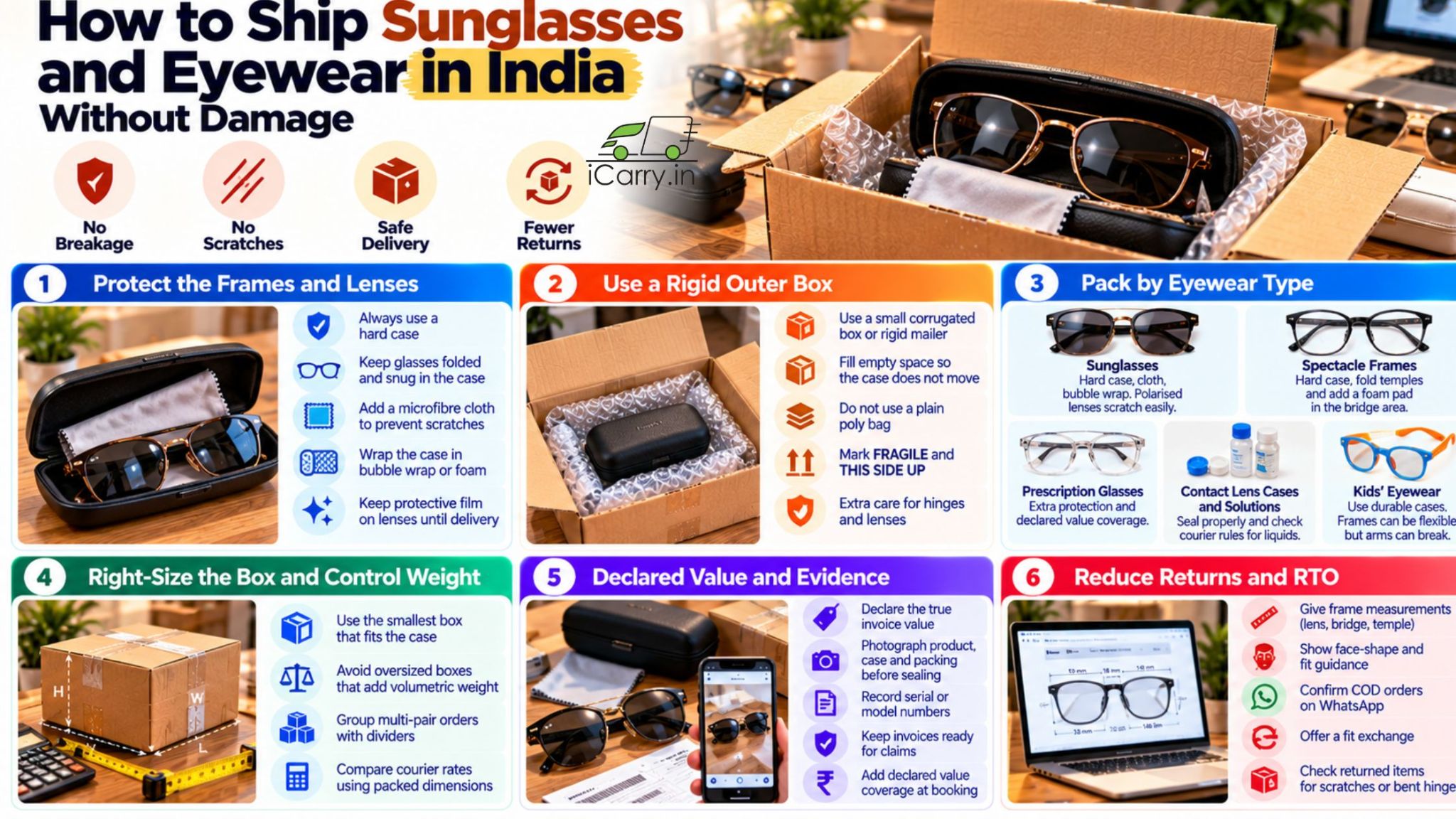
- Always use a hard case: A rigid case protects against crush. A soft pouch or cloth bag alone does not
- Put the glasses in the case, not loose: Frames must be folded and sitting snug. Loose frames bounce and bend
- Add a microfibre cloth: Place it between the lenses and the case wall to prevent scratches
- Wrap the case in bubble wrap or foam: This gives shock protection to hinges and lenses
- Use a rigid outer box: A small corrugated box or a rigid mailer, not a plain poly bag. Poly bags are crushed in bulk bags and trolleys
- Fill empty space: The case should not move inside the box. Add paper fill if there is a gap
- Cover or protect the lenses: Keep protective film on the lenses until the customer opens the box. Remove only if the brand requires it
Packaging by Eyewear Type
- Sunglasses: Hard case, cloth, bubble wrap and a rigid outer. Polarised and mirrored lenses scratch easily
- Spectacle frames: Hard case, with the temples folded and a small foam pad in the bridge area to stop pinching
- Prescription glasses: Extra care. Add a second layer of protection, and use declared value coverage since a damaged pair is a custom product that cannot be resold
- Contact lens cases and solutions: Check courier rules for liquids. Seal bottles, add secondary bags and mark KEEP UPRIGHT
- Kids' eyewear: Use durable cases. Frames are often flexible but arms can break under pressure
Right-Size the Box and Control Weight
Eyewear is small, but cases are bulky. A standard sunglass case in a small box can still be about 20 x 10 x 7 cm, which is a volumetric weight of 280 g (L x B x H in cm divided by 5,000), still within the first 500 g slab.
- Use the smallest rigid box that fits the case and cushioning
- Do not use oversized boxes. They add volumetric weight and let the case shift
- Group multi-pair orders in one box with dividers instead of separate cases in one large carton
Compare courier partners at your packed dimensions with the iCarry® domestic rate calculator before you book.
Declared Value and Evidence
- Declare the true invoice value: A pair of branded sunglasses costing ₹2,500 to ₹6,000 should not travel at a default liability
- Photograph before sealing: Capture the product, the case, the packing and the label. A pre-dispatch photo is your evidence for a damage claim
- Record serial or model numbers: Helps with disputes about swapped or fake returns
- Keep invoices ready: For claims, you need proof of value
Reduce Returns and RTO
- Give frame measurements: Lens width, bridge width and temple length in millimetres. Many returns are size mismatches
- Show face-shape and fit guidance: Help customers choose before ordering
- Confirm COD orders on WhatsApp: Fashion eyewear is often an impulse purchase
- Offer a fit exchange: Exchange keeps the sale when the frame does not fit. Under the Consumer Protection (E-Commerce) Rules, 2020, sellers must display return, refund and exchange information
- Do a quality check on returns: Check for scratches, bent hinges or swapped products before restocking
How iCarry® Supports Eyewear Sellers
iCarry® is a courier aggregator that gives eyewear sellers access to multiple courier partners and shipping tools to help manage fragile and higher-value orders.
- Transit Loss Insurance: Choose to add Transit Loss Insurance during booking for eligible shipments. Review the applicable fee, coverage details, and terms before confirming.
- Pre-uploaded Product Images: Save images for standard SKUs to help support weight discrepancy disputes with relevant product and packaging evidence.
- Courier Rate Comparison: Compare available courier options using your packed parcel's weight and dimensions through the domestic shipping rate calculator.
- Delivery Boost: Get additional pre-delivery coordination to help reduce failed delivery attempts.
- Two-way WhatsApp Engagement: Let customers confirm availability, update address details, or coordinate delivery, while you keep track of conversation history.
- Address Quality Scoring: Identify incomplete or potentially problematic delivery addresses before dispatch to help reduce avoidable delivery issues.
Start with the free Bronze plan, with no minimum shipment volume.
Frequently Asked Questions (FAQs)
How should I pack sunglasses for courier delivery?
Put the sunglasses in a hard case with a microfibre cloth, wrap the case in bubble wrap or foam, and place it in a small rigid corrugated box with no empty space. Avoid soft pouches and poly mailers alone, as they offer no protection against crushing.
Can I ship spectacle frames in a poly mailer?
It is not recommended. Frames bend and hinges loosen under pressure. Use a hard case inside a rigid mailer or small corrugated box with cushioning. Poly mailers are only suitable for non-fragile accessories such as cleaning cloths and cases without frames.
Do I need declared value coverage for eyewear?
Yes, for any pair above ₹2,000, and always for prescription or premium frames. Declare the invoice value and keep pre-dispatch photographs and invoices ready. A claim is paid against the declared value, so under-declaring reduces your recovery.
How do I reduce returns on eyewear orders?
Publish lens width, bridge width and temple length in millimetres, add face-shape guidance, show customer reviews on fit, confirm COD orders on WhatsApp, and offer an exchange before a refund. Check returned pairs for scratches or swaps before restocking.
Eyewear is light but unforgiving: a hard case, a microfibre cloth, bubble wrap or foam and a rigid outer box protect frames and lenses far better than any cheap freight rate will. Right-size the box to keep volumetric weight down, declare the true invoice value on every pair above ₹2,000, and photograph each parcel before sealing. Then cut returns at the source with frame measurements, fit guidance and WhatsApp confirmation on COD orders.