Why Footwear Is a High-Return Category
Footwear is bulky, size-sensitive and returned often. A shoe that fits one customer in size 8 may feel tight in another brand's size 8. A pair that looks right online may not look right in person. Every wrong size means a reverse pickup, a second dispatch and a customer who may not return.
Footwear is also one of the most volumetric-weight-heavy categories. A pair of shoes in its original box takes up a lot of space for very little weight, so courier billing is often driven by box size, not shoe weight. Packaging, size accuracy and COD control are the three levers that decide whether footwear shipping is profitable.
India's footwear market reached US$20.67 billion in 2025, yet buyers still return pairs that do not fit, so fit and delivery decide who keeps the sale.
What Is Footwear Shipping in India?
Footwear shipping is the courier delivery of shoes, sandals and sneakers, which are bulky, size-sensitive and returned often. Courier billing depends mainly on box size rather than shoe weight, so packaging, size accuracy and COD control decide whether you make a profit.
How to Pack Shoes for Courier Delivery
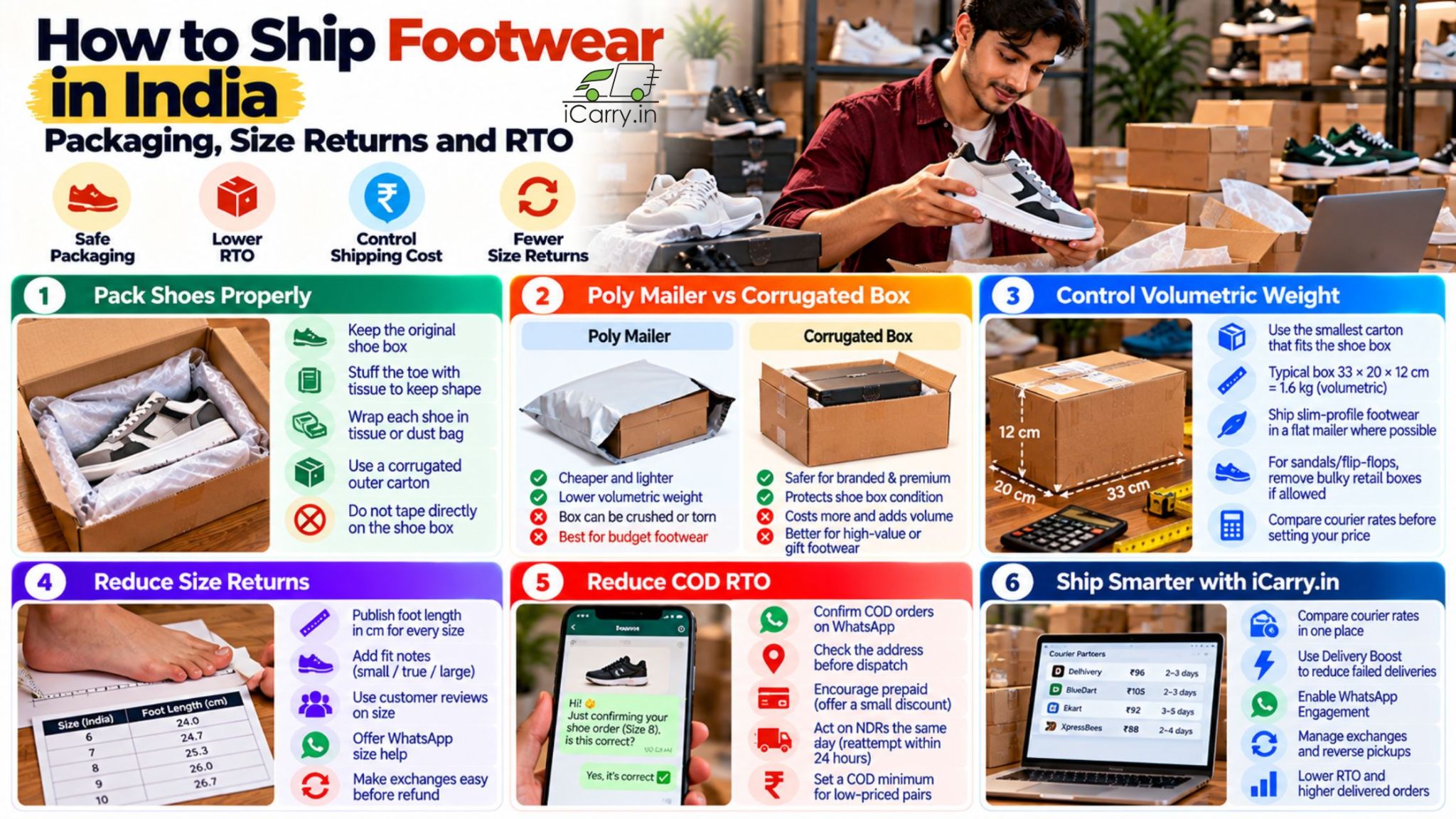
- Keep the original shoe box: Customers expect to receive shoes in their brand box. Never ship a bare pair in a poly bag
- Stuff the toe box with tissue: This keeps the shape and stops the box collapsing when pressed
- Wrap each shoe in tissue or a dust bag: Protects colour and finish, especially for white and suede shoes
- Use a corrugated outer or a strong shipping carton: A shoe box alone is not a shipping box. It crushes at the corners in sorting centres
- Do not tape directly on the shoe box: Tape tears the printed finish. Use an outer carton or a poly sleeve and put the label on that
- Secure sandals and heels: Strap sandals in place. Wrap heels in foam or cardboard so they do not puncture the box
Poly Mailer vs Corrugated Box for Footwear
- Poly mailer over the shoe box: Cheaper and lighter and reduces volumetric weight, but the shoe box can be crushed or torn. Suitable for budget footwear where a damaged box is a lower risk
- Corrugated carton: Safer for branded, premium or gift footwear, and for sneakers where box condition matters. Costs more and adds volume
- Test and decide by price point: Use poly mailers for low-priced pairs and corrugated for higher-priced pairs, then compare damage and return rates
Control Volumetric Weight
A standard shoe box measures about 33 x 20 x 12 cm. Volumetric weight is length x breadth x height in cm divided by 5,000, so this box is about 1.6 kg, even though the shoes weigh less.
- Choose the smallest carton that fits the shoe box and protects it
- Ship slim-profile footwear in a flat mailer where possible
- For sandals, flip-flops and slippers, remove bulky retail boxes if your brand allows and use a snug mailer
- Calculate the chargeable weight for each shoe type before setting your price or free shipping threshold
Check volumetric billing for your box size with the iCarry® domestic rate calculator before you set your free shipping threshold.
Reduce Size Returns
- Publish foot length in cm: S, M and L are not enough. Add foot length for every size so customers can measure at home
- Add fit notes: State whether the shoe runs small, true to size or large, and whether it suits wide or narrow feet
- Use customer reviews on size: Show reviews that mention fit. They are more trusted than brand claims
- Offer WhatsApp size help: A quick chat before dispatch prevents many wrong-size orders
- Make exchanges easy: Offer size exchange before refund. Free exchange keeps the revenue and the customer
Reduce RTO on COD Footwear Orders
- Confirm COD orders on WhatsApp: Many footwear COD orders are impulse purchases. A confirmation message removes the lowest-intent buyers
- Check the address before dispatch: Incomplete addresses are a common cause of failed deliveries
- Encourage prepaid: Offer a small discount on prepaid orders. The saving on RTO usually exceeds the discount
- Act on NDRs the same day: A reattempt within 24 hours converts far more orders than a delayed one
- Set a COD minimum for low-priced pairs: Return freight on a cheap pair can wipe out the margin
Cut failed deliveries with Delivery Boost and WhatsApp Engagement. Start with a free iCarry® account.
Handling Returns and Exchanges
- State the return conditions clearly: unworn, with original box and tags. Under the Consumer Protection (E-Commerce) Rules, 2020, sellers must display return, refund and exchange information
- Do a quality check on returned pairs. Look for wear marks, sole dirt and missing items
- Restock only unworn, resalable pairs and grade the rest
- Keep the box and shoe condition photographed at dispatch so you can dispute false claims
How iCarry® Supports Footwear Sellers
iCarry® is a courier aggregator that gives footwear sellers access to multiple courier partners and shipping tools to help manage shipping costs, returns, and delivery coordination.
- Courier Rate Comparison: Compare available courier options using your packed parcel's actual weight and dimensions to understand shipping costs before booking. Use the domestic shipping rate calculator to estimate shipping charges.
- Delivery Boost: Get additional pre-delivery coordination to help reduce failed delivery attempts on footwear orders.
- Two-way WhatsApp Engagement: Customers can confirm availability, update their address, or coordinate delivery, while sellers can view conversation history. This helps improve communication around COD orders and delivery attempts.
- Address Quality Scoring: Identify incomplete or potentially problematic addresses before dispatch to help reduce avoidable delivery failures.
- Shipment Management: Manage bookings and track shipments across available courier partners through one account, making it easier to monitor footwear orders and coordinate dispatches.
For better shipping cost control, measure the packed shoe box accurately and compare available courier options before booking. To help manage returns, provide clear size charts and fit guidance before dispatch.
Start with the free Bronze plan, with no minimum shipment volume.
Frequently Asked Questions (FAQs)
Can I ship shoes in just a poly mailer?
You can ship shoes in a poly mailer if they are in their shoe box, and the box condition is not important to the customer. For premium or gift footwear, use a corrugated outer so the shoe box arrives uncrushed. Never ship a bare pair without any box or protective wrap.
Why is shipping shoes so expensive?
Shoe boxes are bulky, so volumetric weight is much higher than actual weight. A box of about 33 x 20 x 12 cm has a volumetric weight of about 1.6 kg. Choosing a smaller carton or a flat mailer for suitable footwear reduces the chargeable weight.
How do I reduce size exchanges for footwear?
Publish foot length in centimetres for every size, add fit notes on whether the shoe runs small or large, show customer reviews on fit, and offer WhatsApp size help before dispatch. Offer a free exchange instead of a refund to keep the revenue.
Should I offer COD on footwear orders?
COD helps conversion but increases RTO risk. Confirm COD orders on WhatsApp, verify the address, offer a prepaid discount, and consider a COD minimum for low-priced pairs so return freight does not erase the margin.
Footwear profit comes down to three levers: packaging, size accuracy and COD control. Keep the original shoe box inside a corrugated outer for anything premium, choose the smallest carton that protects it because courier billing follows box size rather than shoe weight, publish foot length in centimetres to cut size returns, and confirm COD orders on WhatsApp before dispatch. Photograph the box and shoes at dispatch so false return claims can be disputed.