Why Paints and Chemicals Are Restricted
A tin of solvent paint is accepted at booking, then rejected at the courier hub. The order is stuck, the customer is waiting, and you pay to bring it back.
Paints, adhesives, solvents and cleaning chemicals can be flammable, corrosive, toxic or pressurised. A leak can damage other parcels and injure handlers. For this reason, many couriers either refuse these products, accept only certain types, or apply conditions and quantity limits.
Demand for paints, DIY chemicals and cleaning products is growing, helped by India's expanding online retail market. The main shipping problem is not packaging alone. It is knowing which products can travel by courier at all, and declaring them correctly.
What Is Paint and Chemical Shipping in India?
Paint and chemical shipping is the courier delivery of paints, adhesives, sealants and cleaners, many of which couriers restrict because they are flammable, corrosive or pressurised. It starts with classifying the product from its Safety Data Sheet (SDS), then confirming courier acceptance in writing before you pack and book.
Step 1: Classify the Product
Check the product's Safety Data Sheet (SDS or MSDS) from the manufacturer. It lists hazards, flash point, storage and transport information. Use it to place the product in one of these groups:
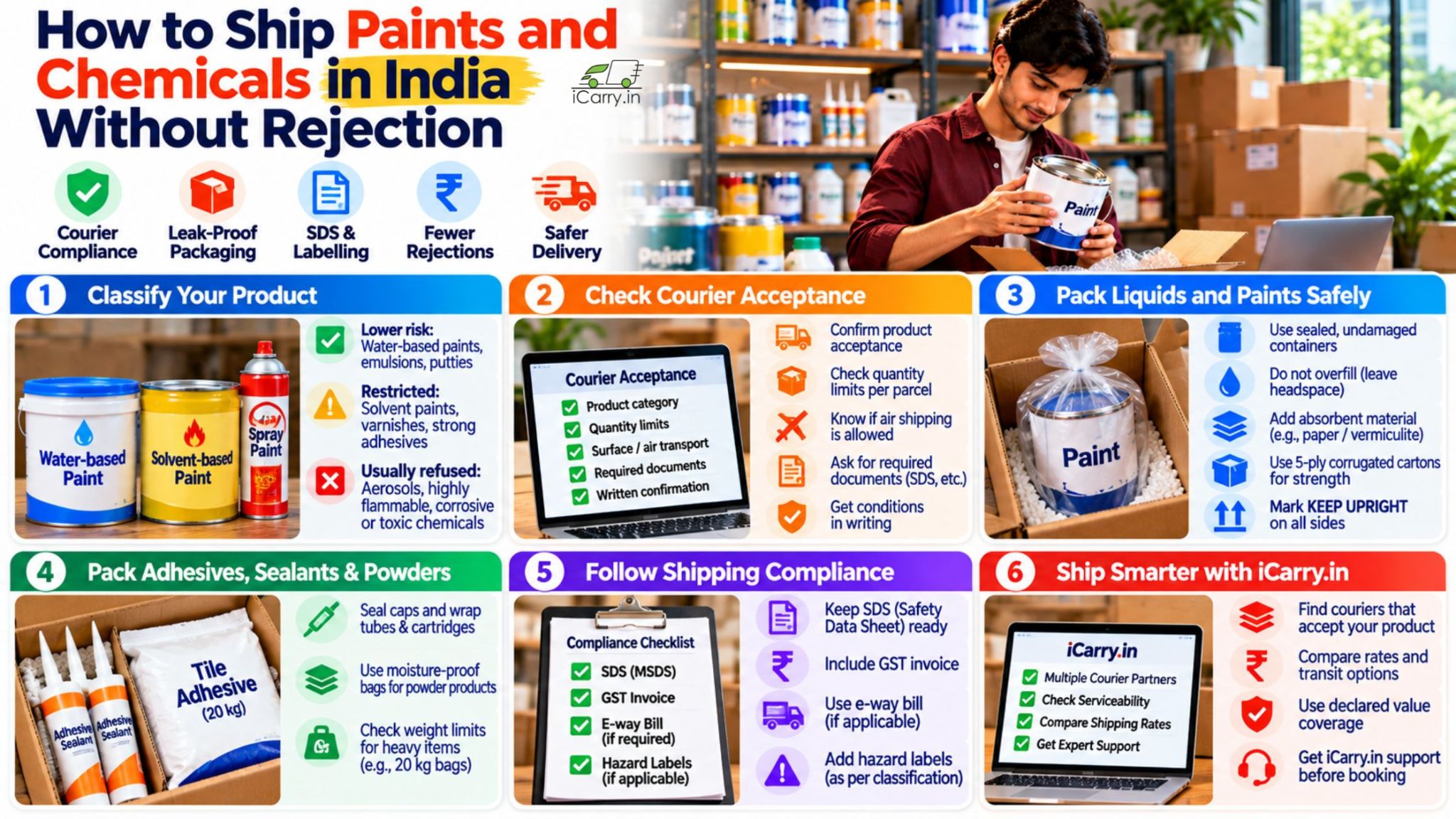
- Generally lower risk: Water-based paints, emulsions, many wall putties and tile adhesives in sealed containers, non-flammable cleaners
- Restricted or conditional: Solvent-based paints, thinners, enamel paints, varnishes, spray paints, strong adhesives and sealants with flammable solvents
- Usually refused by couriers: Pressurised aerosols, highly flammable liquids, corrosive acids and alkalis, oxidisers, toxic or poisonous chemicals
Important: A product that looks harmless can still be classed as hazardous. Do not guess. Use the SDS and confirm with the courier.
Step 2: Check Courier Acceptance Before You Book
- Ask each courier partner whether the exact product category is accepted, and under what conditions
- Confirm quantity limits per parcel and per shipment
- Ask whether surface transport only is allowed. Many restricted liquids cannot go by air
- Confirm the documents required, such as SDS, declaration or hazardous goods form
- Get the acceptance conditions in writing. A booking accepted online can still be rejected at the hub if the product is restricted
Do not describe a hazardous product as something harmless to get it accepted. A mis-declared parcel can be seized, penalised, and rejected, and a claim for loss or damage is likely to be refused.
Not sure which courier accepts your product? Ask iCarry® support before you book.
Packaging Liquids and Paints
- Use sealed, undamaged containers: Metal tins need tight lids. Hammer or press the lid fully down and use a tamper seal
- Do not overfill: Leave headspace, especially for adhesives and solvents that can expand with heat
- Wrap each container in a leak-proof bag: Use a thick polythene bag or ziplock around every tin or bottle
- Add absorbent material: Put absorbent paper or vermiculite around each container to soak up leaks
- Use rigid dividers: Separate containers so they cannot rub or hit each other
- Use 5-ply corrugated cartons: Liquids are heavy. Use strong cartons and tape all seams
- Mark KEEP UPRIGHT: On all four sides and the top
- Use hazard labels where required: Label as per the product's classification and your courier's rules
Packaging Adhesives, Sealants and Powders
- Tubes and cartridges: seal caps, wrap each item in a bag, and use dividers
- Powder adhesives and cement-based products: use moisture-proof inner bags and strong outer sacks or cartons
- Aerosol-based products: confirm acceptance. Many couriers do not accept aerosols
- Heavy items such as 20 kg tile adhesive bags: use sturdy packaging and check weight limits
Heat, Monsoon and Seasonal Risks
- In summer, heat raises pressure and flammability risk. Avoid dispatching volatile products during peak heat
- Dispatch early in the week to prevent weekend depot storage
- In monsoon, protect labels and cartons from moisture so hazard markings stay readable
Documents and Compliance Basics
- SDS: Keep an up-to-date SDS for each product and share it when the courier asks
- Product labels: Include product name, batch number, manufacture date, net quantity and safety information
- GST invoice: Correct HSN code and tax details. Paints and varnishes are taxed at 18% since 22 September 2025, but check the HSN code and rate for each adhesive and chemical
- E-way bill: Required when the consignment value exceeds ₹50,000
- Licences and permits: Some chemicals need specific licences or approvals for sale and transport. Check requirements for your product category
Compare rates at your packed weight across multiple top courier partners with the iCarry® domestic rate calculator.
When Courier Is Not the Right Mode
- Large volumes of paint, drums or bulk chemicals are better suited for freight or specialised hazardous goods carriers
- Products classed as dangerous goods may need a licensed transporter
- Consider regional distributors or local delivery for heavy and restricted products
How to Ship Paints and Chemicals in 5 Steps
- Read the SDS: It lists hazards and flash point, which decide whether a courier can take the product
- Check acceptance in writing: A booking accepted online can still be rejected at the hub
- Pack against leaks: Use a sealed container, a leak-proof bag, absorbent material and a 5-ply carton, since a leak damages other parcels
- Mark and label: Add KEEP UPRIGHT and hazard labels where required, so handlers know how to treat the parcel
- Prepare the documents: Carry the SDS, GST invoice and e-way bill if needed, because couriers can ask for them at any point
How iCarry® Supports Paint and Chemical Sellers
iCarry® is a courier aggregator that gives sellers access to multiple courier partners through one account. Since acceptance rules for paints, adhesives and chemicals vary by product and courier, contact iCarry® support to confirm eligibility before booking.
- Multiple Courier Partners: Access multiple courier options and check whether a partner accepts your specific product category. Acceptance is subject to each courier's restrictions and conditions.
- Rate Comparison Before Booking: Compare available courier rates using your actual packed shipment weight before choosing a service.
- Transit Loss Insurance: For eligible shipments, you can choose to add Transit Loss Insurance during booking. Review the applicable fee, coverage details and terms before confirming.
- Address Quality Scoring: Identify incomplete or potentially problematic delivery addresses before dispatch, helping reduce avoidable delivery issues.
- Delivery Boost: Get additional pre-delivery coordination to help improve communication and reduce failed delivery attempts, particularly for heavy parcels.
Always confirm courier acceptance, packaging requirements and documentation for your exact product before dispatch. Do not book restricted or hazardous goods without the courier's approval.
Start with the free Bronze plan, with no minimum shipment volume.
Frequently Asked Questions (FAQs)
Can paints be shipped by courier in India?
It depends on the type. Water-based paints in sealed containers are often accepted by some couriers, while solvent-based paints, thinners and enamels are commonly restricted. Check the SDS, ask your courier about the exact product and conditions, and get acceptance confirmed before booking.
Can I ship spray paints and aerosols by courier?
Most couriers refuse pressurised aerosols or accept them only under strict conditions. Do not book aerosol products without written confirmation from the courier. Mis-declared aerosols can be rejected, seized or lead to claim refusal.
What is an SDS and why do couriers ask for it?
An SDS (Safety Data Sheet), also called MSDS, is a manufacturer document listing hazards, flash point, handling and transport information. Couriers use it to classify the product and decide whether it can be accepted and under what conditions.
How should I pack liquid adhesives or paint tins?
Use sealed containers with a tamper seal, avoid overfilling, wrap each in a leak-proof bag, add absorbent material and dividers, use a 5-ply corrugated carton with taped seams, and mark KEEP UPRIGHT on all sides. Confirm that the courier accepts the product before dispatch.
With paints and chemicals, the product decides whether a courier can take it at all, so settle that before you pack. Read the SDS to classify the product, get courier acceptance in writing, and never describe a hazardous product as something harmless. Then pack against leaks with a sealed container, a leak-proof bag, absorbent material and a 5-ply carton marked KEEP UPRIGHT, and carry the SDS, GST invoice and e-way bill where needed. For drums and bulk volumes, use freight or a hazardous goods carrier instead.