A customer in London orders a Banarasi silk saree from a small Varanasi weaver's Instagram page. Ten days later it arrives with a crease across the zari border that won't iron out, and a faint stain from a cosmetic sample that shifted inside the same poly bag. The saree was never the problem. The packaging was.
Sarees and traditional Indian clothing are not simple flat-pack items. They vary enormously in fabric, embellishment, and drape, and often carry real value - the domestic apparel market alone is estimated at Rs 9.35 lakh crore, or around USD 105.5 billion, with women's wear the single largest category, and a growing share of it bought and gifted online. Every one of those shipments has to survive transit exactly the way it left the tailor's table.
This guide covers the packaging materials, folding technique, and presentation choices that keep sarees, lehengas, and traditional outfits looking the way they did when the seller wrapped them - plus what changes for embellished pieces and international orders.
How Do You Pack a Saree for Shipping?
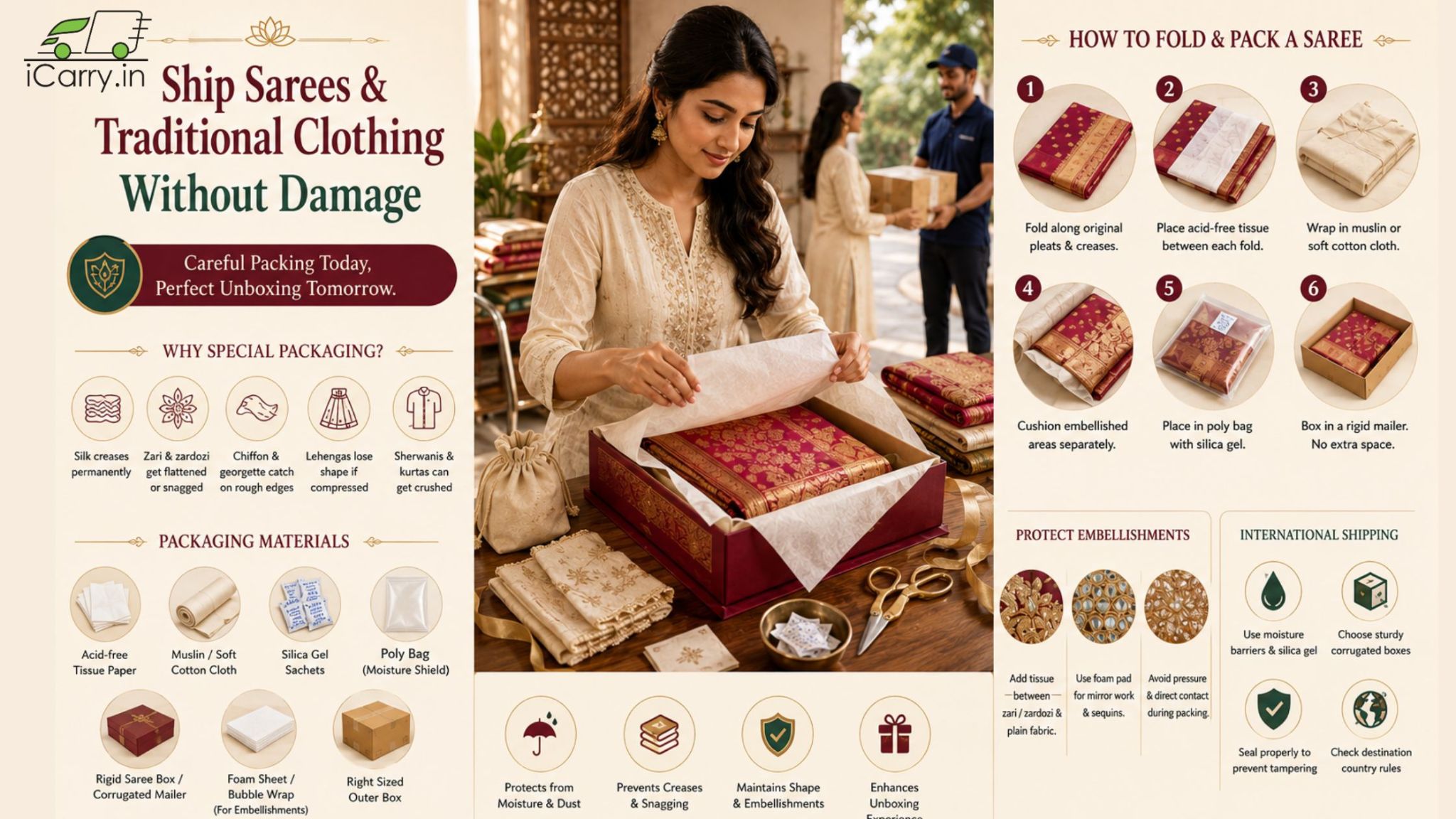
A saree should be folded loosely along its original creases, wrapped in acid-free tissue paper or a soft cotton cloth, and placed in a poly bag or rigid mailer that blocks moisture without compressing any embellishment. Zari, zardozi, or mirror work needs its own layer of padding so it doesn't rub against the rest of the fabric in transit.
Quick Checklist - Before You Pack a Saree or Traditional Outfit
- Do you have acid-free tissue paper or a soft cotton cloth for the inner wrap?
- Is the garment completely dry and free of loose threads before folding?
- Are zari, zardozi, or mirror-work areas cushioned separately from plain fabric?
- Does the outer packaging protect against moisture without pressing down on embellishments?
- Have you sized the box to the folded garment, with no empty space for it to shift in?
Why Sarees and Traditional Wear Need Different Packaging
Silk creases permanently if it's folded along a new line instead of its existing ones. Zari and zardozi threads flatten or snag under pressure. Chiffon and georgette catch on rough cardboard edges. Lehengas carry a bulky, flared skirt that loses its shape if compressed. Sherwanis and kurta sets have a structured collar and placket that crush easily under other packages.
None of this applies to a plain cotton t-shirt. It's why generic apparel packaging - a poly mailer and nothing else - is the single biggest cause of damage claims and returns on traditional wear, especially for bridal and festive orders where the piece is expensive and effectively irreplaceable on short notice.
Packaging Materials You'll Need
- Acid-free tissue paper: wraps directly against the fabric without leaching color or dye
- Soft cotton or muslin cloth: an extra breathable buffer for silk and embellished pieces
- Silica gel sachets: control humidity inside sealed poly bags, especially during monsoon-season shipping
- Poly bags: keep out moisture and dust once the garment is already wrapped in tissue or cloth
- Rigid saree box or corrugated mailer: stops the parcel from being folded or crushed under other shipments
- Foam sheet or bubble wrap: for hard embellishments like mirror work or metal-thread borders only - never placed directly against plain fabric
- Correctly sized outer box: close to the folded garment's dimensions - extra space is what lets a garment shift and crease
How to Fold and Pack a Saree for Shipping
The steps below are sequential - each one depends on the step before it - so they're numbered rather than listed as bullets.
- Lay the saree flat and fold along its original pleats and creases. New fold lines are far harder to reverse than existing ones.
- Place a sheet of acid-free tissue paper between each fold to stop fabric rubbing against fabric.
- Wrap the fully folded saree in a layer of muslin or soft cotton cloth.
- Cushion embellished borders or the pallu separately with a folded strip of tissue or thin foam.
- Place the wrapped saree in a poly bag with a silica gel sachet, pressing out excess air before sealing.
- Box it in a rigid mailer or corrugated box sized to the garment, filling any remaining gaps so it can't shift in transit.
Protecting Zari, Zardozi, and Mirror Work
Never let an embellished area press directly against another fold. Add a layer of tissue between any zari, zardozi, or embroidered section and the plain fabric next to it. For heavy zari borders, rolling instead of sharply folding preserves the thread work better, if the fabric and the tailor's care instructions allow it. For mirror work or sequins, a thin foam pad over the embellishment stops it catching on stitching elsewhere in the parcel.
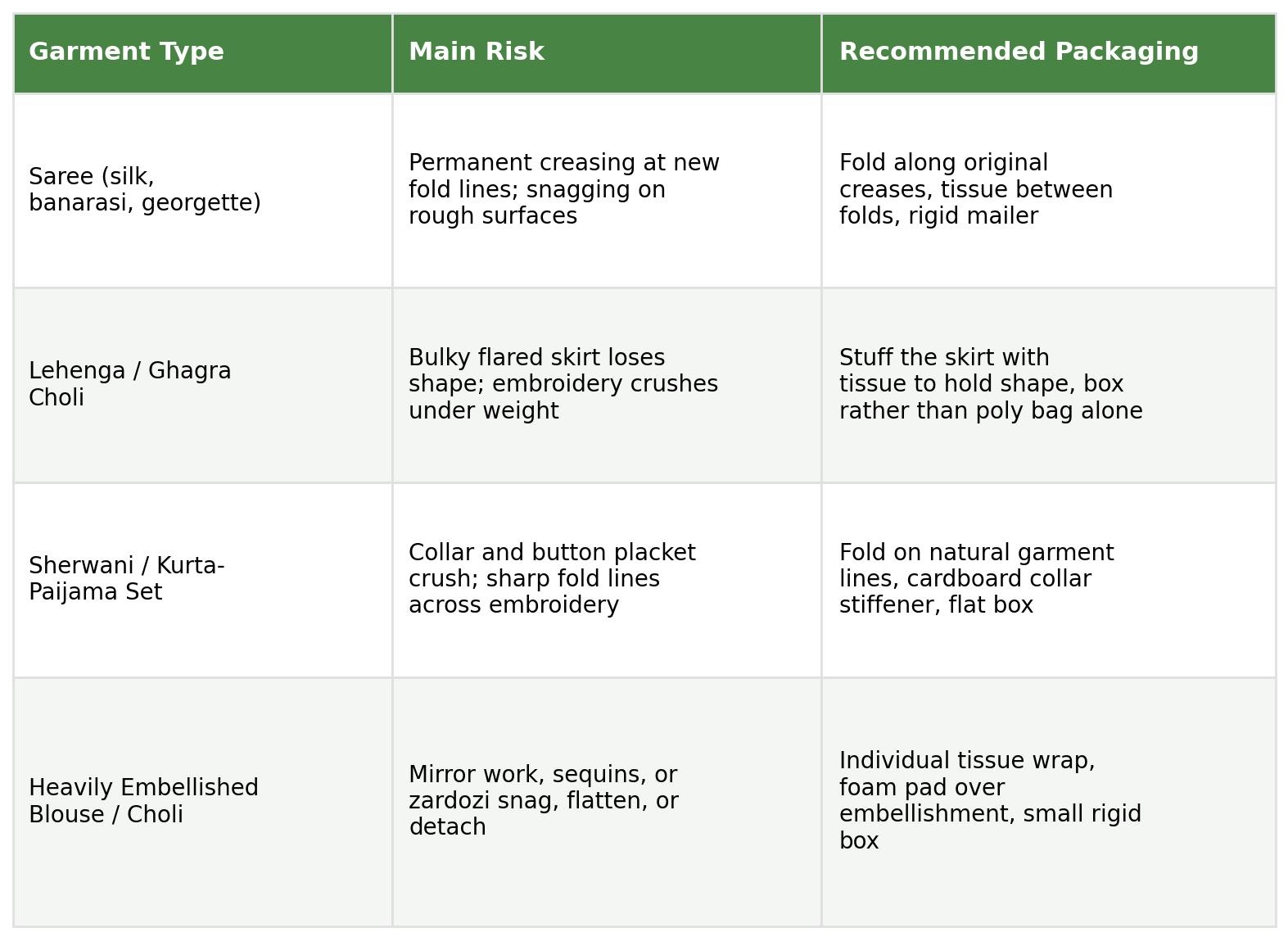
Packaging by Garment Type
Presentation: Making the Unboxing Feel Premium
Traditional wear is bought for weddings, festivals, and gifting far more often than casual apparel is, and the unboxing is often part of the experience the customer is paying for. A few low-cost additions make a real difference:
- Branded or colored tissue paper with a ribbon or sticker seal instead of plain plastic
- A small care card noting dry-clean-only fabrics, safe ironing temperature for zari, and storage advice
- A handwritten or printed thank-you note for festive and bridal orders
- A rigid box instead of a poly mailer for premium or bridal pieces, even on domestic orders
Shipping Sarees and Traditional Wear Internationally
International demand for Indian traditional wear is significant and growing. India's handloom exports alone crossed US$ 142.23 million between April 2025 and February 2026 , with sarees and traditional wear among the categories in highest demand from NRI buyers and global ethnic-wear retailers. Every one of those shipments has to clear customs and survive multi-week transit without the fabric shifting inside the box.
For cross-border orders: declare the correct HS code and an accurate transaction value on the commercial invoice, use a rigid box rather than a poly mailer alone given the longer transit time, and add extra tissue padding since international parcels change hands more often than domestic ones.
Sellers already shipping internationally on other platforms can use the same checklist that applies to Etsy exports - see Etsy Seller Shipping from India for the full customs and packaging breakdown for cross-border orders.
Common Packaging Mistakes That Cause Damage or Returns
- Packing multiple sarees loosely in one large poly bag, so new dyes bleed onto lighter fabric and embellishments rub against unrelated pieces
- Using colored tissue paper directly against light-colored fabric, which can transfer dye in humid conditions
- Oversized boxes with empty space, which let the garment shift and form new creases
- Skipping silica gel during monsoon season, leading to moisture stains on silk
- Folding zari or zardozi borders sharply instead of along or away from the embellishment line
- Under-declaring the value of a high-value bridal piece, which weakens any damage claim and can cause customs delays on international orders
Address quality matters as much as packaging for this category, since a large share of saree and lehenga orders are cash-on-delivery and high value. iCarry® 's Address Quality Scoring checks delivery addresses before dispatch, which cuts down on the delivery exceptions that put a well-packed, high-value order at risk of RTO.
How iCarry® Helps Sellers Ship Sarees and Traditional Wear
iCarry® is a courier aggregator built for sellers who need more than one courier to handle a catalogue this varied - a Rs 500 cotton kurta and a Rs 40,000 bridal lehenga don't need the same handling, and they shouldn't have to use the same courier by default.
- Multi-courier routing: route each order to the courier that performs best for that pincode and category, rather than defaulting to one partner for everything
- Delivery Boost: proactive outreach to consignees before delivery on high-value COD orders, reducing failed first attempts on expensive festive and bridal pieces
- Address Quality Scoring: validates delivery addresses at the pre-dispatch stage, catching the incomplete addresses that turn into NDRs
- International courier access: FedEx and Aramex available from the same dashboard used for domestic bookings, for NRI and export orders
- Damage claim support: pre-dispatch photo upload creates a record for every shipment, which matters if a courier damages an embellished piece in transit
Final Thoughts
A saree or a lehenga rarely fails because of the courier. It fails because it was folded along the wrong line, packed with nothing to stop it moving, or shipped in a poly bag when the piece needed a box. None of the fixes here cost much, and most of them take the same five minutes that careless packing does.
Treat packaging and presentation as part of the product, not an afterthought after the sale - especially for embellished, bridal, and international orders where a single damaged piece is expensive to replace and hard to explain to a customer who was gifting it forward.
Frequently Asked Questions (FAQs)
What's the best material to wrap a saree in for shipping?
Acid-free tissue paper against the fabric, followed by a layer of soft cotton or muslin cloth. Avoid colored tissue paper directly against light fabric, since dye can transfer in humid conditions.
How do you pack an embellished or zari-work saree without damaging it?
Keep embellished sections separated from plain fabric with an extra layer of tissue, and add a thin foam pad over mirror work or sequins so they don't catch on other stitching. Roll rather than fold heavy zari borders where the fabric allows it.
Can I ship a lehenga in a poly bag, or does it need a box?
A rigid box is strongly recommended. A lehenga's flared skirt loses its shape and the embroidery can crush if it's compressed inside a poly mailer alone, especially under other parcels in transit.
How do I ship a saree internationally without customs issues?
Declare the correct HS code and an accurate transaction value on the commercial invoice, and don't under-declare a high-value piece to save on duty - it weakens any damage claim and can trigger customs delays.
What causes most saree shipping damage?
Oversized boxes with empty space, which let the garment shift and crease, and missing padding around embellished areas. Both are packaging choices, not courier handling issues, and both are avoidable.
Does iCarry® help reduce RTO on high-value saree or lehenga orders?
Yes. Address Quality Scoring catches incomplete delivery addresses before dispatch, and Delivery Boost proactively contacts consignees on high-value COD orders before the delivery attempt - both reduce the exceptions that turn into RTOs on expensive traditional wear.
A saree or a lehenga rarely fails because of the courier. It fails because it was folded along the wrong line, packed with nothing to stop it moving, or shipped in a poly bag when the piece needed a box. None of the fixes here cost much, and most of them take the same five minutes that careless packing does. Treat packaging and presentation as part of the product, not an afterthought after the sale.