Introduction
You have a product. You have your first customers. And now you need to get the product to them - reliably, affordably, and without spending your entire week managing logistics.
For small businesses in India shipping their first orders, the logistics landscape can feel overwhelming. Multiple couriers with different rate cards. COD management. Weight calculations. Return handling. Labels, manifests, and tracking numbers. It looks complicated from the outside.
It does not have to be. The basics of shipping for small businesses in India are learnable in a day and manageable in under an hour per day once set up correctly. This guide covers everything from your first shipment to building a logistics setup that scales with your business.
India's small business sector is one of the country's most dynamic commercial forces, with millions of MSMEs contributing across manufacturing, trade, and services - over 6.3 crore MSMEs contributing around 30% of India's GDP (IBEF). Shipping is the physical bridge between a small business and its customers - and getting it right from the start is what allows a business to grow without logistics becoming the constraint.
What Is Shipping for a Small Business?
Shipping for a small business means setting up a repeatable process to weigh, package, book, and dispatch orders through a courier - without needing the volume or bargaining power of a large retailer to get fair rates. In India, this is done through a courier aggregator, which gives small sellers access to pre-negotiated multi-courier rates, COD management, and tracking from the very first order, with no minimum volume required.
How to Prepare for Your First Shipment
- Business registration or GST number (not mandatory to start, but required as you scale)
- A courier aggregator account - free to create, no minimum volume required
- A weighing scale that measures in grams - essential for accurate weight declaration
- Packaging materials: corrugated boxes in 2 to 3 sizes, poly mailers, tape, bubble wrap
- A label printer or access to a standard A4 printer for printing shipping labels
- A bank account linked to your aggregator for COD remittance
Understanding How Shipping Charges Work in India
Before booking your first shipment, understanding how couriers calculate charges saves you from billing surprises later.
Actual Weight vs Volumetric Weight
Indian couriers charge based on whichever is higher - the actual weight of the parcel or its volumetric weight.
Volumetric weight = L x B x H (in cm) / 5,000
A 200g product in a 25 x 20 x 15 cm box has a volumetric weight of 1,500g. You pay for 1,500g, not 200g. This is the most common source of billing shock for new shippers. Always measure your sealed parcel before declaring weight.
Delivery Zones
Shipping rates increase with distance. Indian couriers use a zone system - Zone A (same city) is cheapest, Zone E or F (remote national) is most expensive. A 500g parcel might cost ₹25 to Zone A and ₹85 to Zone E from the same pickup point.
Additional Charges
On top of base freight, watch for: fuel surcharge (10 to 20% of base freight), COD handling fee (₹15 to ₹25 + 1 to 2% of order value), and ODA surcharge (₹30 to ₹100 for remote pincodes). Understanding all hidden shipping charges before your first shipment prevents the invoice surprises that catch most new sellers in the first month.
Choosing a Courier for Your Small Business
Small businesses in India have two main options for accessing courier services: booking directly with a courier company, or using a courier aggregator.
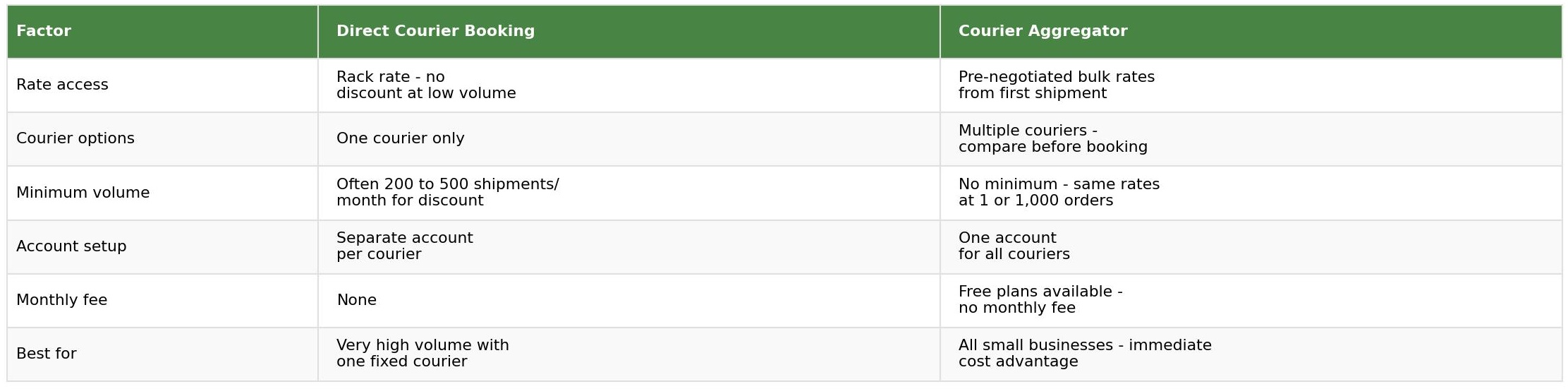
For virtually every small business in India below 5,000 monthly shipments, a courier aggregator gives better rates and more flexibility than direct booking. The rates aggregators negotiate across their combined volume are not accessible to small businesses booking individually - regardless of how much you negotiate.
Setting Up Your First Shipping Account
What You Need to Register
Mobile number and email address for account creation
Business name (can be your personal name if not yet registered)
GST number if registered (add later if not yet)
Bank account details for COD remittance
Pickup address - your home, office, or warehouse where orders will be collected
Registration typically takes 5 to 10 minutes. Watch How to Sign Up and Activate Your iCarry® Account for a step-by-step walkthrough of the complete setup process.
Packaging Your Products for Safe Delivery
Good packaging protects your product and your margin. A damaged delivery costs you the product, the return freight, and a customer relationship - all preventable with the right box and a few minutes of care.
Choosing the Right Box Size
The most important packaging decision: right-size your box. An oversized box inflates volumetric weight and costs you money on every single order. A box that fits snugly around your product (with 2 to 3 cm of padding on each side) minimises volumetric billing and protects the product from shifting in transit.
Keep 2 to 3 standard box sizes for your most common products. Measure each product category once, calculate the ideal box size, and order in bulk.
Basic Packaging by Product Type
Fashion and soft goods: Poly mailers for flat items (t-shirts, scarves, unframed prints). Corrugated for anything that can be crushed or requires structure
Electronics and accessories: Bubble wrap around the product, corrugated box with snug fit. Never poly mailers for hard or breakable products
Beauty and liquid products: Individual ziplock inner seal, corrugated outer. Never poly mailers for any liquid product
Books and paper: Book wrap or snug corrugated mailer. Polythene inner wrap for moisture protection
Jewellery and small accessories: Individual pouch or small box, rigid mailer outer. Photo the item before sealing for any dispute
How to Book a Shipment - Step by Step
Step 1: Weigh the sealed parcel on your scale. Record in grams.
Step 2: Measure length, breadth, height in centimetres. Calculate volumetric weight: L x B x H / 5,000.
Step 3: Log in to your courier aggregator account. Enter origin pincode, destination pincode, chargeable weight (higher of actual vs volumetric), and product category.
Step 4: Compare available rates across couriers. Select the best option for your order (rate vs transit time vs reliability for that route).
Step 5: Enter shipper and consignee details. Declare the order value. Select COD or prepaid. Confirm booking.
Step 6: Print the shipping label. Stick it clearly on the outer surface of the parcel.
Step 7: Hand over to the courier at pickup or drop at the nearest courier facility.
Watch How to Estimate Shipment Cost to see how rate comparison works before confirming any booking.
Managing COD Orders as a Small Business
COD (Cash on Delivery) remains important for reaching the broadest customer base in India - particularly first-time buyers who are not yet comfortable paying online for an unfamiliar brand. But COD comes with specific management requirements that prepaid orders do not.
COD Confirmation Before Dispatch
For every COD order, send the customer a WhatsApp message confirming their order before you dispatch. Ask them to reply to confirm. This eliminates the lowest-intent COD buyers - the impulse orders that would have become doorstep refusals - before you spend money on packaging and shipping.
COD Remittance
Cash collected by the courier on your COD orders is remitted back to your bank account after a settlement cycle. The standard cycle is T+7 - seven business days after delivery. For small businesses managing tight cash flow, knowing exactly when COD money arrives is important for planning inventory purchases.
As you scale, early remittance options (T+0 to T+4) allow faster access to COD collections at a small fee - useful during growth phases when cash flow timing matters.
RTO Risk on COD
COD orders have a higher return-to-origin (RTO) rate than prepaid orders. A customer who has not paid is more likely to refuse at the doorstep if they change their mind. Reducing COD RTO through order confirmation, tracking communication, and active follow-up on failed deliveries is one of the highest-impact habits a small business can build from day one.
Setting Your Shipping Prices
Decide how you will handle shipping cost for customers before your first order - not after:
Free shipping: Include shipping cost in your product price. Simple for customers - removes checkout friction. Requires careful cost modelling per zone to ensure you are not losing money on long-distance orders
Flat rate shipping: One shipping fee regardless of destination. Simple to communicate. Works well if your customer base is geographically concentrated
Actual cost shipping: Charge customers the actual courier cost based on their pincode and order weight. Most accurate but requires a rate calculator at checkout or manual communication for each order
Free shipping above a threshold: Free shipping for orders above ₹499 or ₹799. Increases average order value while keeping shipping cost manageable for smaller orders
Model your per-order shipping cost (base freight + fuel surcharge + COD fee if applicable) for your top 5 customer pincodes before deciding. The gap between Zone A and Zone E shipping on the same product can be ₹40 to ₹60 - significant on low-margin products.
Handling Returns as a Small Business
Returns are a reality of any shipping operation. As a small business, the key is having a clear policy before orders start - not figuring it out when the first return arrives.
Define your return window: 7 days is standard for most categories. Communicate it clearly at checkout and in the parcel insert
Define return conditions: Unused, original packaging, tags intact. Be specific about what constitutes a returnable item
Decide who pays return shipping: For low-value products, free return shipping often costs more than the product. For high-value products, absorbing return freight is part of the customer experience investment
Inspect every return before restocking: Grade A (resalable as new), Grade B (resalable at discount), Grade C (write off). Never relist a product that cannot honestly be sold as new
Tracking and Customer Communication
Small businesses that proactively communicate shipment status generate significantly fewer 'where is my order?' queries - which saves support time and builds customer trust.
Send the tracking number via WhatsApp immediately after dispatch
Share the courier name so customers know which app or website to track on
Send an out-for-delivery notification when the status updates
For orders that experience a delivery failure, contact the customer within 24 hours to reschedule
This level of proactive communication does not require expensive tools. A WhatsApp message with the AWB number and courier name, sent manually or through a template, is enough for businesses processing under 50 orders per day.
Common Shipping Mistakes Small Businesses Make
Not weighing after packaging: Declaring product weight without accounting for box and fill material causes weight discrepancy charges. Always weigh the sealed parcel
Using oversized boxes: The most expensive packaging mistake. A 100g product in a 30 x 25 x 20 cm box bills at 3,000g volumetric weight. Right-size always
Not comparing courier rates: Defaulting to the same courier for every order misses the ₹10 to ₹25 rate difference that often exists between couriers for the same route
Ignoring NDRs: A failed delivery notification that is not acted on within 24 hours becomes an RTO. Check for NDRs every morning
No COD confirmation step: Dispatching COD orders without buyer confirmation creates avoidable doorstep refusals. A 30-second WhatsApp message prevents them
No return policy communicated: Customers who do not know your return policy before ordering create ad-hoc disputes that take significantly more time to resolve than a clear policy prevents
Scaling Your Shipping Operation as Orders Grow

The tools and processes that work at 10 orders per day do not work at 200. Build the next stage's infrastructure before you need it - not when the current system breaks under volume.
How iCarry® Helps Small Businesses Ship Better
iCarry® is a courier aggregator founded in Bengaluru, trusted by 50,000+ Indian businesses, and specifically built to serve businesses of every size - from a home-based seller shipping 10 orders a week to a growing brand processing thousands of daily shipments. It is a courier aggregator that gives small businesses access to multiple courier partners at pre-negotiated rates from the very first shipment.
What iCarry® provides for small businesses:
Free Bronze plan: No monthly fee, no minimum volume, no contract. Rates from ₹21* per 500g. Access to multiple courier partners from day one
Live rate comparison: Compare Delhivery, Blue Dart, Xpressbees, Ekart, Amazon Shipping, Shree maruti, FedEx, Aramex and more before every booking
Delivery Boost: Trained agents who call your customers before delivery, audit fake NDRs, and coordinate reattempts - in the customer's regional language
Two-way WhatsApp engagement: Your customers receive delivery updates they can actually reply to - to reschedule, update their address, or confirm availability. You see every conversation
Address Quality Scoring: Flags risky or incomplete addresses before dispatch - preventing failed deliveries before they happen
Free daily COD remittance: Automatic T+7 settlement every business day with no manual action required, plus optional Early COD for faster access to your funds.
Store integrations: Connect Shopify, WooCommerce, Flipkart, and others in minutes for automatic order sync
For a small business shipping its first 50 orders or its 50,000th, iCarry® provides the same rates and tools without a minimum commitment. Register free at iCarry today.
Final Thoughts
Shipping does not have to be complicated. The fundamentals - right-sized packaging, accurate weight declaration, rate comparison before booking, COD confirmation, and daily NDR review - take under an hour to learn and under an hour per day to execute at most small business scales.
The businesses that get shipping right from the start avoid the spiral that catches many small sellers: growing order volumes with growing logistics problems, rising RTO rates eating into margin, and operational firefighting that consumes the founder's time instead of product development and customer acquisition.
Start simple. Get the basics right. Add tools as volume demands them. And treat logistics not as a cost to minimise but as a customer experience investment that directly determines whether your buyer comes back.
Frequently Asked Questions (FAQs)
How do small businesses in India start shipping?
Register on a courier aggregator. Set up your pickup address and COD remittance bank account. Get a weighing scale and right-sized packaging for your products. Book your first shipment by entering origin pincode, destination pincode, weight, and dimensions - compare rates across available couriers and confirm booking.
What is the cheapest way to ship for small businesses in India?
Join a courier aggregator to access pre-negotiated bulk rates that are 20 to 40% lower than direct booking rack rates. Right-size your packaging to avoid volumetric weight penalties. Compare courier rates before every booking rather than defaulting to one carrier. Shift COD orders to prepaid where possible to eliminate COD handling fees.
Do small businesses in India need GST to ship?
GST registration is not mandatory to start shipping. You can register on a courier aggregator and ship without a GSTIN. GST registration becomes mandatory once annual turnover exceeds ₹20 lakh (or ₹10 lakh in special category states). Add your GSTIN to your aggregator account when registered to claim ITC on courier invoices.
How much does shipping cost for a small business in India?
Indicative aggregator rates: ₹21 to ₹35 for 500g Zone A (same city), ₹35 to ₹58 for Zone B/C (regional), ₹58 to ₹85 for Zone D (national), ₹85 to ₹120 for Zone E (remote). COD handling fee adds ₹15 to ₹25 plus 1 to 2% of order value per COD shipment.
How do I reduce RTO as a small business?
Confirm every COD order via WhatsApp before dispatch. Act on every NDR within 24 hours. Enable Address Quality Scoring to catch bad addresses before dispatch. Use Delivery Boost for high-risk COD orders. Track your RTO rate by courier and route - replace underperforming couriers on specific pincodes with better alternatives.
Can I ship pan-India as a small business from day one?
Yes. A courier aggregator gives access to pan-India delivery coverage from the first shipment with no minimum volume. Coverage spans 29,000+ pincodes through multiple courier partners. Check pincode serviceability and ODA surcharge applicability before accepting orders from specific remote pincodes.
Shipping does not have to be complicated for small businesses in India - the fundamentals of right-sized packaging, accurate weight declaration, rate comparison before booking, COD confirmation, and daily NDR review take under an hour to learn and under an hour per day to execute at most small business scales. The businesses that get shipping right from the start avoid the spiral that catches many small sellers: growing order volumes with growing logistics problems, rising RTO rates eating into margin, and operational firefighting that consumes the founder's time instead of product development and customer acquisition.