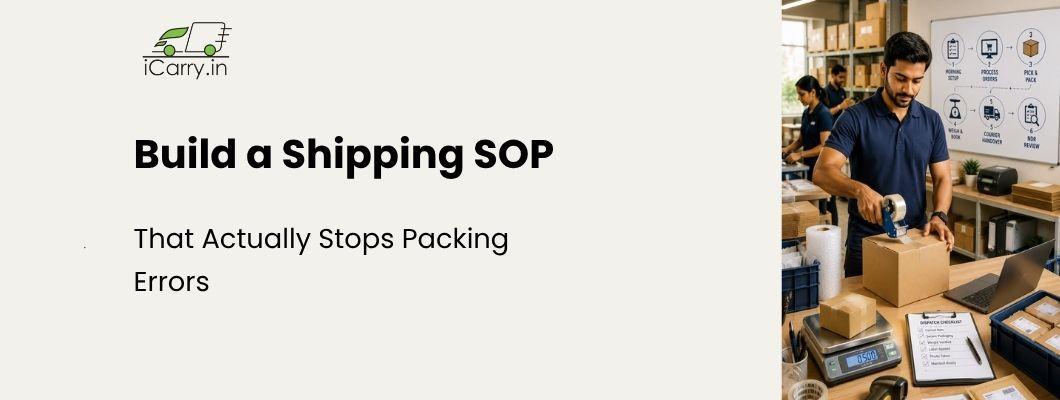
Two packers. Same business. Different days.
On Monday, Packer A processes 80 orders. Every parcel is weighed after sealing. Every COD order is photographed. Labels go flat on the top face of the box. Manifest is signed before handover. Zero errors.
On Wednesday, Packer B processes the same 80 orders. Seven parcels are weighed before sealing - without inserts. Three labels are applied to box seams. The manifest is not requested from the courier agent. Two COD declared values are entered incorrectly. Four wrong-box-size decisions are made.
Same business. Same product. Same volume. Different outcomes - not because of different people, but because there was no SOP. As Indian businesses scale their dispatch operations - and India's roughly 6.3 crore MSMEs (IBEF) rarely have the dedicated ops layer that makes consistency automatic - the SOP is what makes performance consistent regardless of who is working, what the volume is, or whether it is a regular day or a peak spike.
This guide walks through how to build a shipping SOP for your dispatch team - from the morning setup to the evening NDR check - with the specific steps, decisions, and standards that prevent the errors that cost money.
What Is a Shipping SOP?
A shipping SOP (Standard Operating Procedure) is a written, step-by-step document that tells anyone on the dispatch team exactly how to process, pack, weigh, and book an order - in the same order, the same way, every time. Instead of each packer relying on memory or whatever a senior colleague happened to show them, a shipping SOP makes the correct process the default, which is what prevents the packing errors, weight discrepancies, and missing documentation that come from inconsistent handling.
How to Check If Your Team Needs a Shipping SOP
- Do errors increase when a specific team member is absent?
- Do new hires make the same packing mistakes repeatedly?
- Does dispatch quality vary between days without an obvious reason?
- Has your team ever missed a courier pickup due to poor process timing?
- Are weight discrepancy charges or wrong-item errors a recurring problem?
If yes to any of these, an SOP is the fix. It is not complex to build - but it must be specific, written, and enforced.
What a Shipping SOP Covers
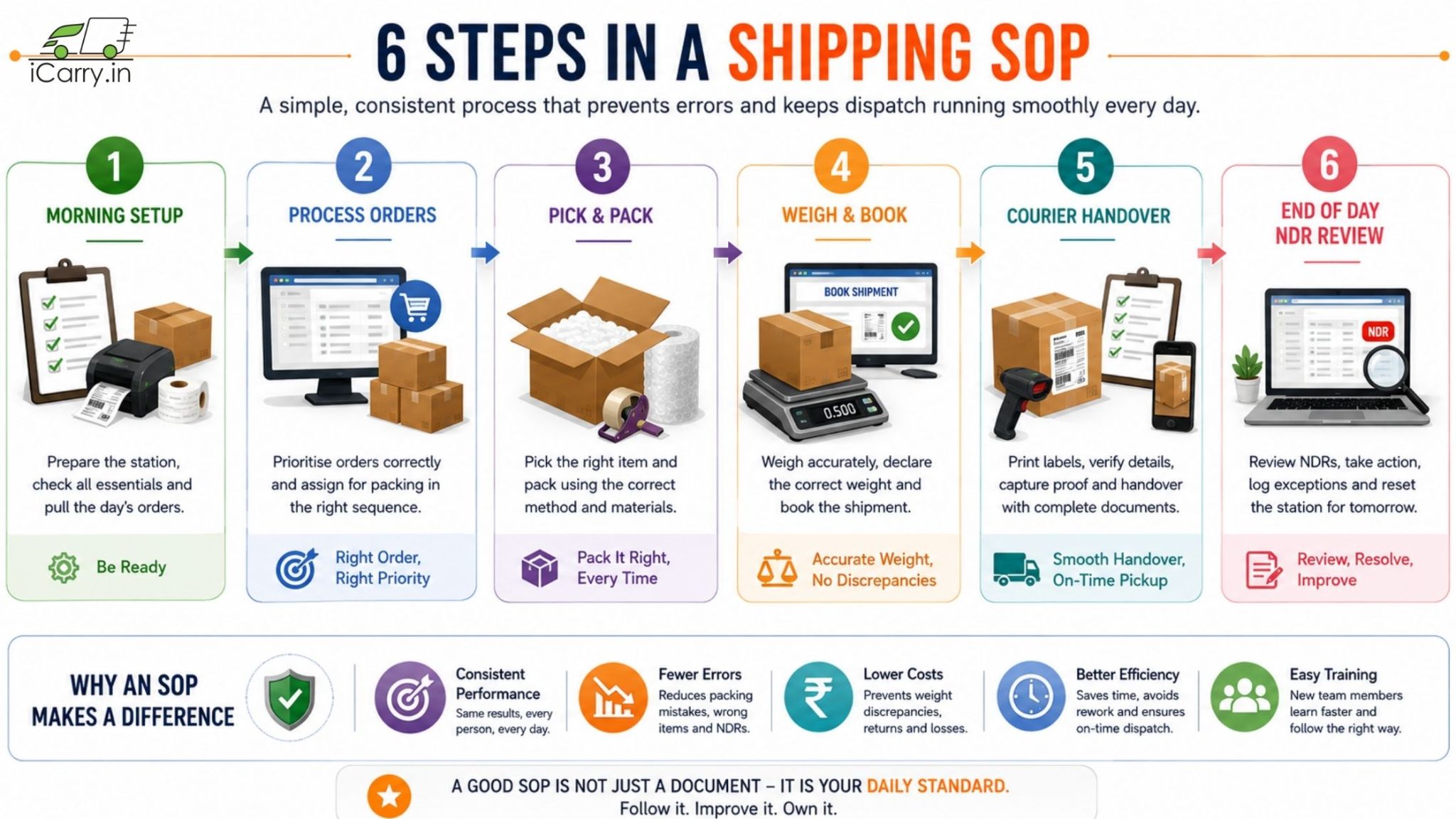
A complete dispatch SOP covers six areas:
- Morning setup: Preparing the station before the first order is processed
- Order processing: How orders are pulled, prioritised, and assigned
- Pick and pack: Exact steps from picking the product to sealing the parcel
- Weighing and booking: Accurate weight declaration and shipment booking
- Courier handover: Label printing, manifest, photography, and pickup
- End of day: NDR review, station reset, and exception logging
Section 1: Morning Setup SOP
Before the first order is processed, the dispatch station must be ready. A packer who has to stop mid-pack to find tape or refill bubble wrap wastes time and creates errors.
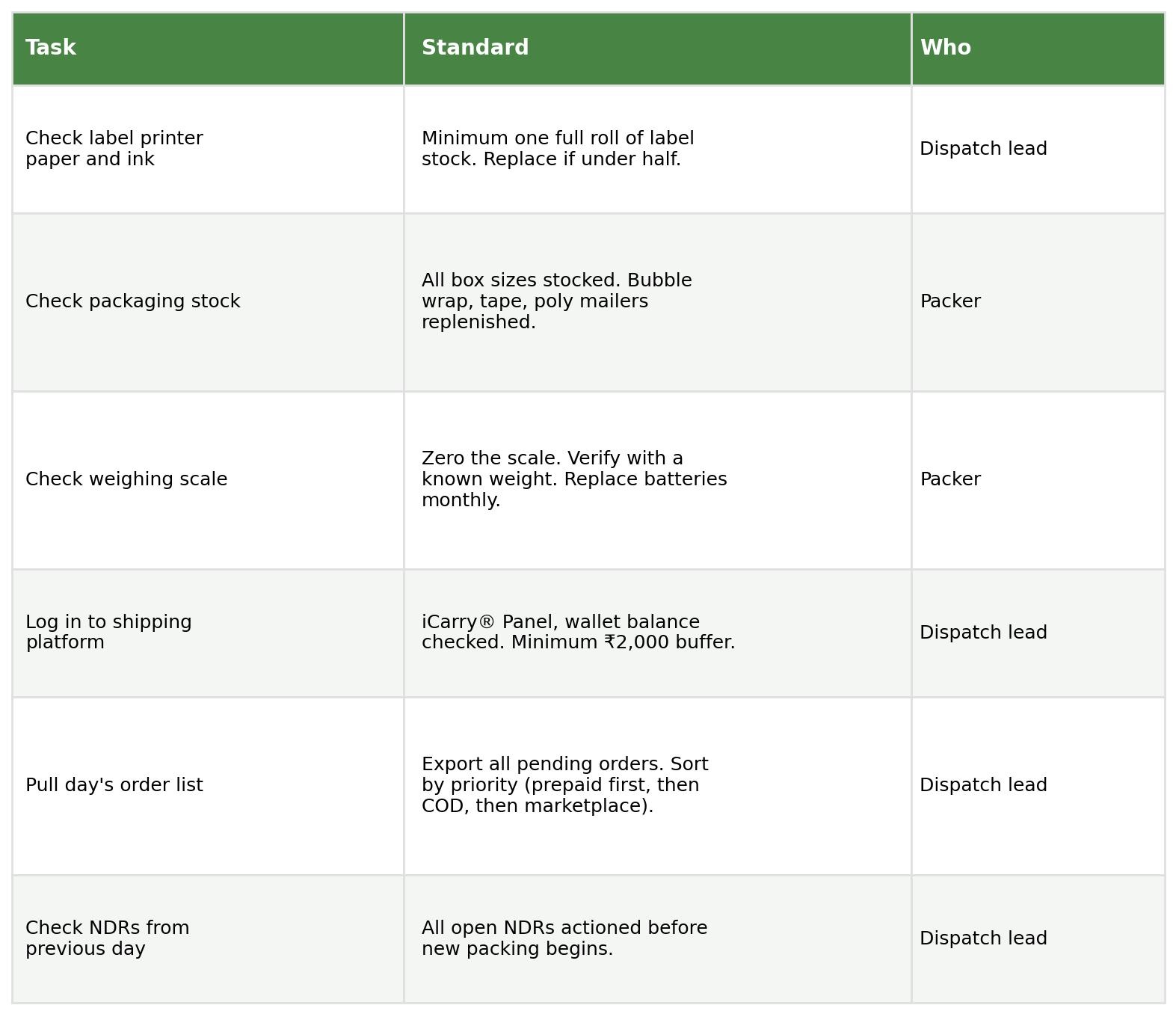
Morning setup should take 10 to 15 minutes. If it takes longer, the station is under-stocked. Fix the stocking, not the time.
Section 2: Order Processing SOP
Priority Order for Processing
- Priority 1 - Marketplace orders with dispatch SLA today: Late dispatch triggers marketplace penalties. Process first, without exception.
- Priority 2 - Prepaid orders (oldest first): Committed buyers. Process before COD.
- Priority 3 - COD orders (confirmed first): Only process COD orders that have received WhatsApp or phone confirmation from the customer. Unconfirmed COD orders are held.
- Priority 4 - Unconfirmed COD orders: Send confirmation message. Process only after confirmation received or after the 4-hour window closes.
COD Confirmation Step
For every COD order above ₹499: send a WhatsApp message to the customer within 30 minutes of order placement requesting confirmation before packing begins. This step is non-negotiable and must happen before the packing team touches the order.
Template: 'Hi [Name], your order for [Product] (₹[Amount] COD) has been placed. Please reply YES to confirm and we will dispatch today. Reply NO to cancel.'
Orders that do not confirm within 4 hours: call once. If no answer, hold the order. Do not dispatch unconfirmed high-value COD orders.
Section 3: Pick and Pack SOP
The pick and pack SOP defines every step from pulling the product off the shelf to sealing the outer box. It must be specific enough that a new hire can follow it on day one.
Step-by-Step Pack Procedure
- Step 1 - Pull the pick list: Match the SKU on the order to the product on the shelf. Do not pick by product name alone - always verify SKU code or barcode.
- Step 2 - Select the right box: Use the box reference chart posted at the station. Choose the smallest box that fits the product with 3 to 5 cm of cushioning on all sides. Do not use oversized boxes.
- Step 3 - Wrap fragile items: Any product on the fragile SKU list gets foam sheet wrap followed by minimum 2 layers of bubble wrap before boxing. Check the fragile product list at the station before every order.
- Step 4 - Insert packing slip and any inserts: Packing slip, promotional card, and any other inserts go in before the product is boxed - not after.
- Step 5 - Fill void space: No movement inside the sealed box. Pack until the contents are immovable. Shake test: if anything moves, add more fill.
- Step 6 - Pre-seal verification: Before sealing, read the order. Confirm: correct item, correct variant (size/colour), correct quantity. This check takes 15 seconds and prevents wrong-item returns.
- Step 7 - Seal: Tape top flap fully. Tape all side seams. No open edges.
Section 4: Weighing and Booking SOP
Weighing Standard
- Weigh only after the parcel is fully sealed with all inserts, void fill, and tape applied
- Write the weight in grams on the top flap of the box before booking
- Round up by 50g to account for scale variance from courier scales
- Never declare the product weight from the product label - always use the sealed parcel weight
Booking Standard
- Bulk book all confirmed orders in one session - not one at a time
- Verify the declared COD amount matches the order value for every COD shipment before confirming booking
- Enable declared value coverage for all shipments above ₹2,000
- Generate all labels for the session in one print run after bulk booking
- For rate comparison before booking: How to Estimate Shipment Cost shows the comparison process in iCarry®
Section 5: Courier Handover SOP
Label Application Standard
- Apply labels flat on the top face of the outer box only - never on a corner, seam, or edge
- Cover the entire label with clear tape - not just the edges
- Verify the label is readable, not bubbled, and not covering any box seam
- For fragile parcels: apply FRAGILE stickers on all four sides and the top before label is applied
Pre-Handover Photography
- For all shipments above ₹2,000: photograph the sealed parcel with AWB label clearly visible
- For all shipments above ₹5,000: photograph on the weighing scale with weight readable
- Store photographs against the AWB number - use a naming convention: AWB_date.jpg
- Photographs are non-negotiable for fragile, high-value, and COD orders. Make it a station habit, not a discretionary choice
Courier Pickup Handover
- Count all parcels against the manifest before the courier agent collects
- Require the courier agent to sign the manifest. If they refuse, call courier aggregator support before releasing parcels
- Keep the signed manifest - photograph it immediately after signing
- Print the shipment manifest from iCarry® before pickup. How to Print Shipment Label and Manifest shows the exact process
- No parcel leaves the premises without a signed manifest. No exceptions.
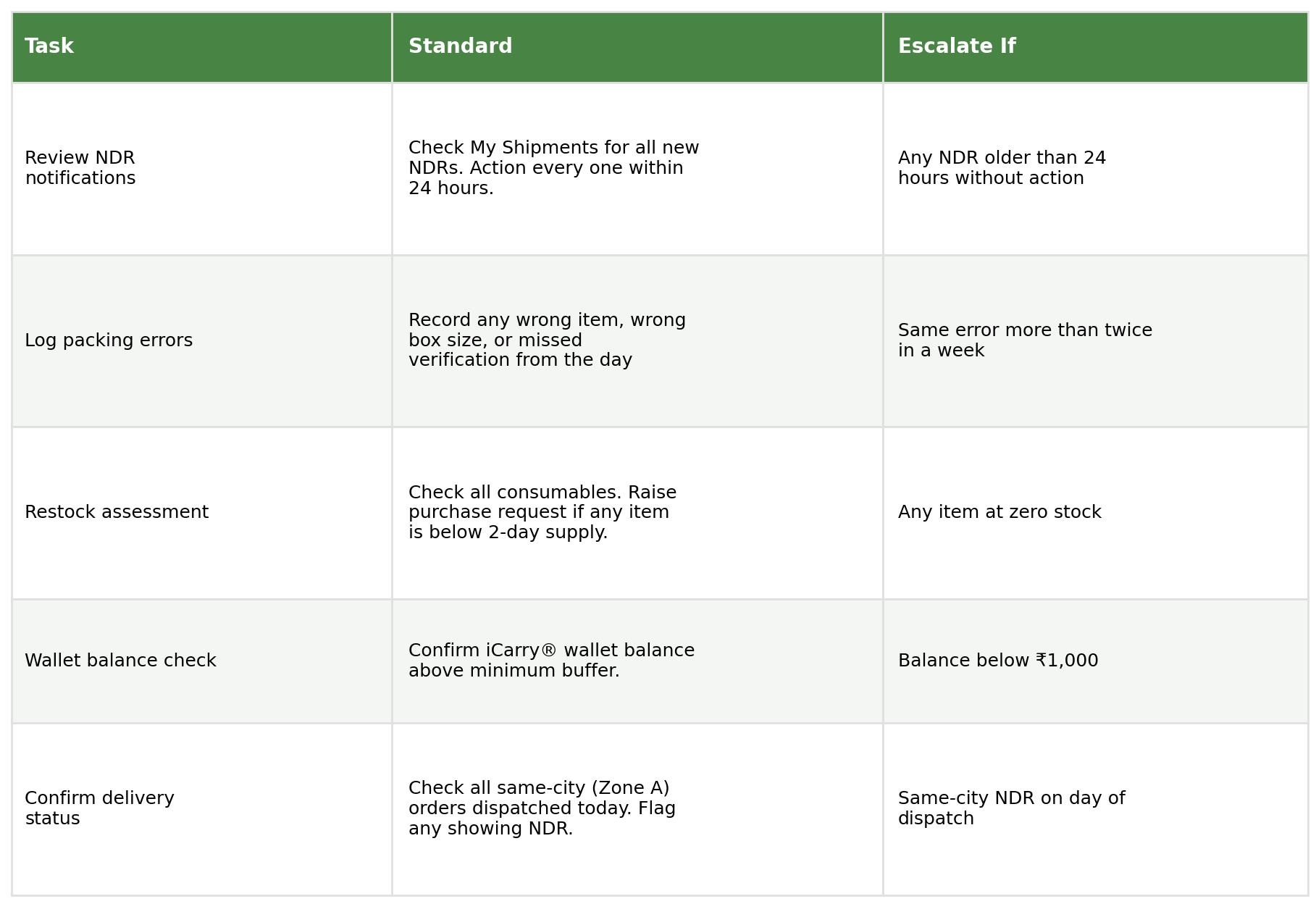
Section 6: End of Day SOP
Making the SOP Stick - Training and Enforcement
An SOP written and filed is worthless. An SOP trained, posted, and audited is a margin protection system.
- Train new hires before first live order: Walk through every step. Have them pack 10 test orders before processing a live one. Correct errors on test orders, not on customer shipments.
- Post the SOP at every station: Laminated, at eye level, in the language your packing team reads most comfortably. The SOP must be visible from the work position, not in a folder.
- Audit 10% of packed orders daily: Supervisor randomly checks 10% of sealed parcels before they go to the courier. Weight declared vs actual. Label placement. Photograph taken. Manifest signed.
- Update the SOP when errors repeat: If the same error appears more than twice in a month, the SOP has a gap. Add a specific step that prevents that error. The SOP is a living document.
- Seasonal review before every peak: Review and refresh the entire SOP before Diwali, year-end, and any major sale period. Temporary packers must be trained to the same standard as permanent staff.
How iCarry® Integrates With Your Dispatch SOP
iCarry® is a courier aggregator that provides the platform your SOP operates within - from order booking to manifest generation to NDR management:
- Bulk booking: All confirmed orders booked in one session. Eliminates individual booking inefficiency and ensures all orders are processed before the courier pickup window
- Label and manifest printing: One action to print all labels and the courier manifest for the day's dispatch. Reduces the time between pack-complete and courier handover
- NDR dashboard: All end-of-day NDR reviews happen in My Shipments - filterable by status, courier, and date. No missing an NDR because it came from a different courier
- Wallet management: End-of-day wallet balance check is a 10-second task in the dashboard
- Address Quality Scoring: Flags risky addresses before booking - preventing a correctly packed parcel being dispatched to an address that will fail delivery
- Free Bronze plan, no minimum volume.Register at iCarry.in.
Final Thoughts
A shipping SOP is the difference between a dispatch operation that runs on the founder's presence and one that runs on documented process. The founder who is in the warehouse every day ensuring quality is managing a people dependency. The founder who has built and enforced a written SOP is managing a system.
The SOP does not need to be long. It needs to be specific. A one-page checklist for each section, posted at the station, trained to every team member, and audited weekly is more valuable than a 20-page document in a folder that no one reads.
Build it once. Train it properly. Audit it consistently. Update it when errors repeat. The compounding value of consistent, error-free dispatch over 12 months - in reduced discrepancy charges, reduced wrong-item returns, and faster courier handover - is significant.
Frequently Asked Questions (FAQs)
What is a shipping SOP and why do businesses need one?
A shipping SOP (Standard Operating Procedure) is a written document that defines exactly how every step of the dispatch process should be done - from order prioritisation to packing, weighing, booking, courier handover, and NDR review. It ensures consistent dispatch quality regardless of who is working and prevents the errors that cause wrong-item returns, weight discrepancy charges, and missed courier pickups.
What should a shipping SOP include?
A complete shipping SOP covers morning station setup, order processing priority (marketplace first, then prepaid, then confirmed COD), pick and pack steps including the pre-seal verification check, weighing standard (sealed parcel only), booking standard (bulk booking, COD amount verification, declared value coverage), courier handover (label placement, photography, signed manifest), and end-of-day NDR review.
How do I enforce a shipping SOP with my dispatch team?
Post the SOP at every station in laminated format at eye level. Train every new hire before their first live order - have them pack 10 test orders first. Audit 10% of sealed parcels daily for weight declaration accuracy, label placement, and photograph compliance. Log errors and identify patterns - if the same error repeats more than twice in a month, update the SOP to specifically prevent it.
How often should I update my shipping SOP?
Review monthly as part of your delivery performance report - identify any recurring errors and add specific steps to prevent them. Update before every peak season with a full team refresh. Major updates are triggered by: new product categories with different packing requirements, courier changes, or new tools and integrations in your shipping platform.
What is the most important step in a packing SOP?
The pre-seal verification check - confirming the correct item, correct variant, correct quantity, and correct label before sealing. This 15-second step is the only point in the process where a wrong-item error can be caught before it ships. Wrong-item returns cost forward freight, return freight, replacement product, and a customer relationship. The verification step costs 15 seconds.
How does iCarry® support a dispatch SOP?
iCarry® provides bulk booking for all confirmed orders in one session, combined label and manifest printing, a centralised NDR dashboard for end-of-day review, Address Quality Scoring to flag risky addresses before dispatch, and multi-courier rate comparison before every booking. All key SOP steps - booking, labelling, manifesting, NDR management - happen within the iCarry® platform.
A shipping SOP is the difference between a dispatch operation that runs on the founder's presence and one that runs on documented process. It does not need to be long - it needs to be specific, posted at the station, trained to every team member, and audited weekly. Build it once, train it properly, audit it consistently, and update it whenever the same error repeats more than twice in a month. That compounding consistency is what turns a people-dependent operation into a system.