Introduction
Your metro orders deliver smoothly. 2-day delivery, high prepaid rates, low RTO. Then you look at your Tier 2 and Tier 3 orders - and the numbers are completely different. Higher RTO, more NDRs, slower transit, and address issues that keep coming back.
This is not a reason to avoid these markets. It is a reason to understand them better.
According to reports from Bain & Company, India's next phase of eCommerce growth is being driven increasingly by consumers outside major metros, with Tier 2 and smaller cities contributing significantly to new online shoppers. Brands that crack delivery to these cities have a structural advantage that metro-first competitors cannot easily replicate.
What Makes Tier 2 and Tier 3 Shipping Different in India?
Shipping to Tier 2 and Tier 3 cities in India involves structurally different logistics conditions compared to metro delivery - higher COD ratios (60-80%), more address ambiguity, ODA surcharges on remote pincodes, and higher fake NDR rates due to less-supervised franchise delivery networks. These are not random variations - they are consistent, predictable patterns that require different courier selection, NDR management, and COD handling strategies.
This breakdown covers the specific challenges of shipping to Tier 2 and Tier 3 India - and exactly what to do about each one.
Tier 2 vs Tier 3 Cities: What Changes for eCommerce Shipping?
Tier 2 and Tier 3 markets are often grouped together, but shipping challenges are not identical. A city with established courier infrastructure behaves very differently from a smaller town where last-mile delivery depends heavily on local networks.
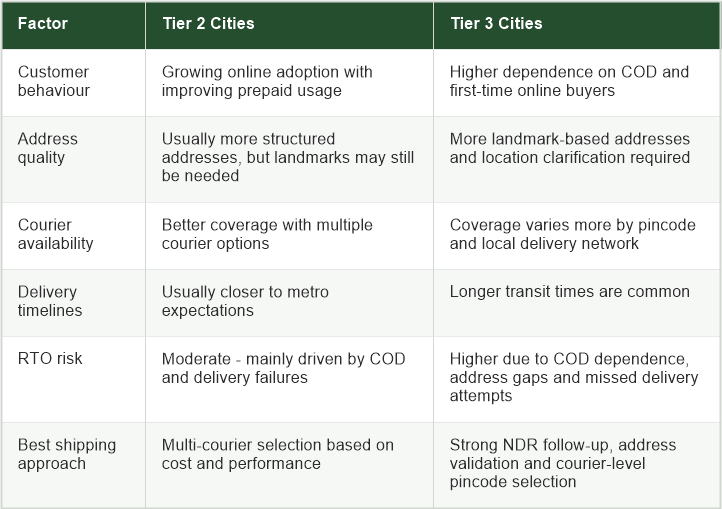
Understanding this difference helps brands avoid applying metro shipping strategies to smaller markets. The right courier, COD approach and delivery process should change based on where the customer is located.
Quick Checklist - Before You Expand to Tier 2 and Tier 3
- Have you verified pincode serviceability for your target cities before listing products there?
- Do you know which couriers actually perform in smaller towns - not just which ones claim coverage?
- Is your COD remittance set up to handle the higher COD ratio these markets typically generate?
- Do you have an NDR follow-up process ready? Tier 2 and Tier 3 failure rates are structurally higher.
- Are you accounting for ODA surcharges in your shipping cost model for remote pincodes?
- Is your address collection at checkout collecting enough detail - landmark, district, and nearest town?
Why Tier 2 and Tier 3 Shipping Is Different
Higher COD Ratio
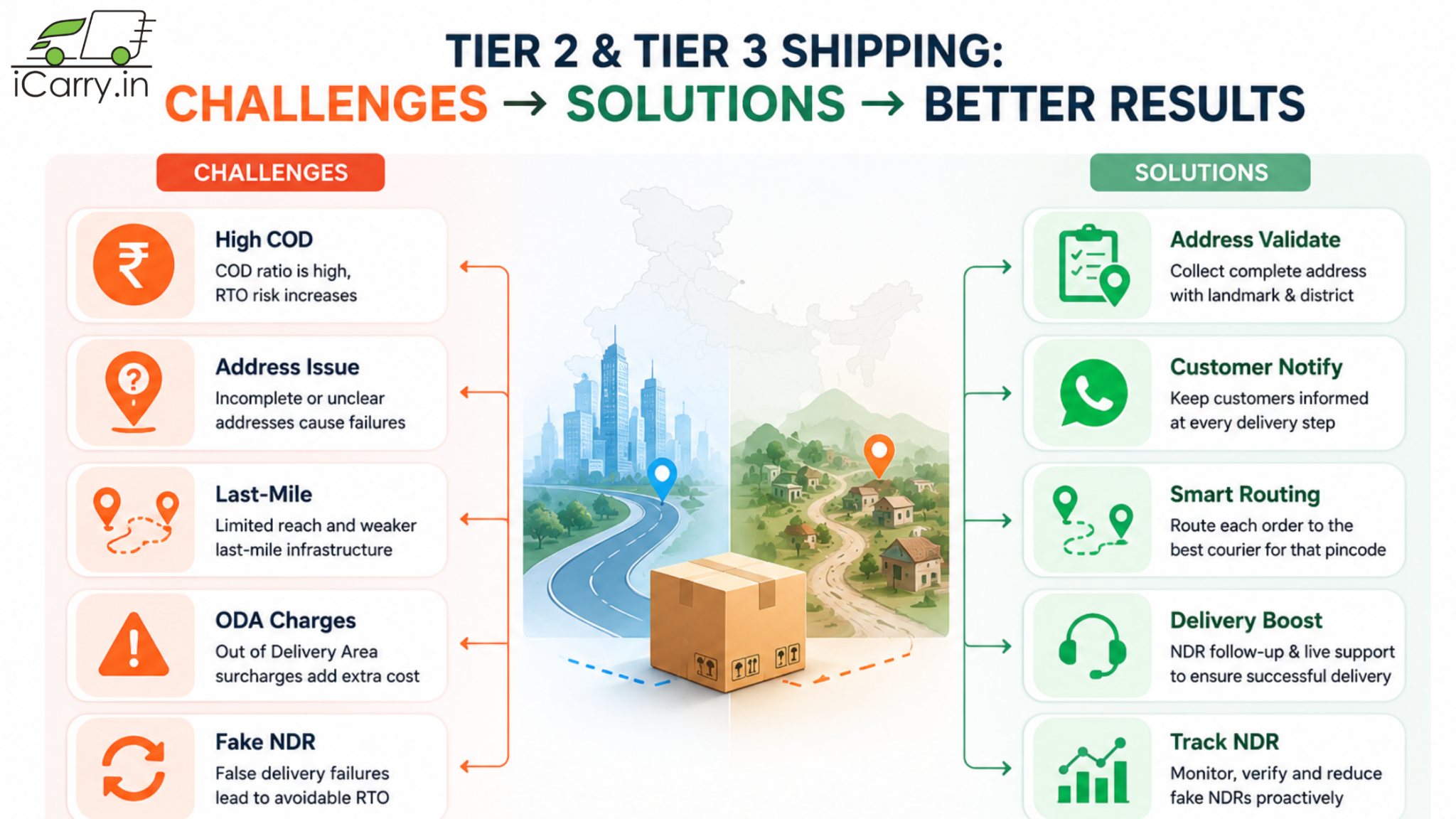
Prepaid adoption is lower in smaller cities. Most eCommerce brands shipping to Tier 2 and Tier 3 India see 60 to 80% COD ratios in these markets - significantly higher than metro orders. This means higher RTO risk on every order and a larger working capital gap from remittance delays.
Address Ambiguity
Unlike metros where pin codes are precise and addresses are standardised, Tier 2 and Tier 3 addresses often rely on local landmarks, colony names, or near-town references. Incomplete addresses are the leading cause of failed first-attempt deliveries in these markets.
Last-Mile Gaps
Courier networks thin out significantly beyond Tier 1 cities. Franchise delivery operations replace company-owned last-mile networks, and franchise accountability is harder to enforce. Last-mile delivery challenges in India explains why delivery failure rates in smaller towns are structurally different from metro failures - and what targeted interventions actually reduce them.
ODA Surcharges
Out of Delivery Area (ODA) surcharges apply to pincodes outside a courier's standard delivery zone. In Tier 2 and Tier 3 markets, ODA charges are more common and can add ₹30 to ₹100 per shipment on top of base freight. If you are not accounting for this in your pricing, it silently erodes margins.
Higher Fake NDR Rate
Courier delivery executives in smaller towns operate with less oversight. Fake non-delivery reports - where the courier marks a delivery as failed without making a genuine attempt - are more prevalent in Tier 2 and Tier 3 geographies. Each fake NDR that goes unchallenged becomes an avoidable RTO.
How Major Couriers Typically Perform in Tier 2 and Tier 3 Markets
Not all couriers perform equally outside metros. The courier that delivers 95% on-time in Bengaluru may struggle in Tier 2 cities.
Many sellers moving beyond metro markets also reconsider their courier aggregator setup because courier performance varies significantly by geography. See our comparison of the top Shiprocket alternatives in India.
Here is how major couriers compare in smaller markets:
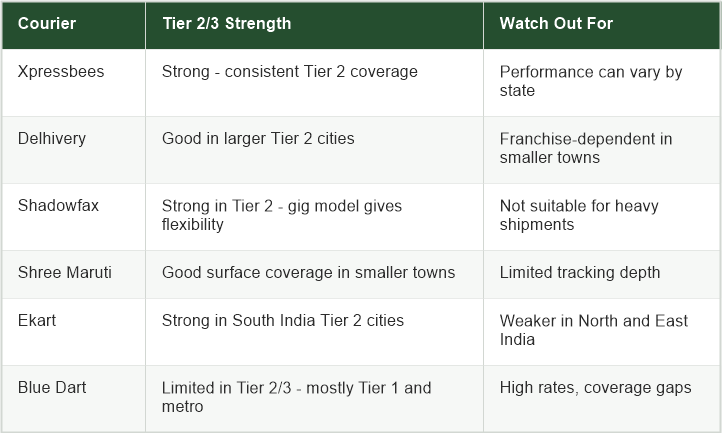
Note: Actual performance varies significantly by pincode, product category, shipment weight and local delivery network. Always evaluate courier performance at a pincode level rather than nationally.
The practical approach is to use multiple courier partners and route each Tier 2 or Tier 3 order to the courier with the best actual performance in that specific pincode. Multi-courier allocation allows you to build routing rules that automatically send orders to the right courier based on geography - without manual decision-making per order.
Before committing to any courier for a new Tier 2 or Tier 3 market, compare live rates across multiple couriers using an online rate calculator to see which option is most cost-effective for that specific pincode and weight.
Managing COD for Tier 2 and Tier 3 Markets
COD is not optional in these markets - it is the default. Managing it well is what separates profitable Tier 2 and Tier 3 operations from ones that bleed money on every return. Choosing the right courier for COD orders covers how to evaluate courier partners specifically on COD RTO rate and remittance reliability - the two metrics that matter most in these geographies.
iCarry® processes COD remittance automatically every business day at zero cost for all plans - including the free Bronze plan. For brands with high COD volume in Tier 2 and Tier 3, early remittance from T+0 to T+4 is available at a nominal fee to reduce working capital pressure.
Reducing RTO in Tier 2 and Tier 3 Cities
RTO is structurally higher in smaller cities. But a significant share of it is preventable.
- Validate addresses before dispatch: Ask for landmark, district, and nearest major town at checkout. An incomplete address in a small town has no fallback route for the delivery executive.
- Enable WhatsApp Engagement: iCarry®'s two-way WhatsApp notifications from +91-63621-82961 keep customers informed at every stage while allowing them to respond for delivery coordination, address updates, or queries. All interactions are recorded as timestamped logs, enabling sellers to view complete communication history and proof of customer notification within the iCarry® panel. In markets where delivery agents may not call before attempting delivery, these notifications significantly improve first-attempt success by ensuring customers are aware and prepared.
- Use Delivery Boost for high-value COD orders: iCarry®'s trained agents call customers on your behalf, audit fake NDRs, and open tickets with couriers - particularly valuable in Tier 2 and Tier 3 markets where franchise accountability is weaker.
- Enable OTP Verified Delivery: For high-value orders in smaller cities, delivery verification becomes increasingly important because dispute resolution depends heavily on available delivery evidence. Learn more about OTP Verified Delivery in ecommerce.
- Act on NDRs within 24 hours: Every hour of delay on an NDR in a smaller city reduces reattempt success probability. Check your NDR section daily, not weekly.
The full guide for reducing RTO in Indian eCommerce applies with even more urgency in Tier 2 and Tier 3 markets where base RTO rates start higher.
Using iCarry® for Tier 2 and Tier 3 Shipping
iCarry® covers 29,000+ pincodes across India through multiple courier partners - including deep Tier 2 and Tier 3 coverage through Amazon shipping, ekart, Xpressbees, Delhivery, Shadowfax, Shree Maruti, and DTDC. No single courier covers every smaller city well. Access to multiple options from one platform is what makes consistent Tier 2 and Tier 3 delivery operationally manageable.
You can monitor every shipment - including NDR status, transit delays, and delivery confirmation in smaller cities - from the My Shipments dashboard. For a full walkthrough, watch Overview of My Account > My Shipments to see how iCarry® tracks shipments across all couriers from one view.
For sellers worried about NDR patterns in specific pincodes, iCarry®'s NDR section shows every failed delivery attempt with the courier's stated reason - making it straightforward to identify which pincodes and couriers are generating disproportionate failures.
Final Thoughts
Tier 2 and Tier 3 cities are where India's eCommerce growth is actually happening. The challenges are real - higher COD ratios, address gaps, ODA surcharges, and weaker last-mile accountability. But none of them are insurmountable.
The brands winning in these markets use multiple couriers routed by pincode performance, validate addresses at checkout, follow up on NDRs within 24 hours, and treat RTO reduction as a weekly operational priority rather than an afterthought.
iCarry® gives sellers access to multiple courier partners covering 29,000+ pincodes, free daily COD remittance, Delivery Boost, WhatsApp Engagement, and a dedicated NDR dashboard - all from a free Bronze plan with no minimum volume. Start with a free sign up.
Frequently Asked Questions (FAQs)
Which courier is best for Tier 2 and Tier 3 cities in India?
No single courier is best for all Tier 2 and Tier 3 pincodes. Amazon shipping, ekart, Xpressbees, Shadowfax, Shree Maruti, and Delhivery all have meaningful smaller-city coverage. The right approach is using multiple courier partners and routing each order to the best performer for that specific pincode.
Why is RTO higher in Tier 2 and Tier 3 cities?
Higher COD ratios, address ambiguity, weaker last-mile accountability in franchise networks, and higher rates of fake NDRs all contribute to structurally higher RTO in smaller cities compared to metros.
What is an ODA surcharge and how does it affect Tier 2/3 shipping?
ODA (Out of Delivery Area) surcharges apply to pincodes outside a courier's standard delivery zone. In Tier 2 and Tier 3 markets, more pincodes attract ODA charges - typically ₹30 to ₹100 extra per shipment. Always check for ODA applicability before listing products to customers in new smaller cities.
How do I reduce COD RTO in smaller Indian cities?
Collect complete addresses at checkout (landmark, district, nearest town), send WhatsApp delivery confirmations before dispatch, act on NDRs within 24 hours, use Delivery Boost for high-value COD orders, and route COD orders to couriers with the best RTO track record in those specific pincodes.
Does iCarry® cover Tier 2 and Tier 3 cities?
Yes. iCarry® covers 29,000+ pincodes across India through multiple courier partners. This includes deep Tier 2 and Tier 3 coverage through partners like Amazon shipping, ekart, Xpressbees, Shadowfax, Shree Maruti, DTDC, and Delhivery. Use iCarry®'s pincode serviceability check before booking to confirm coverage for specific destinations.
How much does it cost to ship to Tier 2 and Tier 3 cities in India?
Shipping costs depend on the shipment weight, destination pincode, courier partner, COD/prepaid type, and ODA charges. Tier 2 and Tier 3 deliveries can sometimes cost more due to longer routes and higher last-mile complexity.
The cheapest option is not always the lowest cost overall - courier performance, RTO rates, and COD handling also impact your final cost per delivered order. Using a multi-courier platform helps compare options and choose the right courier based on the shipment.
Shipping to Tier 2 and Tier 3 cities in India involves higher COD ratios, address ambiguity, ODA surcharges, and higher fake NDR rates than metro delivery - but none of these are insurmountable. The right approach uses multiple couriers routed by pincode performance, complete address collection at checkout, 24-hour NDR follow-up, and tools like Delivery Boost and WhatsApp Engagement to improve first-attempt delivery success.