
You went from 20 orders a day to 200. The same corner of your garage that worked six months ago is now a pile of mislabeled boxes, misplaced stock, and late dispatches. Your team is spending more time searching for inventory than actually shipping it.
Warehouse management is one of the most overlooked growth bottlenecks for Indian D2C brands. Most founders fix marketing, fix the product, fix the website - and discover the warehouse problem only when it is already costing them customer complaints, delayed refunds, and missed same-day dispatch windows.
What Is Warehouse Management for D2C Brands?
Warehouse management for D2C brands is the system of processes that controls how inventory is received, stored, picked, packed, and dispatched from a fulfilment location. For D2C brands in India, this includes everything from SKU location mapping and stock tracking to packing station setup and same-day dispatch cut-off times. Unlike marketplace sellers who outsource this to FBA or FBF, D2C brands carry the full operational responsibility - and the full margin benefit when they get it right.
The brands that scale smoothly are rarely the ones with the biggest warehouses. They are usually the ones with the most consistent fulfilment processes. As order volumes grow, small inefficiencies in storage, picking, and dispatch become expensive very quickly.
This breakdown covers the core components of warehouse management for Indian D2C brands, common mistakes, and best practices that apply whether you are operating from 200 square feet or 2,000.
Quick Checklist - Is Your Warehouse Ready to Scale?
Before reading further, check where your current operation stands:
- Can any team member locate any SKU in under 60 seconds without asking someone else?
- Do you have a defined picking sequence that minimises movement across your storage area?
- Are all inbound products inspected, counted, and labelled before being stored?
- Do you have a minimum stock threshold for each SKU that triggers a reorder before you run out?
- Is your packing station set up so every standard order can be packed and labelled in under 3 minutes?
- Are dispatches happening within a consistent window daily - not whenever someone gets around to it?
- Do you track inventory digitally rather than relying on memory or physical notes?
Three or more no answers means your warehouse process has room to improve before it becomes a ceiling on your growth.
Why Warehouse Management Matters More for D2C Than Marketplaces
When you sell on Amazon or Flipkart through FBA or FBF, the marketplace handles warehousing, picking, packing, and dispatch. You pay for it through fulfillment fees, but the operational complexity is off your plate.
D2C brands carry all of that complexity themselves. Every delayed dispatch is your problem. Every mispicked order is your return. Every stockout is a lost sale you cannot blame on someone else.
This is the operational tax that D2C brands pay for the higher margins and customer relationship ownership that make the model worth it. Managing it well is what separates D2C brands that build compounding advantages from those that hit a growth ceiling.
Core Components of Warehouse Management for D2C Brands
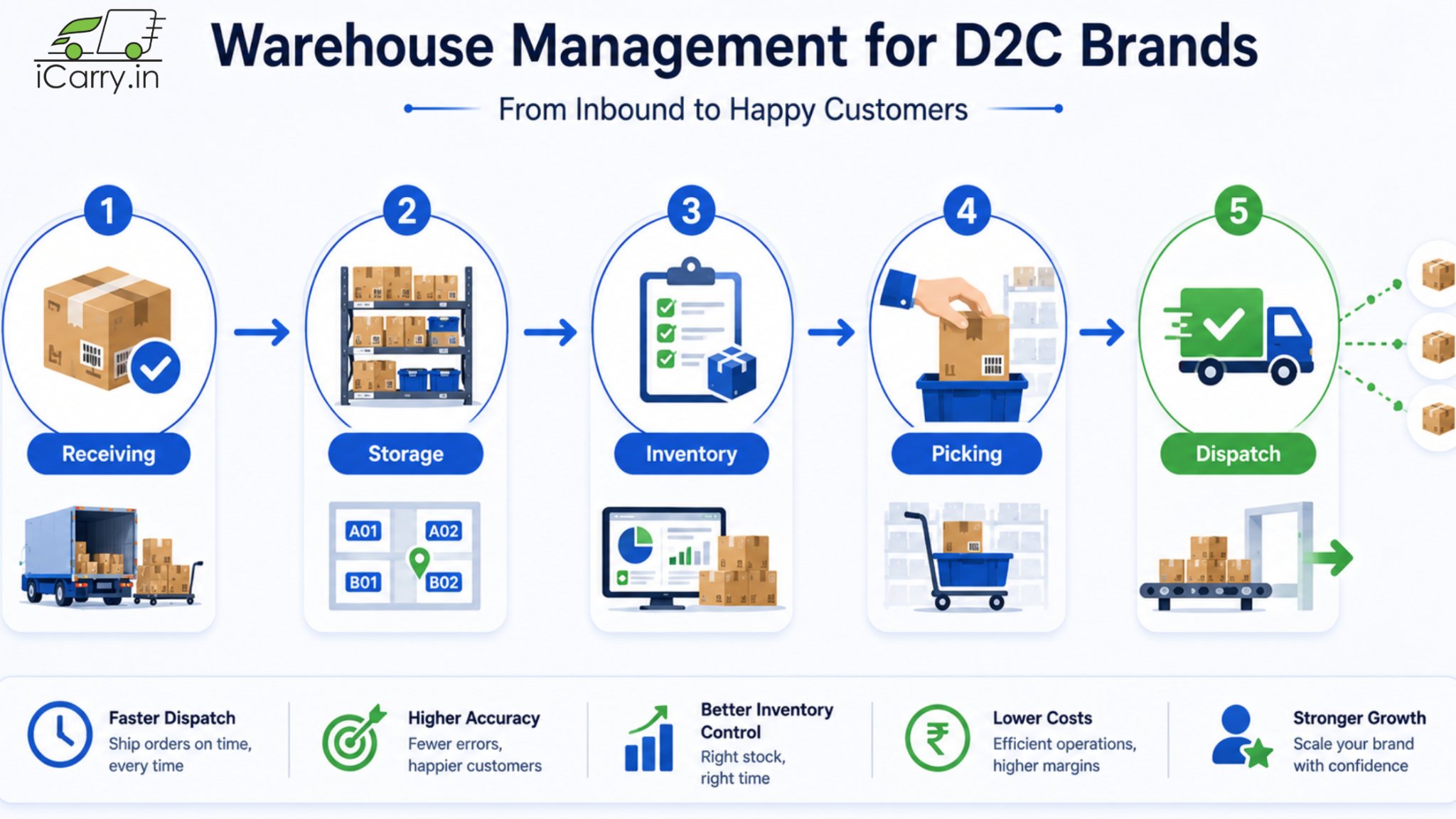
1. Receiving and Inward Processing
Every product that enters your warehouse should go through a consistent inward check before it is stored. Count against the purchase order. Inspect for damage. Label with SKU and batch if relevant. Enter into your inventory system.
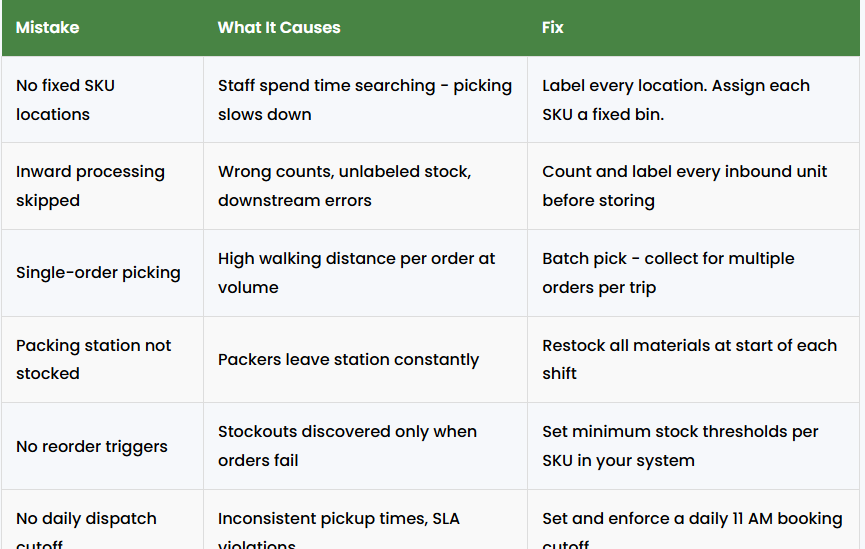
Skipping this step to save time creates problems downstream - wrong counts, unlabeled stock, and units that cannot be located when an order arrives. Most D2C warehouse errors trace back to rushed inward processing.
2. Storage and Location Management
Give every SKU a fixed location. This sounds obvious, but most early-stage D2C warehouses operate on memory - someone just knows where things are. When that person is sick or leaves, the warehouse stops functioning efficiently.
Label every shelf, bin, and rack. Map product locations in a simple document or spreadsheet. Fast-moving SKUs should be closest to the packing station. Slow-moving and overstock should be stored furthest away.
3. Inventory Tracking
Real-time inventory visibility - knowing exactly how many units of each SKU you have at any moment - is the foundation of everything else in warehouse management. Without it, you cannot forecast reorders, cannot prevent stockouts, and cannot reconcile losses.
For most D2C brands at early to mid-scale, a spreadsheet-based system works until 50 to 100 daily orders. Above that volume, a dedicated inventory management software becomes a genuine operational necessity rather than a nice-to-have.
4. Order Picking
Picking is the process of collecting the right products for each order from storage. At low volumes, a picker reads the order and walks the warehouse. At higher volumes, picking efficiency becomes a throughput constraint.
Batch picking - collecting items for multiple orders in a single warehouse walk - is the single most effective picking optimisation for D2C brands. Group orders by similar SKUs, pick everything in one trip, then sort and pack at a dedicated station. This reduces picker walking time by 30 to 50% compared to order-by-order picking.
5. Packing and Labelling
The packing station should have every material needed within arm's reach - boxes, tape, bubble wrap, void fill, brand inserts, and a label printer. A packer who has to leave the station to get supplies is a packer who is adding 30 to 60 seconds per order.
Standardise your packaging by weight range and product category. Pre-fold boxes at the start of each shift. Pre-cut common tape lengths. Small setup investments at the start of a shift save significant time across the full day's order volume.
6. Dispatch and Handover
Dispatch is where the warehouse connects to shipping. Once an order is packed and labelled, it needs to be booked with a courier, manifested, and handed over to the pickup agent. The faster this happens after packing, the sooner the customer's order is in the courier's network. To see how courier booking and manifest generation work at the point of dispatch, watch for a walkthrough of how iCarry® manages the post-packing workflow.
Set a daily dispatch cutoff time - typically 11 AM for same-day pickup with most couriers. Any order packed before the cutoff time ships same day. Any order packed after, ships next day. Communicating this cutoff clearly to your team creates a natural daily rhythm.
Common Warehouse Mistakes D2C Brands Make
How the Dispatch Stage Connects to Shipping Performance
Warehouse management ends at the dispatch stage. Shipping performance begins there. How efficiently your team books, labels, and hands over parcels directly determines whether you meet courier SLAs, avoid late dispatch penalties on marketplaces, and give customers accurate delivery ETAs.
iCarry® is an online courier aggregator platform - currently does not provide offline warehousing. So the moment your packed orders are ready for dispatch, iCarry® handles everything that follows. Multiple courier partners accessible from one platform, live rate comparison before every booking, bulk shipment processing for high-volume dispatch windows, and COD remittance run automatically. For your reference on how courier rate comparison works immediately after packing, How to Estimate Shipment Cost shows exactly how to check rates across multiple couriers before committing to a booking.
The tighter your warehouse dispatch window, the more effectively iCarry® can be used. Brands that pack orders in batches and book in bulk through iCarry® process their full dispatch queue in minutes rather than hours. Reducing shipping costs starts with knowing your exact chargeable weight at packing - something accurate labelling and weight recording during dispatch makes straightforward.
Warehouse Metrics Every D2C Brand Should Track
Warehouse efficiency can only improve when it is measured. These are the metrics that matter most - track them weekly alongside your logistics KPIs for a complete operational picture:
- Order processing time: From order placed to packed and ready for pickup. Target under 4 hours for same-day dispatch.
- Picking accuracy rate: Percentage of orders picked correctly on first attempt. Below 98% indicates a storage organisation or labelling problem.
- Inventory accuracy: System count vs physical count per SKU. Run a weekly spot check on fast-moving SKUs.
- Stockout rate: Percentage of orders that could not be fulfilled due to zero inventory. Even one stockout per 100 orders indicates a reorder trigger problem.
- Returns due to wrong item: A direct reflection of picking accuracy. Track separately from courier-caused returns.
Managing Returns Without Creating Inventory Chaos
Returns are part of warehouse management whether you sell fashion, beauty products, electronics, or home goods.
The mistake many brands make is treating returned inventory as an afterthought. Products arrive back at the warehouse and sit in a corner waiting to be checked. Over time, this creates stock inaccuracies, delayed refunds, and inventory that exists physically but cannot be sold.
Create a simple returns workflow:
- Inspect returned products within 24 to 48 hours of arrival
- Separate sellable, damaged, and defective inventory immediately
- Restock approved items back into their assigned locations
- Update inventory records the same day
- Track return reasons to identify recurring product or packaging issues
A well-managed returns process improves inventory accuracy, speeds up customer refunds, and prevents working capital from getting stuck in unsellable stock.
When to Outsource to a 3PL
Third-party logistics (3PL) providers handle warehousing, picking, packing, and dispatch on your behalf. You store inventory at their facility and they fulfill your orders.
3PL makes sense when: your order volume exceeds the capacity of your self-managed warehouse, you are expanding to serve customers in a different city and need regional inventory placement, or your team's time is better spent on product and marketing than on daily fulfillment operations.
The shipping and courier side of the operation remains the same whether you use a 3PL or self-manage. iCarry®'s API integration works with both setups - 3PL providers can connect their systems to iCarry® to book shipments directly. Multi-courier allocation is equally relevant whether the person booking the shipment is in your warehouse or your 3PL partner's facility.
Final Thoughts
Warehouse management is not glamorous. It does not show up in your Instagram feed or your brand story. But it is the operational foundation that determines whether your D2C brand can actually deliver on the customer experience it promises.
Start simple. Fix the basics - location labelling, inward processing, batch picking, a daily dispatch cutoff. These changes cost nothing and improve throughput immediately. Add digital inventory tracking as volume grows. Consider 3PL when self-management becomes the constraint.
And when your packed orders are ready to leave the warehouse, iCarry® handles the rest - multiple courier partners, live rate comparison, bulk booking, free COD remittance, and real-time tracking from one platform. Start free at iCarry.in.
Frequently Asked Questions (FAQs)
What is a Warehouse Management System?
A Warehouse Management System (WMS) is software that helps businesses manage inventory, storage locations, picking, packing, and dispatch operations. As order volume increases, a WMS improves inventory accuracy, reduces manual errors, and gives real-time visibility into stock levels across the warehouse.
In simpler words, it is the system of processes that govern how your D2C brand receives, stores, picks, packs, and dispatches inventory. Effective warehouse management reduces errors, speeds up fulfilment, prevents stockouts, and ensures orders leave your warehouse on time and correctly packed.
What are the most important warehouse KPIs for D2C brands?
The most important warehouse KPIs include inventory accuracy, picking accuracy, order processing time, stockout rate, dispatch turnaround time, and returns due to wrong-item shipment. Tracking these metrics regularly helps identify operational bottlenecks before they begin affecting customer experience.
When should a D2C brand invest in warehouse management software?
A basic spreadsheet system works up to 50 to 100 daily orders. Above that, dedicated inventory and warehouse management software significantly reduces picking errors, improves stock visibility, and saves daily operational time that outweighs the software cost.
What is batch picking and why does it matter?
Batch picking means collecting items for multiple orders in a single warehouse walk rather than completing one order at a time. It reduces total picker walking distance by 30 to 50% at moderate to high order volumes - one of the highest-impact low-cost efficiency improvements available to D2C warehouses.
How does dispatch efficiency affect customer experience?
Faster dispatch means faster delivery. Orders packed and handed to the courier before 11 AM ship the same day. Orders dispatched in the afternoon ship the next day. Consistent same-day dispatch builds the kind of delivery reliability that drives repeat purchases.
Does iCarry® offer warehousing for D2C brands?
iCarry® is an online courier aggregator - we provide access to multiple courier partners for shipping from your existing location anywhere in India. Once your orders are packed and ready for dispatch, iCarry® handles the booking, labelling, tracking, and COD remittance side of the operation. Currently it does not offer offline warehousing service.
What is the right time to move to a 3PL?
Consider a 3PL when self-managed fulfillment is consuming more of your team's time than it should, when order volume consistently exceeds your warehouse capacity, or when you need regional inventory placement to reduce delivery timelines. The shipping integration with iCarry® works the same way through a 3PL as it does in a self-managed setup. Reducing RTO remains equally important whether you or a 3PL is running the warehouse.
How do I prevent stockouts in a D2C warehouse?
Set a minimum stock threshold for every SKU based on your average daily sales and your supplier lead time. When stock drops to the threshold, trigger a reorder. Review fast-moving SKU thresholds monthly as order volume grows - a threshold set when you shipped 30 orders per day may not protect you when you ship 150.
Warehouse management is the operational foundation of D2C fulfilment. Start with the basics - fixed SKU locations, inward processing, batch picking, and a daily dispatch cutoff. These changes cost nothing and improve throughput immediately. When your packed orders are ready, iCarry® handles the courier booking, rate comparison, and COD remittance from one platform.