Your tracking dashboard shows a new status: 'Delivery Exception - Customer Not Available.' Three words that mean nothing to a first-time seller and everything to an experienced one.
A delivery exception is any event that prevents a shipment from being delivered as planned. It is not a loss. It is not damage. It is a deviation from the normal delivery path that requires action - from you, the courier, or the customer - to get the shipment back on track.
In India's courier ecosystem, delivery exceptions are common. With millions of daily shipments crossing diverse geographies - from metro high-rises to Tier 3 districts with challenging address formats - exceptions occur on a meaningful percentage of every courier's daily delivery load. Last-mile handling is already a large share of what businesses pay for logistics - India's overall logistics cost is estimated at 7.97% of GDP, per the government's latest NCAER-DPIIT assessment - so every exception that turns into an RTO adds directly to that spend. The businesses that manage exceptions well have lower RTO rates, better customer satisfaction scores, and meaningfully lower logistics costs. The ones that don't absorb the full cost of every exception that converts to RTO.
This guide explains what delivery exceptions are, the most common types in India, and exactly what to do with each one.
What Is a Delivery Exception?
A delivery exception is a status the courier applies when a shipment cannot be delivered as planned and needs action before the next attempt - common causes include the customer being unavailable, an unclear address, or a refused parcel. It does not mean the shipment is lost or damaged; it means the courier is waiting on you, the customer, or itself to resolve something first.
Quick Checklist - When a Delivery Exception Appears
- Have you identified which type of exception it is? Each type has a different resolution.
- Have you acted within 24 hours? The reattempt window narrows quickly after an exception.
- Have you contacted the customer directly to inform them and gather updated delivery information?
- Have you updated delivery instructions in your courier aggregator dashboard?
- Have you confirmed the exception is genuine and not a fake NDR?
What a Delivery Exception Actually Means
A delivery exception is a notification from the courier indicating that a shipment could not be delivered as planned and requires intervention before delivery can be completed. It appears as a specific status code or message in the tracking system.
The word 'exception' simply means the delivery fell outside the normal successful delivery path. It does not automatically mean the shipment is lost, damaged, or going to be returned - it means something happened that needs to be addressed before the next delivery attempt.
The speed and quality of your response to a delivery exception is what determines whether it resolves into a successful delivery or escalates into an RTO.
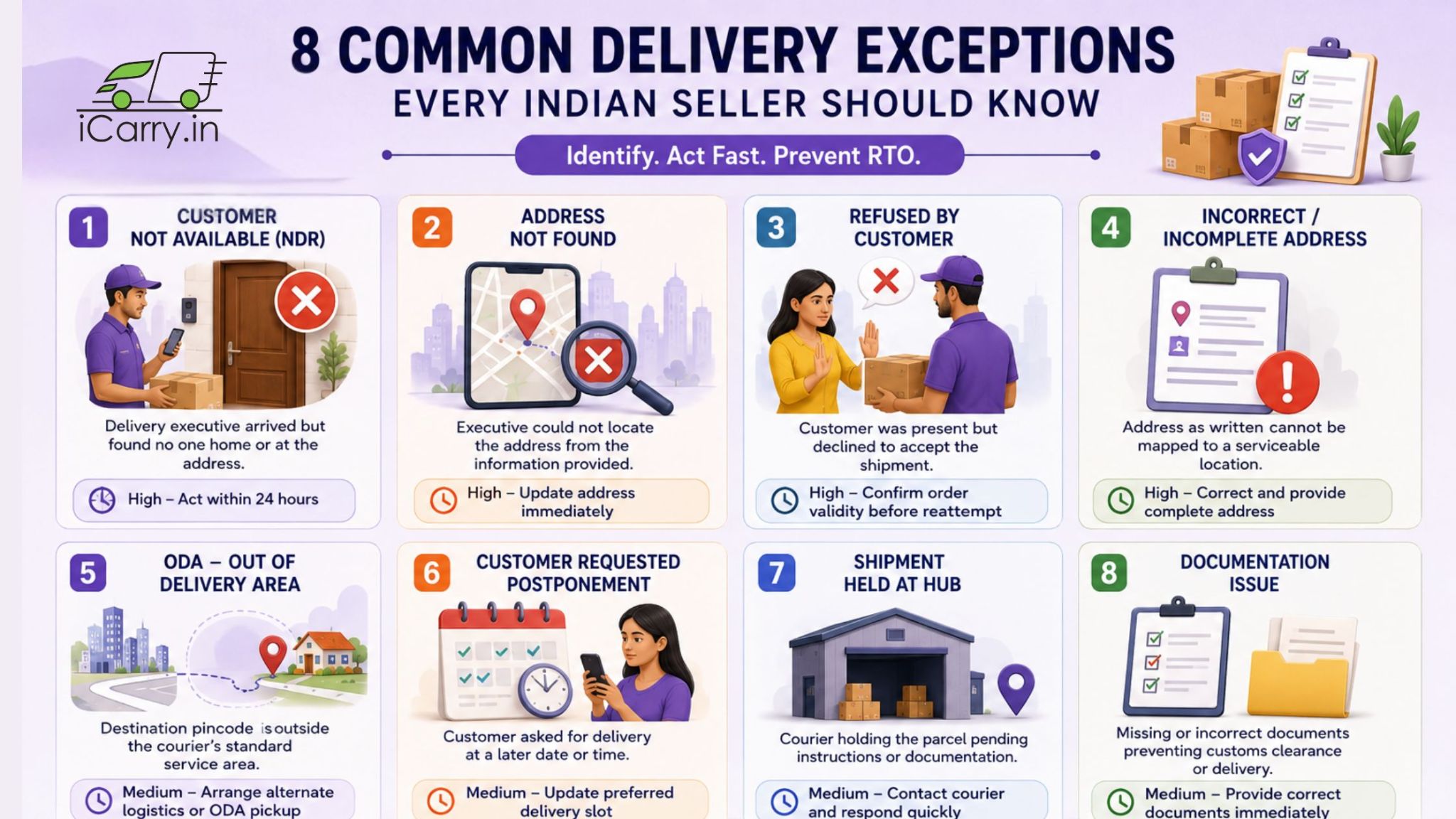
The Most Common Delivery Exceptions in India
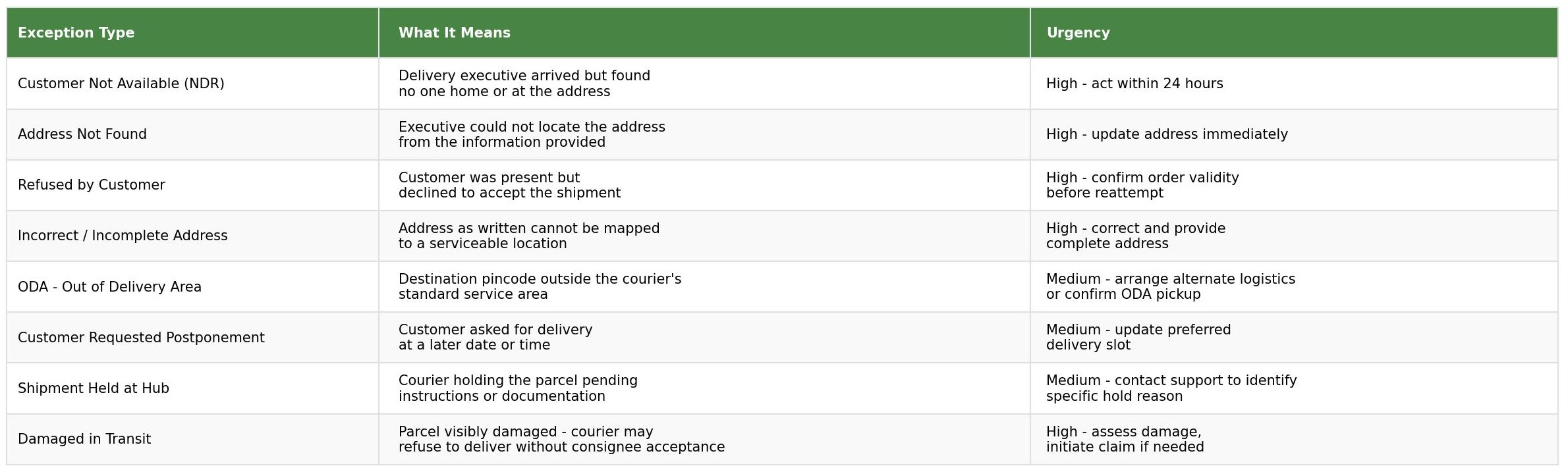
How to Resolve Each Exception Type
1. Customer Not Available (NDR)
The most frequent exception in India. The delivery executive arrived, the customer was not home, and the parcel has been returned to the hub pending reattempt.
Resolution:
Contact the customer immediately via WhatsApp or phone to confirm their availability for the next delivery attempt
Update delivery instructions in your shipping platform: preferred time slot, alternate contact number, gate access instructions, or neighbour who can receive
Request reattempt through your courier aggregator dashboard within 24 hours
If the customer claims they were home and no attempt was made, this may be a fake NDR - escalate and request GPS proof of the delivery attempt
Key fact: Most couriers allow 2 to 3 reattempts before triggering RTO. Each day of inaction after an NDR uses up one of those reattempt opportunities. When you're managing NDRs across several couriers at once, the fastest way to avoid losing a reattempt to a missed notification is a single dashboard that shows every open exception - which is exactly what iCarry®'s My Shipments view is built for.
2. Address Not Found
The delivery executive could not locate the address. Common causes: missing floor or flat number, wrong locality name, landmark that no longer exists, or a pincode mismatch between what was entered and where the customer actually lives.
Resolution:
Contact the customer immediately and get the complete, precise delivery address - building name, floor, flat number, street name, and a nearby landmark
Update the address in your shipping platform. Note: most couriers allow address detail updates but not pincode changes
Share a Google Maps pin with the courier support team if the location is difficult to describe textually
Request reattempt with the corrected address and a note to the delivery executive
3. Refused by Customer
The customer was present and actively declined to accept the shipment. For prepaid orders, this is rare and usually means the customer changed their mind or received a duplicate order. For COD orders, refusal at the door is a primary source of RTO.
Resolution:
Call the customer within the hour. Understand why they refused - change of mind, quality concern, duplicate order, or affordability
For prepaid orders: if the refusal was a mistake, request reattempt. If the customer genuinely does not want it, accept the return and process a refund
For COD orders: this is the most expensive exception because it converts directly to RTO freight cost. Identify the refusal reason and decide whether another reattempt is viable based on the conversation
If the customer says they never placed the order, investigate for fraudulent order placement before any reattempt
4. Incorrect or Incomplete Address
The address exists but is missing critical details - a society name, flat number, or district name - making it undeliverable as-is.
Resolution:
Contact the customer and collect the missing information specifically - do not ask for the full address again, ask for exactly what is missing
Update the delivery instructions field with the specific detail, not a complete address rewrite
For rural addresses: ask the customer for the nearest landmark, the name of the panchayat, or the block-level address format that couriers in that area recognise
5. ODA - Out of Delivery Area
The destination pincode is outside the courier's standard service area. An ODA surcharge applies and special arrangements may be needed for last-mile delivery.
Resolution:
Check whether the ODA surcharge has already been applied at booking. If not, you may need to pay the additional amount before delivery proceeds
Some ODA pincodes have a hub delivery option - the parcel is held at the nearest courier hub and the customer collects. Confirm with the customer if this is acceptable
Switch to a courier that serves the pincode as standard (non-ODA) if one is available through your aggregator
Always check ODA applicability before accepting orders from remote pincodes. Hidden shipping charges including ODA surcharges should be factored into your pricing before dispatch.
6. Shipment Held at Hub
The parcel is physically at a courier hub but the courier is not releasing it for delivery. Common causes: documentation discrepancy, prohibited item flag, GST or e-way bill issue, or awaiting payment of a fee.
Resolution:
Contact courier support immediately and ask for the specific hold reason in writing
For documentation holds: provide the missing document (invoice, e-way bill, permit) through the courier's support channel
For fee-related holds: confirm the exact amount and pay if legitimate. Get written confirmation of the hold reason before paying
For prohibited item flags: if the product is not prohibited, provide product documentation. If it is prohibited by the courier's policy, arrange an alternate courier
The 24-Hour Rule - Why Speed Matters
Every delivery exception has a natural window for resolution. The longer a parcel sits at a hub pending reattempt instructions, the higher the probability it converts to RTO.
Three things happen when you delay acting on a delivery exception:
The courier's reattempt allocation for that shipment decreases - most allow 2 to 3 total attempts
The customer's urgency for the product decreases - particularly for COD orders where purchase intent was already lower than prepaid
The parcel moves deeper into the return queue - hub staff prioritise active reattempts over held parcels awaiting instructions
The rule: Act on every delivery exception within 24 hours of notification. Not 48 hours. Not when you get to it. Within 24 hours.
Fake NDRs - When the Exception Is Not Genuine
A significant proportion of NDRs in India are fake - the delivery executive marks 'customer not available' without making a genuine delivery attempt. This happens because delivery executives have route targets that are difficult to meet, and an NDR is faster than a delivery attempt at a difficult location.
Signs a delivery exception may be fake:
Customer confirms they were home all day and received no knock or call
Tracking shows 'out for delivery' for less than an hour before the NDR was filed
The same delivery executive has filed NDRs on multiple of your shipments to the same area
The customer reports this is a pattern with the same courier in their area
For suspected fake NDRs, escalate through your courier aggregator's ticket system and request GPS verification of the delivery attempt. iCarry®'s Delivery Boost addresses this specifically - trained agents audit NDR claims and open tickets for suspected fake non-deliveries, with call recordings uploaded as evidence for the courier. How fake delivery attempts inflate RTO rates covers the full picture.
How iCarry® Helps Resolve Delivery Exceptions Faster
iCarry® is a courier aggregator that gives Indian businesses the tools to manage delivery exceptions across all couriers from one dashboard:
Centralised exception view: All NDRs and delivery exceptions across all couriers appear in My Shipments in real time. No logging into multiple portals to find which shipments need attention today
Direct reattempt instruction: Update delivery instructions and request reattempt directly from the iCarry® dashboard against the specific AWB. See how this works in My Shipments
Delivery Boost: For high-risk COD orders and high-value shipments, Delivery Boost agents proactively contact consignees before delivery, reducing the probability of an exception occurring at all. When an exception does occur, they audit the NDR and coordinate reattempts in the customer's regional language
Two-way WhatsApp engagement: When an exception occurs, iCarry®'s coordination team can contact the consignee via WhatsApp on your behalf - to get a corrected address, confirm a delivery window, or reschedule. The customer can reply directly. All conversations are logged and visible to you as the seller
Address Quality Scoring: Catches address-based exceptions before they happen by validating every delivery address at the pre-dispatch stage
Free Bronze plan, no minimum volume.
Watch Overview of My Account > My Shipments to see how the exception dashboard works across all courier partners.
Final Thoughts
A delivery exception is not a failure - it is an alert. It is the courier's system telling you that something needs attention before the next attempt. The exception itself is not the problem. Ignoring it for 48 hours is the problem.
The sellers with consistently low RTO rates treat their exception queue the same way they treat their order queue - as a daily operational task that gets done before anything else. Every exception resolved becomes a delivered order. Every exception ignored becomes an RTO with double freight and zero revenue.
Build the 24-hour exception response habit. Use the right tools to identify, categorise, and act on each exception type correctly. And use delivery management features - Delivery Boost, two-way WhatsApp coordination - to prevent exceptions from occurring in the first place on high-risk orders.
Frequently Asked Questions (FAQs)
What is a delivery exception in shipping?
A delivery exception is a notification that a shipment could not be delivered as planned and requires intervention. Common types include customer not available, address not found, refused by customer, and out of delivery area. An exception does not mean the shipment is lost - it means an action is needed before delivery can be completed.
What is the difference between an NDR and a delivery exception?
NDR (Non-Delivery Report) is a specific type of delivery exception where the courier executive attempted delivery but could not complete it - typically because the customer was unavailable or the address could not be found. All NDRs are delivery exceptions, but not all delivery exceptions are NDRs. Other exception types include ODA, shipment holds, and refused deliveries.
How long do I have to respond to a delivery exception?
Act within 24 hours. Most couriers allow 2 to 3 reattempts before triggering RTO. Each day of inaction reduces your remaining reattempt opportunities. The 24-hour window is the point at which your response is most likely to result in a successful reattempt before the parcel moves into the return queue.
How do I know if an NDR is fake?
Signs of a fake NDR: the customer confirms they were home and received no knock or call, tracking shows 'out for delivery' for less than an hour before the NDR was filed, or the same courier has filed NDRs on multiple shipments to the same area. Escalate suspected fake NDRs through your courier aggregator and request GPS verification of the delivery attempt.
What happens if I do not respond to a delivery exception?
If no reattempt instruction is given within the courier's exception window, the shipment enters the RTO (Return to Origin) queue. The courier charges forward freight plus return freight, the product comes back to you, and the customer receives nothing. For COD orders, there is also no revenue collected. Responding within 24 hours prevents this outcome.
How does iCarry® help manage delivery exceptions?
iCarry® shows all delivery exceptions across all courier partners in one My Shipments dashboard. Reattempt instructions can be updated and submitted directly against each AWB. Delivery Boost agents proactively coordinate delivery for high-risk orders and audit fake NDR claims. Two-way WhatsApp engagement allows consignees to provide updated delivery information directly, with full conversation visibility for the seller.
A delivery exception is not a failure - it is an alert that something needs attention before the next delivery attempt, whether that's a customer not available, an unclear address, a refusal, or an ODA surcharge. The sellers with consistently low RTO rates treat their exception queue as a daily operational task, acting within 24 hours on every exception since each day of inaction reduces the courier's remaining reattempt allocation. Every exception resolved becomes a delivered order; every exception ignored becomes an RTO with double freight and zero revenue.